Day Four — A Student


.

The window is black, a mirror of my morning, messy hair, dark glasses, the white light of the Apple logo on my computer the brightest spot in the reflection.

This is how I start, describing what I see — the sky, trees, the old silo on the horizon, a bluebird, a crow, the last johnny jump-up in the garden. Then I try to stretch the image to mean more than it says. That’s what poetry is, for me, pulling words past themselves, layering meaning so an image creates associations that reverberate in unexpected directions. I usually give some direction in my poems, a thread of narrative to help pull the reader along the arc of language, sometimes more directly than others. But there have to be leaps, moments when the reader crosses over from a literal reading to a sense of something more and know that whether that something is exactly what I, the poet, meant doesn’t matter. I explode/inside my own brain, I want other brains/to explode. Another line from The Truth About Death.

Crafting images that speak for more than themselves in prose isn’t any more difficult in individual images, but learning to do it effectively across a much longer and more linear narrative, in a novel or memoir or even essay, is more difficult for me, mostly, I hope, because I’ve done so much less of it. But I’m learning.

And that’s something I’ve loved about the new life I’ve created since leaving full-time work. I left my job to write, imagining myself as a full-time writer, forgetting how much else I do – mother, partner, friend, daughter, sister, board member, hiker, triathlete, runner and especially absorbing, grandmother. My imagined future of hour upon hour at my desk and books pouring out of me hasn’t happened but I do write more than I did and what I’ve loved is learning to write better, especially in genres I’d only dabbled in before.

Last summer I studied novel writing at the Vermont College of Fine Arts Postgraduate Writers’ Conference (with Andre Dubus III who was a terrific teacher) and was the person in the room with the least experience writing fiction. I loved it.  When I was working, I was never the person in the room with the least experience, and often was the person with the most. I was the teacher, leader, boss, presenter.

Now I’m the student and it’s exhilarating. It’s a relief, to learn and not teach.


Day Three — Warm December

unnamed

The cows are clustered around the hay rack in the pasture across the street, a low moan rising out of the one lying off by itself. A few are eating. A calf lies in the curve of a large cow’s body, both heads erect, wet noses glistening, breath steaming.

I can see all this so clearly because I’m outside, on the porch, low sun on my lap, almost hot. I’ve written about this before, there’s a poem in my book titled “Warm December,” another poem was written right here, warm when it should have been cold.

The Porch

This is where I come together, my feet
in white wool socks, the grass still patched
with green, open, a winter with no winter,
the warmest ever. Other people are scared
but I don’t care. Birds fly across the porch
under the grooved wooden ceiling, above
the railings. Small white pines are coming up
in the bit of pasture beyond the barbed wire
fence of the old calving pen where it doesn’t
get bush-hogged in August, the nature of nature.

That was eight years ago. The pattern continues. World leaders are in Paris trying to at least keep worse from happening, but this is going to be the warmest year ever, again. I think the world has always been this dire, the future, the violence, the inexplicable horrors that humans do to each other, or one does to another. We just know more about it, we know the full scope, information coming from everywhere all the time so our heads fill and fill with one tragedy and then the next, a massacre, a disaster, push notifications that ping my phone so I pick it up and read about the latest horrible thing.

I could shut off those notifications.

Last night poet friends gathered here and we ate and chatted and then all read what we’d written in response to a prompt David had come up with – Plagues We Have Known.We always have a prompt to write a poem for the Yogurt Poets holiday party, though past prompts have been gratitude, tradition, grace. Plagues was a whole new direction.

“What wonderful nerds are we?” said Hope as Kay talked about exploring the etymology of “plague.” Nancy had written 14 lines to each of the ten plagues visited on the Egyptians by God, Hope had written one line for each. David had used the metaphor of cell phones as progenitors of infection, a coming epidemic. Mary was happy to have been able to write anything.  I was happy to listen to what everyone had written. A group of creative souls who write for an audience as small as the dozen of us, as small as themselves, because we love the beauty of poetry.

Now the calf has moved to lie against the back of the cow who was moaning earlier. The world is hazy with moisture and inappropriate heat.

Day One — Wilderness

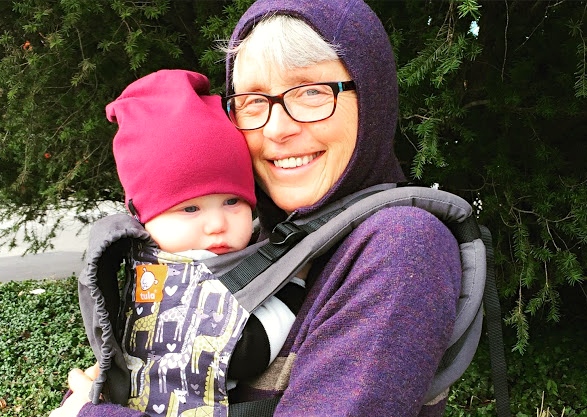
Me and Ava

Wilderness sits at the back of my mind. Before dawn I’m at the kitchen table, sending out the emails that make me think I’m on track. What is the track?  If I get to a spot on a trail where I can’t see the path and can’t find the next blaze, I go back to the last marking I saw and look until I find the next. That keeps me oriented, but does it keep me going where I should?

Are there “shoulds” in life?  There are intentions and desires and choices, but each decision of what to do next, who to call, how long to sit at my desk, which load of laundry to start, what color paper to use as I fold a series of four-pointed stars, which wool sweater to wear to stay warm in the cold house, comes from too many associations to sort through.

None of this has to happen. The laundry gets done because I want clean clothes not because I should do it. Or maybe I’m fooling myself. Maybe my choices are so laden with expectations of what is right and what needs to be done that I can’t feel the “shoulds” under the doing.

I want to get to the wilderness. There are poems there and a new desk in my study for colored paper and collected images, another draft of my memoir that I’ve dared to pare down to the rawest memories, origami sailboats that float at the end of invisible thread, stories I didn’t know I could tell, a walk on another continent, dreams of Eric, a baby resting her head on my chest as she sucks her thumb and reaches the other hand up to my neck, scratching with her tiny fingers, feeling for hair, for an earring, for skin.

Another Day Then Again

Winter-Solstice-02
Image from FunMozar.com

In December 2012 I began writing two weeks before the winter solstice and wrote at least 300 words every day  — Two Weeks to the Turn, I called it.  It was a way to get myself writing every day, and a way to deal with the darkness.  I’ve done it every year since and am about to start again.

This year the solstice is on December 21 at 9:49 p.m. EST in New Hampshire, so beginning on Tuesday I’ll write every day for two weeks.  Maybe I’ll bump right up against the moment of the turn, pen in hand or fingers on the keyboard.  The approaching solstice is a boundary to wrap my intention around.  The fact of its own repetition inspires mine.

My father has been taking a photograph of the marshes near where he and my mother live every month for two years now.  He’s arranged his favorite photograph from each month of 2014 on a big board, the months labeled on white slips of paper.  It’s a terrific piece of art, the whole of the project greater than the sum of each image.

What is it that’s so satisfying about an organizing principle for creativity?  I think artists, like me, who struggle to stay in a focused daily practice gravitate towards work that’s gotten done because someone made a commitment to practice creativity every day.

William Stafford got up early every morning for decades and wrote a poem.  He wrote that in those early hours “something is offering you a guidance available only to those undistracted by anything else.”  In his commitment to the practice, Stafford was “training himself to hear and feel his way back in touch with distant places, ages, epochs,” wrote critic Laurence Lieberman.  To get to the deeper level of any art requires training and training requires repetition.  It’s how you get better at doing anything.

So I love my father’s photographs and how he’s displayed them.  I love that I have two friends who I email every Monday with a writing prompt, and another friend I trade writing with on Mondays, not to be critiqued, but to be accountable to someone to meet a stated goal, 2,000 words a week, or completion of self assigned writing tasks.  Practice.

Starting Tuesday, I’ll write at least 300 words every day for two weeks.  When I did this two years ago much of it ended up on this blog, my writing organized around an idea from another writer friend who asked me, “With all the sadness that’s underlined your relationship since you met, how do you and David move towards happiness?”

I don’t have an organizing question this year, but I have commitment.  I’ve been slacking off on the practice lately and need to get back to it.  You’ll be seeing the result here.


Novel Camp

photo (48)

For the past week I’ve been at a writing conference, which really is more like an adult sleep away camp for people devoted to writing, whether as career writers and teachers of writing, or as a call they can’t help but answer, a passion they squeeze in to lives complicated by jobs and families and all the obligations and distractions of dailiness.

The Vermont College of Fine Arts Postgraduate Summer Writers’ Conference is a special place in the world of summer writing conferences.  I know that not only because I’ve been here twice now, and spent a week many years ago at Breadloaf for comparison, but also because others here all say the same thing.  This is where people come to improve their craft and get support for the often lonely and scary act of writing, not to show off what great writers they already are.

“This is a populist writing conference,” celebrated novelist and memoirist Andre Dubus III said yesterday during an interview with VCFA President Thomas Greene, a novelist himself.  “There’s no stratification here.  We’re all just writers and we all hang out together, whether participants or faculty.”

“I’ve been to Sewanee (one of the prestigious summer writing conferences, held in Tennessee every summer) and honestly, the work of the writers there isn’t as good as what all of you are writing,” said Andy two nights ago at dinner.  Andy is one of the writers in the novel workshop I attended, led with great enthusiasm and wisdom by Andre.

One feature of the conference is readings every night by faculty members, top-notch writers who can leave a room stunned, as Patricia Smith did after reciting a long poem in the voices of mothers whose black sons have been killed by police.  She was followed by Lee Martin who read a short story that rode a wave of mounting tension before breaking open at the end with heartbreaking clarity about the follies inherent in being human.

There’s also a participants’ reading every day, with each person having five minutes.  The writing is more often stunning than not.  “Damn, these people can all write,” I’ve thought all week as I sat and listened.

The conference feels like camp because while it’s rigorous and serious about writing as authentically and deeply as possible, it’s also a lot of fun. Everyone you talk to gets the part of you that sits down at your computer or journal or pad of paper every chance you get. You discuss and critique and listen and write.  This morning’s generative writing workshop used a table full of yard sale items as the basis for prompts to get us writing, whether poems or essays or stories or the beginning of a book. Ellen Lesser, writer, conference director and leader of the workshop, talked about the energy she could feel in the room as 40 people flashed their pens across the pages of notebooks.

I almost didn’t attend.  With Chris so ill it seemed superfluous to go to Vermont to work on my novel.  How could that possibly count as much as being with my sister and helping her family manage her increasing illness and disability?  What difference does it make whether or not I ever figure out how to knit my writing into a coherent, book-length narrative, a story that will bring characters I’ve created to life and keep readers turning the page to find out what happens to them?

The only possible answer to that question is that it matters to me, because the stories in this novel, and in the memoir I put aside last summer, are calling to me.  This week is going to help me answer that call, and to remember that the urge to create is worthy in itself.  It’s not about accomplishment and publication (though I’ll certainly take as much of that as I can get) when you get at the root of why any of us write.  It’s that we can’t not write, so we might as well get as good at it as we can.


The Grind

writing image

Grind:  To crush or pulverize; to polish, sharpen or refine by friction; to rub or bear down on harshly; to oppress or weaken gradually; to operate by turning a crank; to produce mechanically and without inspiration; to instill or teach by persistent repitition.

Or, to write every day.  I’m Grinding this month for the fourth time.  The Grind is a commitment to writing something every day for a month and sending whatever you’ve written to your co-Grinders.  You can only get into the Grind via invitation, and you can only be invited by someone who has successfully done a full month of the Grind without missing a day.

Created by poet Ross White, the Grind creates a virtual writing accountability community. You get sent a link to a website where you sign up for the coming month and choose the category of writing you want to do:  new or revised poetry, new or revised prose, or manic mix, which means write whatever you want.

But you must write!  Ross organizes writers into groups of 10 or so according to genre, then emails out the group assignments.  There are only two rules: you must write something everyday and email it to the others in your group by midnight of whatever time zone you’re in, and you must not share any writing that’s sent to you without permission. This is not a feedback group.  You don’t critique what’s sent to you, you don’t even have to read it.  It’s just about writing and sending.

Simple, and profound.  I’ve never known anyone in my Grind groups, though I do read their bios, which come with the group assignments.  But I’m responsible to them — they are expecting something from me in their inbox every day, as I expect something from them.  Someone is paying attention to whether or not I write.  Or more importantly, I’m paying attention to whether or not I write every day, because I’ve made that commitment to a group of strangers.

I don’t think Grinding is producing “mechanically and without inspiration.”  I think it’s more teaching “by persistent repitition.”  Mostly it’s “to polish, sharpen or refine by friction.”  The friction of making sure I get some words on to the screen and out in to the world everyday.  Friends I’ve invited in to the Grind talk about the value of paying attention to language and creativity for at least a tiny part of each busy day.  One friend hasn’t missed a day of Grinding since January and talks about how it’s fundamentally changed her relationship to her practice of writing.

Grinding is practice and practice is essential to any craft.  So I polish, sharpen, refine, Grind.


Cooked

Gratuitous Mimi Love Photo of Ava Having Little To Do With the Blog Post

“You need to find a sucker who’ll cook for you,” Isabella said.  There was the usual assortment of painters and sculptors and mixed media artists and writers sitting around a long wooden table in the dining hall of Vermont Studio Center, and we were all wondering how we were going to manage returning to our every day lives after almost four weeks of a residency, and specifically, how were we going to manage making meals again?  All we had to do to get fed at VSC was show up at meal time, fill our plates, and bus them when we were done.  We were all doing a residency in order to focus on our creative expressions without the distractions and chores of every day life.  That’s what residencies are for.

“I’m the sucker in my house,” I said.  “I do the cooking.”

Isabella didn’t really mean that someone who cooks is a sucker, what she meant is how much time attending to the daily tasks of life can suck out of a creative focus. How could we recreate the freedom from every day tasks once we got home and continue to concentrate on our creative goals for what felt like almost unlimited hours every day?

We couldn’t, and in powerful ways, that’s okay.  In the spirit of the Zen saying, “Chop the wood, carry the water,” there’s a balance that attention and absorption in every day tasks brings to life.  If I had unlimited time for creative expression every day I’d undoubtedly freak out, as I did for close to the first week at Vermont Studio Center last March.  Not that the residency wasn’t fantastic and that I didn’t get a lot done, because it was and I did.  But that kind of unlimited time for creation, ungrounded in the details of life, wouldn’t work for me forever.  My creativity needs to sit in the center of a life attentive to dailiness if it’s going to be connected to life in a grander sense.  Yes, there’s an ongoing need to value my writing and make space and time for it, to believe it matters, but there’s also a need to take care of daily chores and believe that matters too.

Which is exactly what Michael Pollan talks about in his book Cooked.  Cooking matters. Preparing our own food, from real ingredients we’ve grown or chosen ourselves, connects us to our bodies and our place in the world.  We nourish ourselves and those we feed in ways that go beyond the nutritional elements of the food we prepare.  If we can chop an onion with presence and attention and allow ourselves to value and be patient with the entire process of creating a meal, we can then bring that nourishment, attention and patience to the task of writing a novel (though right now it’s editing a novel I’m trying to get a handle on) or painting a picture or playing the guitar or spinning clay into a bowl.

David read Cooked also and is now joining me in the kitchen more, chopping onions and frying eggs and stirring the pot of chili.  Are we both suckers?  No, we’re feeding ourselves.

Practice

Screenshot 2014-11-20 08.57.11

I’ve recently been corresponding via email with a friend who is fairly new to personal writing.  He’s sent me a couple drafts of a memoir essay he’s working on, asking for feedback and general thoughts about what is and isn’t working in the piece.  Reading his essay and framing my thoughts has been helpful to my own writing because it’s another way of looking at a collection of words and thinking about what arrangement would best work to pull in a reader and create associations that will resonate.  It’s doing what I’ve told him is the most important thing he can do to improve his writing.  Keep writing and read, read, read.  In other words, practice.

When we think about a musician getting better as an artist, we expect that he or she would practice, whether it’s hours spent at the piano or the guitar or the flute.  We wouldn’t expect a painter to be a good painter the first time oil met canvas.  The same with a dancer or singer of photographer.  But I think writing is often seem more as a talent — you’re either good or you’re not.  That may be true to some extent, but even if you’re naturally good, you’re not going to get better without practice.

Perhaps it’s that writing practice is often all the drafts of a story or novel or poem that no one but the writer ever sees.  Will the 36,347 words I’ve logged so far in this year’s NaNoWriMo amount to anything, or the more than 72,000 total words of the novel so far? Does the instant publication gratification of writing a blog post deem the words written any more worthy than words that fill my journals no one will ever read?  What about the boxes of old poems and stories and manuscripts stored in the barn, or the full file drawer in my study.

In a way, none of that matters.  It’s all practice.  Besides NaNoWriMo, I’m also doing The Grind this month, a practice-based endeavor that the writer Ross White organizes.  Ross sorts Grinders in to groups by genre (poetry or prose, new or revised, or manic mix, which is the group I keep choosing and I don’t want to think too deeply about what that says about me) 10 or 12 per group, then sends everyone each other’s email and you’re responsible to send a new piece of writing every day to each other via email.  You don’t comment on each other’s work or even acknowledge it.  This isn’t about feedback or workshopping, it’s about being accountable to other people, strangers in fact, to practice each day by writing.

Pairing NaNoWriMo and The Grind has worked out well, because I’m working on the novel almost every day.  On days when I don’t get to the novel, I write a poem to send my sister and fellow grinders, or send the revision of a poem I’ve just edited, or a fragment of essay, anything that makes me practice my writing.  I’m getting a lot of practice this month, and I have faith that it’s all going to make me a better writer if nothing else.

Writing this blog has been good practice, practice about practice.  How meta.

NaNoWriMo

Participant-2014-Web-Banner

Yes, I’m doing it again, participating in NaNoWriMo, or National Novel Writing Month. My first NaNoWriMo was in 2011, when I met the challenge of writing 50,000 words in the 30 days of November.  NaNoWriMo was launched in 1999 when a group of 21 writers got together and decided to each try to write a novel in a month.  The idea has been growing ever since and last year over 300,000 adults and almost 90,000 young writers participated.  Clearly, deadlines and a sense of community, even if virtual, works for writers. One of the best reasons the website listed for writing a novel when I took part three years ago was that finishing a novel allowed you to change your “I’ve always wanted to write a novel,” line at parties to “I wrote a novel.”  True, I’ve used that line.

I didn’t completely finish my novel in November 2011, though I wrote over 50,000 words, and I finished the novel a month later.  And it wasn’t exactly a novel either.  I wrote a very marginally fictionalized account of a family situation that had happened the summer before.  It felt more like transcribing an experience, with different names for the characters, than imagining and writing a story.  I suspect it’s not a particularly compelling novel, because I’ve never even read it myself.

Now I’m writing a novel that is completely fiction and it’s more fun than I could have imagined.  After the fairly soul-wrenching work of the memoir I spent much of the last six months pulling into shape, I needed a break.  A decent draft of the memoir is waiting for me to make the next set of edits.  But before I go back into the sad and anxious time in my life the memoir recounts, I wanted to write something like the well-crafted but decidedly not-heavy novel I read just as I was finishing the last draft of the memoir.  “That’s what I want to write next,” I said to myself when I finished The Storied Life of A.J. Fikry.

Before I left for Europe, I had the idea of writing a novel about a young woman traveling, visiting the places I went on my recent trip.  My idea of working on the novel while I was traveling and able to recount details of the places I stayed quickly fell aside in favor of just experiencing those places.  As a friend said to me in Europe, “You don’t need to be writing now.  You’re doing your research.”

That was a good enough excuse for me, and actually, it wasn’t an excuse.  Now as I’m writing, when I need facts and real experiences from Normandy or Amsterdam or Provence, my research brain is there to provide the details.

What’s fun about this novel is experiencing the delicious excitement of writing fiction, not fictionalized fact.  When I sit down at the computer every day to write the next few scenes, I don’t know what’s going to happen, what new secrets are going to pop out, what my characters will do and what they’ll say.  In fact, I’m just getting to know my protagonist and I’m 36,000 words in to the novel.  But that makes sense, right?  You don’t get to really know someone when you first meet her.  It takes awhile, like 36,000 words worth of awhile.

Being already 36,000 words in to the novel, does that mean I’m only going to write 14,000 words in November?  No, my plan is to write another 50,000 words, because that should be enough for me to finish the novel.  I want a first draft of the novel done by the end of December so I can get back to work on the memoir.  Trying to work on both isn’t working. My head is firmly in this novel — I think about the characters as I move through my day, plot ideas drift through my mind (though very rarely translate in to what actually happens when I sit down to write), and when I go in to my study and shut the door for my uninterrupted hours of writing, finding out what happens next to Cecelia and her friends Nina and Sally is all I want to do.

So, I’m doing it.  Fifty thousand words in 30 days, starting tomorrow.  I’ll let you know how it goes.

The View From Here and Now

IMG_3142

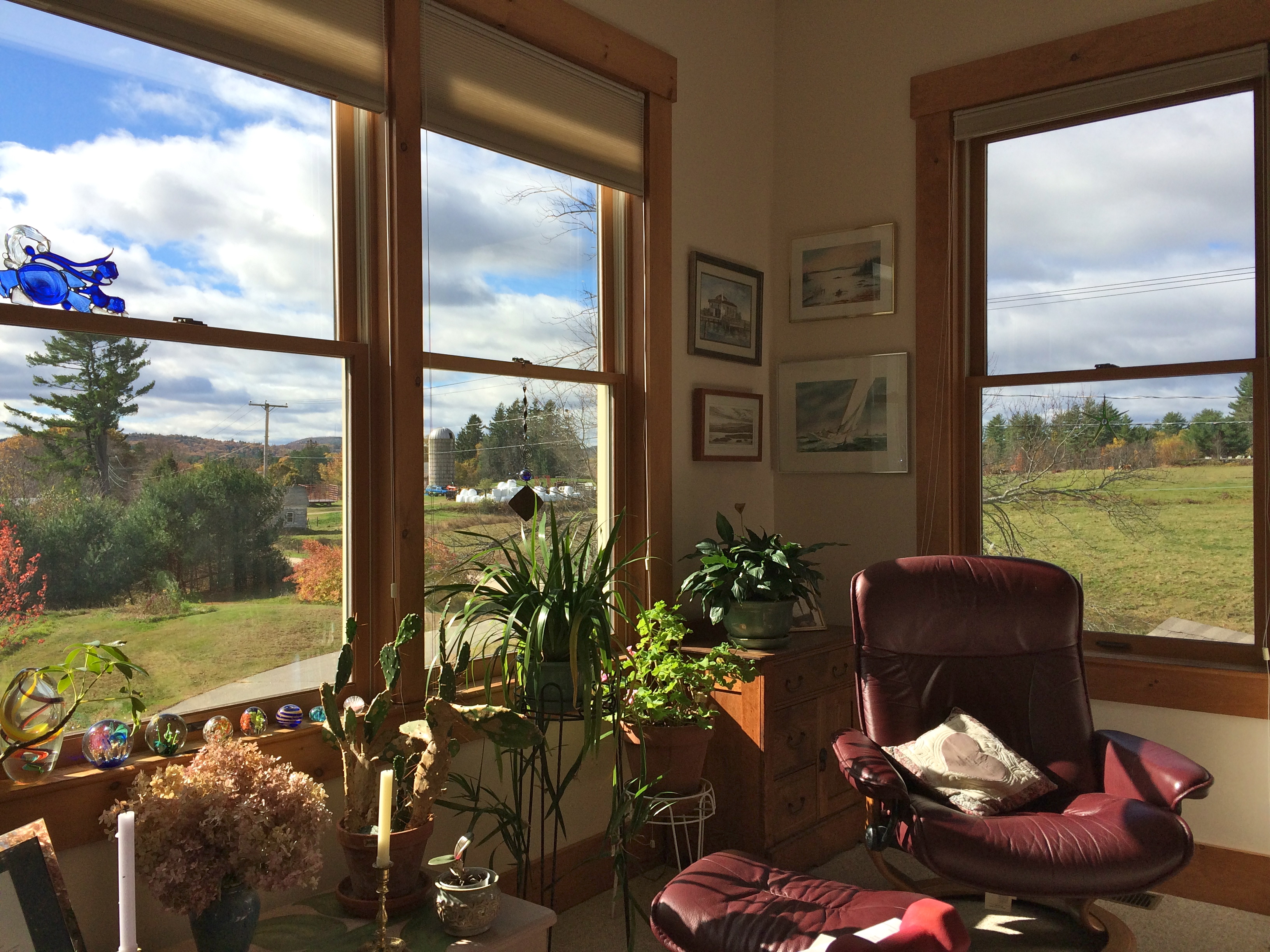
My study is a room with a view, full of light.  Three big windows face south and one faces west, all looking over pastures and the remains of a dairy farm, with the mountains of Epsom as a backdrop.  When Eric was alive, this was his favorite room, with the TV in the corner and his stylish Danish recliner positioned for a view out the windows or at the television screen. When Eric was dying this is where we put a bed for him to spend his last weeks.  That was partly because of the television so he could watch Red Sox games or his favorite movies, but it was also because this was, essentially, his room.

It remained his room for years after he died.  No one spent much time here during those years.  A new, large, flat screen TV had been installed in the family room, part of the finished upstairs of the barn, and the “tower room” as we called it then, the second story of the tower we built to connect the upstairs of the house with the rooms over the barn, served as a passage between rooms, not as a place anyone hung out.  There was still too much sorrow in the room, too much weighted memory.

Six years ago, when I first started to think about moving my study in to this room, my friend Marsie was over for a visit.  I brought her upstairs to show her how I might change the room in to a study and she stood by the western window for a few moments.  “There’s still a lot of Eric’s energy here, but Eric is getting ready for this to become your room,” she said.  “Talk to him about it and the energy will clear.”

Even though I’m not sure what I believe about how the energy of loved ones who’ve died manifests in this world, Marsie’s advice made sense to me.  I spent time in the tower room, thinking about Eric and all the changes in my life since he’d died.  I let him know I was going to transform the room, and six months later I did.

Now I have a glorious study with a view of trees snapping in a brisk wind and a hillside of russet and ochre oaks.  As I sit at my desk, I’m less than a foot from where Eric died.  He sits here with me and I sit here by myself.  I look out the windows and then look at the fall of sunlight in to the room.  I’m grateful and warm and reminded not to take any moment of this day for granted.  I’m here now.