Deep Cuts: In Trump-Adjusted Terms

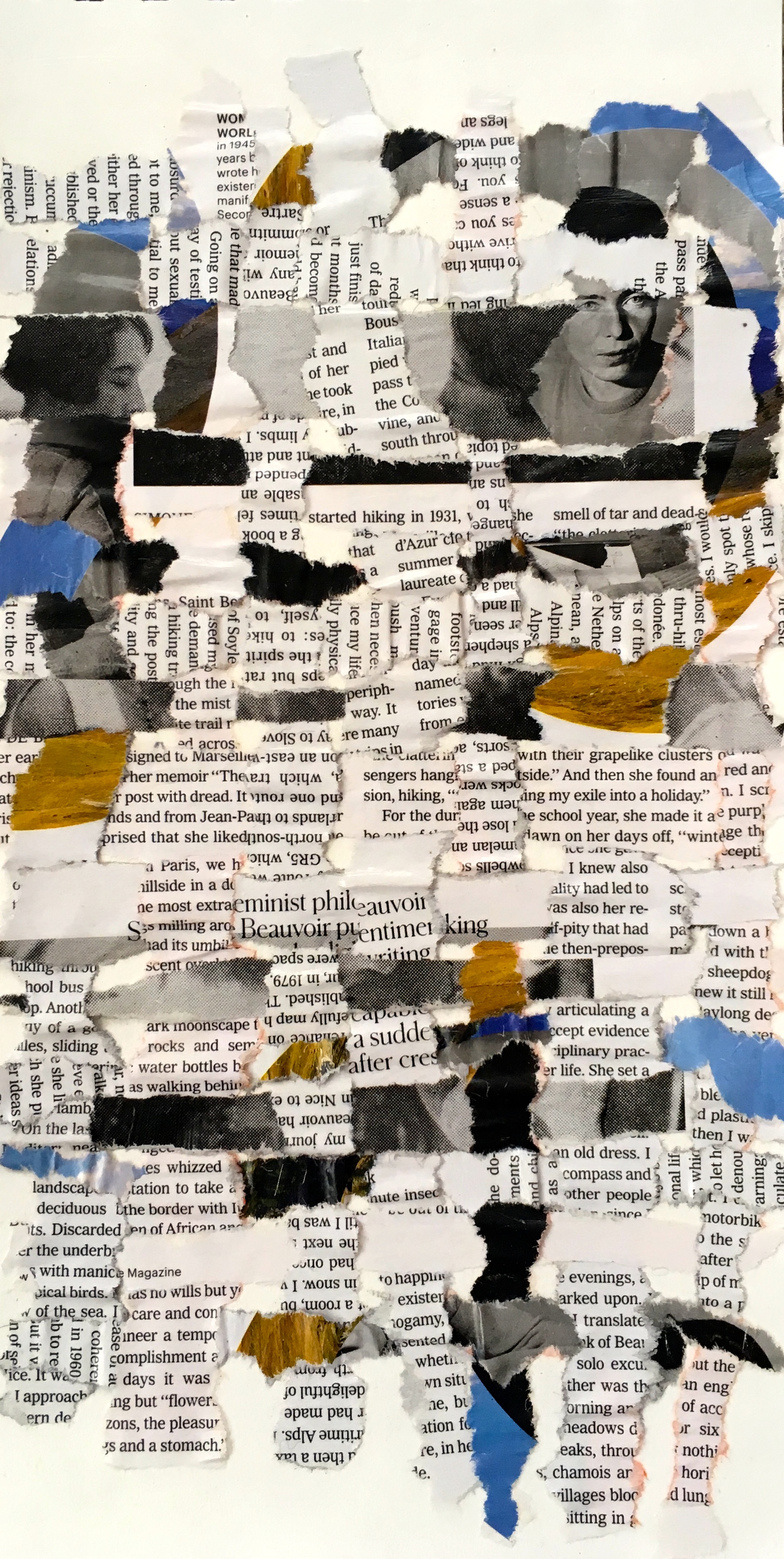
Detail of One Story At A Time by Kim Rugg

“In Trump-adjusted terms, I’m fine.” That was the answer a woman gave on a podcast I listened to this week when asked how she was.

Perfect! I thought. A way to skip the usual five minute greeting of yes, things are okay for me except I’m completely freaked out about the ongoing circus that our federal government has become — the meanest, freakiest, scariest circus ever — and half the time feel like I can hardly breathe. Now we can just give our TAT score.

In TAT I’m doing well, in part because I saw the Deep Cuts exhibit at the Currier Museum of Art on Wednesday.

An attractive part of delving into visual art for me is the absorption in making something with my hands, beyond my fingers on the keyboard as I write. Most of my writing time these days is editing anyway, which doesn’t even mean many keystrokes — mostly I’m reading and sifting.

Time spent weaving a collage of newspaper strips or cutting blocks of words or gluing beads to a piece of paper for a pressure print as I listen to music can feel like slow snow — a suspension that’s going to amount to something at some point, and the creeping pace to that place feels just right.

But the level of detailed suspension in a head space of meticulous making displayed in the Deep Cuts exhibit is breathtaking. It can take me an hour or more to fuss with the strips of newspaper I weave to make a collage, painstaking for a relative newbie like me.

Then I saw Kim Rugg’s collage in the exhibit, “One Story at a Time,” and understood painstaking on a whole other level. Her work is a reconstruction of the front page of the NY Times after dissecting it letter by letter and pixel by pixel. The letters are put back together by alphabet, starting with all the a’s and preceding to z.
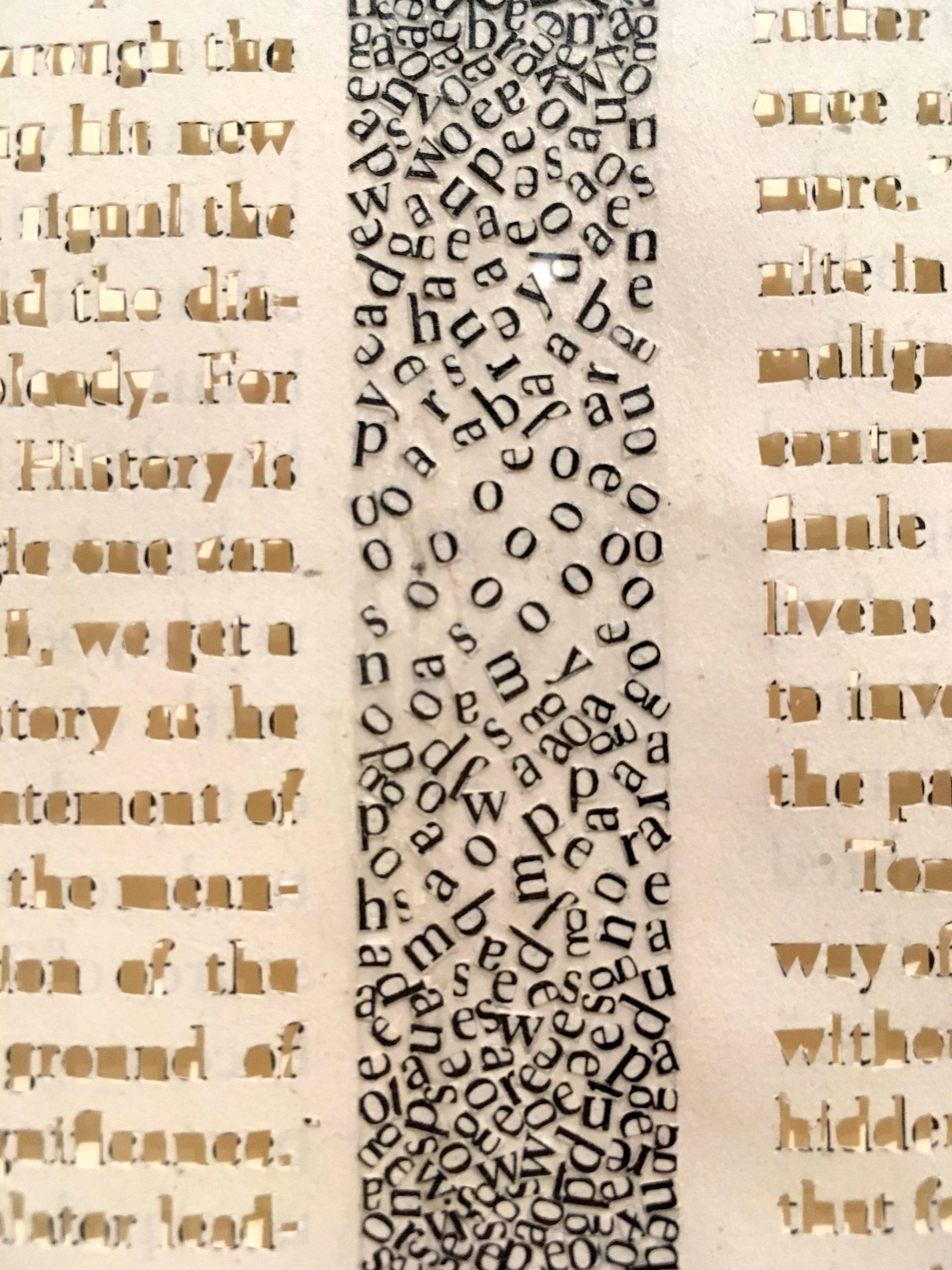
Detail of Altered Text: Unbearable Lightness of Being by Youdhi Maharjan
Detail of I am the rejection of you by Ambreen Butt


Youdhi Maharjan cut every single letter out of pages of Kundera’s The Unbearable Lightness of Being, along the exact lines of the letter, then massed them in a central column that runs through the excised pages pasted on either side. The letters are all discernible and black — you can see each letter in the cut spaces also, glowing gold from the background of the collage.

Ambreen Butt cut and collaged pieces of rejections letters — her own and others she got from friends — into a 10 foot circle that looks like an alternative sun. It’s beautiful, a source of light from an unexpected globe.

This is just a taste of this mind-blowing exhibit. Where do these artists’ brains go during the hours upon hours upon hours of exacting work? The same place my own brain goes as I continue to massage 85,000 words into a book constructed of the exact right words in the exact right places?

Whatever that place is, in TAT, being in that headspace myself, or looking at the marvels artists make from that space, makes everything better.


Bookmaking


This slideshow requires JavaScript.

I’ve been making books (the first definition of bookmaking is someone who takes bets –those of us making actual books come in second).  I’ve learned how to fold sheets of paper into zines and bind pages with the five hole pamphlet stitch. Next week I’ll learn caught loop binding and then on to coptic binding, a beautiful braid of stitches to hold a book together.

I’ve been making phone calls. My goal each week is 15 acts of resistance, which include making collages and going to meetings but mostly calls to Senators Hassan and Shaheen with occasional calls to Annie Kuster. My message is basically the same — resist the Trump autocracy/hypocrisy/treachery flavor of the day. I also make regular calls to McConnell’s office because his particular brand of partisan bullshit cowardice is particularly infuriating to me. Sometimes I even get through. When I don’t, there’s no way to leave a message. Of course.

I’ve been drawing. Every day. I’m bound to get better.

I’ve been getting smart feedback on my memoir manuscript from incredibly generous friends (you know who you are) which has made my writing brain fire off in flashes of insight that I know will lead to a tighter, stronger, more dynamic book. Part of yesterday was spent making lists of what’s coming and going in the next draft — getting ready to dive back in.

I’ve been writing pushback against injustice. Yesterday I sent off a column to the Concord Monitor pointing out the absurdity of arguments against a bill to protect trans people from discrimination; opponents claim it will lead to women being assaulted in bathrooms. I’ve had it with the “bathroom bill” idiocy. NH’s bill to add gender identity to the anti-discrimination law isn’t about bathrooms and the opposition isn’t about protecting women. Let’s be real — the bill is about justice and the opposition is about bigotry. HB 478 — call your NH House Rep to support the bill today.

I’ve been running. According to my training plan I’m running 11 miles this morning. That means my legs won’t do much else today. My gratitude for a body strong enough to still be running long distances is deep, but I definitely feel the difference between a body that’s 60 and a body that’s 63. Hopefully it will all stay on track for the NYC Half Marathon on March 19. Can I run a time qualifying half marathon again? I’m sure going to try.

I’ve been making collages. I’ve made a book collage of collages inspired by Ta Nahesi-Coates’ essay in The Atlantic, “My President Was Black.” The article describes a concert and party the Obamas had at the White House in October, a farewell celebration. It was presented by Black Entertainment Television and was primarily a party for black people — black performers, black guests, black luminaries.

It was a joy to read about, black people having a party at the White House. A house built by black slaves.

But I know there are people in this country, not the majority but enough of them, who couldn’t stand the idea of a black family in the White House, much less that family celebrating there. The White Fuckboys particularly couldn’t stand it.

Now the White Fuckboys are trying to run the country though they’re not having an easy time of it, partly because their treachery keeps catching up with them and partly because of the organic rise of resistance that’s swept across country.

Let’s keep it up. We have no choice.

This slideshow requires JavaScript.

Is Every Point Turning?


NYTimes 2-15-17
NYTimes 2-15-17

The double whammy this week of Mike Flynn’s resignation, followed by the NY Times, and then CNN, reports of extensive contacts between the Trump campaign and Russian intelligence, felt like a turning point.

But turning to what? Whatever it is Trump is hiding finally being exposed? The cowardly party-before-country anti-patriots of the Republican Congress seeing that they really do need to serve as a check on Trump to save our democracy? The emergence of some sanity from the White House?

I fear not. While those of us firmly planted in a stance of resistance applaud news reports that chip away at the credibility of Trump as President, where is this all taking us? Though that’s not the point, actually.

The point is to tell the truth. Truth! Who knew that would become such a difficult concept to hang on to.

Whatever this week was, and whether we’ll look back and see this was the turning point, or one of the corners we rounded, on our way back to a safe, tolerant, respectful and proud country it certainly felt profound and important.

So I wove together stories and images from the NY Times published on Wednesday, which featured the story on the Trump campaign contacts with Russian intelligence on the front page and a full page story on the resistance. I once again didn’t — haven’t yet and don’t intend to — use Trump’s face, though this collage features many faces: women protesting, Elijah Cummings (D-MD), John McCain, Pence, Spicer. And then a hulking black figure over a dark path leading from a government building.

But the thing is, when I make collages only from newspapers it’s difficult to get past the dullness of newsprint. I showed the collage to David this morning and talked to him about the visual effect and he said, “This is the artist in you growing. You see what needs to be different.”

So now I’m thinking about how to highlight elements of newspaper collages in ways that have a stronger visual effect — adding color and shading  and my own outlining.

A turning point.

Image & Text

The New Yorker 2.6.17 Time 2.6.17
The New Yorker 2.6.17
Time 2.6.17

Working With Image & Text is the name of the class David and are taking at the NH Institute of Art. It’s also an area of fascination for me. I love words. I love visual art. I love when they’re put together in ways that make the meaning of each bounce back and forth against each other. Looking for ways to combine image and text is what led me to make collages from newspapers and magazines. It’s not only an act of resistance, shredding and weaving the news as a reflection of the world we live in now, there’s also a possibility of beauty.

The Image & Text class is taught by Erin Sweeney, a sculptor, printer and book artist, and Glen Scheffer, a photographer. They’ll teach us how to alter digital photographs, do screen and letter press printing and book binding, and anything else they know about playing along the borders of images and text that we want to know.

Based on the first class, we’ll also learn how to let ourselves go into creating art out of everyday life, the records we keep, what we do, see and hear. Our homework — spend 10 minutes every day writing and drawing in our sketchbooks, including 1) a list of what we did, 2) a list of what we saw, 3) something we overheard 4) a drawing of what we saw.

David and I have been absorbed in our homework; our sketchbooks are open a lot more than 10 minutes a day. I’ve been drawing, pasting, cutting, folding, writing, listing, coloring, printing.

When I went to Vermont Studio Center two years ago John the Founder (he’s one of the founders and that’s what everyone calls him) greeted the gathering at dinner on Sunday night, or first meal together. He welcomed us and talked about the culture at VSC — leave the competition and judgment at the door so it doesn’t get in the way of what you came here to create. “We’re all people who, for whatever reason, like to make things. So go make things.”

I made a collage in answer to a call for artists to respond to the crisis in Syria through the medium of postcards. Art for Aleppo has organized a show and online exhibit of the postcards as a way to raise awareness and money. I made mine from a NY Times article about the evacuation of Aleppo.

“My President Was Black” by Ta-Nehisi Coates was in the January/February issue of The Atlantic. The article was excellent and intersected well with the cover photo of Obama in a crowd of jubilant supporters.

My collage of the front pages of the January 21 and January 22 NY Times, the inauguration of Trump dominating the 21st and the Women’s March dominating the 22nd, came out darker than I’d imagined. The joy of January 22 was real and delicious but was still shadowed by the inauguration, a shadow I walk out of everyday.

Yesterday I wove the New Yorker cover of a reimagined Rosie the Riveter in a pussy hat with the Time cover of a pussy hat underneath the title The Resistance Rises, How A March Becomes A Movement.

We all keep moving towards justice and freedom, that’s how we create a movement. I’m having fun and satisfying something really deep by combining images and text. But I also make phone calls and send emails almost every day  — reps, senators, Governor Sununu, the House Ethics Committee — picking actions from the news and the multiple resources that have been created to keep the resistance strong.

The luck that led me to a life with time to do all this amazes me. I’m squeezing that luck to get every bit of good out of it I can.


Wrong Brain: This Is What TRANS Feels Like

Painting Fragment --Michelle Rose Pizzo
Painting Fragment –Michelle Rose Pizzo

When David and I reached the fourth floor voices rose from down the hall to the left. We turned and saw a few people gathered by an open door. Once we stepped through the door into Wrong Brain Headquarters the buzz of dozens of excited people shot us full of energy. The room was packed with people of all sizes and ages, with long hair and short, facial hair and tattoos and bright clothes and black leggings, jeans and skirts and dresses and blazers, people standing and sitting and talking in groups, exclaiming at the art and greeting friends.

David went off to look at the exhibition —  This Is What TRANS Feels Like, hosted by Wrong Brain, a nonprofit arts organization in Dover that “aims to provide an outlet and venue for unconventional, under-represented and emerging art of all kinds.”

I got caught by a rack of brightly colored zines — hot pink, orange and purple covers with black text and fantastical drawings. A sign announced the zines were free and I began stacking one of each in my hands. What great colors and images for collages, what a resource for burrowing in to the world of Wrong Brain.

A old friend greeted me and I noticed her tag (David and I had been swept into the room right past the welcome table) had her name, as well as her preferred pronouns — she, her. I looked around and saw everyone’s name tag included their choice of pronouns, both gender binary and neutral. I felt like I’d found a refuge.

I read a lot of news — daily doses of the NYTimes, the Concord Monitor, the Washington Post, and then clicks off Twitter into The Guardian, Slate, the Wall Street Journal, BBC, Politico, The Hill. Despair can be hard to push back because it feels like tolerance, respect and kindness are all being pushed back. Suddenly black and brown people more than ever are fair game for overt hatred and discrimination, Muslims are terrorists, gay people are deviants and transgender people are just plain weird.

Well not in Dover, NH last Friday night. The exhibition was put together to give artists a place to express “what it means to be transgender and the unique experiences transgender Granite Staters face.” What a relief, to still be able to walk into a room of people ready to celebrate diversity, to look at art that comes out of struggle and pain, to witness courage in expression.

In “The Gender Series,” a stunning display of nine photographs, Jeff Kramer poses in self-portraits that move from feminine to neutral to masculine. Kramer, a trans man, told Kelly Sennott at The Hippo in an excellent article reviewing the show when it was in Manchester last summer, that “I was going through my transition, and I was having a very hard time. . . .  Photography saved my life. By doing this series, I was getting my feelings from the inside to the outside.”

The rest of the wall with Kramer’s series was hung with pieces from trans artists as well as allies. But honestly, I didn’t get to see the rest of the art because David and I were meeting friends for dinner and I’d spent most of the time talking to Beth Wittenberg, a resident artist. She had made many of the zines I picked up and exuded good cheer and enthusiasm and had a lot to say about making art and creating space to welcome others into the process. “Come visit and we’ll make a zine,” she said when I told her I write and make collages.

It was David who led me to the photos. On the adjacent wall was a large, grafitti-like painting by Michelle Rose Pizzo with dark, stylized figures dancing through colors as bright and rich as the zines that had first pulled me when I walked in.

David and I had to leave; there was still so much to see. I want to go back. If you need some reinforcement of your own courage and resistance, go see this show. This is art that says I’m here, art matters, I matter — this is what TRANS feels like.

The show will be up until February 14, at Wrong Brain, Washington Street Mills, 1 Washington Street, Suite #459, Dover, open Monday — Saturday 11 – 5 and Tuesday until 8 p.m. The exhibit, coordinated by Freedom New Hampshire (FNH) in partnership with the ACLU-NH, and Rights and Democracy NH (RAD-NH), is free.

I’ve read all the zines. Amazing, intriguing, wholly inventive. The archived zines on the Wrong Brain website are well worth a visit also.


All I Have To Say Today


img_6924-2

My Own Sin

I drop the apple.
I turn from the voice.
I hold my tongue and let
my breasts ascend.

I spit back at the snake.
I knot my hair.
I name nothing, press
my lips to the tree.

I plant cherry seeds.
I throw away the rib.
I walk through the gate
my hands empty and open.

From Stories to Resistance


A Six-Day Walk Through the Alps, Inspired by Simone de Beauvoir by Emily Witt
A Six-Day Walk Through the Alps, Inspired by Simone de Beauvoir
by Emily Witt

My response to the incoming Trump administration fluctuates between rage and terror. Staying in the range of rage feels more useful. Fear can lead to paralysis and actions that are protective and defensive, rather than challenging and offensive. I want to be on offense.

In that stance, I’m calling back my original adult rage as a woman, when I first began to understand how patriarchy and male domination shaped not only my life but the course of human history. Men’s subjection and ownership of women has done nothing but harm, though the men in charge would argue that this statement is meaningless because men controlling women is how the world should be organized.

To which I would say, “Not true. And fuck you!” Yesterday the Trump transition team sent a memo to the State Department, asking for information “outlining existing programs and activities to promote gender equality, such as ending gender-based violence, promoting women’s participation in economic and political spheres, entrepreneurship, etc.” Should we be worried? Hell, yes. State Department employees are and so am I. 

I’m also pissed and returning to my feminist roots to shape my fury and dig in against the coming assaults by the Trump administration on reproductive rights, gender equity, body autonomy, public benefits and a living wage, because keeping people poor and dependent hurts no one more than women and their children.

In that spirit, my most recent collage is from a the NY Time Style Magazine article on Simone de Beauvoir, an early feminist. The Second Sex was one of the first feminist books I read. Beauvoir’s analysis of women’s oppression and gender as a social construct influenced my thinking and put me on the path to my career working to end violence against women.

Battered women’s and rape crisis programs began by women telling each other their stories of violation and abuse. Out of these stories a movement of resistance was born, because listening to each other helped women understand they were not alone, they were not to blame for violence perpetrated against them, and they could organize to support each other in getting out from under the control of abusers.

Now the stories emerging post-election are essential to the resistance against the intolerance, greed and autocracy we see coming as Trump and his cronies take over the most powerful positions in our country. Listening to stories of frustrations and wrongs and triumphs will remind us we’re not alone, we’re not to blame for the violations of our human rights and that we can organize to support each other and push back at attempts to control us.

Here are three stories I’ve heard recently.

The day after the election, a second grade boy in North Carolina was inconsolable and couldn’t stop crying. He was afraid when he went home his parents would be gone, kicked out of the country.

A woman in West Virginia left her house early on election day to be sure she’d have time to vote before having to be at work at 9:00 a.m. When she got to the polls she was told her home was no longer in the district for that polling place and the location where she could vote was 40 minutes away. Some of her neighbors were also there and unable to vote. When they asked why they hadn’t been notified of the change, they were told a notice had been published in the paper — as they found out, a tiny notice on an inside page. The woman never got to vote because she couldn’t afford to be late for work.

A young man whose family had voted for Obama talked to his father after the election and it came out that the father had voted for Trump. When the son asked how he could have done that, the father wavered and said he’d thought he’d vote for Clinton but he didn’t agree with all of Clinton’s policies. Finally, the father admitted that when he got in the voting booth, “I just couldn’t bring myself to vote for a woman for President.”

Feminist anger as fuel. I’m ready to blast off.


Kindness On Top

img_6793

President Obama is a kind man. You can see it in his eyes. You can see that he loves other people, that he can love women and children without threat, to himself or them. He’s not afraid of other people’s personal power. He’s not afraid of powerful women. He’s not afraid of much I don’t think.

I’ve been frustrated by some of Obama’s choices (tackling health care before climate change, not fighting dirty enough to counter the obstructionist Republican Congress) but I also have deep admiration for his intelligence, resolve, patience and kindness.

There’s no kindness evident in the administration Trump is assembling. One nasty person after another has been nominated for the Cabinet — misogynists, homophobes, xenophobes, billionaires with no compassion. Already people around me are longing for some sign that those who’ll be making decisions for all of us, our next leaders, care about something besides themselves, their rich friends, and tearing down protections for people “other” than them — women, LBTQI people, brown people, black people, Muslims, Jews, Palestinians, refugees.

Is this what we get because a black man who is kind and trustworthy has been President?

My series of collages to make sense of what’s happening in national politics continues. Last night I again used Obama’s face and words, from an interview in Rolling Stone. His eyes — kind eyes, compassionate eyes, brave eyes —  kept looking out from the weave of words.

There’s a message in those eyes, a message President Obama spoke to all of us. “There’s no benefit that’s derived from pulling into a fetal position. We go out there, and we work. And we slog through challenges, and over time things get better.”

So let’s get to work and make sure we get kindness on top again.


Fewer Words, More Seeing

img_6781

How do you see the world? Through a liberal or conservative lens, fundamentalist or progressive, Democrat or Republican? Which bubble are you in? What frame do you use to organize your thoughts about what’s happening around you, which for me right now is focused much more than usual on national politics.

I can’t turn away from national news and neither can most of the people around me. For much of my adulthood my knowledge of political machinations has hovered at the periphery of my life. I’ve known what’s going on — the Republican shutdown of the government in 2013, opposition to Obama’s ACA, the Supreme Court’s recent rulings in favor of same sex marriage and affirmative action and against abortion restrictions in Texas. But political news hasn’t been at the center of my attention for much of the day every day.

Now it is — Trump’s election, reactions to his lies and hyperbolic assessments of his victory, his increasingly scary and bizarre cabinet picks, breaking news about Russian hacking and pressure on Electors not to elect Trump — are at the dead center of my attention. I check the news as soon as I get up and before I go to sleep and during every break I take during the day — Twitter, NYTimes, Washington Post, clicks through to CNN and Slate and Newsweek, Huffington Post and Politico. I read at least a dozen opinion pieces a day. While I run or drive or walk I listen to the 538 and NPR Politics and Show About Race podcasts. There’s a constant feed of news into my brain, almost none of which is good, and the opinions about what has happened, what might happen, why what happened happened, and what each of us should do about it all is overwhelming.

After a dose of online reading I usually come away feeling like everyone is telling each other how to see the world. But everyone is doing way more talking than seeing. There’s an overload of words meant to convince each other who to believe, who to understand better, which bubble to try to penetrate, your own or someone else’s.

I’ve turned to words myself. Besides the political reading I’ve done in the last six months, probably more than I’d done in the previous ten years, I’ve been writing and talking about this election and its outcome for months now. It’s time for something beyond words.

The most comfort I’ve found in responding to the election of Trump and my fears about living in an increasingly authoritarian, white, male, Christian controlled world has been literally weaving the news, revealing the fractures in truth we’re living through.

I started with the Sunday, December 4 NY Times, ripping strips of the paper, printed with news of Trump and responses to his decisions and actions and Tweets, then weaving the strips into a collage. I’ve since done five more collages with newspapers and magazines and the last one is my favorite — Barry Blitt’s drawing of President Obama on the cover of The New Yorker with text from David Remnick’s article.

Finally, a way of expressing how I see the world right now that doesn’t need words. Cutting and ripping and weaving and gluing shreds of news is calming.

If I can’t stitch the truth together out of what I read and hear, I can at least make something that shows the truth I see.


Resistance: Making Room for Making Art

fullsizerender-23

Because I’m dutiful and generally complete what I begin, I just finished a collage I started before the election. I’d wanted to weave paper, prints of paintings, and had already cut slits in Paul Klee’s Twittering Machine. Next was to cut strips from Cézanne’s Fruit Bowl, Glass and Apples. The prints came from a stash of fine art books I kept from the many dozens David recently gave away to declutter his studio. The piles now in my study are a rich resource I feel okay about cutting up because making art with art makes sense to me.

But does making art still make sense? Since the election the sliced Twittering Machine and the Cézanne print had sat untouched on my art desk. What difference did it make to a world that suddenly felt so out of tilt to make this collage? What difference does it make to work through another revision of my memoir? Does any writing other than poems and essays and blog posts that push back against the current rise of intolerance and tyranny make sense?

Because a hard wave attempt at tyranny is what’s happening. This isn’t abstract. White men without compassion or empathy for others, white men who believe they should be in charge of everything because that’s the way it’s been for much of human history in the Western world and they like it that way, will soon be leading our government.

Is going on with my life, satisfying my need to create, normalizing what’s happened? There’s a strong push to not normalize this election and I’m totally on board with that. Trump is setting up a government of men (maybe he’ll throw a woman or two in there) who want to take away civil rights, reproductive rights, the separation of church and state, and the right to vote if you’re from a constituency they don’t want to have an equal say in how our country is run. Which is everyone who doesn’t fit in their particular narrow definition of who matters and who gets to have a voice.

So where does creativity for the sake of creativity fit in a stance of firm resistance to demagoguery? Is there room for the beauty of art?

I’m glad I read Elizabeth Gilbert’s Big Magic before the election. Her embrace of creativity and permission to make things just because it makes you happy and makes beauty is a message of hope. If we let go of our impulse to create, whether it’s a collage or a lyrical poem or a loaf of bread or tool bench or a blog post protesting the rise of white supremacy, then the world really does get dark.

We need to make room for creativity and the beauty that brings because that’s part of our voice, and isn’t that what we’re fighting for? For everyone to have a voice, to be able to be who they are in the world as long as they’re not hurting others?

Yes, I know this could be criticized as an highly privileged, elite, coastal, liberal point of view. What about people who work three jobs and have no time to be creative? What about people who have no voice? What about people living in the shadow of a controlling partner who doesn’t give them a single free moment to breathe?

I felt despair as I wove the strips of paper for my collage, but that despair made me really think about all these questions, and recall Gilbert’s book, and remember that even in the midst of the worst times we need to get up in the morning and make breakfast and do the laundry and make pies for Thanksgiving. And make art.

Making art is part of my resistance. Creating is asserting voice. The collage I made isn’t going to do anything to stop the white fuckboys from trying to control our lives.

But it made me happy to make it. They can’t control that.