On the Subject of Gratitude

IMG_1665

It started with a L’Shanah Tovah greeting from a friend.  “The Year of Gratitude” was the heading of her email.  It resonated.  One way to deal with the inevitable heartaches and troubles of any life, my life anyway, is to be grateful for what is right, what is beautiful, what is comforting and sweet.

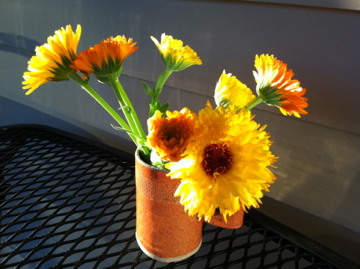
As the Jewish year of 5774 starts, I’m embracing gratitude: for the station function on Rdio which delivers an interesting mix of music familiar and new while I move around the house, processing garden bounty, cooking, kneading challah; for the flock of black birds moving through my corner of the physical landscape, flying in a twirling cloud across the yard and into a tall white pine and back into the grass of the pasture across the street, their wings beating in late afternoon sunlight like a thousand lit pages; for my health and the health of most of those I love, especially the almost miraculous continued presence, if not full health, of a beloved sister; for the reappearance of calendula in my garden, which only happened because a dear friend lost a life partner and she loved, the one who died of cancer, these flowers and we were all given packets of seeds at her memorial service in October, and now they’re blooming in my garden again, to my great delight.  I picked a bouquet today when I got home from services and put it on my new table on the porch.  Bright, hardy and simple, my kind of flower.

So gratitude will be my way of approaching another year, after a year in which all the complications of life and love and what needs to be done resulted in me to going to Rosh Hashanah services alone, for the first time, ever.  I cried through much of the service, but that’s okay.  Any truthful contemplation of forgiveness and repentance, of what has been and what might be, deserves some tears.  It’s a New Year.  5774.

Razor Life: Seven Years Later

IMG_1352

Seven years ago today Eric died, on a glorious, sun-drenched day.  The forsythia was blazing, warm air drifted through the open windows and the maple buds were dropping their red skin to let the green leaves out.

Six years ago I wrote this poem, on another day of spring sunshine, the forsythia bushes in the neighborhood bringing me full circle to the season of loss.  Finally, I was understanding Eric was really gone, and that holding on to life, while honoring his loss, might just be possible.  “Razor Life” is the penultimate poem in The Truth About Death.  It’s not an easy poem, it’s not an easy book, but it’s the truth as I lived it.  A sister poet recently reviewed the book on Amazon and Goodreads and said “grief is palpable, yes, but so is the skill of the poet . . . this is not a romantic look at death, but rather a blunt and powerfully raw assessment.”

That assessment now includes knowing the rawness of grief does ease, the razor edge softens, and days march on and on whether we can keep up with their beauty or not.  A few days ago I came upstairs to find a swallow flapping in front of the big windows in my study, the room where Eric died.  It had flown in the small opening of our shaded bedroom window and moved towards the light.  David helped it fly out without any harm.

I still watch swallows  against the sky and the cows are already out in the pasture across the road.  Everything changes; so many essentials stay the same.

Razor Life

The pastures are green again, right on cue,
the cows will be out in days. I steal lost time
to meet you, where the train runs into the river,
it’s dark and we move fast, forsythia flashes
gold in our yard, the neighbors’ yard, the bush
in the cemetery on the hill, the catbird who sang
above the blooming lilac in the weeks of desperation
on the porch after you died, you died, you did,
swallows high in the blue, their bellies white
as they turn. I am back to watching the sky,
we still have a car for everyone, we drive a lot,
I talk all the time, the machine is working,
it’s everything will be okay and ah fuck
at the same time, all the time, my razor life.

Three Days, Three Cities, Interrupted

IMG_1299

Yesterday David and I spent a few hours in Manhattan.  We dropped Emilio off at daycare, took the train to Penn Station, and went for a walk — 7 miles, through the Greenmarket at Union Square, then down the Bowery through Chinatown and Little Italy and back up Broadway with a two-bags-full stop at the Strand Book Store.  As we walked, I thought about our plans to spend today in Boston, ending with my reading with other WordTech poets at Boston Public Library.  Then on Wednesday we had plans to spend time with Melia in Portland.  Three days, three cities.  Sweet.

Except yesterday ended in sorrow and dismay, and today was not what we planned, not what thousands of people in the Boston area had planned.  There is so much sadness in the world due to natural causes, why does anyone do anything to add to it?  I know that sounds ridiculously naive and innocent, but it’s a time of year that generates sadness as I move into the zone where I remember everything that was happening from seven years ago, as Eric’s grave illness was diagnosed and he got sicker and sicker.  That grief gets layered with other losses and struggles of people I love dearly who are very close to me, people I care about who are a little further out, people I don’t know well but whose difficulties cross my path and send in ripples of sadness, people I don’t know at all, but whose losses happen in the public sphere and so we all know about it almost instantly and feel a flash of their pain.  As we did yesterday.

Tomorrow we’re still planning to go to Portland, so it will be two cities in three days, with a swim through sorrow in between.

My Loss Guru

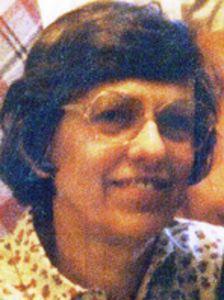
Natalie Schain

After Eric died, his mother Natalie and I grew closer than ever. Our relationship was already a happy story of transformation.  When Eric and I married in 1980, I hadn’t yet converted to Judaism — in fact, that didn’t happen for another 20 years.  Disapproving of Eric’s marriage to a non-Jewish woman, Eric’s Orthodox Jewish parents didn’t come to the wedding.  They’d been unhappy about our relationship for the five years we’d been together — I was divorced (so was Eric), I wasn’t Jewish, I was a feminist who refused to convert to a “patriarchal religion” as I told the Rabbi Eric’s parents arranged for me to meet with prior to the wedding.

For years there was controversy about our attendance at Passover Seders and other family events, and arguments among the aunts and uncles and cousins about how we should be treated.  But over time, and especially as Eric’s parents got to know me better and began experiencing the joy of their first grandchild, Adrienne, their attitude towards Eric and me warmed and softened and then grew close and supportive.  As Adrienne and Sam grew up, visits to Eric’s family were frequent and happy occasions.  When Eric died in 2006, the strong connection between Natalie and me got even stronger.

I would call her several times a week to talk about Eric.  We would relay the dreams we were both having about him, talk about how much we missed him, where we thought he was now, how we could stay connected to him.  Natalie told me stories about Eric as a baby, Eric as a boy, Eric as a teen-ager.  I told her stories about Eric’s jobs and the wonderful sympathy cards I was getting from people who’d known Eric, how much they admired him.

Natalie was devastated and overwhelmed with grief, as I was, but she kept plugging through her daily life, as she had through so much loss.  Her mother died when she was eight, her father when she was a teenager.  She lost her oldest sister in her 50’s and spent close to a decade caring for Eric’s father as he became more and more disabled from MS.  Ray died in 2004, and within 3 years Natalie lost another sister, a brother-in-law, Eric and three of her closest friends.  Then she lost her remaining sister, her sister-in-law, her brother, and many more friends.  When she talked about surviving and moving through grief, she knew what she was talking about.  I called her my Loss Guru.

Now Natalie is gone.  She died early Monday morning, after a year of failing health.  I can’t call her and talk about grief and how to manage the groundlessness of the ever shifting world that includes both joy and pain, loss and gain.  I can’t call her and cheer her up with happy news about her grandchildren and great-grandson.  I can’t call her and listen to her talk about seeing and talking to Eric, because over the past year she’s been in touch with him a lot, a trick I asked her about at one point.  “It’s really interesting that you talk to Eric so much, because he doesn’t exist in this dimension any more.”

“I know,” she said.

“Then how do you talk to him?”

“He calls on a special number,” she said.

Now she’s taken that number with her.

Life’s Left Turns

Navigating the unexpected left turns in life is no easy thing.  Taking a left turn is always tricky — assessing the oncoming traffic, making sure there’s space for you to cross lanes, moving swiftly but confidently in the face of not being quite sure what might pop up in front of you.

After Eric died, I read a good bit of Pema Chodron, and was very attracted to her messages about embracing groundlessness — letting go of our expectation that life always has to be happy and perfect and planned, and realizing that life is a process unfolding in unpredictable ways that bring both joy and pain, loss and gain, grief and acceptance.  Being truly present in each moment of my life, and understanding that that’s really all there is, was a lesson I learned through my grief process, and one I have to keep relearning.  Remembering that my attachment to the idea that I know exactly where I am and where I’m going is an illusion, and that the groundlessness of life is going to catch up with me over and over again is helpful.  Get back into this moment, because really, that’s all there is.

It’s warm enough to be on the porch writing this afternoon, and I’m grateful for the soft air and the shelter that lets me be outside as intermittent showers veil the fields surrounding me.  The maples that still have leaves are yellow, and the oaks are amber behind the gray rain.  This is a moment to savor as I spin the wheel to the left.

Walking In the Woods

This slideshow requires JavaScript.

Walking In The Woods

We have been walking in the woods since we were children,
we never stopped, we can see the forest, now our son
tells me to slow down, there’s no hurry anymore,
you are already dead, he runs. Water drops downhill,
a stone bridge at the top of the gorge, ice and snow still,
goblets of ice hanging from branches that cross a small fall,
sharp angles of rocks, going to the river. I find dry leaves
in a sunny spot above the water, a cloud shadow and the brook
is black and white, gold glint gone, then gold again, the cloud
is in everything, at the river, a rock bench by a pool under cliffs,
snow shards, a flurry in a squall, a bank of river stones.

From The Truth About Death

Yom Kippur: Memory, Love, Stones

Last night at Kol Nidre services, the eve of Yom Kippur, I sat next to a woman who was the pianist at services for many years.  She turned to me when I sat down.  “Hello, Grace, I’m Justine.”  I told her I knew her and was glad to see her again.  At the end of the service the Rabbi asked that we leave quietly, as the Yom Kippur service doesn’t officially end, but extends for 24 hours, with breaks for sleeping and resting.  Justine turned to me and said, “I know I’m not supposed to talk, but I just wanted to tell you how much I miss Eric, what a special man he was.  I wish I’d known him better.”  This is the seventh Yom Kippur since Eric died.

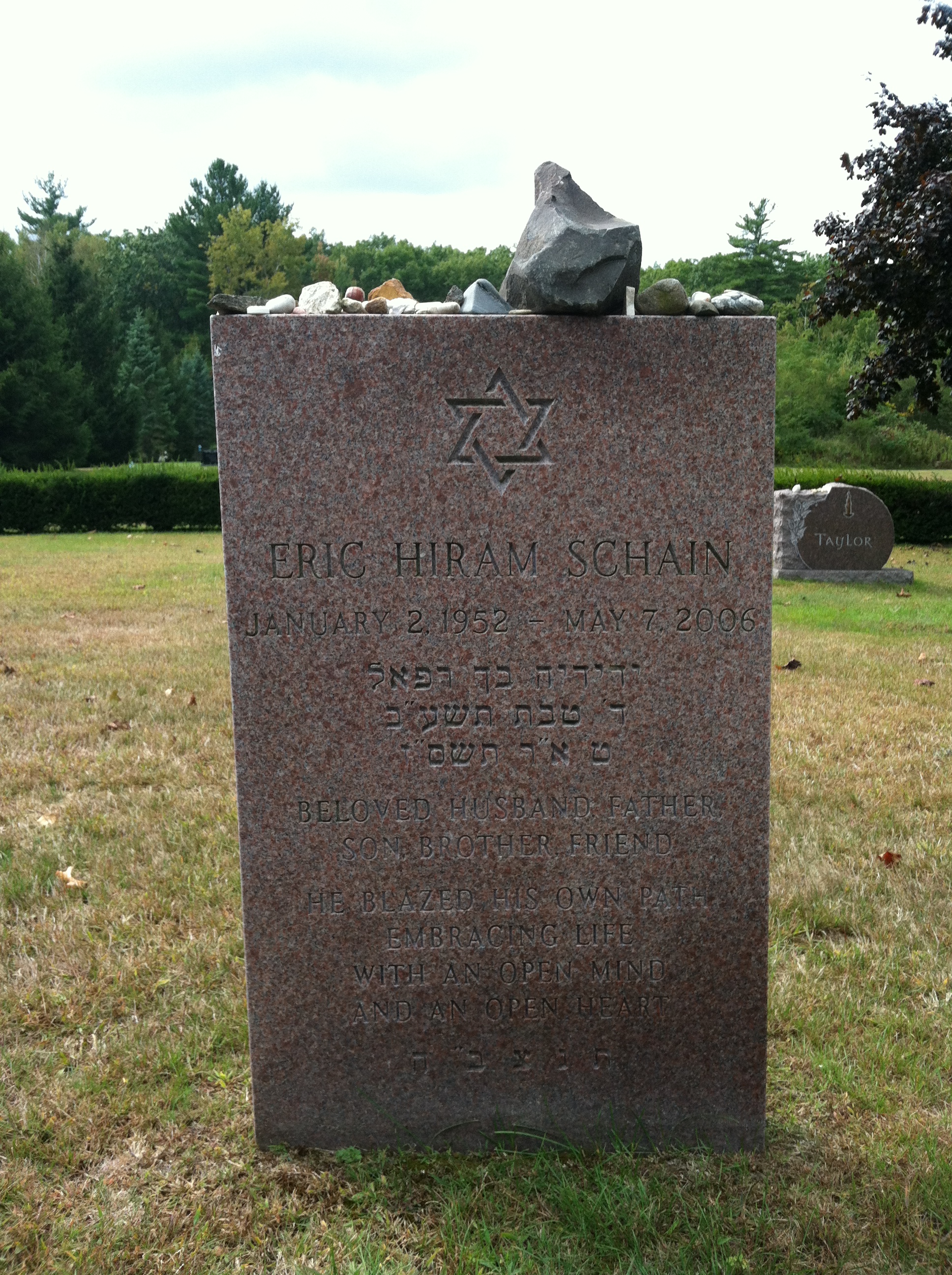
After my D’var Torah during Rosh Hashanah last week, a member of the Temple told me she’d gone to the Temple’s section of Blossom Hill Cemetery the day before.  Part of my D’var Torah talked about visiting Eric’s grave and leaving stones there.  He has a lot of rocks on his grave.  More than any other gravestone there.  “I had some young ones with me, and one boy wanted to know what the stones on the graves meant,” she told me.  “I explained that loved ones visit the graves and leave rocks as reminders of their visits.  Then he asked me how come some of the gravestones don’t have any rocks.  I explained the best I could, that maybe their family is far away, or gone.  Then the boy pointed to Eric’s grave and said, ‘Well look at all the rocks on that gravestone.  A lot of people must love him.'”

Grief

I know a lot about grief.  Hey, I wrote a book called The Truth About Death.  When I was at the Vermont College of Fine Arts Writers’ Conference two weeks ago, I ran into an old friend, another poet.  He bought my book and by the next morning he had read much of it. “Wow,” he said.  “The book is so tight, so powerful.  That poem ‘Hole’.”  He shook his head.

The next day we talked again and this time he’d finished the book.  “You know, I’m mad at you,” he said.  “I’m supposed to have the saddest poem in the country, and now you do.”  He smiled, I smiled.  I was happy he thought a poem of mine was the saddest in the country.

Now I’m sad because two people I care about have lost someone dear to them in the last week.  One lost a best friend, one lost a brother.  Grief has moved in to live with them for now, because grief doesn’t wait to be invited.  It shows up and sits next to you on the couch, sits across the table from you when you eat, rides in the shotgun seat of your car, slams you in the gut when you wake up in the morning.  Grief is a whole other beast than sadness, which you can be happy about.  Sadness is where you can get after grief starts letting you breathe again.

I don’t know which poem in my book my friend thought was the saddest, but here’s ‘Hole’ because it’s the one he mentioned.

Hole

Brief brilliant color at dawn and now low grey
as I leave for a tidal zone, before the floods, fly
through the storm. I’ve been flooded all along,
peeling each day, birch bark curls, iridescent
interior sheen, hatched with black on the outside.
There was an opening we both walked through.
My land is difficult, flinty rocks, a scrappy brook,
water moving every day, how simple, follow
the rules. I peeled oranges for you, I was happy
to do it. Stuffing your jacket into the overhead
bin I see the hole in center of the back.

Reactions to the Truth

“Your poems were beautiful, but I can’t buy your book,” a woman said to me after my first reading from The Truth About Death.  “Sure you can,” I said.  “Just read one poem at a time if you have to,” I urged her.  Because I do want to sell the book, and because I do think it tells the truth about death.  I know that’s hard for many people.  “No,” she said.  “I just can’t even have it in the house.  I can’t handle it.”

In contrast, a woman I know through work came to that first reading and bought two books, one for herself, and one for friends who recently lost an adult son, as she did almost two years ago.  “I have never been to a reading before so it was nice to meet people who do write poetry,” she wrote to me two days later.  She went on, “I truly enjoyed reading your book.  I am just amazed at how profoundly honest you are with your thoughts and feelings, and of course only someone who has faced death can even begin to write about it as you have.  Losing  someone can be such a lonely and sad journey so I did find reading your book makes you realize you are not alone.”

I did a training in Rhode Island the week before last, and my good friend Deb, the Executive Director of the Coalition there bought a book.  She also wrote to me a few days later with the subject line of the email “blown away.”  “I just wanted to tell you how phenomenal your poems are…. I am ‘enjoying’ them, as emotionally brutal as they are, and savoring each one.”  Deb has never known me as a poet, only as a sister Coalition Director, so it meant a lot to me to hear from her about my poetry.

And just this morning, another widow who leaves nearby emailed me about the copy of the book she bought earlier this week.  She sent me a passage from her journal.  “The book has not been disappointing. Waited for it for months.  The Truth About Death.  I think it could be named The Truth about Love. Soulful, riveting language and content, so intimate, sexy. Painful. Her relationships are so rich. She says so much with so little. Her grounding in the wilderness where she lives gives me pause. I rave about where I live but do I inhabit these woods the way she and her Eric did?  I could not stop writing in my travel journal as I read it through the first time. Always a sign I am reading something terrific when it makes me crazy to write myself. Revised a few poems tonight and wrote two short new ones. It has been like taking a crash poetry workshop. I like her use of coma, no conjunctions. The coupling of things not usually put together as all my favorite poets do. The way the mind actually works, I think, before we squash our thoughts and refine them for public use.”

I realize this post could be taken as shameless self-promotion, and of course as I said, I do want to sell books.  But not just because they’re my books.  I believe in this book and its power to affect people in the ways my friends have written to tell me.  The truth is I want this book in the hands of people who need to hear this truth.

Yahrzeit

The first year after Eric died I noted the anniversary of his death three times — on the actual day (first Sunday in May), the Roman calendar date, and the Jewish calendar date — the yahrzeit (Hebrew for ”
time of year”).   It was grueling, three days to think about him having been gone a year.  “No more triple anniversaries,” I told myself, or “deathaversaries” as Adrienne calls them.

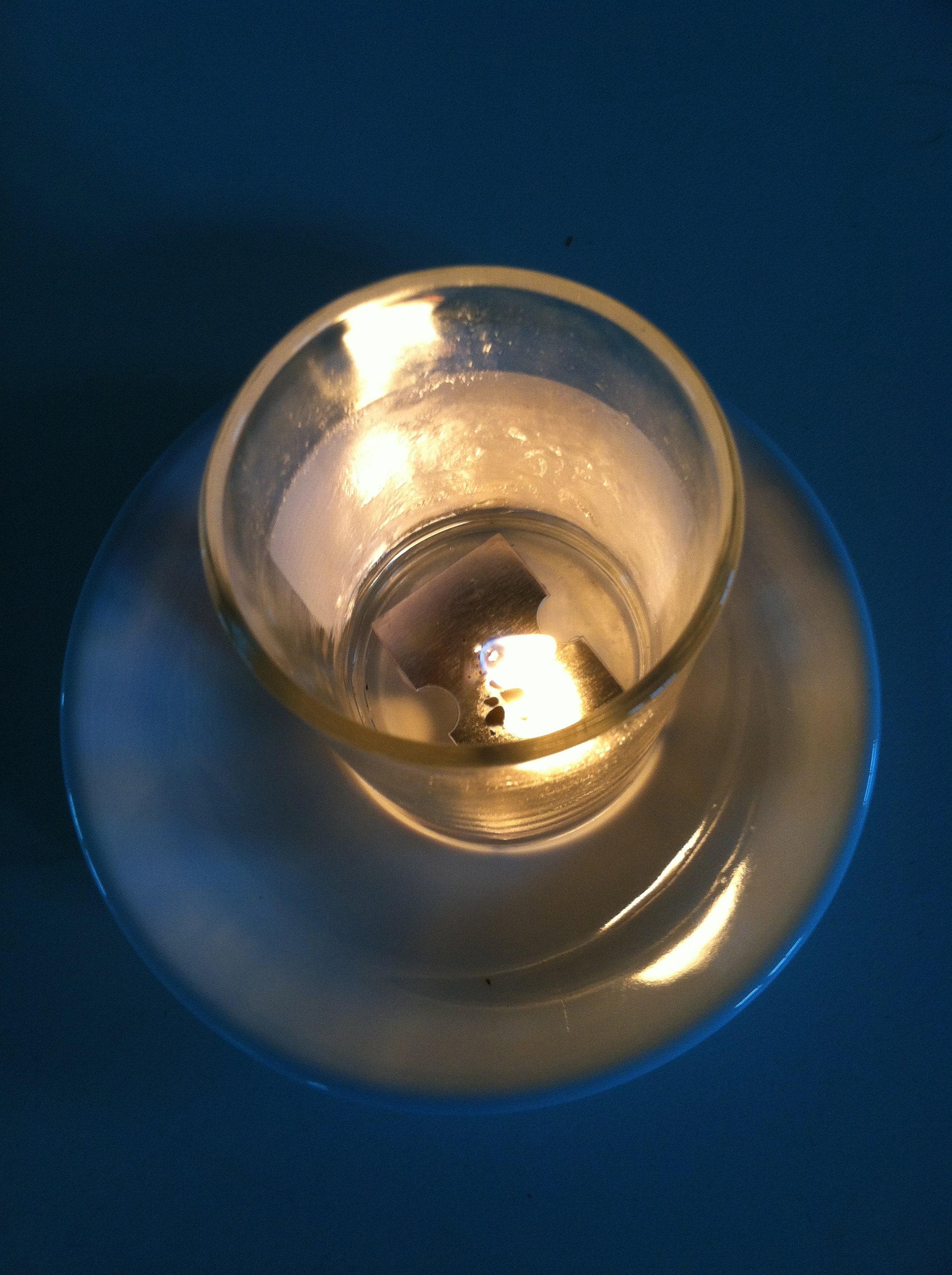
But here I am, burning a yahrzeit candle today, on the Jewish calendar anniversary.  And I’m very aware that this year Sunday is May 6 and I’ll think about that being the day of the week Eric died.  And then the next day is May 7, the actual common calendar date of his death.

All this awareness is only heightened by the fact that I’m doing readings from The Truth About Death.  Several people at the book launch last week at Gibson’s in Concord (smashing success, with 83 people there and many many books sold, check out the photos) told me how nice it was for them to remember Eric and feel like he was there in the room.  He’s here, as everyone we’ve ever loved is with us in our hearts, but he’s also really really not here.