I did a radio interview yesterday afternoon, talking about The Truth About Death and my book launch this evening. I was on the show “Attitude with Arnie,” hosted by Arnie Arneson, a well-known New Hampshire radio personality and former candidate for Governor. The night before I’d called Arnie to talk a bit before the on-air interview and when I said, “How are you?” she answered in a hushed and somber voice, “I’m reading your poems.” You can listen to the interview here, but if you don’t have time for that, here’s the quick synopsis. Arnie’s husband has terminal cancer and Arnie is very close to the issue of losing a loved one. She recently brought an aunt home from the hospital to die. She understands how we all live right next to death, and she found my book very, very hard to read. But necessary and real. At one point in the interview she started to cry and asked me to take over the talking, which I did. Crying is okay, in fact, sometimes I miss how much I cried in the year after Eric died, because of how deep the release of troubling emotions can be in those moments. I know The Truth About Death is just that — hard, sorrowful truth about what it is to lose someone who is at the center of your life. But I know how much I wanted that truth in the early months of disorienting grief, and I hope this book speaks to others in that place, and to those who’ve yet to experience that kind of loss. The truth about death is that it’s what happens to all of us, and sometimes first to those we think we can’t bear to lose. The more we can live with that truth the more fully present we can be to what is in our life right this moment. For me right now, that’s morning sunshine with a full day of truth telling ahead.
The Trail to the Cairns
 If you walk out Canterbury Road from my house it turns into an old woods road, eventually petering out. It used to be the way to Canterbury, and at a party at a neighbor’s house decades ago, a man from Canterbury told me he used to ride his horse from his house to my neighbor’s house on that road. Many many years ago.
Eric and I walked the road often. It rises slightly from my house, passes an old cemetery bordered by dairy pastures, goes back down hill, back up through grand old maples, down and up and down again many times as it passes houses and then heads into the woods, passes a junction with two other old roads, then about two miles from the house loses its definition. There’s a large glacial erratic that sits along the road side just about where the road becomes indistinguishable from the ramble of woods around it, and that’s where Eric and I would stop. Sometimes we’d hang out for a while, just happy to be in the woods. It was our turning back point.
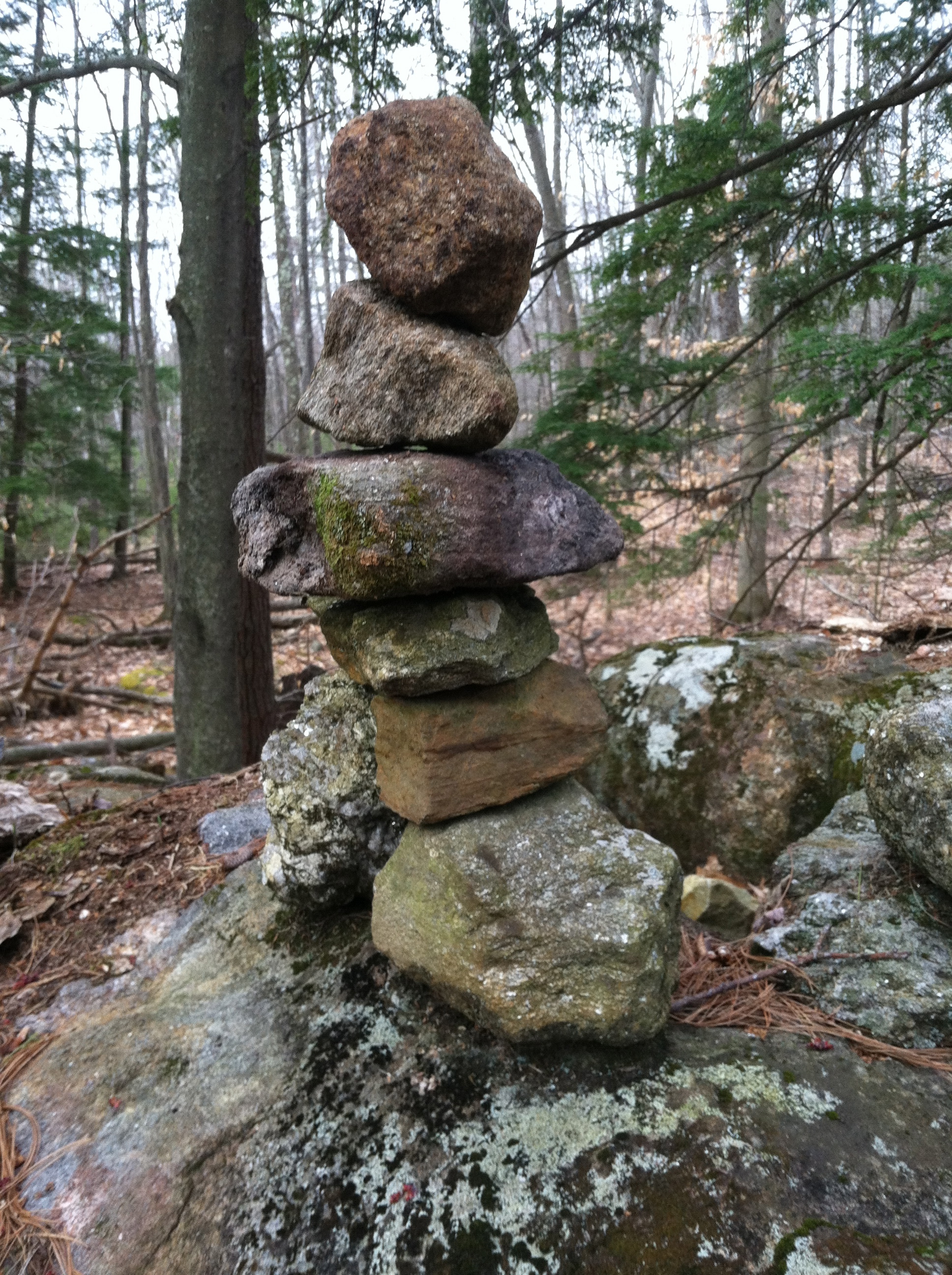
After Eric died, I started building cairns on the big rocks, a monument to Eric. I walked out there often in the first two years after he died, adding to the cairns each time I went. Then in July 2008 a tornado ripped through Northwood and laid a wide swath of downed trees and bramble and jumbled branches across the road, about a quarter mile short of the cairn rock. I tried walking around it once shortly after the tornado, but the road was perpendicular to the tornado’s path, so the mess of downed trees went on for as far as I tried to walk around it. I got lost.
After the hurricane, my neighbor who owns the land told me he planned to clear the tornado damage and open the road again. I’ve been walking or snowshoeing or skiing out to the point of the tornado path for almost four years, hoping to find the road reopened. When David and I walked out the road on Tuesday morning, our neighbor was working on moving and cutting the trees. “It should be done in the next couple of days,” he said. Today we walked out there again, and there were two young men, still clearing the last of the thick white pines that were the main trees to come down in the face of the tornado. “We should be done by the end of today,” one of them told us.
But there was enough cleared for us to get through this morning. I was so happy to get back to that rock, to those cairns, happy to pick up the few rocks that had fallen and put them back on top of one of the three piles. Joy can be so simple. A blocked path in the woods, open again. Cairns at a turn around point, on random rock, rock I can reach.
The Angle of Light
 How is the memory of traumatic events triggered? I’m thinking about this again, because it’s the time of year when Eric began to feel the back pain and other symptoms that we would later learn was metastatic ocular melanoma. I remember him saying to me, in February of 2006, “I feel like I have the flu or something most of the time.” We both agreed he was probably just tired from working too much.
Then one morning in early March when we went out for our morning run, he tapped himself on the chest and said, “I think I pulled a muscle here swimming yesterday, because it hurts.” I remember thinking, “No one pulls muscles in their chest,” but I let the thought slide by. Then he started to have back pain, and as it got worse and worse through March, and he had less appetite and energy, I let any thoughts about what could be going on other than a strained back and too much work also slip by. Eric and I both knew if the ocular melanoma he’d been treated for 3 years before metastasized there would be no treatment available. That would be it.
And that was it. By the beginning of April Eric was still getting himself to work every day, but sleeping through much of the weekends and hardly eating. By the beginning of the second week of April, I insisted Eric go back to his doctor (he’d had a check up just weeks before and everything had seemed fine, other than his back pain) to see if something more than a sprained back was going on. Eric finally had the blood work he’d been postponing since his doctor’s appointment, and he got an immediate call to come back and get admitted to the hospital. His liver and kidney functions and calcium levels were all off. Way off. Within 24 hours we had results from all the scans and knew his body and bones were full of tumors. He died on May 7.
So now when the days get longer and bird song accelerates and pussy willows start to break out, I remember how all of that was happening as Eric first began to get sick. I start to relive the days, sometimes remembering exactly what was happening on this same day, now six years ago, and it’s not easy. The second year after Eric’s death I was talking to one of my brothers-in-law about the power of the memories as the anniversary of Eric’s death approached.
“I think some of it may have to do with the angle of the light from the sun hitting your eyes,” he said. “It triggers the memories and brings you back to that time.” So here I am, six years later, watching the angle of light shift as the sun gets higher in the sky each day. Today I got a card from my Temple that a couple just made a donation in Eric’s memory. I love knowing that others are remembering him too.
Legacy
 One of the other poets in my Yogurt Poets group brought a poem to our workshop recently, in which a woman rises from her coffin at her wake to ask for a recipe. Jennifer said, when we talked about the poem, that she’s come to think the only real way we live on after we die is through the perennials we divide and distribute and the recipes we share.
I’ve been thinking a lot about how people live on, have actually thought a lot about it since Eric died, but it’s been closer to the front in the last six months, as I helped to dismantle David’s family’s home. A few things from David’s parents’ house ended up here, but mostly their possessions went to auction and Goodwill and the dump.
When I first started cleaning out the house in Lancaster this summer, I noticed a small bulletin board made of wine corks in the kitchen. “Ah,” I thought. “Alison would like that.” She’s been collecting wine bottle corks for years, maybe even decades. She plans to someday make a table with a top of wine corks, or some sort of cork-sided object.
This winter when David and I were doing the final clean out of the house, while the auctioneers were there carting away room after room of furniture and decorations, the cork board was still hanging in the kitchen. I took it down, took the old papers and tacks off it, and put it at the top of a box I was filling. When Alison came to my house a week later to help me move some rugs into our house, we opened a box looking for scissors and there was the board. “A cork board!” Alison said and I lifted it out and handed it to her. “It’s yours. I brought it back for you.”
When I was at Alison’s this past weekend, there was the board, hanging in her kitchen by the table. So now there is a bit of Betty and Baird in a corner of Alison’s house, a sweet and simple legacy.
Grief
Today’s prompt on the NaHaiWriMo Facebook page is grief. “Good grief,” I thought, “I’ve certainly had my share to say about grief.” After all, the title of my book is The Truth About Death, which is that we all die, and that for almost everyone, that causes a good number of people a lot of pain. “Grief is a tough beast,” I now write often to people, when I write sympathy cards, because it’s a beast I’ve wrestled with myself and I know its toughness.
And then I thought about that expression, “Good grief!” Where does it come from? Answers at Yahoo rated this as the best answer to that question: “Euphemisms are words we say that are more socially acceptable than what we would otherwise choose to say. “Good grief!”, is an expression that means we are very irritated or upset about something. The “…grief” part of the expression refers to the emotional sense of being irritated or upset; grieving about what has happened. The “Good…” part of the expression is a reference to God which is intended to add emphasis and impact to the expression. Many people do not like to say the word God in public conversations so they often substitute the word “Good” instead.
Regardless, here is today’s haiku:
Unusual softness
Winter air brought down by sun
Your bones still cold.
Three Stones
The last small stone I threw into the River of Stones was on Tuesday. It’s been a trying week, with many anxious moments, navigating some bumps in Eric’s mother’s recovery. A friend reminded me yesterday that facing a serious health issue with Eric’s mother triggers the trauma of Eric’s death, so the intensity of reaction makes sense. And that’s on top of how much I love her and am just not ready to lose her yet.
So the three stones I have to offer today are all underlined by simple gratitude — that Eric’s mother is recovering, that I have the privileged position in my life right now to be going on vacation in Paris, and that I’m able to take a moment each day and fully appreciate something. Which I have done every day, I just haven’t gotten to the writing-it-down step.
Wednesday evening the sunset lit the western horizon, which is lined with a small mountain, tall white pines, a silo, open field, and then more trees in the distance, with a pale silver.
Yesterday I was up and out to a meeting at dawn, and watched the light, then color, come into the day.
This morning, as I drove down the road to go for a ski, a cardinal flitted past the car, flashing red on a bright, white morning.
My next small stone will most likely be from Paris. A bientôt!
Sweet Stone
Today, in the midst of doing a few final death chore errands before David and I headed out from Lancaster, he had me pull into a parking lot so he could check the map on his phone, to figure out how to get to where we were going next. A big hawk flapped into the bare magnolia tree right in front of the car, white belly, grey wings settling across the broad back. Then it sat there, alert and watching for whatever is next.
Another Turn of the Wheel
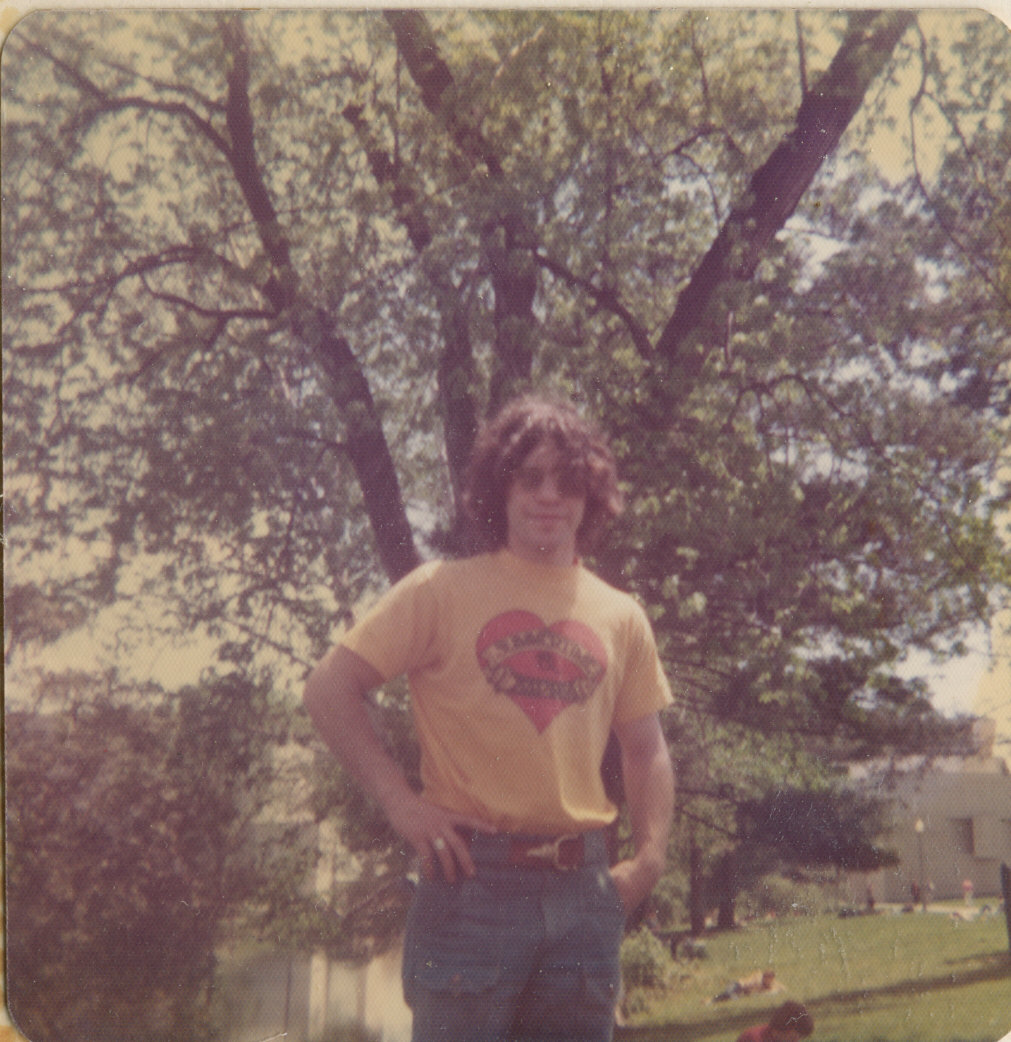
Eric’s sister called me yesterday evening, to let me know she’d heard Jim Borson died. Eric, Jim and Jeff were best friends in high school, all members of a Jewish youth group. They didn’t go to the same high schools, but found a bond of love and friendship that endured through decades that included pretty tough times for Jim and Jeff — substance abuse, career missteps, failed relationships. But Jeff eventually married, got a bit more sober and was loved fiercely by his wife. Jim had two wonderful daughters before divorcing, and in spite of continued difficulties with making any of his dreams come true, was always ready with a smile.
Jeff died first, his over-worked liver finally giving out. In the year before he died, during a visit, he called Eric upstairs to talk with him alone. “Jeff wants me to have his Grateful Dead poster collection when he dies,” Eric told me later as we were driving. “He knows he doesn’t have that long left.” He always always called Eric on his birthday. The year after he died, Eric turned 53 and the silent phone was as much a reminder of his long friendship as a call would have been.
Eric died at 54. Jim came to the funeral, stunned that his two oldest friends were now gone. Wednesday night, just hours before the solstice, Jim’s car broke down in the middle lane of I-95 in Connecticut. According to the article I found online, he got across the right lane, and was crossing an exit lane when he was struck by a car and killed. He was 60.
Three close friends, all dead by 60. I hope they’re having some fun tonight.
Yom Kippur, Again

I just reread my Yom Kippur post from last year, which told a story from two years past on Yom Kippur. And I recently reread Adrienne’s blog post from last Yom Kippur. Looking back is in the spirit of this solemn day, when we think about our transgressions, contemplate atonement and forgiveness, and resolve to be as good as we can be, while loving ourselves even in our imperfection, in the year to come.
Today at services, I could feel Eric sitting beside me. He is so present to me still, and no more so than on days that are rich with all he brought into my life — a spiritual practice that has stayed deeply meaningful for me, with rituals and traditions that keep me connected to friends and family and him.
In a couple of hours, David and I will go over to Mark and Andi’s to continue a tradition we’ve started since Eric died. In the years before Eric’s death, we had started going back into Concord to attend the Memorial and Concluding Services for Yom Kippur. In the midst of the thoughtful swoon that a day of fasting and reflection brings on, getting dressed again for services and driving back into Concord was a lot, but we’d come to count on the tradition.
The year after Eric died Adrienne and Sam and I planned to go back into Concord, after the break from the morning service, for the Memorial and Concluding Services. Being part of the Memorial Service was particularly important to me. But we didn’t make it. I don’t remember exactly why but it was probably a combination of grief and exhaustion. We went to Mark and Andi’s and broke fast with them. We didn’t make it back into Concord the following year either, and by the third Yom Kippur after Eric died, David was in my life and Laura had just died.
“I really want to go to Memorial Services, ” I said to Sam, who was home that year. “But I really don’t want to go back into Concord to the Temple.”
“Do your own service,” Sam said, and we did. I have a copy of the High Holy Days prayer book at home, because when I went to see the Rabbi after Eric died, and asked for his suggestions for helpful readings on the Jewish response to death and grief, he said he thought the Yom Kippur Memorial Service in the prayer book was as good as anything, and I took a copy home. So three years ago I picked out readings and we created our own Memorial and Concluding Service with Mark and Andi. And did it again last year. And will do it again today.
The photo above is from the first Yom Kippur after Eric died, just about 5 months after. The photo makes me think about all that’s changed in the five years, and six High Holy Day seasons since he’s been gone. Mark and Andi and I visited his grave after this morning’s service, and told stories about our lives then and now that made us laugh. Eric loves that — all of us laughing and loving and carrying on our rituals in whatever way keeps us connected to Judaism and to him.
Twisting Vines

David and I arrived at the unveiling for Eric’s Uncle Ben in East Haven, CT almost an hour early yesterday. We drove down the dead end Brockett Place, past the tall iron spike fences on either side of the small road, tall headstones behind the black rails, turned in the circle at the end, and parked heading out. Then got out of the car to go for a walk.
We wanted to stretch our bodies after the drive, and we didn’t want to be present for any family drama that might show up early. All summer I’ve been trying to stay clear of the discord that’s erupted in Eric’s family since Ben’s death. It occurred to me that family disputes that arise after someone dies, centered around wills and inheritance and who got what, or didn’t get what they expected, may just be grief displaced. Or maybe I’m being too nice.
We walked into the driveway of a school and sought the shade along the edges of the open field to each make calls to our families. There were vines twisting up the trees, curling around themselves, circling into spirals that climbed up. The twists looked like family to me, all the ways we love each other and wrap around each other and how some families forget how to make sense of their lives together without conflict and how the best of families support each other’s twisting, new vines growing on old wood towards the clear light at the top of the tree canopy.
 Grace Mattern