Reptilian Me

It’s been a grey, rainy May, as it was five years ago, after Eric died.  Maybe that’s why I’m waking up too many mornings with a low-level churn in my stomach.  There is lots of change coming and already come — I have a grandson, I’m leaving my job and the world of regular income, Sam and Marianna have done a 180 on their plans — so the churn could certainly be related to that.  But this is more, gut level anxiety that my body remembers from those early weeks of grief, waking to my new reality, our “new normal” as the kids and I called it.  The world without Eric in it sucked and made me anxious and wish I could somehow just not wake up.

I chatted with a good friend today, just home from a visit with her frail and elderly father. Talking to her about my anxious waking this week she said, “I know, I did it too this week.  Being back with my family, I’m a little girl again.  Why do I do that?  I know what’s going on, but there I am with a churning stomach.”

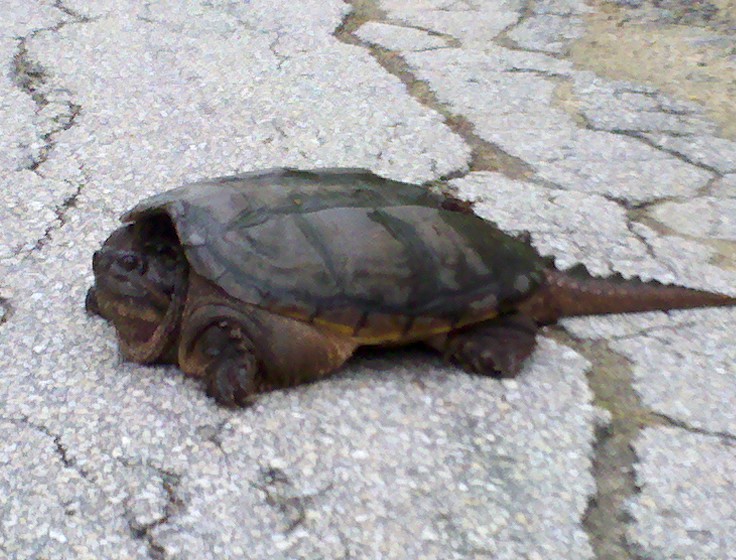
I was thinking about our talk as I drove to get soil and compost and alpaca poo for my garden today.  Cutting across back roads from Pittsfield to East Concord, I saw a dark shape on the side of the road.  A snapping turtle.  A big snapping turtle, well over a foot long, just sitting there, head out, though he pulled back into his shell when I got out to take a photo.

He was my totem animal today, my reminder that I have a reptilian brain, the ancient core that takes care of basic survival and that knows when to “fight or flee.” As the Buffalo State University website on the brain says, “the overriding characteristics of reptilian brain behaviors are that they are automatic, have a ritualistic quality, and are highly resistant to change.” Reptilian me.
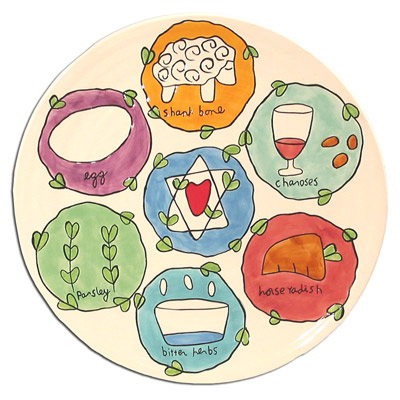
Passover

A determined robin is singing outside, the notes coming through the windows that look out on another gray day.  “April is the cruelest month,” has come to mind often in the last 24 hours.  I’d envisioned these few days off around Passover as sunny and warm, days in the yard gardening, sitting in the sun drinking coffee, gathering with friends for a relaxed Passover celebration.

I woke up to a churning gut and head yesterday, Erev Pesach, the day before the beginning of Passover at sundown.  It was cloudy and cold and windy, making work outside uncomfortable.  With cooking to do for the seder last night, I turned to inside work and tried to focus my attention on making recipes out of Joyce Goldstein’s Cucina Ebraica, a wonderful collection of Italian Jewish recipes.

But the dozens of wheels floating in the air above my head (many thanks to David for this right-on image) just keep whirring, nothing touching down and able to get traction.  When I finally sat down to have some lunch, I found tears more than anything else coming up, and when I looked behind the churning and preoccupation that I was somehow “dithering away” this precious time off, I found grief.  As I often do when I look behind whatever is bothering me.

There, as soon as I recognized it, were all the years of Passover seders with Eric, and the five Passovers he’s missed since he died.  Grief is so sneaky and unpredicable — abating for months at a time, anniversaries of numerous events going by smoothly one year, then slamming me with a “ball to the head” (and thanks to Adrienne for that right-on image) the next year.

Mostly yesterday I keep seeing Eric the last Passover he was alive.  He’d been diagnosed with the metastatic cancer by then, and we’d missed the family seder in Connecticut, and had no capacity for the big seder with friends we’d planned for that weekend.  Eric was just home from the hospital on Saturday, and we had a small seder — Eric, Adrienne and Matt, and Sam and Rachel, his then girlfriend, and me.  Eric sat at the head of the table and told stories about Passover, about the mitzvah of retelling the story every year of the Jew’s liberation from slavery in Egypt, in the same order, “seder” in Hebrew.

It was one of the last times Eric was up at the table, eating with us.  His illness was vicious and swift.  The next year his mother and I skipped Passover all together, unable to imagine the holiday without him,

Now I’m trying to create new traditions, and now there’s a grandson who’ll soon be old enough to start learning Passover stories.  Last night the seder with friends was lovely — a lively reading of the haggadah, the Passover story, friendly discussions and reconnections, delicious food.  Today I’ll go out in the grey and pull the gardening wheel out of the sky and force it onto the ground, getting some traction with earth and compost and the first seeds breaking through the soil.

Tonight David and I have decided to read each other poems as our own, second night seder.  Folding up one set of traditions, we’re unfolding new ones.

I think I’ll read the begining of T. S. Eliot’s “The Waste Land.”

April is the cruelest month, breeding
Lilacs out of the dead land, mixing
Memory and desire, stirring
Dull roots with spring rain.

Image courtesy of http://thesmartlyanonymous.com/

Tidal Haiku

Tide goes in and out
In and out and in and out
In and out and in.

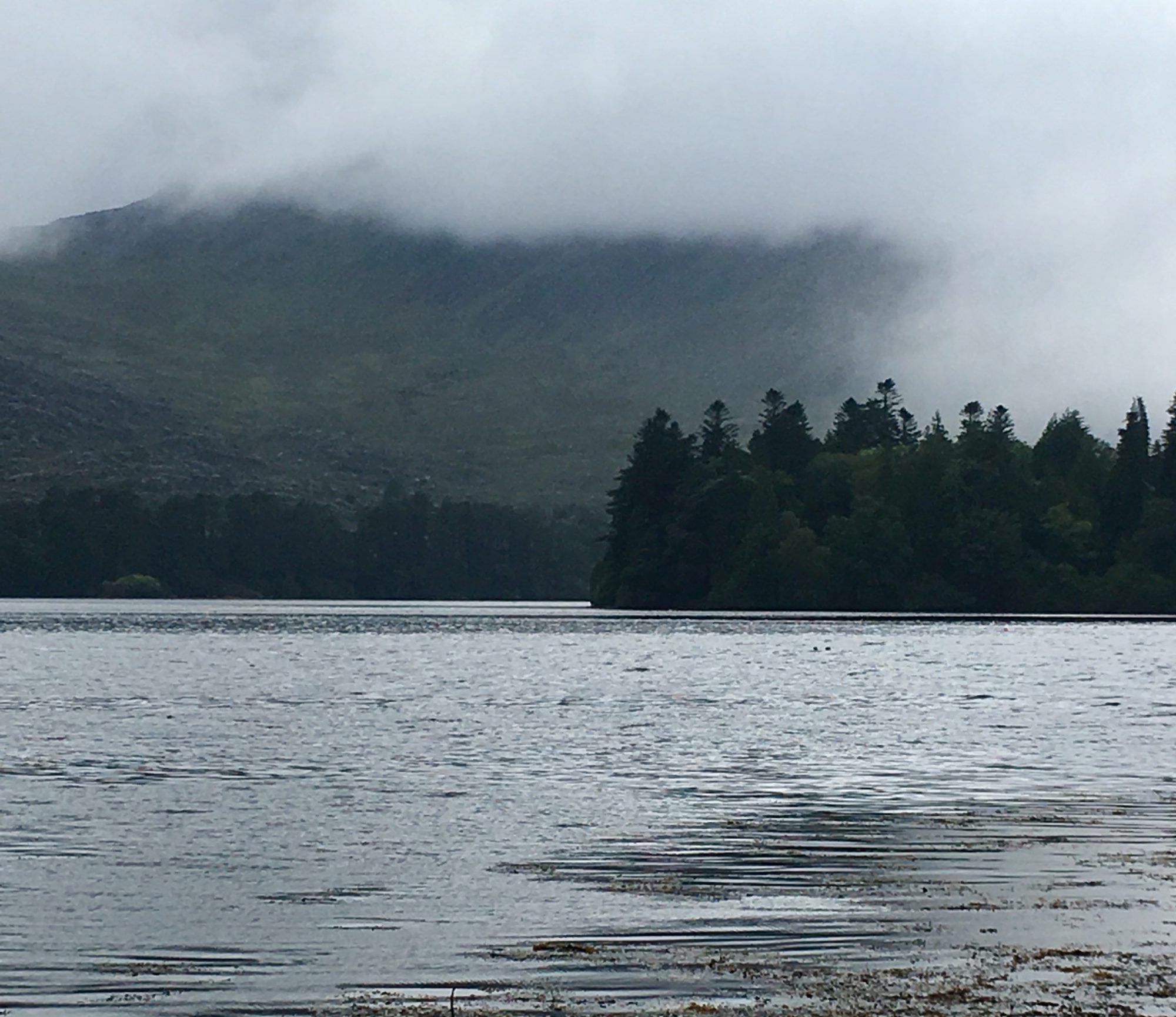
I called David tonight when I got back to my room.  I’m away at a retreat for work, staying in a lovely spot on the ocean.  He had sad news — the 20 year old son of a man we both know killed himself, on the train tracks in Durham.  So once again, loss washes in.  For David it washes in over memories of suicides in his own family and the recent shattering in his family of a new, young relationship that was full of hope and celebration just months ago.  For me, it washes in deep sympathy for the family of the young man, knowing what those mind numbing, disorienting and terribly painful early months of grief feel like.  With heavy hearts, we go to sleep.  I’ll wake to the ocean.  David will wake to fields of snow.  The sun will be up, the day will move on, sadness will be a wake rippling behind us.

Playing Silence

This morning I heard steps across my porch.  My neighbor and friend Amy was at the door.  “We’re hoping you and David want to ski with Paul and me?”  It was like a childhood friend knocking at my door 50 years ago to ask, “Can you come out and play?”  Earlier this week, another friend emailed to say her husband “can go out and play for a couple of hours on Sunday.  Are you guys up for some snowshoeing?”

Three weeks ago it suddenly became winter in NH — snow, frigid air, snow, snow, snow.  The skiing and snowshoeing is the best it’s been in several years, and all our outdoor friends are taking advantage of it.  Last weekend, when I got home from NY, there was a message on my answering machine from Alison.  “The skiing’s great if you’re interested.”  I didn’t get the message until late that evening, after skiing with David, but Alison called again on Sunday morning.  “Anne and Peter are coming over at 11:00 to snowshoe, then Anne and I are skiing.  Want to come?”

I called back.  “Yes, David and I want to come over and play.”  And play we did, snowshoeing the new trail through the Epsom Town Forest, then skiing up a snowmobile trail to the untraveled rise of Tarleton Road, making our own tracks to the height of the ridge.  The snow was dry, light, deep and very cold. 

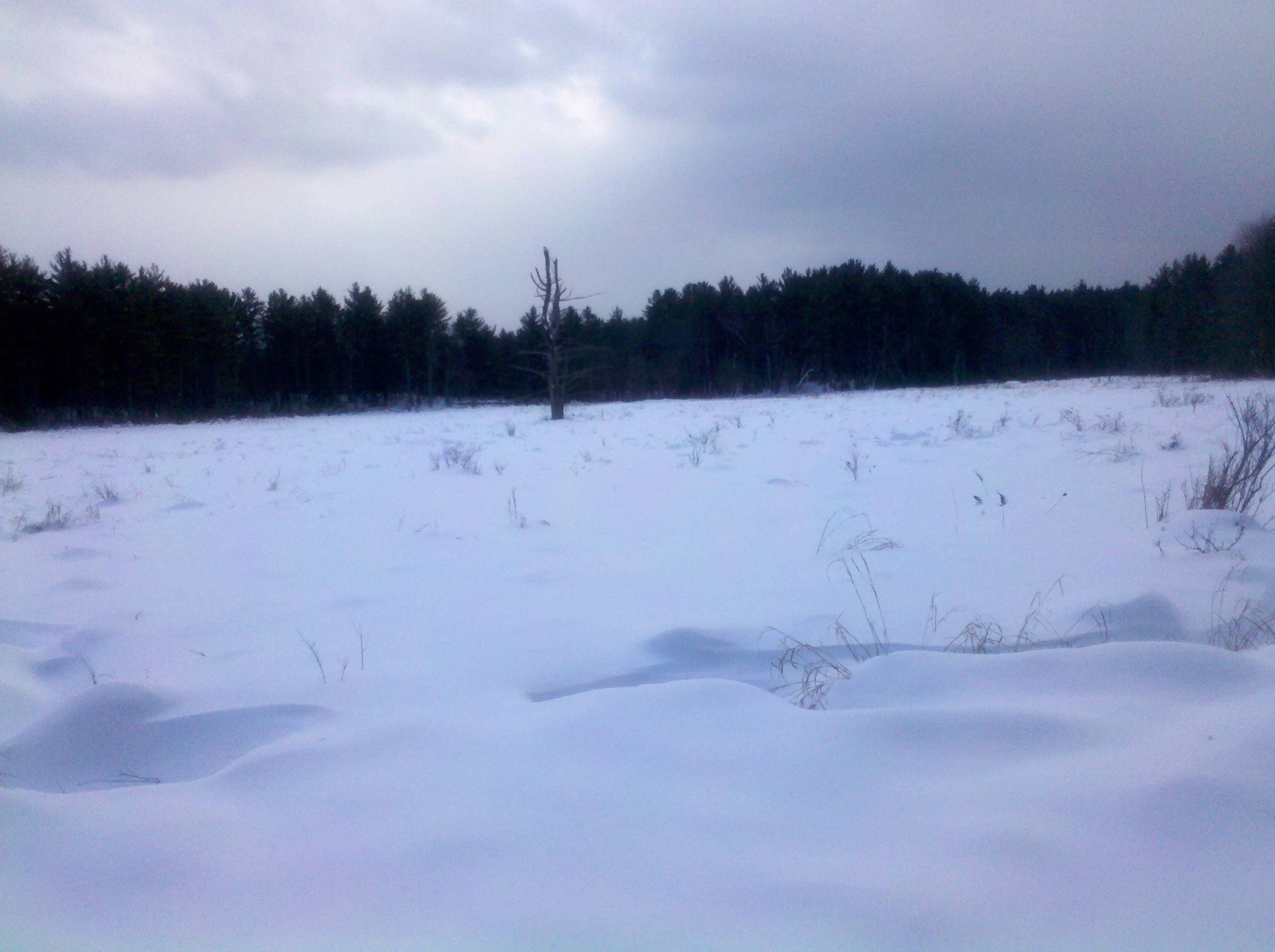
Today is warmer.  There’s been more snow. After skiing with Amy and Paul, David and I came home and had some lunch and headed back out to play.  This time we skied the snowmobile trails from our house, then followed the ski tracks we made last weekend down an old road to a marsh, out across the open expanse. We crossed the brook that feeds the marsh and skied up along its bank, the snow keeping us high above the few spots with water still running between deep mounds.  As we crossed the marsh, I thought of a weekend just about four years ago. 

It was another frigid winter, but there was less snow.  Adrienne had come home for the weekend, as she did almost every weekend that winter after Eric died, and we went for a walk in the woods.  The brook had frozen solid and clear, a long flow of ice, into the frozen swamp.  The poem I wrote that night ended up in the book I wrote that year, and was published the following winter.  Here it is, and here I am, four years later, playing my way through the winter, bumping up against deep snow and silence. 

Silence

I am squatting in the fireplace, hands out
to catch the heat off the first flame, the only
heat in the house, the furnace fan out,
the belt and pulleys jiggled off their mounts. 
Last night a friend and I were comparing pathetic
and now I win.  I am trying silence today,
lie on the floor, again, in the sun on the carpet
in the room where you died, heavy wind,
the shadow of plants below the great windows,
warm, how grateful you were for this room, open
and high.  I don’t want to make sense, I am fed up
with misfortune.  I walked the frozen brook
into the wind of the marsh, following the tracks
of a dog.  I sat in the sun but it was too cold.

A to Z and Back

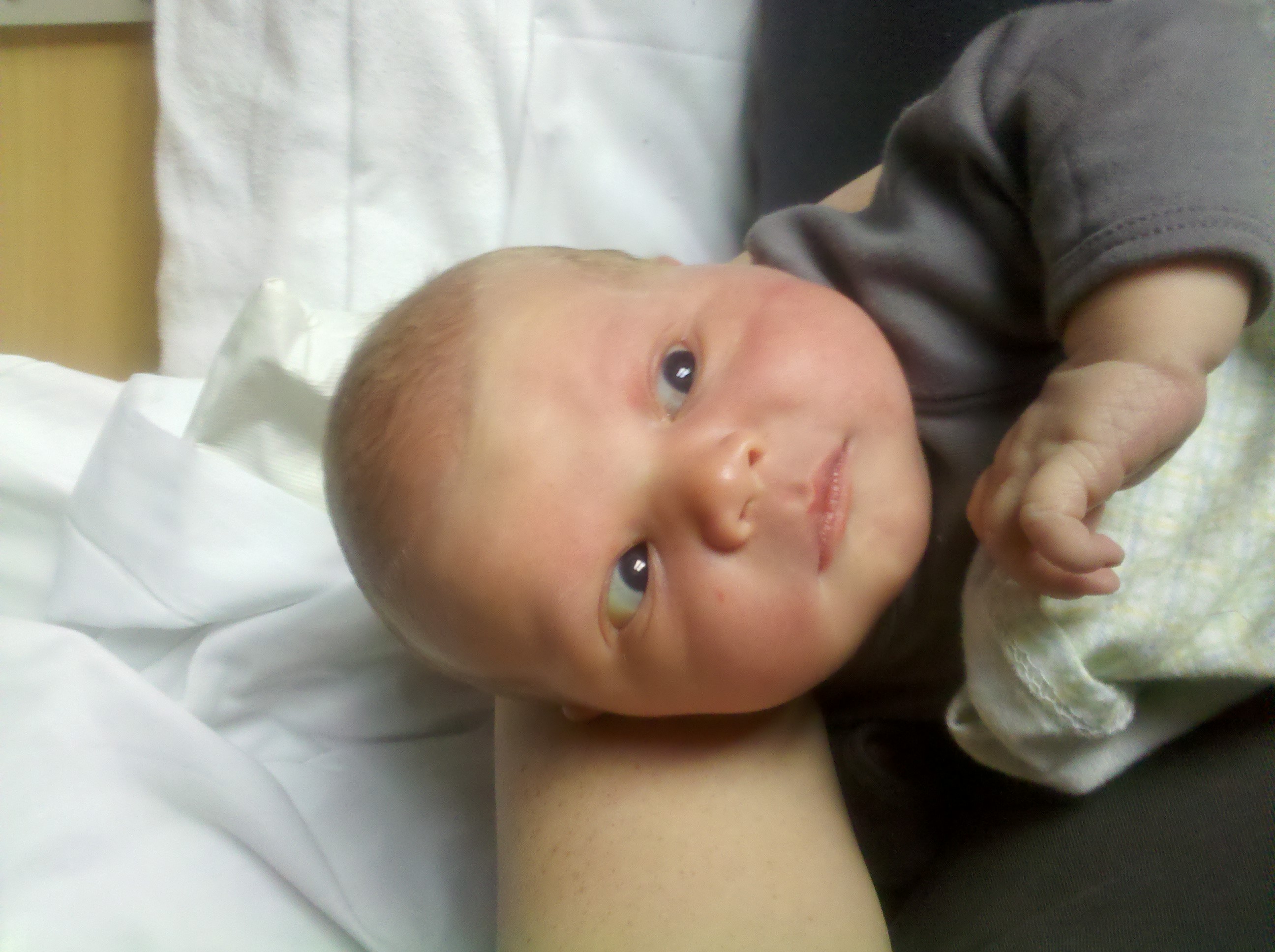
Last night as I came out of Nassau University Medical Center, the hospital where Adrienne gave birth to Emilio Raphael Barnard at 2:02 a.m. on Sunday, the sky was a bruised purple and mauve.  It was dusk and the light of the vast sprawl of Long Island, rising up to meet the storm coming in the low clouds, was throwing off a tinted glow.  Paying attention to something like the colors around me helps me move in and out of hospitals.  The tiles on the hall floor in the lobby entrance are big multi-colored squares set in a diamond pattern.  The fixed, sculpted chairs in the lobby are maroon.  The walls of the third floor maternity ward are Pepto Bismol pink and the waiting room chairs there are hard plastic blue.  There’s a large patch of white on the walkway leading up to the visitors entrance, where someone threw down salt to melt the ice from the last big storm that hit New York.  It’s been crushed to a powder by the constant foot traffic in and out of the entrance.

I’ve had numerous episodes of hospital visits being a routine in my life, and not all of it has ended well.  Eric’s death sealed the hospital in and out, back and forth routine as a numbing trauma one for me.  This episode has ended gloriously, with a beautiful, robust and sweet grandchild.  But the storm that brought my family here was not an easy one to ride through.  Adrienne had planned a home birth, but after close to a day of labor, the midwife suggested the hospital — “dilation failure” I heard her say when she called the hospital to say we were coming.  There they tried a couple of hours of an epidural with pitocin, to see if the cervix would dilate further, but that was only after over an hour of contractions that were making Adrienne scream and turn gray, as we waited for the blood lab results necessary to give her the epidural.  Then as Adrienne and Matt and I tried to rest, another midwife came in the room a couple of times and had Adrienne change positions in the bed, then had her use oxygen.  Clearly, all was not well.  The baby’s heartbeat was starting to show some fluctuations that weren’t dire, but they weren’t good either.  And suddenly Adrienne had a temperature of 100.  “It doesn’t take me long to go from A to Z in terms of worry,” a friend who also lost her life partner said to me once.  I was trying not to go to Z, have been trying not to imagine Z for weeks.  But Z exists and I know that, and I can always feel the rumbles of it beneath me.  

After a couple of hours, Adrienne’s midwife came in, checked and found she hadn’t dilated any further, and gently suggested a C-section.  We were all more than ready.  As we waited in the room Adrienne said to me, “Why do we always have to have trauma be part of what happens to us?  I mean I know we’re good at handling it, but it would be nice not to have to.”  But here it was.  Scary but not tragic and hopefully it was all going to turn out all right. 

As Emilio was lifted from Adrienne’s uterus, the reason for the “dilation failure” was clear.  Emilio was 10 lbs. 6 oz and had the cord wrapped around his neck.  Any attempt for him to navigate the birth canal would not have turned out well at all, and so in the end, everything that happened during the labor was exactly the right thing.

Now I have a grandson and yet another storm has already passed.  Adrienne and Matt are at the hospital.  I’m alone in their house, their dog Khadijah sleeping at my feet as I drink coffee.  The world outside is all white as predicted, but the sky is already clearing, showing blue and pink to the east. 

I’ll shovel out the car and drive back to the hospital and hopefully the family will all come home today.  I’ll walk along the pink walled corridor to Adrienne’s room and will pack up her and Emilio and walk back out.  This hospital routine episode is over and I’m giving it an A.

Snowed In

This slideshow requires JavaScript.

As mostly happens, the snow storm that came through New England last weekend didn’t deliver the expected depths here in Northwood.  New York and southern New England got slammed, but we only got about 8″, disappointingly less than the predicted 12″ — 18″.  But I’ve been snowed in anyway, for reasons beyond the storm.

First, there was the storm.   We got home Sunday night after three days of visiting and parties, just as the wind was whipping up the flakes.  We woke Monday morning to continued snow and got right out into it, skiing for hours.  By the time we got back to the house, cozy and snug in front of the fire, the wind got truly fierce, blowing sheets across the fields so the view out the windows was nothing but white, white, white-out.  Tuesday morning when we got up to go to work, there were two almost four-foot drifts in the walkway between the porch and cars.  I decided to work at home and spent a good part of the daylight hours shoveling and listening to the beep beep of the back hoe backing up as it cleared the drifting snow from my road.  The pastures to the west are slightly higher than the road, so when the wind drives the snow off the field, it dumps it in the road, often sculpting beautiful drift lines along the top of the bank.  I’ve seen a plow truck stuck trying to clear the road — now the road agent is smart enough to send a back hoe over when the snow and wind combine in a blizzard like this one.

But as I said, it wasn’t all that much snow.  Still, I’ve felt snowed in all week, hovering in suspension.  I’m waiting for a phone call from Adrienne, to tell me her labor has started.  But I think I’m also waiting for 30 years ago to happen.  As the dusk collected in the living room this evening I could feel the sadness welling up.  Thirty years ago my labor started at dusk on New Year’s Eve, and Adrienne was born at 1:30 a.m.  1/1/81. 

In many of the years since, Eric and I hosted what was for us, and many of our friends, the party of the year.  Eric and I would start planning the menu months in advance, and then would shop and cook and set up for days, throwing a gourmet dinner party for a dozen or so of our closest friends.  The group varied a bit over the decades, but a core knot stayed with us.  The New Year’s Eve after Eric died I had the party.  I didn’t know what else to do.  Late into the night, I was sitting at the table with a good friend.  “Look at you,” he said.  “You’re proof of the resiliency of the human spirit.  Here you are, going on with your life, with the party.”  “I think this may just be proof that I like to party,” I said, at least a bit drunk, I’m sure, as I proceeded to be for much of the next year.

I got over that, but the next year I agonized about the New Year’s Eve party.  It had been an excruciating year.  I’d let myself get conned into an email relationship, and then a date, with a literal genius I met at Vermont Studio Center.  The process of deciding to possibly let another man into my life had been highly anxiety producing, and he turned out to be a cad, trying to cheat on his famous poet girlfriend.  That was layered and intertwined, in complicated ways that make their own entire story, with losing my best friend in the fall out from her husband crossing some boundary of affection and imagined passion with me.  Nothing ever happened, but I’d been too grief-stricken, and frankly intoxicated, most of the time to realize what was happening until too much damage had been done.  So all I wanted to do that New Year’s Eve was crawl into a cave.  I didn’t do that, but I came close. 

This week the cad emailed me again.  After 3 years.  I figure he’s run out of prospects for a side cheat on his famous poet girlfriend (they’re still together, it was all I asked in my reply to him).  Which makes me think of losing my best friend, who was with me 30 years ago tonight, there with me as I had Adrienne, there with me through Adrienne’s childhood and teenage years and young adulthood.  There with me when Eric died.  Eric who isn’t here tonight, cooking a fabulous New Year’s Eve dinner with me. 

And now Adrienne is about to have a baby and here I am.  Snowed in by sadness and memories and some regrets.  But the benefit of staying present to all that’s happened all these years is I know how to carry whatever I’m feeling.  And I’m free to walk out the door as soon as the phone rings.

Funerals

This slideshow requires JavaScript.

Two summers ago when Aunt Freda died, David and I stopped in Worcester, where Sam was living, to pick him up on the way to the funeral in Connecticut.

“I told someone I was going to a funeral,” Sam said as we drove south.  “And he said he’d never been to a funeral.  ‘What?’ I said.  ‘You’re a senior in college and you’ve never been to a funeral?  I’ve been a pall bearer like six times.'”

Eric came from a close family, with small generations.  His mother had four siblings, and of the five in that generation, only two had children, five total, and of those five, again only two had children, again totaling five.  Three generations of five meant that my children, two of the third set of five, had numerous great aunts and uncles who were like grandparents.  Every trip to Connecticut to visit Eric’s parents included all these aunts and uncles who’d never had children of their own.  Adrienne and Sam were like grandchildren to them, and family gatherings and festivals and parties were rich with an older generation, full of love and delight in watching our children grow up. 

But the other side of that richness is the loss.  Over the past 30 years, we’ve lost ten close relatives, and only Natalie, Eric’s mother, is left.  Last Wednesday morning, Natalie’s brother Ben didn’t show up at schul as usual, didn’t make his usual morning calls, and his phone was continually busy.  Burton, Eric’s cousin, went over to his house and saw through the window that Ben was sitting slumped in his reading chair.  The newspaper was scattered on the floor and the phone was off the hook.

The funeral was Friday, early, because the burial couldn’t be done on Thanksgiving, the funeral home said they wouldn’t do it.  To obey religious law, the burial needed to be completed before mid-day, which the Rabbi determined meant 11:35.  So at 6:00 a.m. I was scraping ice off my car to make driving peep holes, and got on the road. 

When I pulled into the funeral home, the men in dark coats were waiting.  “Are you going to the cemetery?”  When I said yes they had me pull my car into line, gave me an orange tag for my rear view mirror, and put a suction cup flag on my car.  “Funeral,” it announced, black letters on orange.  After the service, we made the familiar drive, headlights on high beams, emergency flashers blinking, through New Haven, across the harbor, to the cemetery in East Haven.

As we drove down the narrow lane with the fenced cemetery on either side, I watched the head stones flashing behind the iron fence rails.  The clouds that had produced ice up north and rain in New Haven were lifting.  Cars were turning in the muddy circle at the end of the lane and coming back towards me, pulling over to park heading back out to the main road.  Cars in, cars out, fence rails slipping by black and straight, dark faced stones carved with name, Hebrew and Stars of David, people getting out of cars and walking through the gate to the small tent next to the new grave.  I took Natalie’s hand and helped her to a seat.

After Aunt Fagel’s funeral, the year before Eric died, I said to him, “You introduced me to all these old people in your family who I love and now they’re all dying.  It’s hard to lose so many people.”

“Ah,” he said.  “But they weren’t old when I brought them into your life.”

November Run

The weather widget on my Droid has a red exclamation point, and when I click through to the Severe Weather Alert I find a Wind Advisory.  The wind certainly feels severe as I start my run headed west, up the small hill past the cemetery.

Eight hours later:  Just as I wrote the above the phone rang.  Eric’s brother was calling to let me know that Uncle Benny died last night.  So that changed the day, of course.  The words that had been swirling through my head for this post, like the brown oak leaves whipping in the wind as I ran, swam away, and I spent the next couple of hours on the phone, rearranging the Thanksgiving weekend plans, calling Adrienne and Sam, checking in with Eric’s cousin Burton and my mother-in-law Natalie, figuring out what to do about the double Thanksgiving dinner plans, the baby shower plans, feeling the inexorable pull of life and all it brings crashing and thrashing around me, around all of us.

And now it’s another four hours later and the cooking is done and the table is set for tomorrow.  Friday morning I’ll be on the road at 6:00 a.m. to get to Connecticut in time for the funeral.  More phone calls, more shifting of plans, more thinking about Uncle Ben.

Whenever a visit was coming to an end, Ben would say, “It’s been nice for you to see me,” grinning, loving his joke, the biggest joke being it was true, it always was nice to see Ben because he was funny and warm and interesting. 

Today has been quite a November run.

Retarded

It’s currently considered rude to use the term retarded when referring to people who are developmentally disabled, even though a few decades ago that was the only term used.  The shift in language is important, because there is great stigma attached to the word, and it inappropriately lumps together a host of developmental disabilities with a wide range of effects.  But there is a state the word conveys perfectly, which Adrienne uncovered in the months after Eric died. 

“Hey, we’re retarded,” Adrienne said one day when we were sitting on the porch, unable to read, unable to garden, unable to do anything besides sit there and stare and talk now and then.  According to the American Heritage Dictionary, retard means “1. A slowing down or hindering of progress.”  Bingo.  No progress other than breathing, a slow down in every function of our daily lives, like getting out of bed in the morning, cooking meals, doing dishes, making phone calls, getting back into bed at night.  We were good at grieving and spending time together and not much else

Unfortunately, the definition of retarded still means “affected with mental retardation,” and the slang definition for retard is “a disparaging term for a mentally retarded person.”  But retarded can also mean “relatively slow in mental, emotional or physical development.”  Take out the “physical” and “development” and there it is.  We were definitely relatively slow in our mental functioning and our emotional state was stuck in a permanent wail.  We were bogged down with grief, slogging through each day, and unable to process even basic bodily signals like hunger and the need to sleep.  Retarded.

What brings this up now?  Although my sister’s diagnosis of a recurrence of cancer is nothing like Eric’s, and she is already on a treatment that has a good chance of working, just hearing the news of cancer returned in the body of someone I love set off the grief retardation tremors. 

“I was retarded yesterday afternoon,” Adrienne told me, a couple days after we got the news.  “I just sat on the couch and stared into space.”

And I have been retarded too.  My reading dropped off, my concentration was shaky, and I felt this extra weight across my shoulders, making my already tight neck muscles like stretched strings.  It’s eased up, which is how I can now see that it happened.

Retarded.  I’m making a case to reframe the word in a way that isn’t disparaging to a diverse group of individuals, but rather affirming of a natural reaction to the tough side of life.