Day Eight — Left Turns

left_turn_only-1024x680

The unexpected left turns of life can be dangerous. You have to cross a lane of traffic so hope for a quiet road without too much to dodge. But life is a busy road as a good friend found out last week, suddenly navigating a turn she didn’t see coming, hanging on to the wheel and weaving through the potential collisions, steering for safety.

I know what it’s like to be in the hospital room where a sudden medical crisis landed her, sitting for hours listening to the beeping of monitors and watching the line of heart beats on a screen. I’ve spent the night drifting in and out of sleep in a reclining chair, ears alert for any change in the rhythm of machines tracking vital signs. Waking up and waiting. Waiting for the doctor to come in and deliver the latest news. Waiting for the results of scans and blood tests. Waiting for the day to pass because then it will be night and maybe everyone will sleep better and tomorrow will be better.

Then tomorrow is worse.   And still getting shorter and darker.

Last night, driving home from visiting my friend I had a couple of close calls. A truck made a left turn in front of me, drifting across my lane as if I wasn’t there. Then a car pulled out where I was turning left, making a wide arc that cut in to my lane. It was dark and I had trouble seeing the road once I’d made my turn.

Right.  My headlights weren’t on. So I was as invisible as I felt.

We are all so small and invisible. So I pay attention to the road, to what’s coming at me, and to everyone I love who’s riding out a scary turn.

Resurrecting Poems

IMG_3944

It seems like a long time ago that I was a young woman shepharding another young woman into the world, a mother to a daughter.  Watching the changes that puberty brought — the rising and falling tide of hormones, the blossoming of fertility, the chance that another generation was going to unfold (which it so delightfully has), was profound.  I wrote about it.  No surprise, I write about much of what I experience.

Sunday David and I visited friends who live far north in New England, and it was winter there.  It’s creeping closer to winter here, the thermometer reading a chilly 20 degrees yesterday morning.  But driving through Franconia Notch two days ago it was snowing and snow squalls followed us all the way to our friends’ farm where the grass had a white crust and a trailing vine on the porch was laced with icicles.  Ice, snow, a hard wind and a fire in the stove.

Put these together, and I think of another poem I wrote long ago, as I did last week.  The resurrection of poems continues.

Valentine’s Eve

I hear ice in the trees.
Our footprints from before dinner
up the walk to the house,
have crusted.

The sky, thin as newspaper,
shredded white,
hides black ice underfoot.
Oblivious to ice’s season,

another seed falls through me,
and through my daughter now too.
My hand on her arm,
she stops to stand with me —

we listen to ice clack above us,
raise our eyes from the ground,
hearts beating hard
as startled birds abandoning cover.

Zinnias & Sisters

IMG_3797
Zinnias with garden spider

Bold and bright, sturdy and upright, zinnias have long been a favorite in my garden. They’re simple to grow, add splashes of magnificent color and vary in their design — from a single row of petals surrounding a protruding center of yellow stigma florets, to a dome of overlapping petals making a smooth surface of blossom.  These very different shaped flowers often come from the same plant, which is puzzling but delightful.

Zinnias are so not fussy and so satisfying.  White, chartreuse, orange, scarlet, peach, pink, fuchsia and lilac and too many shades in between to name.  Every year at least half my flower bed is devoted to them.  The summer Adrienne and Matt got married I grew extra. The table decorations at the reception were glass globe vases of zinnias, and there was at least one zinnia from my garden in each bouquet, a sweet touch. My sisters and I put the bouquets together the morning of the wedding, pulling stems from the florist’s buckets, and then one or two from my supply.  Jeanne, Chris, Meg and me, working together to decorate a happy day.

It was time for our family to have a happy day.  Eric had died two years before and Adrienne, quite wisely, had resisted my pleas those two years before to get married right away, have a baby, make something good happen.  As it turned out, everything happened exactly when it seemed it should, following the natural cycle of sorrow and recovery and beginning to understand how life flows on in its unrelenting dailiness, marked again at some point with bright days of joy, splashes of zinnias in a garden.

Yesterday I was home again from several days with Chris and her husband Jon.  Jon has been sorting through decades of photographs and gave me a picture of my sisters and me from a happy day several years ago, the four of us in a clear frame with the word “sisters” in varied fonts inscribed in silver around the photo.  I propped the photo in my study so I can see it from my desk, and went out to pick bouquets for the house.  Zinnias first.

IMG_3801

Why?  Zinnias pull me into appreciation.  This summer has been tough for my family, and a whole lot more than tough for Chris’s sons and their partners and Jon and my parents. I’m there to help as often as possible and home soaking up the colors of flowers when I can, remembering the bouquets I made with my sisters.  A room full of zinnias, a garden of bright blossoms, tables with joy in the center.

Drugs


Image by David Coursin

I take drugs. The fact that I have an anxiety disorder that is greatly helped by the right doses of medication is a cause for celebration for me, not shame.  Celebration that there are drugs that help, not that I have an anxiety disorder.  That’s been a hard thing to live with, going back to when I was a very young child.

The first episode of intense anxiety that I remember happened when I was five and a kindergarten classmate died of a heart condition.  His obvious frailty and my robust health meant nothing to my five year old brain that was busy imagining all the ways I might die, especially while I was asleep, making sleep terrifying rather than a refuge.  In third grade a class mate died of leukemia.  In high school a student in the next town died of spinal meningitis.  Life was dangerous — it ended in death.

But I didn’t need a death close by to feed by anxiety. I made up many of my fears by myself.  When I was a pre-teen it was brain tumor that was going to kill me.  One day an aunt asked me why I was always feeling my scalp and I told her I was checking to see if the lumps on my head were getting any bigger because I was afraid they were tumors.  She laughed, kindly, and told me I wouldn’t be able to feel tumors from the outside and I just had a lumpy head.  For some reason, that didn’t translate into a fear that tumors I couldn’t feel were growing in my brain, probably because that particular bout of anxiety was waning.

My acute phases of anxiety weren’t constant and usually lasted several months and then got better.  When I went through a particularly bad bout at 30, I thought back to other bad patches and realized the anxiety had peaked in six to seven year cycles since that first episode at five.  It was also when I was 30 that a doctor finally named for me what was going on and suggested medication.  I tried medication eagerly and have never regretted it.

I know there is still stigma about taking medication for mental health problems and I’m a bit of a zealot about trying to convince people to get over it.  In my professional life I watched many colleagues suffer through depressions and anxiety issues, refusing to try medication because they thought they should be able to take care of their moods and distress themselves.  Yes, I would tell them, you can take care of it, by seeing if you might be helped by medication.

It’s not always easy to find the right medication, and you have to find the right medical practitioner to work with you until you find the one or the combinations that work for you.  I feel lucky that my route to effective medication has been fairly straightforward.  I used to only need the medications periodically, when a flare up of anxiety would manifest.  But since Eric’s death I’ve only been off my anti-depressant for less than a year and needed to get back on it, and I’ve never even tried to stop taking my anti-anxiety medication.  I live with such a weight of knowledge of the pain in the world, I need the floor that the medications provide.  It gives me something to rest that weight on.

When Eric died, I admit (which is clear from reading The Truth About Death) that I turned at times to pretty hearty self-medication on top of prescribed ones.  And thus the third of the four truth-telling poems — death, drugs, sex, money.   I talk.

Drugs

I wake up drunk, I wake up hung over
on klonopin, I go for a run and hear
and then see a cardinal at the top of a spruce,
down by the lake still frozen but softening.
By now you were walking more than running
and I walked with you. I explode
inside my own brain, I want other brains
to explode, fragments hit me, I cherish
the bits, the glint of metallic memory,
the shine of light off your glasses.

Birth and Death

It’s been over a week since I posted “Sex,” a poem from The Truth About Death which was one of the four that addressed “the more universal, the more silence.”  I said I’d post the other three by the end of the week, but instead I was awakened early Thursday morning by a call from Adrienne, letting me know her labor had started.

At 9:30 that night, Ava was born, a pink package of baby life finally slipping free of the birth canal (lots of heroic pushing on Adrienne’s part) and seeming to fly up to Adrienne’s chest. I know it was the midwife who caught Ava and guided her up to Adrienne, but from my vantage, looking over Adrienne’s shoulder as I helped her hold up her head and shoulders to curl around her womb and push, it looked like a magic dance, a bright red face then chest then wormy body suddenly in the world and then snuggled against Adrienne as the cord pulsed between them.

So what does a birth and a new baby mean in the context of a poem about death, a poem written when I was entirely absorbed in the exit from life rather than the entrance?  It means it takes me over a week to write a new post, because my days have been full with being an extra set of hands for Adrienne and Matt and Emilio — shopping, cooking, cleaning up, washing and folding laundry, holding Ava, walking and rocking Ava, driving Adrienne and Ava to appointments, sleeping with Ava sleeping on my chest.  Right now she’s cuddled up against me in a fabric sling, squeaking and squealing, those tiny baby noises that come back in a flood of memory once I hear them again.  Her breath is so quick and shallow it feels like there’s a bird at my breast.

But it’s a person.  A birth.  So far from what was happening in my life when I wrote the poem “Death.”

Death

You took the crash course, and me along with you
because where else would I be except beside
you? Now I study death with the deliberate
focus you loved. People are afraid of me,
especially couples. I smoke on the porch
in your jacket, making the brown moleskin smell,
watching planes cross the dark sky as they fly
in and out of the airport to the south. I think
about quitting. What do we each know now
that the other doesn’t? And our children,
think of all they know that we didn’t.

Yom Kippur #9

IMG_3120

Life has been full of dailiness since my return home from our European travels.  There was mail to sort, arriving in piles for days after we got back — hardly a personal piece in any of it — plants to water, laundry, shopping and cooking, driving to visit all the family we’d missed, spending time with friends we’d missed, watching the trees turn and turn again to bare, meetings to attend, dump runs, doing dishes, running and recovering from running.

Staying present to all this dailiness, in the way I was to the unfolding amazement of traveling in beautiful places, when my only occupation was to see and think and absorb, has been easier than I’d expected.

I’d actually been surprised I was able to be so present during our trip — there was hardly a moment of overthinking about the luxury and privilege of comfortable travel or worry about someone back home.  Not that I didn’t think about how lucky I was to have the time and resources to enjoy Europe for weeks, or worry about friends and family back home. But those thoughts didn’t turn into feelings of unworthiness and my worries, mostly, didn’t get in the way.  I let myself sink in to the experiences: drinking wine on a leaf-shadowed patio in France, hiking in the Alps, sitting around a breakfast table in a garden in Italy, drinking coffee and chatting with European friends.

Really, what I’m saying is that I haven’t been anxious, the most common reason for me to lose track of my connection to each moment.  Was it the magic of travel that kept my anxiety at bay?  Meditation?  Medication?  Whatever the reason, I’m thankful my ability to be present to myself and what’s before me hasn’t shifted, even now that much more of what’s before me is the routine maintenance of life.

This is a long way of explaining why I’m several days behind in my annual Yom Kippur post.  Services were lovely — good sermons and outstanding music — and connecting with friends was sweet.  As usual I thought a lot about forgiveness and the knot of unforgiven hurt that still comes up for me every year.  I thought a lot about Eric — this is Yom Kippur #9 without him — and could picture him beside me through both services.  David and I told each other what our intentions were for behaving closer to the ideals we pray about on Yom Kippur.

Now it’s a bright autumn afternoon and I’m enjoying the light gleaming on the leaves of the plants in my study’s tall windows.  I know time is passing because otherwise nine years couldn’t have gone by.  But I also know there is stillness in the center of time, in the center of everything, and somehow I’m getting better at living in that stillness.  Centered.  Maybe it’s just a function of slowing down as I get older.  No matter.  It’s a pleasure to be here.

Cairn Rock

IMG_2273

“I have something I need to talk to you about,” my neighbor said, stepping out of his truck’s cab.  He’d stopped at the end of my driveway when he saw me heading out for a run this morning.  He looked upset and I was immediately worried.

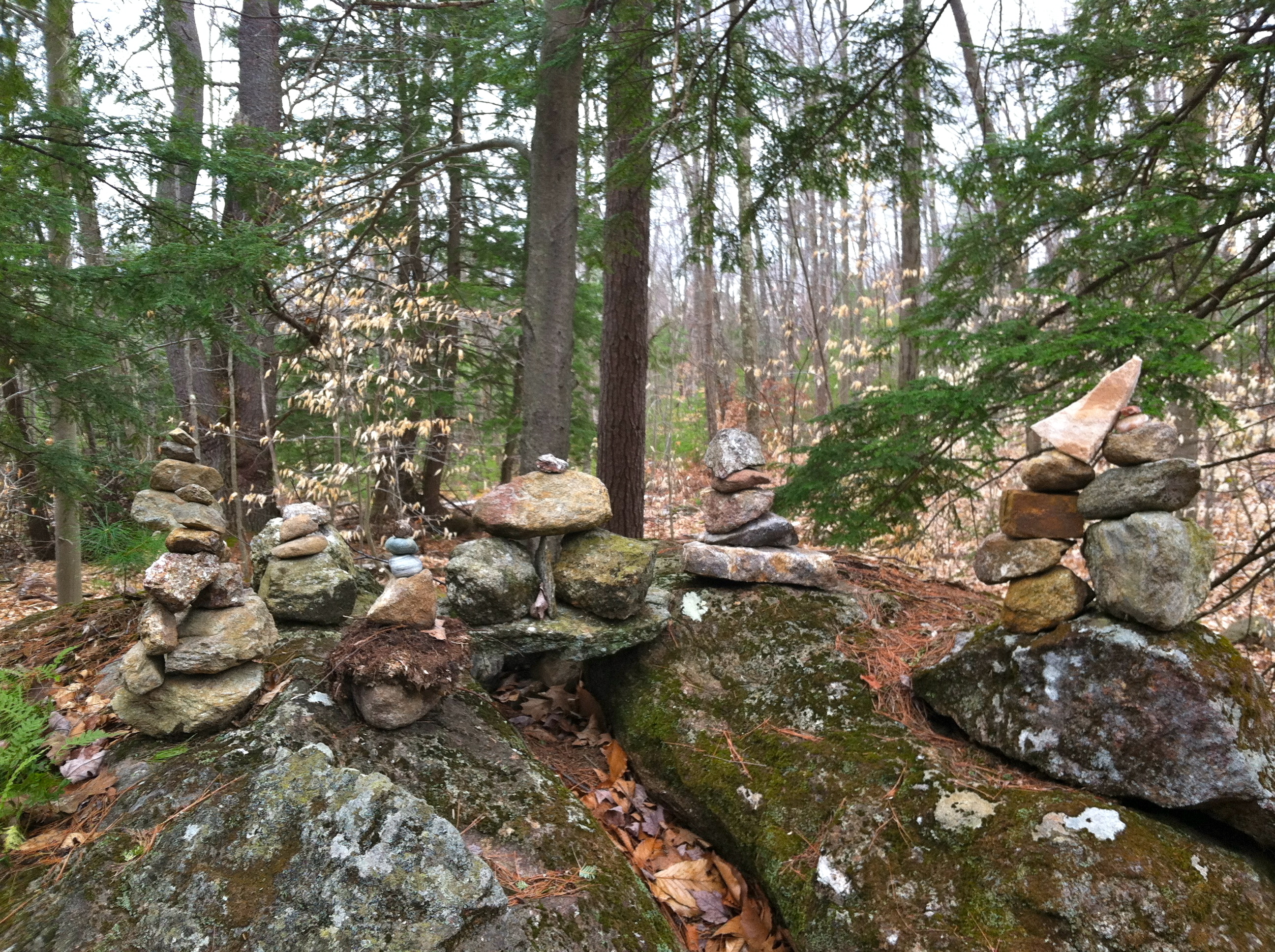
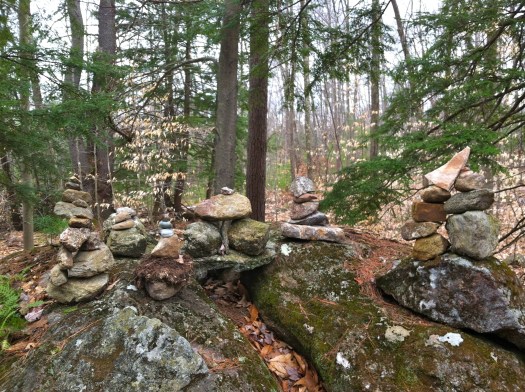
“You know we’re doing a lot of logging out the road,” he said and I said of course, we see a dozen or more large trucks a day going by our house, making the sharp left turn to climb the small hill of Canterbury Road up through the fields and then into the woods. The same road I’ve written about before, the road I walk to a large set of rocks where I’ve been building cairns for Eric since he died.  The closed trailer trucks come back out the road packed with mulch; the open bed trailers with tall steel side supports roar by stacked with huge logs of oak.

David and I walk out there often and have been watching the progress of the loggers cleaning up blown down trees from the tornado in 2008, shredding them into mulch, and cutting tall oaks for lumber.   It’s the most action our street has seen since I’ve lived here.  It’s made the road surface in the woods much smoother for walking and we’ve been assuming the blockage in the road, that keeps us from getting to the cairn rock, will be cleared once all the lumbering in done.

“I told the logger I hired one thing he had to be sure to to be careful of,” my neighbor said, still looking worried through all my talking about how much work he’s getting done on his land and how much better the road in the woods is now for running.  “I didn’t want anything to happen to the rock where you make stone piles.”

“Oh,” I said, finally understanding why he looked upset.

“But there was a new young man working out there last week and he pulled trees over the rock and now everything is knocked down.  I’m really sorry.”

“That’s okay,” I said.  “I build those cairns for Eric, but I don’t mind rebuilding them.  I often have to pick up fallen rocks.  It’s fine.”

“I know the rocks are for Eric.  That’s why I really didn’t want them disturbed.  I feel so badly.  I’m going to clean out all the brush and bark that got left there and once the old road is open again you’ll be able to get to the rock and it will be all fixed.  I’m so sorry.” He was holding his hand to his heart.

“It’s really okay,” I said.  “It’s so sweet of you to be that concerned, but please don’t worry about it.  You’re completely forgiven.  I’m fine about rebuilding the cairns.”

“When I realized you were making those rock piles for Eric, I started doing it for my Dad.  He used to take me out there when I was a kid, and now it’s a place I go to remember him.”  His father died four years ago.

“It’s a good spot,” I said, nodding.

“I have photographs of it so you can see what it was like before it all got knocked down.  And I’m going to make it even better.  I’ve gotten a granite cross I’m going to put out there.”  Now I knew where the cross made of lashed together branches that appeared on the rock this spring came from.

“Oh, that’s so nice,” I said.  “You’re so kind to stop and tell me all this, but really, it’s completely fine.  It will be a pleasure to rebuild the cairns.”

Eric would be delighted by the sequence of events that have led to a granite cross marking his remembrance rock.  I’ll make a Star of David with lashed together branches and put that next to the cross.
Small Stone #19

From Writing Our Way Home

“Boong, boong, boong.”  The timer signaling the end of the 10 minute meditation chimed across the room.  I rubbed my hands together, then cupped them in front of my face, eyes closed, as the teacher instructed.  “Drink in the energy,” she said.  “Now open your eyes and look at your hands.”  Late sunlight was filtering into the room through the thin, bare trees outside.  I was surprised at how quickly the ten minutes had passed.  I was surprised to find myself having just finished a mediation class.  I was surprised at my ability to be still, if only for minutes at a time.  I was delighted.

Voice

D-SunMandala-400

Voice, both literal and metaphorical, the sound produced by the vocal organs or the distinctive expression of an artist or the ability to express a choice or opinion, is critical to being heard.  If you have no voice, no one can hear what you’re trying to say, whether it’s because you’re unable to talk, or what you say is silenced and ignored, or you’re afraid to express yourself (perhaps for good reasons).

Since leaving my job at the New Hampshire Coalition Against Domestic and Sexual Violence, I’ve spent a lot of time thinking about voice — my voice in particular.  Working as a leader in the movement to end violence against women, it was a rewarding part of my job, as well as a passionate commitment, to give voice to victims who are voiceless. Whether that was speaking to reporters about the reality and tragedy of intimate partner violence after a woman was murdered by her husband or boyfriend, or testifying to legislators about the need for a statute to better protect victims, or meeting with government officials to urge changes to policies that would better support battered women and their children, I felt the force of all the victims who could not speak for themselves behind what I said.  It was an honor to provide a voice for those who were silenced by shame or poverty or fear, women who had never learned that they mattered, and so what they said mattered.  I made sure I stayed close to direct work with victims, and talked often with victims myself, so my voice could reflect theirs.

Now the voice I’m focused on is my own and what I’m working to express, distinctly, is my singular creativity.  This hasn’t been easy.  Speaking for the disempowered to promote more attention to their needs was easy because it wasn’t personal and it wasn’t for me.  I could use my verbal skills on behalf of someone else.  Transitioning to a life focused on expressing deeply personal experiences and reflections has been a more difficult journey than I expected.

After all, I’ve been writing poetry and short fiction since I was a child.  I’ve published and received fellowships, I studied creative writing in college, I’ve always been part of writing workshops where I regularly share what I’m writing.  I imagined a smooth shift.  But making my personal writing the center of my life has been hard to do in the wake of making the needs and struggles of others the central expression of my voice.  Who cares if I write another poem about the faint rose that first rises in the eastern sky at dawn and then circles around to light the horizon to the west?  What difference does it make in the world if I change a comma in a poem to a semi-colon to add weight to the following clause?

This is circular thinking for me, because it was exactly the need to have a more direct impact in the world that led to my long career at the Coalition.  I started my adult life as a writer, but couldn’t get enough traction with writing as a way to make a difference in the world.  As well as make a living.  Following my passion for social activism into social service jobs and then to the Coalition made sense.  When I left my job over two years ago, it was to give myself — my self — an opportunity to live in the middle of my own focus, to have my voice count.  So the struggle to value time spent on my own creation is nothing new, and wondering how it makes a difference to the world is a same old story for me.

But this week I’ve had an opportunity to change that story.  I’m taking an e-course, Renew Your Creative Voice, being taught by Sarah Whitten, a voice and yoga teacher and the creator of The Mindful Singer. Through breath work, meditation and journal prompts, and conversations on a Facebook page, I’ve been connecting with my creative history, obstacles, champions, goals and energy.  It’s also been a week when I’m figuring out a more natural rhythm to my day that includes intentional and focused time to write. The inner critic and the inner activist seem to be on vacation, because they haven’t been around to question what difference all those edits I’ve made to poems this week make.

The difference?  The poems are sharper.  And I can hear my voice.

Day 14: The Next Season

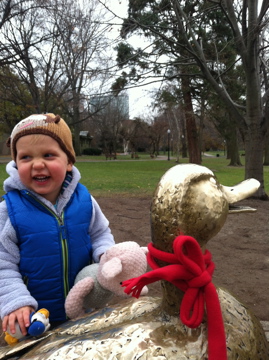
Gratuitous Mimi Pride Photo Having Nothing To Do With the Blog Post

12:11 p.m.  Winter solstice, the moment of the shift.  Earlier today, as David and I drove to yoga class, the sun was a huge ball of fuzz in a cloudy sky, a ring of blurred light much bigger than itself.  Then the day sank into a gray dimness. Now the sun is out again, snow is dripping from the roof and I’m on the porch as I write, fingers bare on the keyboard.  A bit of spring on a day that will soon be dark again.

Can I celebrate the darkness?  That was the focus today in yoga class, to find the impulse inside for what is coming next, what is going to grow, how the stillness of this season, when so much of nature has quieted, can let us go deep enough to find what needs to emerge.

Mostly I feel like I endure the growing darkness and steel myself to get through the days of diminishing light, reaching towards this point, when the earth’s orbit starts to tilt us closer to the sun again.  But I know there are many more months of darkness to come, and that this is just the beginning of a season, even if the light is changing.

So I’m going to focus on making darkness my ally.  Cultivating a capacity for stillness is completely new for me.  Sitting still, concentrating on my breath, and listening to a teacher talk about finding balance in my mind, body and spirit is something I always thought I wanted to do, but never thought I would actually do.  Now I am.

Wherever embrace of the darkness and a focus on inner impulses leads me, I’m ready.  Tomorrow night when we gather with friends to celebrate the solstice, lighting candles and making wishes for the coming year, I’m going to welcome the darkness, rather than try to race through it.  Slow down, breathe, listen, and let what needs to emerge come to the surface.  I’ll say hello, most likely write about whatever it is, and move through it.  Namaste.