Day Three — Warm December

unnamed

The cows are clustered around the hay rack in the pasture across the street, a low moan rising out of the one lying off by itself. A few are eating. A calf lies in the curve of a large cow’s body, both heads erect, wet noses glistening, breath steaming.

I can see all this so clearly because I’m outside, on the porch, low sun on my lap, almost hot. I’ve written about this before, there’s a poem in my book titled “Warm December,” another poem was written right here, warm when it should have been cold.

The Porch

This is where I come together, my feet
in white wool socks, the grass still patched
with green, open, a winter with no winter,
the warmest ever. Other people are scared
but I don’t care. Birds fly across the porch
under the grooved wooden ceiling, above
the railings. Small white pines are coming up
in the bit of pasture beyond the barbed wire
fence of the old calving pen where it doesn’t
get bush-hogged in August, the nature of nature.

That was eight years ago. The pattern continues. World leaders are in Paris trying to at least keep worse from happening, but this is going to be the warmest year ever, again. I think the world has always been this dire, the future, the violence, the inexplicable horrors that humans do to each other, or one does to another. We just know more about it, we know the full scope, information coming from everywhere all the time so our heads fill and fill with one tragedy and then the next, a massacre, a disaster, push notifications that ping my phone so I pick it up and read about the latest horrible thing.

I could shut off those notifications.

Last night poet friends gathered here and we ate and chatted and then all read what we’d written in response to a prompt David had come up with – Plagues We Have Known.We always have a prompt to write a poem for the Yogurt Poets holiday party, though past prompts have been gratitude, tradition, grace. Plagues was a whole new direction.

“What wonderful nerds are we?” said Hope as Kay talked about exploring the etymology of “plague.” Nancy had written 14 lines to each of the ten plagues visited on the Egyptians by God, Hope had written one line for each. David had used the metaphor of cell phones as progenitors of infection, a coming epidemic. Mary was happy to have been able to write anything.  I was happy to listen to what everyone had written. A group of creative souls who write for an audience as small as the dozen of us, as small as themselves, because we love the beauty of poetry.

Now the calf has moved to lie against the back of the cow who was moaning earlier. The world is hazy with moisture and inappropriate heat.

Resurrecting Poems

IMG_3944

It seems like a long time ago that I was a young woman shepharding another young woman into the world, a mother to a daughter.  Watching the changes that puberty brought — the rising and falling tide of hormones, the blossoming of fertility, the chance that another generation was going to unfold (which it so delightfully has), was profound.  I wrote about it.  No surprise, I write about much of what I experience.

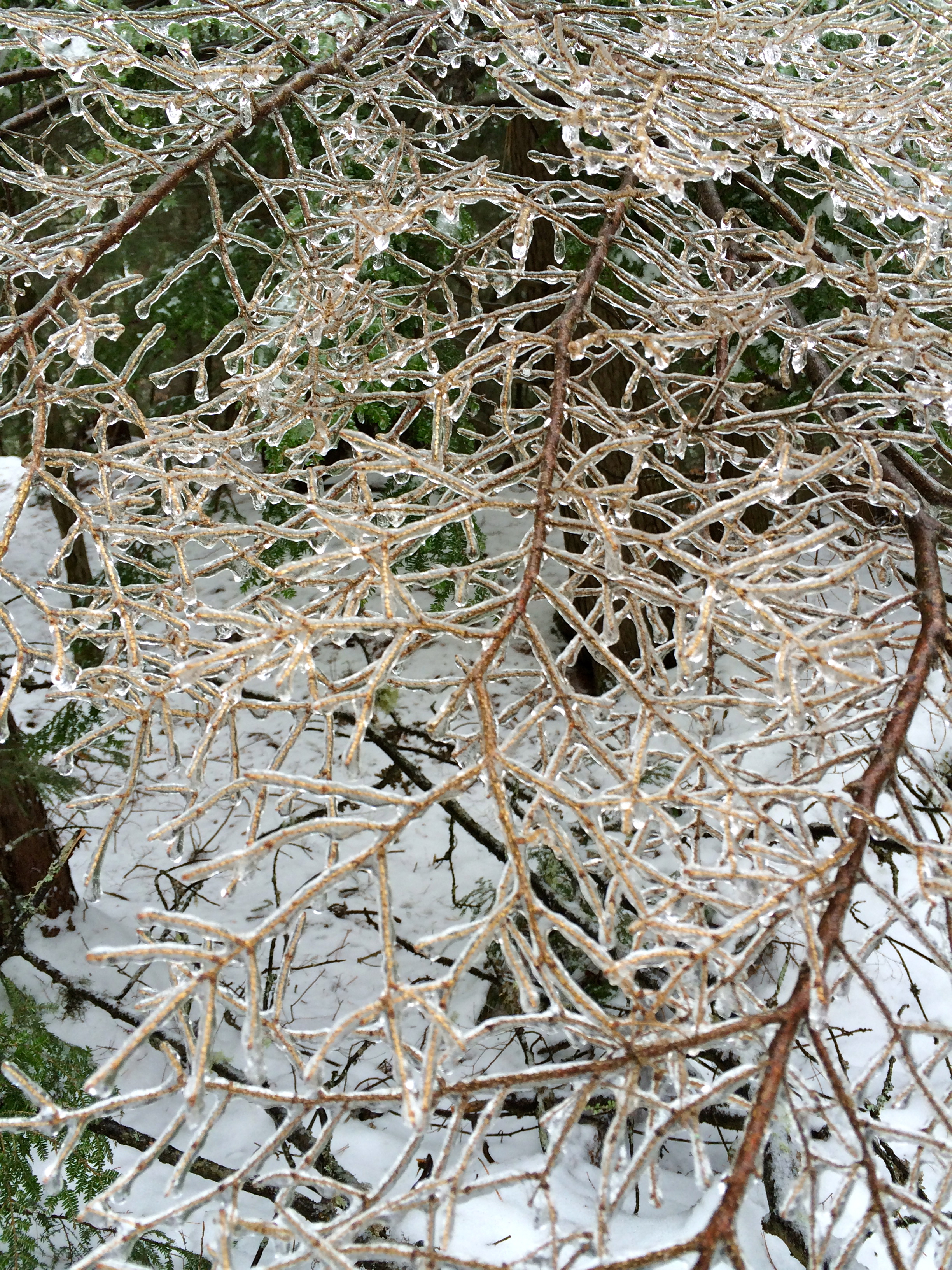
Sunday David and I visited friends who live far north in New England, and it was winter there.  It’s creeping closer to winter here, the thermometer reading a chilly 20 degrees yesterday morning.  But driving through Franconia Notch two days ago it was snowing and snow squalls followed us all the way to our friends’ farm where the grass had a white crust and a trailing vine on the porch was laced with icicles.  Ice, snow, a hard wind and a fire in the stove.

Put these together, and I think of another poem I wrote long ago, as I did last week.  The resurrection of poems continues.

Valentine’s Eve

I hear ice in the trees.
Our footprints from before dinner
up the walk to the house,
have crusted.

The sky, thin as newspaper,
shredded white,
hides black ice underfoot.
Oblivious to ice’s season,

another seed falls through me,
and through my daughter now too.
My hand on her arm,
she stops to stand with me —

we listen to ice clack above us,
raise our eyes from the ground,
hearts beating hard
as startled birds abandoning cover.

Parents Always

IMG_3903

One of the first things David and I agreed on when we met was “the kids come first.” Falling in love in your 50s and 60s is complicated for many reasons, and how a new relationship will play out for your children can be one of the trickiest.  Luckily for us, it has worked out well — our kids get along with each other and with each of us.

Good thing, because no matter how old your children, you’re still their parent.  Maybe even more so when one parent has died.  That fact and the glorious foliage this morning got me thinking about this poem I wrote at least 20 years ago.

PLAYING CATCH

The boy at the bus stop
tries to break his record of ten
leaves caught falling
from the maple,

leaves yellow as butter
cupping foggy morning light.

Not only leaves stir in the fog;
crows rattle branches, muzzle loaders
pock the morning with shots,
bus doors yawn open and shut,

children leave, come home,
leave again.

Instructions From Chris

FullSizeRender (1)

The memorial service for Chris was Saturday.  Over two years ago when she was planning her service, she asked me to read a poem as part of it.  I did.

Instructions From Chris

“You could use this poem,” my sister says
when she asks me to read at her memorial.

She’s reread my book, found more darkness
than she wants, she knows people will cry

but even so, she’d prefer a celebration, more
ideas than despair. “This one towards the end,”

when grief first starts to curve away
and my sisters appear, musical, muscular hawks,

long, strong wings, a slice of sun.
I understand. She wants her own poem.

She is second of four, the smarter, prettier one
I could never catch, a life in preview.

But I do no better than what’s she’s written
herself; the space created when a book is lifted

from the table, an opening that fills with shadow
and chance, quickening, quiet. I delete, start over,

come back to her smile as she carries her hope
and illness before her, a globe in her hands.

I toast bread, open a jar of her strawberry jam, ruby
sugar, red as magic slippers, no place, home.

Petrichor

Photo from Downgraf.com

Two of my sisters and my niece, Amelia, and I email each other, on a rotating basis, a word of the week, every Sunday.  It was Amelia’s turn this week and her word — petrichor — was a revelation to me, a word for what I’ve been I’ve been trying to describe for years, the pleasant smell of rain after a long, dry spell.

A citrus tang layered over an earthy sigh of musk, a release of heat you can smell.  More than a dozen words to describe what can be said in a word. Petrichor.  

As the word sunk in I remembered I had two poems published in the Petrichor Review a year ago.  How did I not notice the meaning then?  I always study journals I submit to, carefully looking for a fit between my poems and what they publish.  I looked again and saw I hadn’t read past the etymology of the word on the website “about” tab:  “Petrichor (pronounced /ˈpɛtrɨkər/; from Greek petra “stone” + ichor the fluid that flows in the veins of the gods in Greek mythology)”

I missed “the scent of rain on dry earth.”  No wonder, after reading about a stone fluid in the veins of Greek gods.

The editors of the journal sent me the nicest acceptance email I’ve ever received, saying my poems are “an excellent exercise in poetic restraint; they’re succinct, unpretentious, and casually deep.”  (Okay, yes, a bit of brag there.)  And they’ve known all along about petrichor, a word I needed and didn’t know exists.  No wonder my poems fit in the Petrichor Review.

Questions


IMG_2820

WOM-PO, a women’s poetry list serve, has had a round of posts in the past week lauding a poem by Alicia Ostriker recently published in Plumean online poetry journal.  “Q&A,” the poem, has touched many women on the list serve, setting off numerous exclamations of “Brava!” and appreciation for the poem’s content, format and effect.

Why are we drawn to questions?  What is the role of literature, of poetry specifically, in asking questions and answering questions we don’t even know we have?  As William Carlos Williams wrote, “It is difficult/to get the news from poems/yet men die miserably every day/for lack/of what is found there.”

The truth telling of poetry is the truth telling of breath, how language and thought move through us to create meaning and carry it into the rhythm of our bodies.  Poetry is a distillation of experience into a music that hums under the surface of conscious awareness. A well written poem reaches past what we know about the words collected on the page and tugs at a deeper understanding than what our logical mind constructs from those words, until we understand that we feel something deeper, even if we can’t exactly name what it is.

All of which reminds me of a poem I wrote years ago about exactly this, after asking myself a simple question.

Hope

What would be enough? Sometimes
it’s simply getting through
this hour and the next. Sometimes
it’s the hours dropping away, the day
a river of light, the passage
of sun moving shadows across snow.
More rare, the swelling of enough,
like a pool filling at the unreachable
core I can feel but not locate,
that comes sudden and sweet – the thin
chip of a cardinal on a winter
morning, the sun rising north
of the white pine, again, the last
clothespin clipped to the sheet’s corner
as the hemmed end charges a clear sky.

Money

photo (2)

In this season of advertised merriment with its vision of happy times supported by a hefty bout of shopping, posting the last of the four poems in my list of universal experiences that hold too much silence — sex, death, drugs, money — seems very appropriate.

Here I’m recounting the responses to what counts as wealth in the larger world and my own reckoning of true wealth, having experienced a deep and encompassing love.

On this gray morning polished by slow snow, as we travel towards the turn of the sun, the winter solstice only hours away, may you find your own sources of wealth to celebrate.

Money

I sit on the window ledge of the restaurant
and talk to the woman beside me, her head
wrapped in a bandana, she lives on the streets,
she had a brain aneurysm, her family is lost
along the west coast, no chemicals,
it keeps her safe, she didn’t repeat herself
for a long time. Two men in a row tell me
it’s not my luck but my heart that makes me
put large bills in their cups, the blessing
I carry with me. You ate pears whole,
ignoring the core, to you all fruit.

Drugs


Image by David Coursin

I take drugs. The fact that I have an anxiety disorder that is greatly helped by the right doses of medication is a cause for celebration for me, not shame.  Celebration that there are drugs that help, not that I have an anxiety disorder.  That’s been a hard thing to live with, going back to when I was a very young child.

The first episode of intense anxiety that I remember happened when I was five and a kindergarten classmate died of a heart condition.  His obvious frailty and my robust health meant nothing to my five year old brain that was busy imagining all the ways I might die, especially while I was asleep, making sleep terrifying rather than a refuge.  In third grade a class mate died of leukemia.  In high school a student in the next town died of spinal meningitis.  Life was dangerous — it ended in death.

But I didn’t need a death close by to feed by anxiety. I made up many of my fears by myself.  When I was a pre-teen it was brain tumor that was going to kill me.  One day an aunt asked me why I was always feeling my scalp and I told her I was checking to see if the lumps on my head were getting any bigger because I was afraid they were tumors.  She laughed, kindly, and told me I wouldn’t be able to feel tumors from the outside and I just had a lumpy head.  For some reason, that didn’t translate into a fear that tumors I couldn’t feel were growing in my brain, probably because that particular bout of anxiety was waning.

My acute phases of anxiety weren’t constant and usually lasted several months and then got better.  When I went through a particularly bad bout at 30, I thought back to other bad patches and realized the anxiety had peaked in six to seven year cycles since that first episode at five.  It was also when I was 30 that a doctor finally named for me what was going on and suggested medication.  I tried medication eagerly and have never regretted it.

I know there is still stigma about taking medication for mental health problems and I’m a bit of a zealot about trying to convince people to get over it.  In my professional life I watched many colleagues suffer through depressions and anxiety issues, refusing to try medication because they thought they should be able to take care of their moods and distress themselves.  Yes, I would tell them, you can take care of it, by seeing if you might be helped by medication.

It’s not always easy to find the right medication, and you have to find the right medical practitioner to work with you until you find the one or the combinations that work for you.  I feel lucky that my route to effective medication has been fairly straightforward.  I used to only need the medications periodically, when a flare up of anxiety would manifest.  But since Eric’s death I’ve only been off my anti-depressant for less than a year and needed to get back on it, and I’ve never even tried to stop taking my anti-anxiety medication.  I live with such a weight of knowledge of the pain in the world, I need the floor that the medications provide.  It gives me something to rest that weight on.

When Eric died, I admit (which is clear from reading The Truth About Death) that I turned at times to pretty hearty self-medication on top of prescribed ones.  And thus the third of the four truth-telling poems — death, drugs, sex, money.   I talk.

Drugs

I wake up drunk, I wake up hung over
on klonopin, I go for a run and hear
and then see a cardinal at the top of a spruce,
down by the lake still frozen but softening.
By now you were walking more than running
and I walked with you. I explode
inside my own brain, I want other brains
to explode, fragments hit me, I cherish
the bits, the glint of metallic memory,
the shine of light off your glasses.

Birth and Death

It’s been over a week since I posted “Sex,” a poem from The Truth About Death which was one of the four that addressed “the more universal, the more silence.”  I said I’d post the other three by the end of the week, but instead I was awakened early Thursday morning by a call from Adrienne, letting me know her labor had started.

At 9:30 that night, Ava was born, a pink package of baby life finally slipping free of the birth canal (lots of heroic pushing on Adrienne’s part) and seeming to fly up to Adrienne’s chest. I know it was the midwife who caught Ava and guided her up to Adrienne, but from my vantage, looking over Adrienne’s shoulder as I helped her hold up her head and shoulders to curl around her womb and push, it looked like a magic dance, a bright red face then chest then wormy body suddenly in the world and then snuggled against Adrienne as the cord pulsed between them.

So what does a birth and a new baby mean in the context of a poem about death, a poem written when I was entirely absorbed in the exit from life rather than the entrance?  It means it takes me over a week to write a new post, because my days have been full with being an extra set of hands for Adrienne and Matt and Emilio — shopping, cooking, cleaning up, washing and folding laundry, holding Ava, walking and rocking Ava, driving Adrienne and Ava to appointments, sleeping with Ava sleeping on my chest.  Right now she’s cuddled up against me in a fabric sling, squeaking and squealing, those tiny baby noises that come back in a flood of memory once I hear them again.  Her breath is so quick and shallow it feels like there’s a bird at my breast.

But it’s a person.  A birth.  So far from what was happening in my life when I wrote the poem “Death.”

Death

You took the crash course, and me along with you
because where else would I be except beside
you? Now I study death with the deliberate
focus you loved. People are afraid of me,
especially couples. I smoke on the porch
in your jacket, making the brown moleskin smell,
watching planes cross the dark sky as they fly
in and out of the airport to the south. I think
about quitting. What do we each know now
that the other doesn’t? And our children,
think of all they know that we didn’t.

Sex

IMG_3192

No, this isn’t a post about sex, or not exactly.  “Sex” is the title of a poem in The Truth About Death, which I thought about today because I walked out to the rock featured in the poem, the rock where I’ve built cairns since Eric died, and it was another icy day, like the day almost eight years ago when I first wrote it.

There’s a poem called “Talk” in the book with the lines:
The more universal, the more silence –
death, drugs, sex, money.  I talk.

So there is a poem for each of those topics — Death, Drugs, Sex, Money. I don’t know that anyone has ever noticed that, but it was very intentional on my part. Truth telling was my mission in writing the book and if a topic was difficult for people to talk about, I wanted to open a door to the possibility of talk that could lead to truth.

The truth about today is that the poem came to mind not because of sex, or how Eric’s absence continues to inhabit the world, especially on a day when the fog coming across the pastures like an enormous animal grazing on sleet is so thick it makes the nightlight in the hallway outside my study flicker on and off, as if it can’t decide whether it’s night time after all, but because of the ice lace on everything as I walked to the rock. Every twig, bud, bush, branch, berry, weed stalk and blade of glass sticking through the crusty snow like the white whiskers on an old man.

So, the poem. Probably the other three by the end of the week.

Sex

I walk to the rock we used in the years the house
had packs of children coming and going
in unpredictable waves and the two mile walk
across the open meadows of the ridge
and into the woods along an old road overhung
by hemlocks, rising into oaks and maples,
was just far enough, to the rock with a ledge
just the right height, a condom and tissue
in your back pocket. Today I start a second cairn,
an ice storm makes lace of the blueberry stems.