Sisters and Bluebirds

2013-11-16 16.12.16

More happiness?  Saturday I was walking with my sisters Meg and Chris and my brother-in-law John when we crossed a bridge over the Assabet River.  Meg stopped and pointed to a bird among the branches of a small tree on the river bank.  “I think that’s a blue bird,” she said and Chris and John and I all stopped next to Meg and leaned over the railing to look at the bird. “It looks brown,” Chris said and just as I was about to agree, I saw a glimpse of blue.  The bird opened its wings and flew to a bush a bit upriver.  Blue wings.  “It is a bluebird,” Chris said.  “Good luck,” said Meg.  John said he hadn’t seen a blue bird in years.

I saw a flock of blue birds one morning last fall, and began writing 300 to 400 words each day for the next two weeks leading up to the winter solstice.  Seeing a patch of blue birds cross my path running that morning made me decide to enact an idea I’d read about in The Sun.   A small press had invited 30 writers to write 300-400 words each day during November, 2010.  Chapbookpublisher.com then produced hand-bound books, one for each day by each author.  That’s 900 books.

The decision stuck.  I loved having a project that got me to my computer every day and that focused me beyond the light diminishing each day as we progressed to the darkest. And I was fascinated by the hand crafted books.  Almost any type of paper crafting is satisfying to me, and nothing more so than making a book.  The absorption of a creative project, whether writing or printing and folding and binding paper to make a book, is a circle of positive reinforcement.  Letting the flow of creation take over, making something appear that wasn’t there before, that only existed in my head, makes my head feel lighter.

Looking for a new way in to that creative circle earlier this fall, I decided to make books of the haikus my family all wrote as part of our annual Labor Day weekend gathering this year. Meg had emailed and asked everyone (four generations) to write at least one haiku about summer (many people wrote more, including my father who wrote 14).  As encouragement to get everyone writing, I offered to make a book for anyone who contributed a haiku, a collection of all the haikus that were shared. After the weekend was over, a number of family members still hadn’t contributed a haiku.  As a further inducement, I asked everyone to make a cover for a book, and if you contributed a cover, you would get a book, even if you didn’t write a haiku.  In the end, of course, I decided I’d make a book for every household in the family regardless of whether they wrote a haiku or made a cover.  That’s 16 books.

Making the books has been a wonderfully absorbing project; it took me weeks of fiddling with the word document to get the poems set up to print on back-to-back pages correctly. I spent a conference call I was on last week standing at the kitchen counter as I cut the 13 pages for each of 16 books, neatly slicing the paper cutter’s razor roller up and down, making printed paper into pages.

But Saturday was the most fun.  Meg and John met me at Chris’s house, and we spent part of the afternoon folding and glueing the pages of the books, then putting each set of pages into a cover.  Not everyone in the family made a cover, but we had enough.  Again, my father’s production outdid everyone.  He made seven covers.

We’d gone on our walk before we started working on the books.  The blue bird indeed seemed like a good sign, since we’d just been talking about the ever cycling reality of worry and difficulty and the utter messiness of life, and how much better we all felt being outdoors and walking.  Some of the afternoon’s sun was still settled in our shoulders when we sat down to fold and glue. We quickly figured out faster ways to do every step of the book assembling process than what we first tried.  We made mistakes and laughed, then fixed them.  We were absorbed and focused.  Meg and Chris and I have been doing this for 56 years, the first people I sat with at a table, working in the flow.  How sweet.

Civil Disobedience, Rangers and Cowboy Poets

IMG_1878

Just as we were rounding the first mound of rock to disappear on the Chimney Rock Trail in Capital Reef National Park yesterday, we heard a siren whirl from the road and saw a National Park truck pulling up to the trailhead.  We’d parked in a pull-out up the road and walked down to the trail.  The word in town (because we’d talked to people as we bought groceries and coffee) was that all the trail entrances along Route 24 were blocked, people were parking elsewhere and walking to the trails, and if they got caught, were being given $150 tickets.  David and I stopped and looked and a woman got out of the truck and yelled at us.  “You need to come back and get off this trail.”

We walked back.  The ranger began the conversation by being firm and telling us we had to leave, that it didn’t matter to her if we felt we weren’t doing anything wrong by walking on our public land, and that we’d get ticketed (yes, $150) and even arrested if we didn’t get off the trail.

“But we were in the park yesterday,” I said.  We’d gone to the southern end of Capital Reef the day before, because we’d heard (everyone out here is talking about the national park closures) at dinner that the eastern and southern ends of the park were open.  “They only have 5 rangers for the whole park,” one person told us.  “They can’t patrol it all.”

IMG_1869 IMG_1853

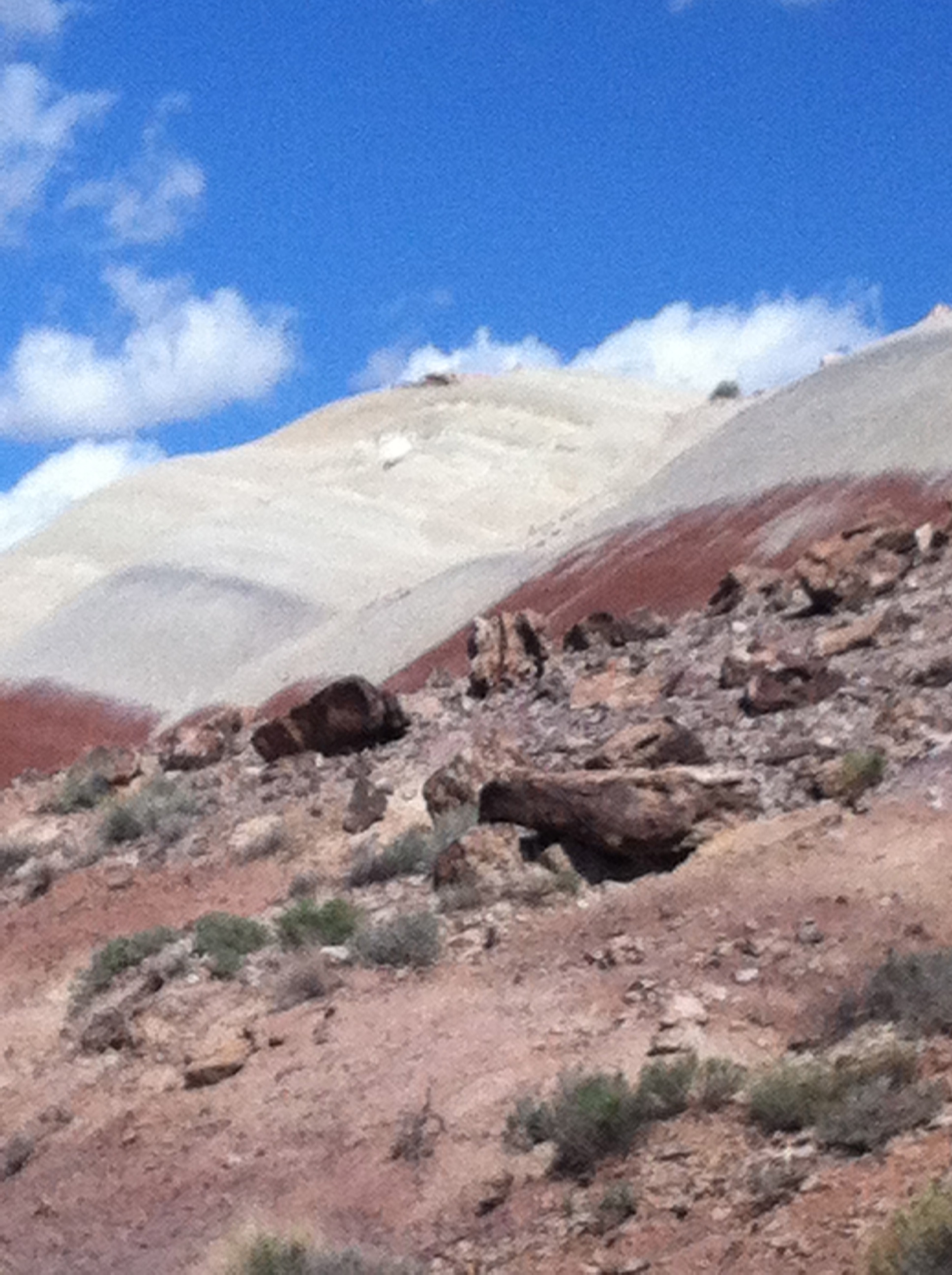
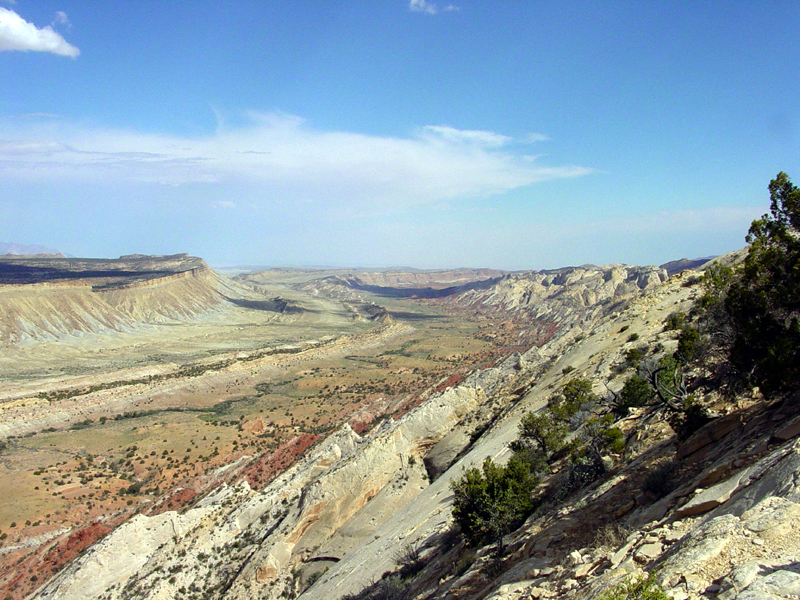
We’d driven the long, gravel Notom Road down the eastern side of the park, then turned on the Burr Trail, a 35 mile road that climbs through the Waterpocket Fold of Capital Reef on steep and narrow switchbacks.  The fold is an upheaval of layers of the earth along a fault that’s almost 100 miles long and that reaches over 2500 feet (it used to reach over 7,000 feet).  David and I had hiked the Upper Muley Twist Canyon the day before, which follows the wash of a river through the spine of the fold after climbing to the top, providing incredible views of the jumbled rocks stretching north and south.

Photo from Wikipedia

“We were on the Upper Muley Twist trail yesterday,” I told the ranger.  “Well you were hiking illegally,” she said.  We hadn’t really engaged in civil disobedience, I thought but didn’t say, because there were no signs saying the trail was closed.  Instead, I told the ranger I felt a moral obligation to continue to hike as planned, in spite of the national park closures, because I truly believe the parks are public land and that the public can’t be denied access.  David talked to her about his vision of national park protests and sit-ins by older Americans, the people taking back the parks.  “You’d need to pick a more well-known park than this one,” she said.  She argued with us for a few more minutes, but then started suggesting other hikes that wouldn’t be illegal and asked us not to continue with our protest right then and there by continuing to hike, “because then I’ll have to arrest you and take you to jail all the way in St. George, and that’s not going to be fun for anyone.” 

IMG_1861

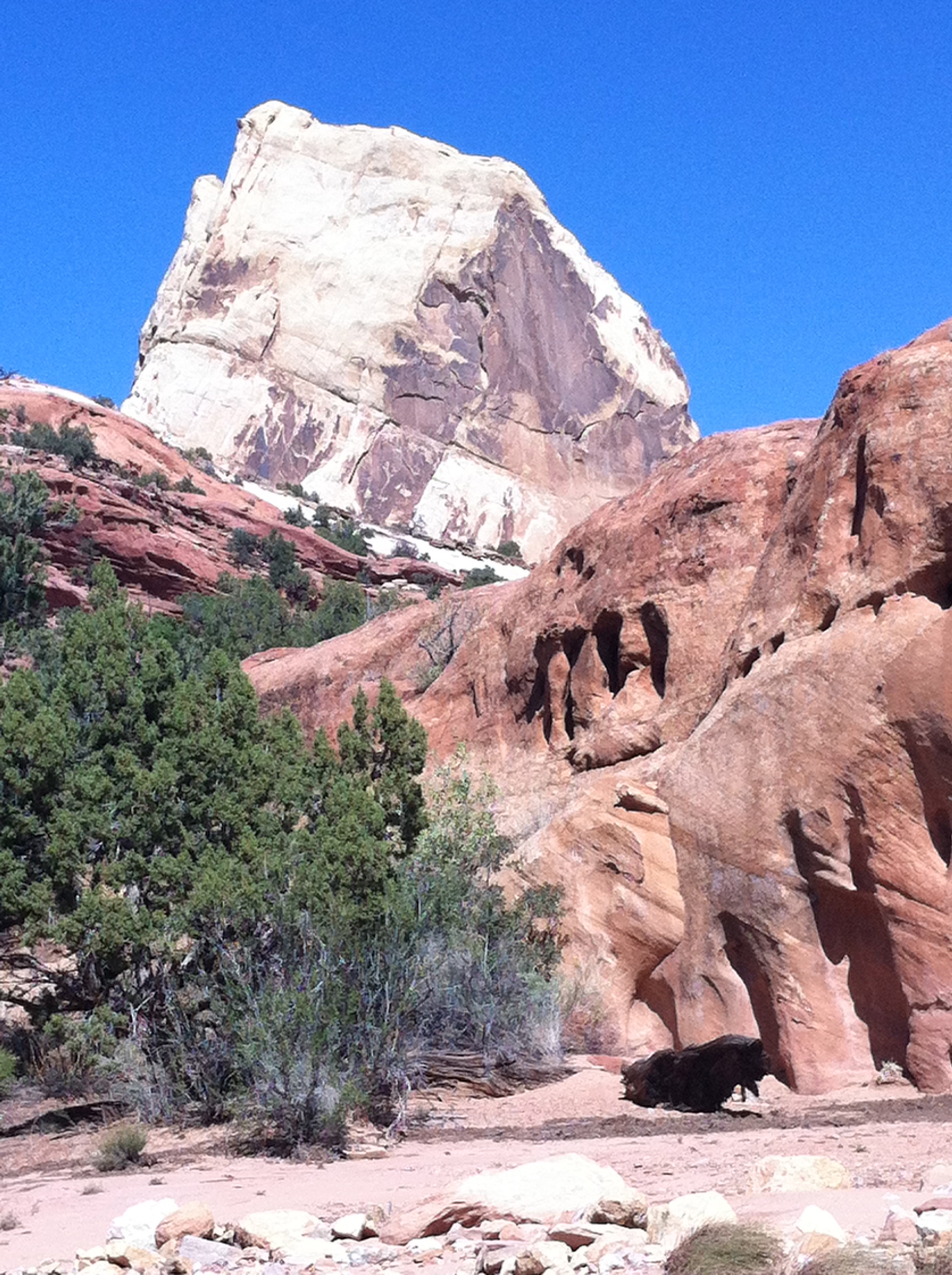
The ranger was reasonable, she was only doing her job (without pay), she was listening to us and she was nice.  We didn’t want to ruin her day, and we didn’t want to spend the weekend in jail (which the ranger had told us would likely happen if she did arrest us) so we left, after thanking her for working without pay.  We drove back down the Notom Road to Cottonwood Wash, another river bed that runs west into the Waterpocket Fold, and walked up through a series of unimaginably varied, colorful and angled rocks.

We’d shifted our plans and decided to do half of the long drive back to Santa Fe yesterday, rather than a 10 hour drive today, so we came to Durango, Colorado last night.  We’d heard it’s a wonderful town (it is) and the drive was spectacular, with the widely varying landscapes we’ve come to expect on this trip, including a long descent through a red canyon, 1,000 foot walls of Navajo sandstone rising on either side of us, and dropping us at a northern edge of Lake Powell where the Dirty Devil and Colorado Rivers flow in.  Towards the end of the drive we got into more familiar looking mountains, forested with spruce and colored russet and golden with the changing foliage of oaks.

IMG_1891

We expected an interesting and charming town, steeped in cowboy culture, which we found.  What we didn’t expect is that this weekend is the 25th anniversary Durango Cowboy Poetry Gathering.  Last night after dinner we walked into the Strater Hotel and listened to cowboy poets reading and singing and telling stories.  All the men were wearing cowboy hats and all the poems rhymed.

The next four days in Santa Fe don’t include plans to visit national parks, so our days of civil disobedience might be over.  Or maybe we’ll get back to New Hampshire and start organizing in a park people have heard of.  A sit-in at Acadia next weekend?

What Counts

wabi_logo

Several months ago I read a column in Poets & Writers magazine about the bounds of realistic ambition for a writer, or more specifically, for a poet.  The writer of the column made a point I make a lot — how many people have ever heard of those we poets consider famous?  Almost no one.  This was made very real for me recently when Sharon Olds, a neighbor of sorts, won the Pulitzer Prize, after winning the T. S. Eliot prize a few months before, and the local daily paper made a big deal about it, as they should.  But a friend who is deeply involved in and interested in the arts had never heard of her.  Really?  Yes, really.

As a poet I’m used to a small audience, both at poetry readings, and in terms of readers. Even widely published and celebrated poets have a very small audience in our current culture.  If you touch one person with a poem, the column author I read several months ago asserted, count that as a real success.

I’ve been back out in the world with The Truth About Death, giving readings, one of which was in far northern Vermont, at the Galaxy Bookshop in Hardwick, Vermont, The Town That Food Saved.  (It’s a very groovy little town, at the epicenter of Vermont’s grow local, eat local food movement.)  The local weekly paper had requested a review copy of the book, so I sent one off.  I was delighted by the review one of the staff wrote.  “Most people would not be excited to pick up this book,” the writer begins.  “Such a depressing subject, what can she say?  But this book is so well crafted, the poems so tight and intimate, that it is exciting to read.”  Not only did the reviewer praise the book, she got it.  “Some of the poems are elegies to lost love, but many are fierce as the author courageously faces a new reality, a world without a part of her soul.”  

As happy as this review made me, I was even happier when the editor of the Hardwick Gazette came to the reading and immediately approached me.  I thanked him for printing the review.  “I read the book too,” he said.  “I lost my wife two years ago, and your book really spoke to me.  I’m buying one for a friend who lost her husband last year.”  After the reading a woman bought a copy to donate to the local hospice program.

Yesterday I did another reading and again sold a few books, one to a woman who is giving it to her friend whose son died several years ago.  Two readings in two weeks, a total of 20 people at the readings and 10 books sold.  Not very big numbers.  But in those numbers is one man who was truly touched by the book, and hopefully at least a couple others who’ll see something of their own grief journey in mine, and realize that there is a way to navigate that difficult path.  That’s what counts.

Retreat

IMG_1401

I’ve been on retreat, “an act of moving back or withdrawing,” or “a place of privacy or safety.” Retreating, or creating an actual retreat in the midst of every day life, is a powerful way to get creative priorities back in line. Or back to the beginning of the line.

When I left the Coalition almost two years ago, I’d imagined a life with writing as the organizing force, the central focus of what I had to do.  Everything else would fit in around it.  That has been so totally not true.  Valuing writing, valuing spending time  expressing my creative impulses whether or not that expression ever leads to publication, or praise, or whatever it is that might make it somehow count, is still unexpectedly difficult.

But at least I’m spending more time with other writers who all struggle to some extent with the difficulty of getting to the desk and getting words on paper.  I have lots of sympathy for my constant battle to push back the dailiness which can easily fill a life — grocery shopping, cooking, gardening, hanging photos and paintings up in the kitchen and hallway we had painted a year ago, visiting friends and family, training for the next tri, answering email, cleaning the old running shoes out of the bottom of my closet, a task I’d thought would be done within a week of leaving my job — and put my writing first.  “Writing is my job,” a novelist I met last summer told me.  “It comes first, every day, then I get to the other things that need attention.”  Good for her, but how do I do that?

Last week a group of my writer friends and I went on a writing retreat.  One of the women has a sister with a second home in Manchester, Vermont, who was happy to have us use it as a writing base.  After an afternoon and morning of more concentration on writing than I thought I could possibly muster, I said to one of my friends, “This is such a good reminder that going away to write, making space for that, getting to a place where all I have to do is write, really makes a difference for me.”  “It makes a difference for all of us,” she said.  “That’s why so many writers do it.”

Of course.  I keep thinking there isn’t any reason I can’t just sit down at my desk for four hours, or three hours, or five hours, or even 15 minutes, every single day.  But really, there are literally hundreds of reasons to keep me from doing that, every single day.

Sitting in a screened gazebo on a deck overlooking pastures sweeping down to the Battenkill River and up the Equinox Mt. ridge, I spent hours and hours last week, working on poetry.  I woke early the first morning we were there, after an afternoon of writing, and had to get out of bed and get to work.  I couldn’t wait to get to my poems.

Now I’ve been home a week and I’ve still been writing at least a bit every day, some days quite a lot.  Retreating at home is harder, but not impossible.  And one thing I fit in this week was making plans for the next actual retreat.

Razor Life: Seven Years Later

IMG_1352

Seven years ago today Eric died, on a glorious, sun-drenched day.  The forsythia was blazing, warm air drifted through the open windows and the maple buds were dropping their red skin to let the green leaves out.

Six years ago I wrote this poem, on another day of spring sunshine, the forsythia bushes in the neighborhood bringing me full circle to the season of loss.  Finally, I was understanding Eric was really gone, and that holding on to life, while honoring his loss, might just be possible.  “Razor Life” is the penultimate poem in The Truth About Death.  It’s not an easy poem, it’s not an easy book, but it’s the truth as I lived it.  A sister poet recently reviewed the book on Amazon and Goodreads and said “grief is palpable, yes, but so is the skill of the poet . . . this is not a romantic look at death, but rather a blunt and powerfully raw assessment.”

That assessment now includes knowing the rawness of grief does ease, the razor edge softens, and days march on and on whether we can keep up with their beauty or not.  A few days ago I came upstairs to find a swallow flapping in front of the big windows in my study, the room where Eric died.  It had flown in the small opening of our shaded bedroom window and moved towards the light.  David helped it fly out without any harm.

I still watch swallows  against the sky and the cows are already out in the pasture across the road.  Everything changes; so many essentials stay the same.

Razor Life

The pastures are green again, right on cue,
the cows will be out in days. I steal lost time
to meet you, where the train runs into the river,
it’s dark and we move fast, forsythia flashes
gold in our yard, the neighbors’ yard, the bush
in the cemetery on the hill, the catbird who sang
above the blooming lilac in the weeks of desperation
on the porch after you died, you died, you did,
swallows high in the blue, their bellies white
as they turn. I am back to watching the sky,
we still have a car for everyone, we drive a lot,
I talk all the time, the machine is working,
it’s everything will be okay and ah fuck
at the same time, all the time, my razor life.

Spring Pleasure Preview

IMG_1278

Traveling south this time of year, into a spring far advanced past its current muddy incarnation in New Hampshire, is a treat.  David and I were in Knoxville, TN this weekend, to be the support team for Sam and his friend Mike as ran they ran their first marathon.  Besides the pleasure of being with two smart, strong and very funny young men as they pushed their bodies pretty much to the breaking point, there was the delight of sunny days with temperatures in the 70s, and lines of dogwood trees showing off their white blossoms against blue skies.  I’m ready for more of that, right here at home.

As we crossed a street on Saturday evening, littered with fallen petals, I thought of this poem, from years ago, realizing I will probably never stop noticing how trees shape-shift through the seasons.

Rising

What is the weight of a flower, the weight
of a tree bearing such blatant intent?
Every mass of blossoms, snow cloud,
exclamation, exuberance of fruit
to come, has a future, a history,

a moment of abandon, petals
splayed wide, drawing pollen to the core.
The wilt and decay towards apple
is hidden in new leaves, riches spent,
riches returned, petals salting the grass.

March Flowers

This slideshow requires JavaScript.

Any blossom in March is a blessing.  The pink geranium and oxalis plants have been with me for five years now; out on the porch each summer, back inside to winter over and send out flowers as a counter to the monochrome tones of winter.

But already there’s color in the hillsides of hardwoods, the faint blush of the buds just beginning to let go, responding to the lengthening light.  Here’s a  poem from year’s ago, that wonders about that color and what we see of light and dark.

Consequence

What if you failed to notice
low sun on the south trunk of the maple,
its shadow side already drifting

to dark, the horizon ready to assume
the indigo hue of the hillsides
of hardwood, winter tight buds?

We’re only given one run
at the sequence of consequence
that stems from noticing or not,

from being in the woods past dusk,
watching the sky grow grey,
laced by black maples.

Above Tree Line: February

This slideshow requires JavaScript.

The winter world on Mt. Washington’s eastern slope was in black and white on Tuesday, when David and I fulfilled our intention to get above tree line for February.  We hiked into the alpine zone at the base of Tuckerman’s Ravine, on a wide well-packed trail.  Before we left on our hike we could see we’d be hiking into the cloud cover over the mountain.  The view above tree line was of snow, cloud, and dark spruce trees below, mounded with white.  The monochrome day reminded me of a poem from years ago.

Absence or Everything

Moon laced through cold
curtains, the world
in black and white
since the last storm.

Glass feathers freeze,
skin seeks skin, vision
blurs as if walking
into winddriven snow.

The bedroom pinkens,
yet still, outside,
monochrome
trees, fields, fences, sky.

Once Again

IMG_1180

“Look at that tree,” David said.  We’d been following the snowmobile trail that runs past our house for several miles, the fresh snow well packed for our cross-country skis.  “It looks like a tree in England.”

The oak tree does look like many of the trees we saw as we walked across England last summer.  Sitting at the edge of a yard bordering an open field, the tree stands by itself, which is common in English pastures — a single tree with an unimpeded crown, standing grand and full, left to grow on its own for decades and decades.

I know this oak tree, and in fact have been so stuck by it I wrote a poem about it many years ago.  The poem asks a question I’ve yet to answer.

Once Again

If there’s an oak I recall
from year to year for the fineness
of its winter crown against dusk sky
as I climb from woods to cross
the Bailey’s fields, its branches a black
articulation against last light,
do the scars of the intervening year,
matter, all those months without considering
this simple view, now new
and long remembered all at once?