
A friend once said “your poems are like photographs.” What I see goes in to words, translated through what I think, how I sort language to get the image I want on paper. Now I’m trying it without words. And loving it.
Words & Images
A friend once said “your poems are like photographs.” What I see goes in to words, translated through what I think, how I sort language to get the image I want on paper. Now I’m trying it without words. And loving it.

A not uncommon conversation for me over the years: What are you going to do with your journals when you die, or before you die? What instructions will you leave for whether or not they can be read, by whom, when, what can be shared? Or will you destroy them all at some point?
A poet friend records current events and notable weather in her journals, because she plans to leave them to be read and she figures that’s what people will want to know about — what was happening in the world, not in her head.
Which is what my journals are full of. There’s some recounting of events, but much of it is I’m anxious, I’m worried, I’m upset. . . blah, blah, blah. Another poet friend admits the same. “My journals are blah, blah, blah over and over.” Not that the blah isn’t important, it is to us, that’s why we’re writing it. But it probably would be boring to most other people, and would paint a false picture, anyway.
When my mood is mostly even and good I don’t journal much, I do it when I’m confused, when something is upsetting me and I need to figure it out. I write in my journal when I’m anxious because the act of getting worrisome thoughts on paper loosens their uncomfortable grip a bit. I’m honest in my journals about all the ways I’m quirky and irritable and over think the shit out of way too much.
So do I want anyone to read all of that? Would anyone want to? I’m talking serious numbers of journals — 82, including my blue plastic bound Ponytail Dear Diary with a brass lock (key long gone) from grade school.
Jon brought me three of Chris’s journals last week. He wondered if I wanted to read them. He doesn’t want to right now, though he wants to keep the journals. Do I want to read them? Should I? I’ve peeked in to them and so far haven’t read anything that I didn’t hear Chris talk about or haven’t read in her essays. Chris didn’t hide her feelings and worries and struggles. I loved that about her, her honesty about all of life, the joy and the hard road of living with metastatic cancer.
Chris took journaling classes in her last years, and in one she made a cover for the journal she was using. It’s beautiful. Right now it’s at the top of the journal stack on the side of my desk. I love looking at it. I don’t know if I’ll read it.

If you include healing meditation in your daily meditation, which means calling to mind people who need healing of some kind and repeating phrases like, “May they be safe, may they be healthy, may they be peaceful, may they be free from suffering,” you’re supposed to start by first calling for those things for yourself. So I do that, and one of the things I ask for is gratitude. “May I be grateful. . . . ” So, today I’m grateful for:
There is so much more I could list, but this is what came to me this morning over the course of those 9 miles.
I am so lucky.


I send writing prompts to three friends every Monday. It started as a way to help a friend who wants to be writing more in order to remember things about her husband who died last year. Then a writer friend talked about not writing right now and wanting to, so I offered to include her in the prompts. When another friend saw the result of a prompt I’d sent the second friend, she wanted in too. So, I’m up to three.
But today has been an off one for me. A nagging dread has kept me from falling into mindful/mindless absorption in making a collage, or reorganizing my study or fiddling with poems. Is it that I’m working on my memoir, writing about a particularly difficult patch in the months after Eric died, a part of the story I haven’t told yet, which means reading those journals again and living with some of that pain present? Not that it isn’t present on some level anyway.
I was having trouble coming up with a prompt for my friends until I got in the shower late this afternoon and started scrubbing at the nasty scrape I got on my knee when I tripped running last week. It hurt, I started to cry, and I thought, ah, the prompt. Write about the last time you cried and why.
I remembered the side of Chris’s face swollen with scrapes last spring and I cried more. I’d talked to Chris the day before and she’d told me, “I’m not having a very good day.” She’d fallen that weekend out walking with her family and was sore and discouraged. The next day she and Jon came to visit unexpectedly, arriving while I was at an appointment. When I got home and went out on the back deck to greet them I had to suck in my shock. Chris looked so banged up and battered, with red scratches covering one side of her face. Battered by cancer.
In the shower I thought about how much physical limitation Chris had to live with, and then she still died. I cried. I cried because I’m close to a lot of people who have a serious illness, love someone with a serious illness, or have lost someone to illness. I cried because the list of people I include in my healing meditation every day mostly die rather than get better and then I include on the list those left grieving. I cried because my knee hurts and is taking a long time to heal and interferes with much of what I want to do.
Then I turned off the shower, dried off, dressed my knee and sat down to write. To myself and to my friends.
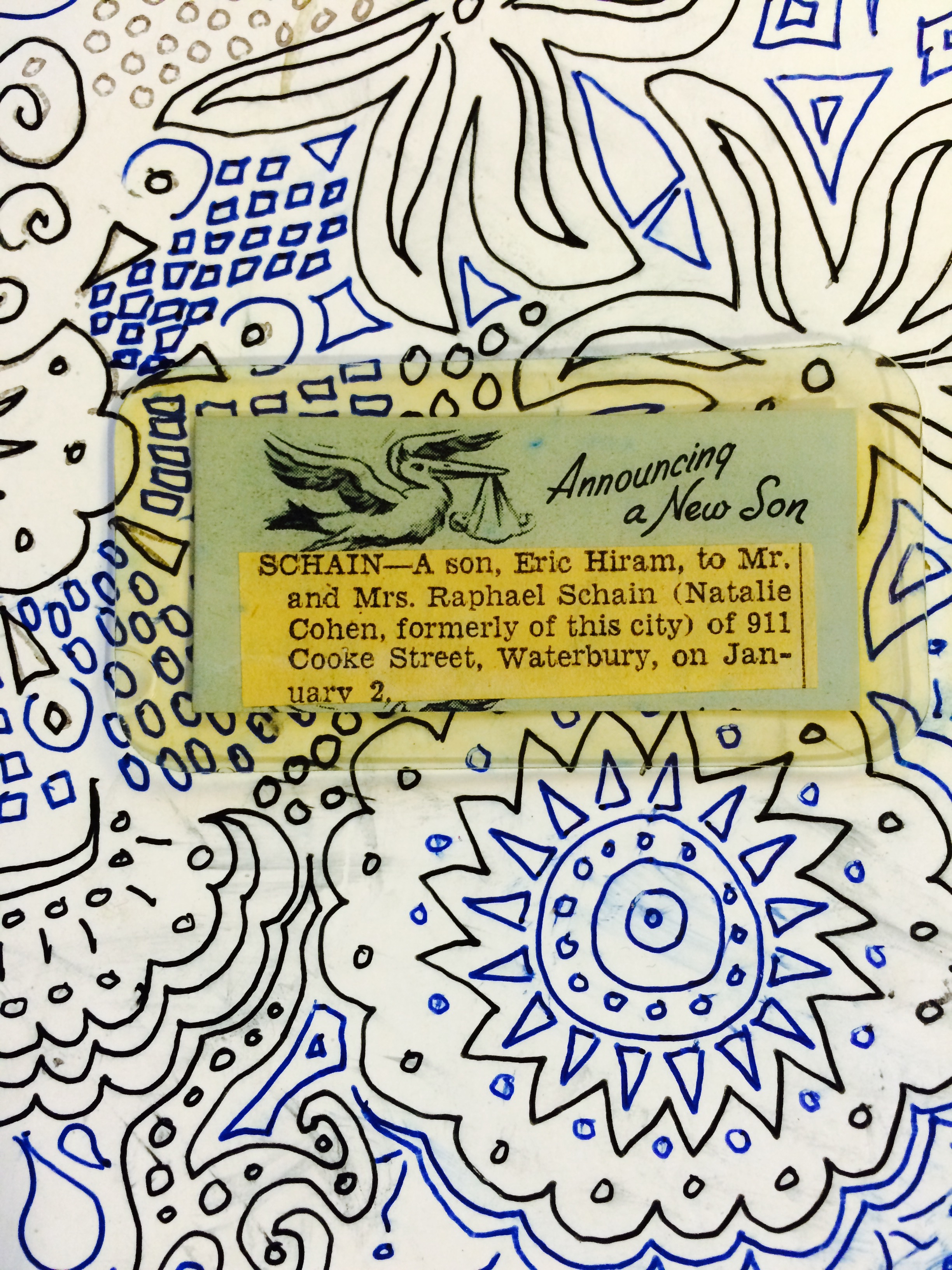
Announcing a New Son
SCHAIN — a son, Eric Hiram, to Mr. and Mrs. Raphael Schain (Natalie Cohen, formerly of this city) of 911 Cooke Street, Waterbury, on January 2.
On the back of the thickly laminated clipping, “Thank you for giving a cerebral palsy child the chance
to walk –
to talk –
to play.
Clipped from New Haven Conn Register”
I found it in an old hutch that I moved out of my study to make way for the new desk. The cupboard was full of VHS tapes — Adrienne’s dance recitals, Eisner Camp summers, professional trainings. The top drawer was stuffed with napkins (Eric often ate while he watched TV in this room), paperwork and power cords from long forgotten small electronics, two ancient, fancy calculators the kids needed for high school math, one gutted to its plastic shell.
The birth announcement was in the drawer, along with a child’s tooth wrapped in a note with handwriting I’m almost positive is mine.
Dear Tooth Fairy,
Mat would like a gemstone rather than money for his tooth. Thank you.
Was my nephew Matt staying with me when he lost a tooth? I don’t remember that but it’s certainly possible. But why didn’t I know how to spell his name? Do I know a Mat? I put the tooth, wrapped back in the note paper, in the box on my bureau with my kids’ teeth. What else could I do with it?
Cleaning up clutter can be an archeological experience. Mother’s Day cards back to the 90’s, diaries and journals that go back to 1964. I must have taken my 1967 diary from my sister Jeanne. Her name is written in the front and there’s a bunch of torn out pages between March 20 and April 20. I take over on April 24th.
April 26: Wed. Dear Diary, Boy, am I depressed. Paul never pays any attention to me anymore. I was president today. I think David likes me. I’m sure Morse hates me. Today at play rehearsal a kid commented on my weight. I wish I weren’t so ugly. Oh well, I’m miserable. Luv, Gracie
I was president? Hot shit. But of what?
I still had a crush on Paul in my 1968 diary.

The wind was gusting over 30 mph when I pulled in to the driveway late yesterday afternoon. Drifted snow, blown off the fields to the west, covered the path to the porch, I had a full car to unload after a long weekend in New York and I was late for a conference call.
I tromped into the house through the snow, sneakers covered in white and leaving wet footprints on the kitchen floor. Earbuds in place and the conference call on mute, I put on my thick down jacket and Winnie-the-Pooh hat that wraps down around my cheeks and chin, pulled on windproof fleece mittens, and shoveled a path to the car as I listened to the meeting. Unloaded. Hurried out to the woodpile before it got dark to throw a day’s worth of wood into the barn because our stock got depleted last week. It was a night for a fire.
Later, dinner done, sitting by the fully throttled wood stove and catching up on email, I realized I’d yet to do my Grind small poem collage for the day. All I could think of was the wind, whipping away any heat the house managed to collect, especially in our bedroom, which faces north-west, directly into the battering gusts. I could feel the house shake and listened to the wind beast trying to break into the house, a constant roar accented with long howls
I sent off a quick, tiny poem to my Grinder group, then went upstairs to make a collage. It was just barely warm enough in my study to work. The images emerged, the words changed, and David and I gave up on the bedroom and slept in one of the beds at the back of the house, under double down comforters, as far from the wind as we could get.


Text with images has been brewing in my creative imagination for a long time. I want to make visual art, I’ve wanted to for years, and having worked with words for so long any visual art that incorporates words attracts me. Maybe I could do that. Touring museums I’m drawn to paintings and collages that incorporate text. Graffiti tags intrigue me, with their interlocking and mostly indecipherable letters, an alphabet more visual than textual, a signature that’s image.
It’s not that I’ve never worked on a visual level. When I was much younger I did small watercolor paintings copied from children’s books but haven’t painted since. I’ve cross-stitched samplers that I designed myself, transformed a denim skirt into a tapestry of crewel work, and knit countless sweaters, hats and mittens, creating designs with different color yarns as I go. When Emilio was younger and obsessed with animals I drew horses and cows for him, which I was able to do by carefully looking at the plastic animals he played with. If I’m at a meeting without knitting my doodling fills whatever margins are available.
But moving in to intentional visual art work as a legitimate use of my creative energy has been hard. Who am I to paint or draw or make collages? A question that makes no sense, because who am I to write poems or a memoir or a novel? Does having been published make writing more legitimate? What about all the writing I do in my journal, the novel I wrote and have never looked at since, the boxes and boxes of writing stored in my barn and my new file drawers that I’ve never tried to get published, much of it never taken past a quick first draft?
So I’m pushing the questions aside and finally giving myself permission to be visual. The transformation of my study to incorporate an art desk is well underway, and I’m not waiting for that to be done to get working.
I’ve been faithfully Grinding for over a week and each day I’ve made a collage to hold the words I’ve written. In fact, for the last two days the image has come first because I’ve been writing erasure poems, a process of crossing out words on a page of text and making a poem from what’s left. The erasure itself is part of the image.
How absorbing this is! Absorbing enough I’m not worrying about what it’s for, who am I to do it, what it means, what it is. I’m just doing it.

I’m Grinding in January. I’m also going to write a “small stone” every day. What is Grinding, what is a “small stone” and why do they work together so well?
Having written about both on this blog before, maybe you know. But here’s a refresher. The Grind is a monthly commitment to writing that poet Ross White organizes. You pick your genre and get put in a group of 10 or so other writers, get each other’s email addresses, and then are responsible to send a new piece of writing every day of the month by midnight of whatever time zone you’re in. You don’t provide feedback or even acknowledge what you get sent. That’s not the purpose of the Grind. The purpose is to write every day and having a group of strangers expecting your work in their inbox, even if they never read it, helps.
It more than helps. For me, it works. This is my seventh Grind in the last two years and it does make me write. Every day. A good thing always.
In January 2012 and then again in 2014 I joined the challenge of writing a small stone every day, reminded to do so both years by sister blogger A Woodland Rose. A small stone “is a short piece of writing that precisely captures a fully-engaged moment.” The bloggers at Writing Our Way Home believe that small stones “help you connect to the world, in all its richness & complexity & juiciness. When we translate something we’ve seen or experienced into words, it is necessary to pay more attention than we usually would. A few minutes of mindful attention (even once a day) helps us to engage with the world in all its beauty.”
The party I was planning to ring in the New Year isn’t happening. Instead I’m navigating another of those left turns that seem to come up in my life regularly. My mother’s in the hospital recovering from a fall due to a stomach flu and David and I are in Massachusetts helping to sort out next steps in getting her healthy and home.
So instead of cooking and decorating and welcoming a group of close friends to eat and drink and be merry together, I’ll be talking to doctors and eating hospital cafeteria food and driving my father back and forth to the hospital. And hopefully getting my mother set up to recover fully at home.
My New Year celebration will be writing every day — a small stone to share with this month’s Grinding pals, and most likely with all of you. Stay tuned.

December 18
Guitar music comes up the stairs. David is playing. He hasn’t painted since April. I’m building a standing art desk next to my writing desk, a space to turn and make things with materials, not words, colored papers and pens and boxes of cards and catalogues I’ve been collecting for years to use for collages.
Which means emptying a book case so I can run the new desk into the corner. Already my date books are in a box in the barn. Next go my journals. What do they say?
March 6, 1979: I confront Jim, a nasty and misogynistic roommate who lived with Eric and me in a house we rented from Lynne Cherry in Marlborough, CT. Lynne sometimes spent a night or two there, had slept with Jim one weekend, but now she was angry at him, he hadn’t paid his rent. She asks us to talk to him so I do.
I don’t back down when he tries to placate me. At one point I just kept talking back at him, wouldn’t shut up – making him face my anger & he told me to leave his room – we had a stare down & he couldn’t budge me – I loved it.
One journal has no date on the cover and my entries don’t even have the day of the month: saturday evening, sunday evening, thursday, saturday early afternoon, friday, the next tuesday may 24 – ah, a date. Still no year and no upper case letters. I think it was 1977. Who needed to know the day of the month in 1977? Not me.
I write a lot about writing. Needing to get possessed. Art desk.
December 19, 2015
When I sit on the end of my bed to put on my shoes, I see a Great Blue Heron on the other side of the far farm pond in the cow pasture. A really big one.
Then I quick catch yet again that it’s not a heron. It’s not Eric. It’s the tall stump of a small tree that blew over two years ago, the wood bent forward in a thick figure of a heron. Eric isn’t in every heron, though seeing a heron fly overhead or standing in water makes me think of him.
This summer when I was home from being with Chris for a few days a heron stood in the intersection of Canterbury Road and West Street for about 30 minutes. It didn’t move, other than to swivel it’s head. A car went by, in the lower part of the intersection several yards from the heron. The car stopped, then went on.
I kept watching. The heron stayed so long I stopped watching. Then I decided I wanted a photo and went to get my phone and a truck came and needed to make the turn up Canterbury Road and the bird lifted and flew away.
Chris has a story on her blog about a heron seeming to follow her one day, and thinking about herons are how Eric comes to me. The winter she learned she had cancer in the lining of her brain she was scared, but she told me Eric had visited her and been close and that felt comforting to her. She wonders about magic — Birds are special; they can fly, they can soar and they can also put their feet on the ground. Birds connect heaven and earth.

I count in my head and have for as long as I can remember. When I swim in Long Pond in the summer, I count 20 strokes breathing to the right, then switch, 20 to the left. When I cut carrots for salad I count the chops of the knife — one, two, three, four, five. I memorize the numbers on license plates of cars in front of me. I count the holes I poke in the dirt with my finger, getting ready to plant beans. I count stitches as I knit. I track my runs and walks and bike rides with an app on my phone then write down the distance on my calendar. I count my inhales and exhales when I meditate, when I hold a pose during yoga.
What does this say about me? That I’m a poet who pays attention to the rhythms in my life? One summer several years ago I wrote 14 sonnets, because a sonnet has 14 lines and I wanted to create the symmetry of 14 x 14. Working in the traditional form, I counted beats in the lines. I spent much of the summer tapping with my fingers as I moved through my day repeating lines from the poems in my head, working to get each line to ten syllables of iambic pentameter. I can’t write a poem without some order to the number of lines in each stanza. Really, I can’t. If a poem just won’t take that shape, I take out the stanza breaks and let the poem run on.
What does that say about me? I like order but I also like disorder. Writing a poem orders the world and also enters the disordered perceptions that make up a moment, roaming among the associations that make meaning of a collection of words. Adherence to a form, even if it’s a form I’m imposing rather than a traditional sonnet or sestina or villanelle or triolet, makes me work harder to make the sense make sense.
I think. And now I’ve counted these words and I’m at the number I’ve decided I’m going to write each day for these two weeks. So I’m done.
 Grace Mattern