Parents Always

IMG_3903

One of the first things David and I agreed on when we met was “the kids come first.” Falling in love in your 50s and 60s is complicated for many reasons, and how a new relationship will play out for your children can be one of the trickiest.  Luckily for us, it has worked out well — our kids get along with each other and with each of us.

Good thing, because no matter how old your children, you’re still their parent.  Maybe even more so when one parent has died.  That fact and the glorious foliage this morning got me thinking about this poem I wrote at least 20 years ago.

PLAYING CATCH

The boy at the bus stop
tries to break his record of ten
leaves caught falling
from the maple,

leaves yellow as butter
cupping foggy morning light.

Not only leaves stir in the fog;
crows rattle branches, muzzle loaders
pock the morning with shots,
bus doors yawn open and shut,

children leave, come home,
leave again.

Instructions From Chris

FullSizeRender (1)

The memorial service for Chris was Saturday.  Over two years ago when she was planning her service, she asked me to read a poem as part of it.  I did.

Instructions From Chris

“You could use this poem,” my sister says
when she asks me to read at her memorial.

She’s reread my book, found more darkness
than she wants, she knows people will cry

but even so, she’d prefer a celebration, more
ideas than despair. “This one towards the end,”

when grief first starts to curve away
and my sisters appear, musical, muscular hawks,

long, strong wings, a slice of sun.
I understand. She wants her own poem.

She is second of four, the smarter, prettier one
I could never catch, a life in preview.

But I do no better than what’s she’s written
herself; the space created when a book is lifted

from the table, an opening that fills with shadow
and chance, quickening, quiet. I delete, start over,

come back to her smile as she carries her hope
and illness before her, a globe in her hands.

I toast bread, open a jar of her strawberry jam, ruby
sugar, red as magic slippers, no place, home.

Home

Lee Krasner, The Seasons, 1957
*Portion of The Seasons, Lee Krasner, 1957, Whitney Museum of American Art

A steady clack comes out of the bedroom where the plastic pull knob on the cord for the blinds taps the sill, pulsing in the wind through the window opened to get air into the house.

Sunshine glints off the screens in the four large windows in my study, screens that will come out in the next few weeks.

There was a frost while we were away, nasturtiums drooping on themselves, the basil brown and wilted.  Was it last night?

Cows still graze the pasture across the street, framed by a branch of the old maple sprouting yellow, orange and red.

When I got home this morning I opened my journal to write about our last few days — all the places and family we’ve visited, the historic First Parish in Concord (this is the congregation Emerson and the Alcotts were part of, where Thoreau’s memorial was held) to meet with the minister who’ll be involved in the memorial service for Chris, the astonishing America Is Hard To Find exhibit at the equally astonishing new building now housing the Whitney Museum, watching Ava clap her gold moccasins together and laugh, fitting the pieces of a table-top-size Spiderman together with Emilio, last night in a Rodeway Inn off the traffic circle in Greenfield, MA, a former Howard Johnson’s with a glass shelf of spectacular crystal rocks behind the check-in desk that the clerk said no one knows the history of, this morning’s drive in pre-dawn darkness into the hills to the west and then east again into autumn smoke rising from rivers and dew — and instead I drew a map, with the buildings and skylines and houses we’ve visited, lines with arrows tracing our route, and then connecting the words when I began to write with language.

Is art hard to find or hard to find the time for?

For the first time since the beginning of July, I’m home with no immediate plans to be anywhere else overnight.  What will I find the time for?

* From Whitney exhibit description of the painting above:  This monumental painting offered Krasner an outlet during a time of deep personal sorrow.  The year before, her husband, fellow artist Jackson Pollock, had died in a car accident.  In the wake of this sudden loss, Krasner remarked about The Seasons, “the question came up whether one would continue painting at all, and I guess this was my answer.”

Memorials

photo (51)

Chris died on Thursday evening as the family gathered around her, including David and I, took turns reading aloud from the Tao Te Ching.  We got home Friday afternoon, just before the long-planned arrival of Carol, my friend who lost her beloved life companion to cancer last winter.  As she came in to the kitchen Carol asked, “Are sure you’re ready for company?” and I said, “I’m ready for you,” because I knew we could both dive right in to talking about death and dying and grief and how do we move on in the face of sorrow and the absence of someone we love dearly.

Our friend Deb arrived the next day and we kept talking and cooking and crying and eating and coloring in my Crazy Paisley coloring book.  Yesterday morning we went for a walk out to the rock where I’ve been building cairns as a memorial for Eric since he died.  I told Carol and Deb the story, which I’ve told here on this blog, about the cairns accidentally being knocked over while the woods around the rock were being logged last summer, and how badly my neighbor who owns the land felt about that.  He erected a stone cross as a way to continue my ritual of using the rock as a memorial site, and also because he’d begun to use the rock as a place to remember and honor his father.

As we walked Carol told me she was looking for large, flat rocks to use in the memorial garden she’s creating for Steve in her yard in Delaware.  She’d shown us pictures earlier of the mosaic sculpture that sits among plantings of perennials and shrubs.  I started looking down as we walked, hoping to find stones she could use.

When we reached the rock with the cross and the beginnings of cairns being rebuilt by me, I stepped up on the top to put a couple more layers on the cairns.  From that vantage I could see that many of the rocks from the previous cairns had fallen in to a cleft in the middle of the rock, piled in a jumble waiting to be reassembled into towers.  There were a half-dozen that were large and flat, some speckled with tiny flakes of mica.

I asked Carol if she wanted any of the flat rocks for her memorial garden and she loved them all. So Deb, David, Carol and I walked back out of the woods carrying rocks, heavy but manageable.

Now Carol has taken rocks from Eric’s memorial cairns back to Delaware to become part of Steve’s memorial garden, and I’m carrying memories of Chris as I help make the arrangements for her memorial service.

It was a sad and glorious weekend, with striking blue skies and sharp air, gusty wind and sunshine glinting on the leaves of the trees, beginning to rattle with autumn dryness.  We looked at photos of Steve and Carol and me and my sisters and talked, talked, talked.

Getting ready to build again.  I’m going to start a cairn on the rock for Chris.

Today

IMG_4141

This is the day my grandson started kindergarten

This is the day the latest heat wave ended.

This is the day I tried to pick enough apples off my Golden Delicious tree so the branch that’s draped all the way to the ground can lift again.  A large branch has already broken off the tree, too much apple weight.  I didn’t succeed.

photo (7)

This is the day I discovered the garden spider is gone, an egg sack left dangling from a bar of the wrought iron trellis the nasturiums climb.

photo (8)

This is the third day my sister hasn’t eaten or taken liquids.

This is the day my grandson started kindergarten.

IMG_4129


We Don’t Have Time To See the People We Love

rio_307954c
Photo from http://www.thetimes.co.uk/

Crossing the lobby of the grocery store I heard someone call, “Chris?  Chris Mattern?”  At the Mattern I turned around.

There was my cousin Sally, who lives in NH but who I haven’t seen for at least ten years, though we trade holiday cards and I recently sent her a condolence card when her mother, my father’s older sister, died.

“I’m Grace,” I said and she said, “Of course.” Sally is wide and beautiful and smiled as she pulled me in to her large bosom.  I told her how sick Chris is and she said she’d called her three months ago, to tell Chris about her own recent diagnosis of lung cancer caused by a genetic mutation, did she think there could be a connection between their cancers?  No, no connection and Sally is doing well.  She just finished chemo and radiation and is going into a clinical trail with a drug targeted to her mutation, a promising development in cancer treatment.

That’s the seventh new diagnosis of cancer among people I know this summer, two of them in their 20s.  And now Oliver Sacks has died of ocular melanoma, same as Eric. Oliver was in the 2% of people expected to have his cancer metastasize.  Eric was in the 10%. Spectacularly unlucky, in that regard.  Chris was in the 10% of people expected to survive her cancer for five years, 24 years ago.

Here was the one in who-knows-how-many chance that I’d run in to my cousin at Hannaford’s.  We had a lot to say to each other and at first didn’t notice people trying to manuever around us to get shopping carts.  We moved out of the way and kept talking.  It was nice to talk to someone who had the same grandmother as me.

When we said good-bye we told each other, and ourselves but I don’t believe we believed it, that we’ll get together this fall, our other cousin from my father’s brother has a vacation house close to Sally, we’ll have a little reunion.

That evening I told David about running in to Sally, and how it would be nice to see her again, to connect with cousins because I see a cousin about once every five years.  He laughed.  “We don’t have time to see the people we love.”

He’s right, and it’s not that I don’t love my cousins, but it’s in a cousin way that turns in to long stretches between connections.  Sally and I were in a hope warp, thinking new time would open up in our lives and we’d be able to make real plans to visit.  But don’t we do that all the time, imagine that our lives will expand into another dimension with infinite opportunities to love all the people we love in person and even add in more?


We Made An Ocean

IMG_3811

“I want to make an ocean,” Emilio said over a month ago, when I was talking to him on Facetime about his upcoming trip to New Hampshire for our family vacation.  I’d asked him what he wanted to do during his visit and expected the answer to be “swim, play baseball, play basketball,” — all activities he’s always eager to do.  I was surprised he had a project in mind.

“How will we make an ocean?  Will we need paper and colored pens, scissors, glue?”  I  envisioned some sort of construction paper creation.

“No, just water and food coloring.  We’ll put blue and green color in the water and then put in animals and it will be the ocean.”

“What will we make it in?  A bucket?  A glass?”

Emilio shrugged.  “Anything.”

We didn’t make an ocean when he was in Northwood in July.  We were busy doing what I’d expected — playing in the water at Jenness Pond, hitting the wiffle ball over the roof of the camp we rented, lying belly down on the dock and looking for fish, playing Sorry! on the screened porch.  The ocean project seemed to be forgotten.

Friday I went with Adrienne to pick up Emilio from his school.  On the way home I asked, “What do you want to do this weekend, Emilio?”  Again, I expected a list of games and sports.  Instead?

“I have a project in mind.”

“Oh, what’s that?”

“We’ll make an ocean.  We’ll put blue and green food coloring in water and put in animals and it will be the ocean.”

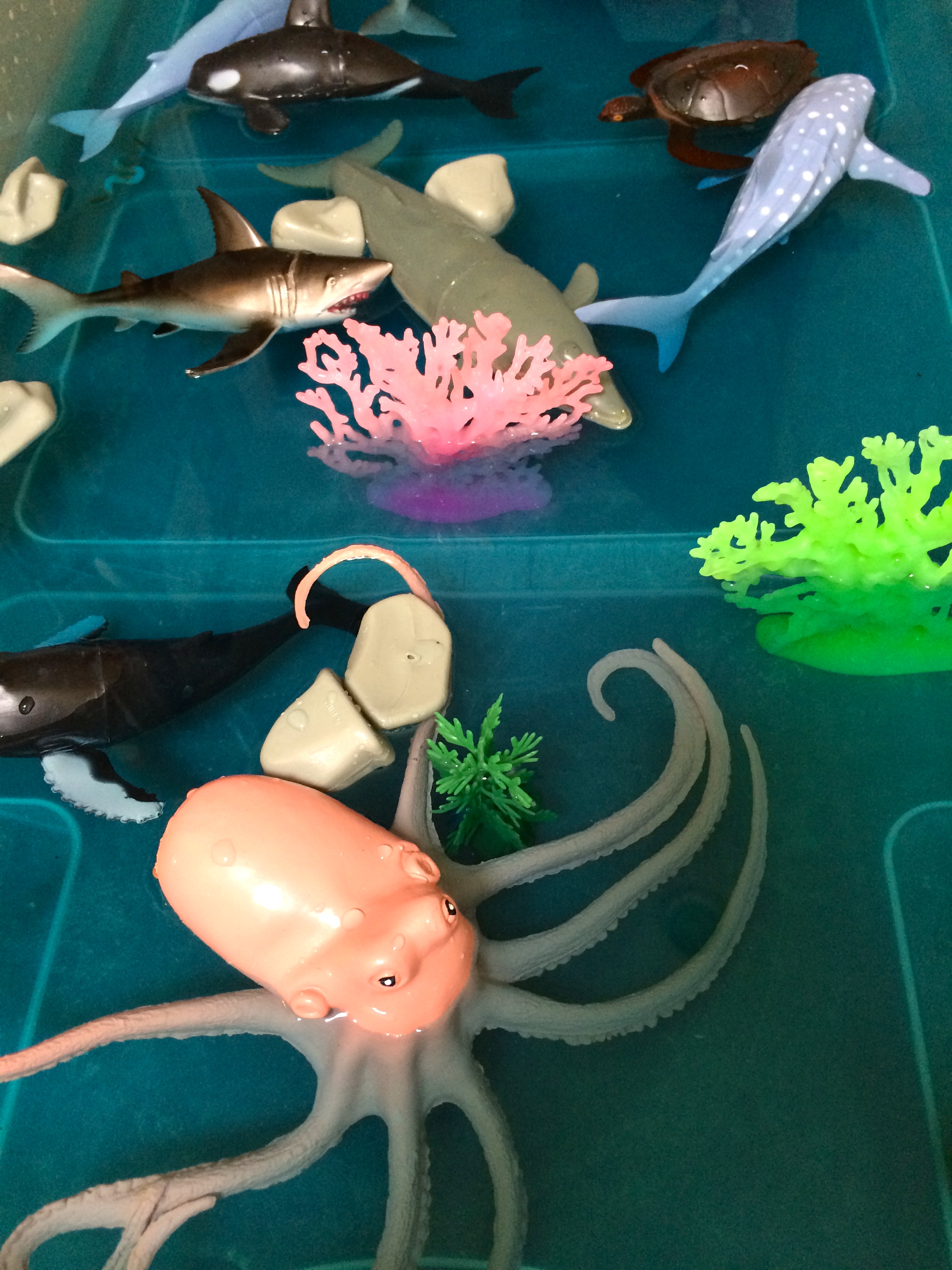
So today we did.  We started with the bucket a set of ocean animals came in, but once we’d filled it with water and mixed in the food coloring, watching the dye swirl into clouds of blue and green, then piled in all the animals, the bucket was so full there was no room for the whales and sharks and octopus and turtle to swim.  So Adrienne got out a long plastic tub and we poured the first ocean in then made more.  Water, blue, green, swirl, animals and rocks and coral and seaweed.

IMG_3825

Kitchen Floor Ocean.  It’s a great place to spend a summer afternoon.

Zinnias & Sisters

IMG_3797
Zinnias with garden spider

Bold and bright, sturdy and upright, zinnias have long been a favorite in my garden. They’re simple to grow, add splashes of magnificent color and vary in their design — from a single row of petals surrounding a protruding center of yellow stigma florets, to a dome of overlapping petals making a smooth surface of blossom.  These very different shaped flowers often come from the same plant, which is puzzling but delightful.

Zinnias are so not fussy and so satisfying.  White, chartreuse, orange, scarlet, peach, pink, fuchsia and lilac and too many shades in between to name.  Every year at least half my flower bed is devoted to them.  The summer Adrienne and Matt got married I grew extra. The table decorations at the reception were glass globe vases of zinnias, and there was at least one zinnia from my garden in each bouquet, a sweet touch. My sisters and I put the bouquets together the morning of the wedding, pulling stems from the florist’s buckets, and then one or two from my supply.  Jeanne, Chris, Meg and me, working together to decorate a happy day.

It was time for our family to have a happy day.  Eric had died two years before and Adrienne, quite wisely, had resisted my pleas those two years before to get married right away, have a baby, make something good happen.  As it turned out, everything happened exactly when it seemed it should, following the natural cycle of sorrow and recovery and beginning to understand how life flows on in its unrelenting dailiness, marked again at some point with bright days of joy, splashes of zinnias in a garden.

Yesterday I was home again from several days with Chris and her husband Jon.  Jon has been sorting through decades of photographs and gave me a picture of my sisters and me from a happy day several years ago, the four of us in a clear frame with the word “sisters” in varied fonts inscribed in silver around the photo.  I propped the photo in my study so I can see it from my desk, and went out to pick bouquets for the house.  Zinnias first.

IMG_3801

Why?  Zinnias pull me into appreciation.  This summer has been tough for my family, and a whole lot more than tough for Chris’s sons and their partners and Jon and my parents. I’m there to help as often as possible and home soaking up the colors of flowers when I can, remembering the bouquets I made with my sisters.  A room full of zinnias, a garden of bright blossoms, tables with joy in the center.

Tidy

photo (50)

I was being tidy yesterday.  Actually, I was looking up, once again, the varieties of my apple trees.  I wrote it down in my gardening log years ago, and have looked it up several times in the last few years, as the run of laden trees continues.  Wanting to compare the taste of the types, I needed to look up what’s what yet again.

David’s blood pressure machine has been sitting on the bottom shelf of a small table in the kitchen for the last year, the cord to the cuff looping over the folder with my gardening log sheets.  As I reached for the folder, holding up the loop and balancing the device so it wouldn’t fall off the back of the shelf, I decided to make room for it in the drawer at the top of the table. One problem — that drawer hasn’t been cleaned out for decades.

There were old maps and menus in the drawer, five dreidels, small plastic bags of metal and rubber parts to long ago gadgets, screws and nuts and a four inch antique nail, a hand forged wedge of steel too beautiful to throw away with the rest of the mess.

And a plastic bag with an unusual assortment.  Two banister supports, some screws and a few washers, a bit of old bead twine and three green clay beads.  I remember the beads were made by Eric’s first wife, Rene, at least 45 years ago.  I don’t know why they were in the bag.

But most surprising was the human tooth, a broken molar.  Who put a tooth in this random bag?  Whose tooth is it?  Eric’s?  On the assumption it is, I’m going to put it with the baby teeth of Adrienne and Sam that I still have in a box on my bureau.  Is that weird?

I found the log sheet with the varieties of apples.  The trees were planted in 1992, thin sticks now over fifteen feet tall and so full they shade the north side of the yard and one of my garden beds.  This year the trees have enough fruit to feed us all winter if we had the ambition to store it. Working west to east, Northern Spy, Cortland, Macoun, Golden Delicious, Baldwin.  Nourishing Courtship Makes Good Babies.

Ah, babies. . . .

11811284_10155942955950014_7002740704902994795_n
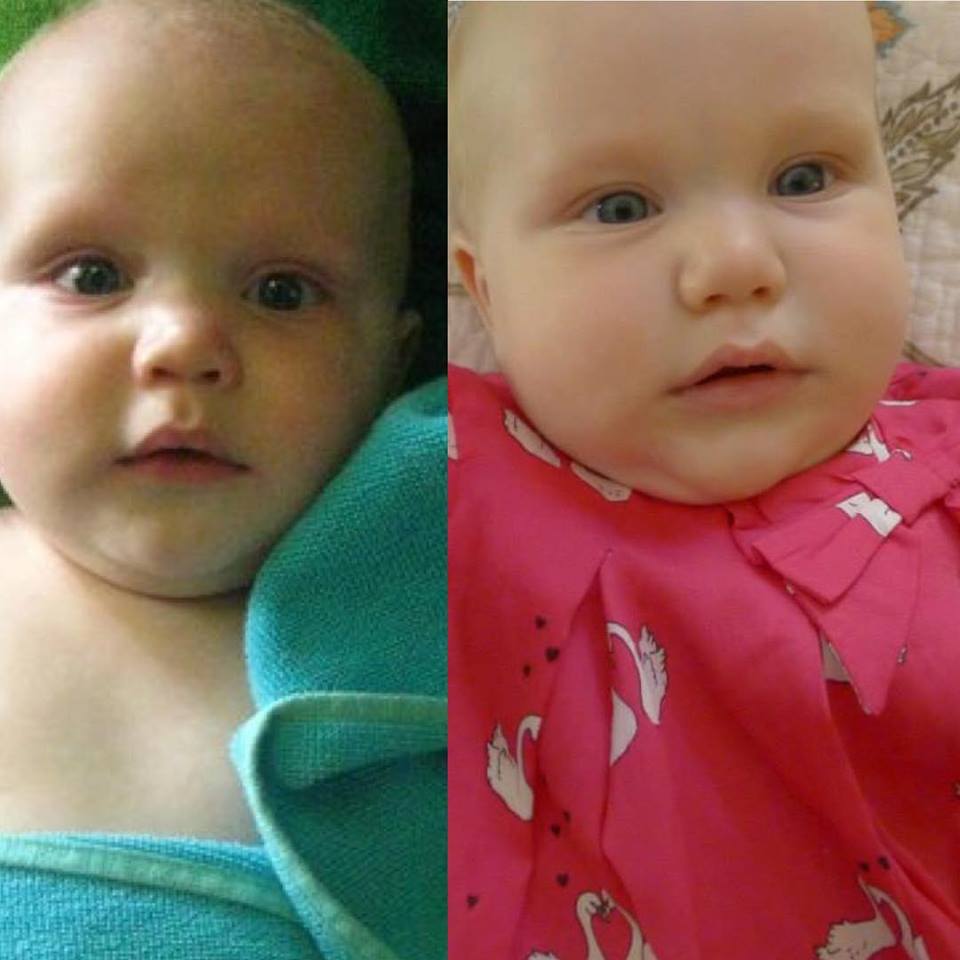
Baby Emilio and Baby Ava

Novel Camp

photo (48)

For the past week I’ve been at a writing conference, which really is more like an adult sleep away camp for people devoted to writing, whether as career writers and teachers of writing, or as a call they can’t help but answer, a passion they squeeze in to lives complicated by jobs and families and all the obligations and distractions of dailiness.

The Vermont College of Fine Arts Postgraduate Summer Writers’ Conference is a special place in the world of summer writing conferences.  I know that not only because I’ve been here twice now, and spent a week many years ago at Breadloaf for comparison, but also because others here all say the same thing.  This is where people come to improve their craft and get support for the often lonely and scary act of writing, not to show off what great writers they already are.

“This is a populist writing conference,” celebrated novelist and memoirist Andre Dubus III said yesterday during an interview with VCFA President Thomas Greene, a novelist himself.  “There’s no stratification here.  We’re all just writers and we all hang out together, whether participants or faculty.”

“I’ve been to Sewanee (one of the prestigious summer writing conferences, held in Tennessee every summer) and honestly, the work of the writers there isn’t as good as what all of you are writing,” said Andy two nights ago at dinner.  Andy is one of the writers in the novel workshop I attended, led with great enthusiasm and wisdom by Andre.

One feature of the conference is readings every night by faculty members, top-notch writers who can leave a room stunned, as Patricia Smith did after reciting a long poem in the voices of mothers whose black sons have been killed by police.  She was followed by Lee Martin who read a short story that rode a wave of mounting tension before breaking open at the end with heartbreaking clarity about the follies inherent in being human.

There’s also a participants’ reading every day, with each person having five minutes.  The writing is more often stunning than not.  “Damn, these people can all write,” I’ve thought all week as I sat and listened.

The conference feels like camp because while it’s rigorous and serious about writing as authentically and deeply as possible, it’s also a lot of fun. Everyone you talk to gets the part of you that sits down at your computer or journal or pad of paper every chance you get. You discuss and critique and listen and write.  This morning’s generative writing workshop used a table full of yard sale items as the basis for prompts to get us writing, whether poems or essays or stories or the beginning of a book. Ellen Lesser, writer, conference director and leader of the workshop, talked about the energy she could feel in the room as 40 people flashed their pens across the pages of notebooks.

I almost didn’t attend.  With Chris so ill it seemed superfluous to go to Vermont to work on my novel.  How could that possibly count as much as being with my sister and helping her family manage her increasing illness and disability?  What difference does it make whether or not I ever figure out how to knit my writing into a coherent, book-length narrative, a story that will bring characters I’ve created to life and keep readers turning the page to find out what happens to them?

The only possible answer to that question is that it matters to me, because the stories in this novel, and in the memoir I put aside last summer, are calling to me.  This week is going to help me answer that call, and to remember that the urge to create is worthy in itself.  It’s not about accomplishment and publication (though I’ll certainly take as much of that as I can get) when you get at the root of why any of us write.  It’s that we can’t not write, so we might as well get as good at it as we can.