A Good Week

IMG_2262

Last week was a good one for so many reasons I want to keep track.

  • My neighbor’s yard of riotous crocuses started to bloom.
  • The sun came out and it was above freezing.  I can’t overstate how sun-starved everyone I know is at this point.  It’s bad enough that there’s so little daylight in Northern New England in the winter (and I was in even northerner NE most of March), but when almost all of that daylight is cloudy and gray and it’s very very cold, people get cranky.
  • I not only met my Momentum Writing Goals for the week, I exceeded them.  And didn’t immediately turn that excess into new, harder to maintain goals.  A steady focus is what’s going to get this book I’m so engaged with done and I’m staying with my plan until I know a faster pace can stay as steady.
  • Three poems were accepted by the Chagrin River Review, a fine online journal I’m delighted to be part of.  Four of the five poems I sent out a couple of months ago have now been taken by journals.  Time to take another look at that fifth poem.
  • I was able to run for three miles twice.  Nursing a knee injury that’s kept me from running for months has not been easy.  Running is my go to stress reduction and standard work out.  Even I’ve been getting tired of listening to my knee complaints.
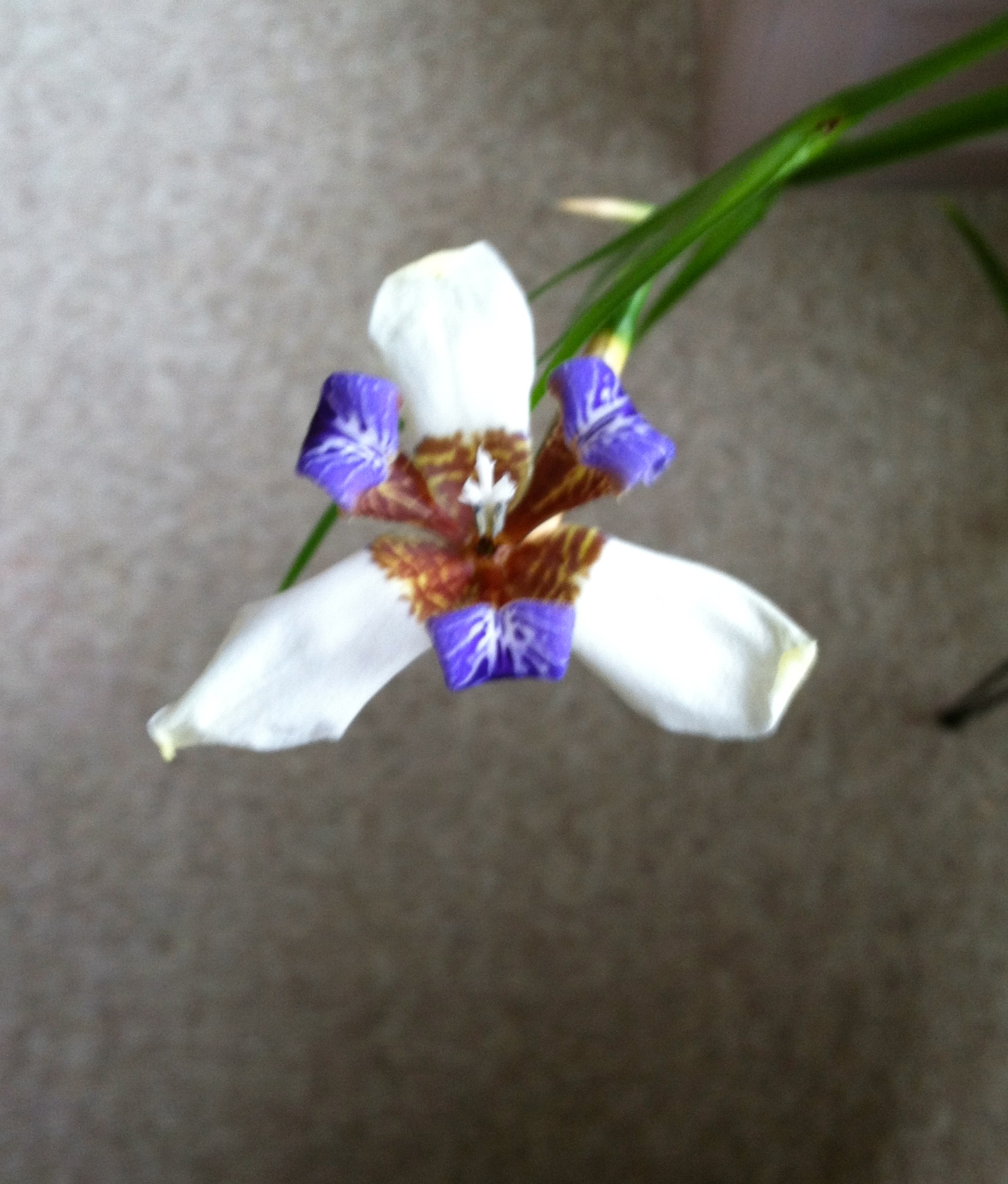
  • My houseplant that blossoms once a year for one day did its thing.  And a beautiful thing it is.
IMG_2260

I’m hoping for a repeat good week.

Momentum

IMG_2258

I’m home.  Sitting in front of the fire with a cup of tea on a raw Sunday afternoon, I’m feeling good about how I’m handling my Post-residency Stress Syndrome.  I was prepared for it, having read an article in a recent issue of Poets & Writers magazine about how hard the transition can be from the wonderfully creative and nourishing space of a residency center back to every day life.

A key point of the article is to plan how to “keep the momentum and sense of creative freedom you had at the colony.”  Vermont Studio Center has an abundance of creative freedom, which was evident at every visiting artist, sculpture and painter slide show and reading, and the slide shows and readings by residents.  The range of writing projects included free verse poetry and sonnets, novels, a book on the sound rhythms of everyday life, a book on Tibetan Buddhism, short stories, a book on food allergies, a few of us working on memoirs.  One woman was translating essays by the Austrian writer Robert Musil.  One writer was on an “emergency residency” to try to catch up to an approaching contract deadline for a novel; another was preparing publicity text and related essays for a memoir that will be published later this year, a memoir she wrote during multiple residencies over the past ten years.

And I can’t even begin to describe the diversity of the projects of the visual artists, from representational oil painting to tiny tempura paintings of single eyes and lips on individual ivory piano keys to closets constructed for an installation and filled with hanging extension cords and ropes and large empty aluminum cans and antique green ginger ale bottles.

But the most precious part of the residency was the time for my own project and how much momentum I built in focusing on my memoir.  I wanted to come home with the book fully occupying my mind, and I did.  Can I keep it up?

I have a solid plan for structured and dedicated writing time that I’ve stuck to so far.  Yes, it’s only been a couple of days, but I’m hopeful.  Instead of structuring my days around time in my studio and getting to meals, as I did in Vermont, I’ll structure my days around going into my study, shutting the doors and turning off the internet, for at least two hours at a time, at least five times a week.  And that’s just 10 of the hours a week I’m planning to devote to writing, and reading that nourishes the writing.  That total is going to be 20. And if I routinely exceed that minimum, which I hope to do, I’ll up it.

I came home from Vermont in the middle of writing a book.  Now it’s just a matter of getting from the middle to the end.

Word Count

IMG_2255

The memoir manuscript is currently at 101,800 words, though I already know a lot of those will be coming out once I get to the serious editing phase.  My word count of new writing each day over the past weeks, on days I’ve written rather than cutting and pasting what I’d already written before I came to Vermont Studio Center, and taking notes on that writing and then coloring those notes, has been 1,510, 2,508, 1,555, 1,017, 2,561, 2,034, 1,606, and 1,657.  I’m already at 2,153 today and there’s more to come. There’s a particularly painful passage in this story that I’ve been reading about in my journals and saved emails for several days now, and I want it out of my head and on to the page.  Today I care more about getting past this part of the book than I do about the word count.  But I’ll still record it.

Does this seem a bit obsessive, to be counting how many words I write a day?  I’m not alone, and that’s one of the wonderful things about being at a writing residency.  Over lunch yesterday I talked with another writer about how much we both like boxes.  She’s writing a novel in boxes.  I told her about the boxes of poems in The Truth About Death, my obsession with shaping the poems on the page to look like containers for the grief and disorientation I was pouring into them.

Then at dinner I sat with two other writers and we started sharing word counts.  One is writing a novel, another a nonfiction book.  Could we all cram another 500 words in during the hour we had between dinner and the poetry reading last night?  We did, and in fact we all went over.

Besides counting words, I’m counting the days I have left here.  Two after today. We’re all counting in some way, and we know we’re among others who count and keep track or let go and lose track.  Wherever our creative process takes us, we follow.  At least while we’re here.  That’s why we came.

Coloring A Book

IMG_2253

When I was at Vermont Studio Center in 2007 putting together the manuscript of The Truth About Death I created a map to figure out what I was doing.  My mind couldn’t hold on to the 271 pages of poetry I’d brought with me to shape into a book.  I was overwhelmed and stuck.  One morning I woke up and knew what I needed to do.  I read each poem and took notes on its images and ideas.  Then I bought colored pencils and colored — light blue for any kind of water, red for the demon, gold for death, purple for birds, a deep green for trees.  I’d been inspired by all the visual artists at VSC and understood that engaging the right side of my brain more directly would help me figure out how to shape my book.

I was right.  Once I’d colored all the pages of poem notes, I hung them on my studio wall and started drawing connections between the poems, relying on the colors to lead me to poems that would hold together in layers across the book.  It worked.  And it was fun.

So I’m doing it again.  I’m coloring.  I’ve taken notes on all the different pieces of the story I’m trying to make into a book and colored the notes according to a color key: Eric is Ice Blue, David is Vermillion, Dark Green is Anxiety/Secrets/Impatience, Blue Violet is Grief and Wildness, Time is Bluish Grey, Poetry is Orange, Love is Bordeaux Red.  I’m looking for balance — is there enough about each thread of the story I’m knitting together?  Too much grief, too little anxiety?

I put the colored notes up on the bulletin board in my studio and studied the colors. Then I started making a timeline map on a big piece of paper hanging on the wall, using the same color code to write out scenes and themes.   As I was putting the colored pencils back in their box I realized I could measure the balance of what’s going on in the book by their relative size.  The pencils I was using the most were smaller,  a natural graph. So far there’s an equal amount of grief and love in the book, a good sign I think.

Disorientation

IMG_2238

David and I get ready to go cross country skiing on the community trails a few miles from Vermont Studio Center.  Except now he realizes he forgot to pack his ski boots. He also didn’t bring his micro-spikes for walking on packed snow trails. We study the walking maps VSC provides and decide to snowshoe on the Long Trail where it crosses through Johnson.  We get to what we hope is the trail head (the hand drawn map is completely out of scale and hard to connect to where we are) and I realize I’ve left my snowshoes in my car back at VSC.  And I don’t have my hat and mittens. Luckily an extra hat and mittens are things David did pack and they’re in his car.  I put on my micro-spikes, because at least I have those.  David puts on his snowshoes.

We follow what we think is the trail, but we never see any white blazes, which mark the Long Trail, and eventually turn around.  We try a different direction on the packed road into the woods and find another parking area.  This time we find white blazes and head uphill, to what we hope will be Prospect Rock.  The map says it has a great view.

It does.  In fact, it’s a 180 degree view, so that hiking intention for March is now met.  It feels good to get something intentional done.  The Green Mountains rise up across the wide valley of the Lamoille River.  It’s sunny and warmer than it’s been for a very long time and we drink in the hint of spring.

We’ve been talking about the book I’m trying to pull into some kind of shape, and some of what’s been confusing and hard to grasp is coming into focus.  From the distance of six years, the disorienting time I’m writing about makes more sense.   How our decisions and reactions and responses to deeply felt needs and answers to those needs affected all that rippled out from that passage in our lives is clear in a way it hasn’t been before.

Spending four weeks away from home, navigating the dislocation of sleeping in one room, writing in a studio a few minutes walk away, eating in a separate building where meals include talking to what start out as 60 strangers and become a new family, figuring out where to keep my computer and books and snacks and journal and boots and toothpaste starts to feel more worth it, because it’s putting me in a place of concentrated focus on this book I’ve been carrying around as a huge intention for years.  Is this an intention I’ll start to meet more fully?  I’ve figured out where to keep my toothbrush, so the work is bound to go more smoothly now.  Right?

When David and I get back to the car, I find my hat and mittens.  They were in a bag in the back seat.

A Map to Where?

IMG_2236

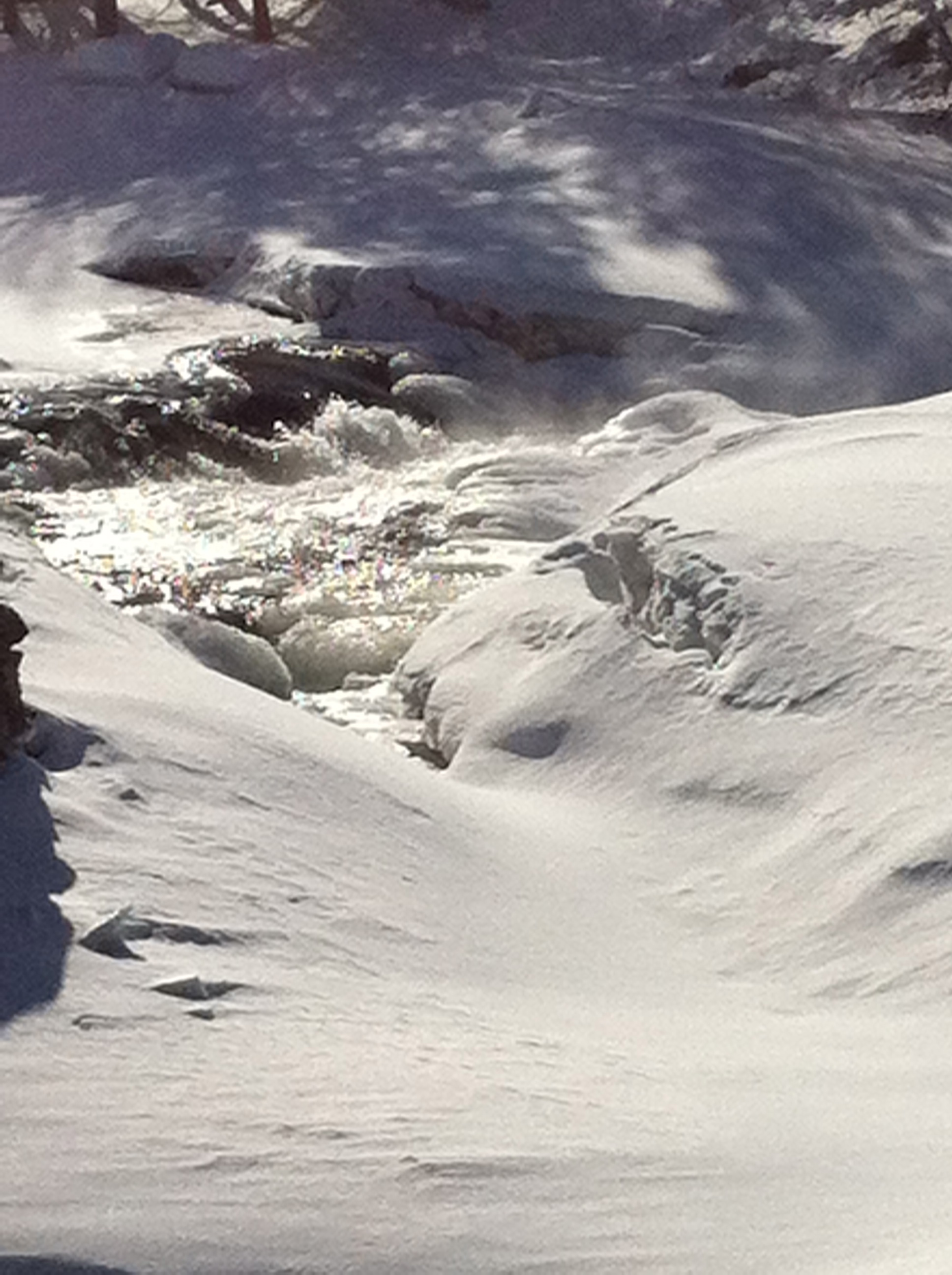
A cup of moon hung above the Maverick writing studios last night, a faint outline of its whole self filling the crescent, a pale circle hovering.  The Gihon River is a long, broad ribbon of snow between its banks, the only water bubbling through at the falls that drop past the old mill, steaming in the frigid morning air.  Bushes along the road have long spikes of red branches, blushed with new sap, though spring seems far away here where I’m waking to morning temperatures well below zero.  Vases hold twigs throughout the Red Mill building, the tips breaking out green, flowers enough for March.

An image strikes me, turns into language in my mind, I need to write it down.  This has been happening to me for as long as I can remember.  It’s why I’ve come to Vermont Studio Center for the month of March, to try to organize some of what has come out of this compulsion over the past seven years.  I was here in the summer of 2007, putting together the manuscript of The Truth About Death.  There are two more books stewing around in my brain and I’m here to try to make a shape that can hold the words that might be in those books, to figure out what those words should be.

Yesterday, my first full day here, I managed to stay off the internet most of the day and began reading and trying to organize the memoir I first started writing in 2008.  I spent much of the morning talking myself out of abandoning the whole thing.  Today I finished reading what I’ve written so far of the memoir and completed the notes I hope will help me map the book. But where will that map lead?  And do I want to go there?

Today at lunch I talked to other writers and artists who are also just beginning their months here, and found lots of encouragement to keep muddling along, to give myself time to get used to giving myself time.  I’ve given myself four weeks here to write.  Four weeks!  No wonder I’m terrified.

Visiting Poet

CareCenter reading

“I would like to invite you to be one of our guest poets here at The Center, where we have a lively visiting author program.”  Here was the email I’d been expecting since a friend had told me she’d recommended me as a visiting poet.  “We have hosted poets such as Naomi Shihab Nye, Martín Espada, Junot Díaz, Marilyn Nelson, Joy Harjo, and many more.”  “Wow,” I thought, and “Yes,” I said.

The Care Center is an educational program in Holyoke, MA for pregnant and parenting teens who have dropped out of school.  After studying the country’s most successful prep schools to learn what creates motivated and successful learners, The Care Center developed a curriculum that encompasses the arts, humanities and athletics and provides ongoing support for students.  GED plus plus.  The program works, with up to 85% of graduates going on to college.

A very popular component of the curriculum is the poetry program.  “Care Center students soon discover that poetry is a kind of self-expression that can take many forms. The most important thing is that it express something authentic about the writer’s life, perspective, or perceptions.” The visiting poet is a popular part of that program and that was me on Tuesday.

The students had studied The Truth About Death before my visit and were ready, after my reading, with insightful and direct questions which led to the liveliest post reading discussion I’ve ever experienced.  “You have a poem called ‘Drugs.’  What kind of drugs were you doing when you wrote this book?”  “In the poem ‘Sex’ you walk miles out into the woods to get it on.  Why would you do that outside?”  “How did you chose the art for the cover?”  “You said you were possessed by a demon while writing the book.  What did the demon feel like?”

I answered as honestly and directly as their questions, and there was laughter and a lot of knowing nods.  The straight forward story of grief, confusion, struggle and a yearning to stay connected to a meaningful life that The Truth About Death tells was a story these young women could understand.  It was a powerful morning of connection, and a reminder to me of how effective poetry can be in keeping us grounded in what is most essential in life — truth, honesty, and a willingness to risk expressing whatever is inside. And it was great fun.

Still Snowing

IMG_2202

I love snow, and woke to a world full of it this morning, snow piled to the railings on the back deck, a huge white hood covering the grill.  Sitting by the wood stove with my cup of coffee, the kindling I’d set on the coals flicked into flame, a burst of light through the glass door. The blush of color ringing the dawn horizon deepened and caught fire also.

All the snow in the past few weeks, the storms and the skiing, and my obsessive checking of weather forecasts, reminds me of so many winters, so many treks through deep snow, so many outdoor adventures reveling in the way a great storm transforms the fields and forests into a cross-country skiing paradise.

In the year after Eric died, I couldn’t bring myself to ski or enjoy winter.  Snow storms made me sad.  Skiing had been such a part of our lives together, it didn’t feel right to ski without Eric.  I spent that first winter watching storms, rather than celebrating them.

Recognizing how far I’ve moved from that place of paralyzed grief, I remembered this poem from The Truth About Death, which I wrote just about exactly 8 years ago.  Eric would be happy knowing I’m back to celebrating explosions of snow like the storm that rode through New Hampshire yesterday.  He would have loved this winter.  Let it snow.

Valentine’s Day

The first real storm washes out the little color
in the landscape, the barn and shed and silo
weathered to the gray of a cut snow bank.
Sparrows peck in the perennial bed, tall stems
and seed heads clustered through snow. Small storms
of snow blow up off the roof of the hay shed,
sweep past. We would ski at midnight to catch
the pure snow before the storm slipped over to sleet.
So much happens every day, I need a wagon to hold
the hole. Last night I lay on the kitchen floor,
where our cat slept for her last year, her old body
bony, weightless. I noticed the narrow maple
floor boards running under the hutch, thinking
the world is flat even as I know it is round.

Above the Rainbow

IMG_2183

The intention David and I continued into this new year, of getting above tree line once a month, or hiking to at least a 180 degree view, was doubled for February.  Not only did we hike to a view two days in a row, we got above a rainbow.

On Saturday we drove a steadily climbing and seriously winding dirt road into the Appalachian Mountains between Knoxville and Asheville to a short trail up Max Patch, a bald mountain top along the Appalachian Trail in North Carolina.  We were taking a side trip from our Knoxville vacation to visit friends in Asheville, and a detour through the mountains seemed like the perfect route.  It was.

Originally cleared in the 1800’s for pasture land, and kept open ever since, Max Patch has incredible views of the Smoky Mountains to the south and the Black Mountains to the east.  We started off on a trail around a grand slope of dried grasses,  then followed the white blazes of the AT up to the summit.  We were surrounded by mountain ridges drawing a horizon in every direction.

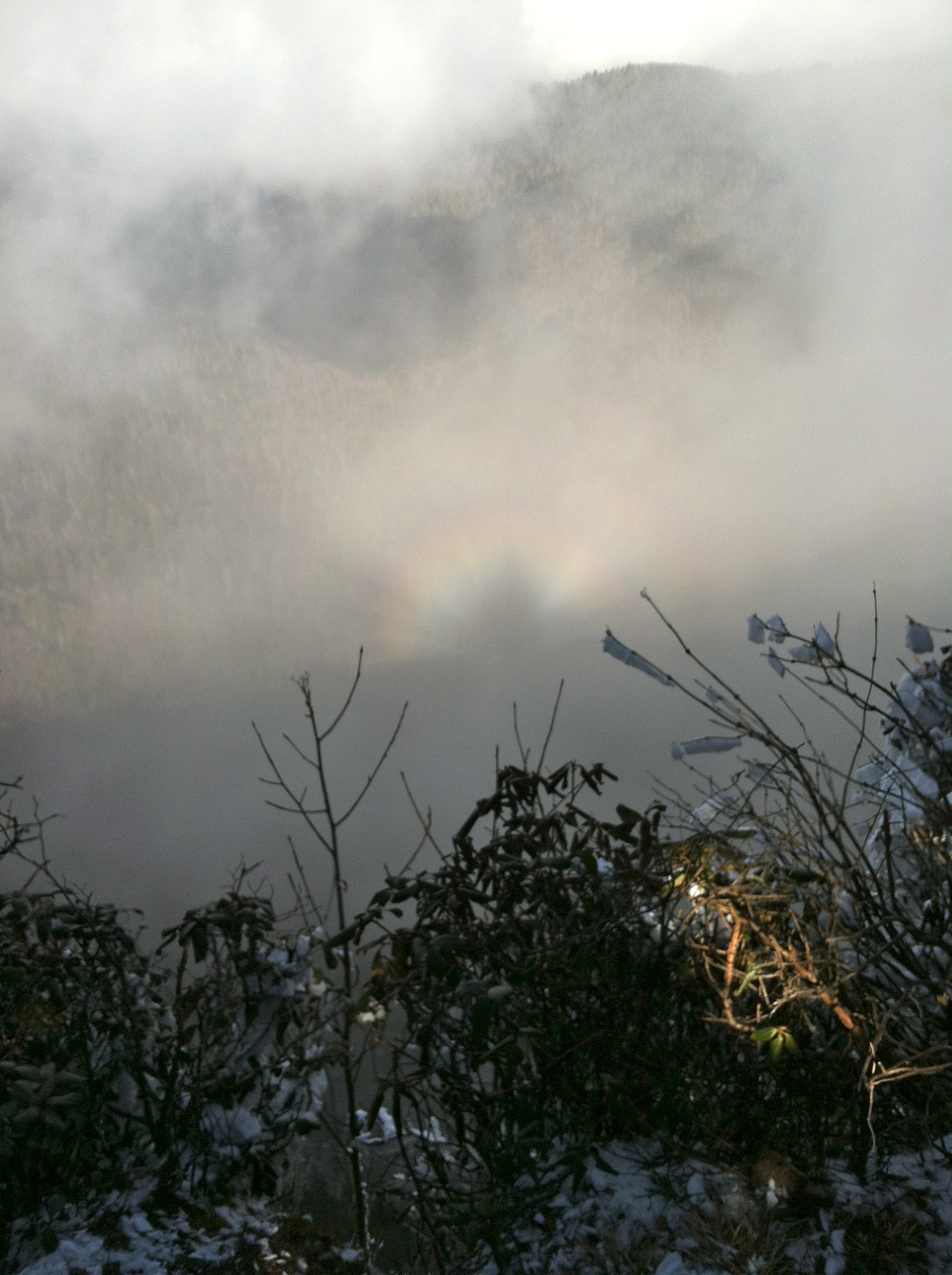
On Sunday we drove back to Knoxville through Smoky Mountain National Park, and met up with Sam and a friend at Newfound Gap.  There we followed the AT once again, this time for a few miles to a trail to Jumpoff, a spur of ridge that ends in steep, brush covered cliffs with a view of mountains to the north.  As we ate some snacks at the edge of the ridge, the clouds that had been blocking the sun off and on all day rolled into the ravine below us.  Now instead of forested mountain sides, we were looking down into a sheets of mist.  Which suddenly picked up enough light to create a circle of rainbow below us.

IMG_2193

There is no tree line in the southern Appalachian mountains — trees grow right to the peaks, even though many of them are higher than the mountains in New Hampshire.  So instead of getting above tree line this month, we got above a rainbow.  I’ll take it.

North Knox Mini Vaca

IMG_2166

Knoxville is gray and cool today, but not cold and snowy like what we flew away from. Sam lives in North Knoxville now, a neighborhood that straddles a hill between First and Second Creeks.  The streets are lined with historic houses in Folk Victorian, Queen Anne, Eastlake and Craftsman Bungalow styles, front porches set up to be three season rooms, with homes at every level of repair and restoration and dilapidation represented.  It’s an interesting area for walking, and a far departure from our usual few miles down Canterbury Road and into the woods at home.

Though this certainly isn’t a tropical beach relaxation retreat, this is a vacation, even if mini. We’re away from our ordinary routines, which opens up the days to exploration and enjoyment of the neighborhood, the fantastically-serious-about-it-all-and-getting-it-just-right K Brew coffee shop two blocks away, our books, my poetry, David’s sketching and painting, studying maps to find hikes and then hiking, yoga with a teacher who can transition from downward dog to easy seated pose by jumping and swinging her legs under her body and through her arms as she crosses her ankles in front before lowering to her sitz bones, and downtown lights glittering last night across the river from Sam’s friend’s condo on a bluff.

Now muted sunlight is making shadows on the hardwood floors of the apartment.  Time for another walk.