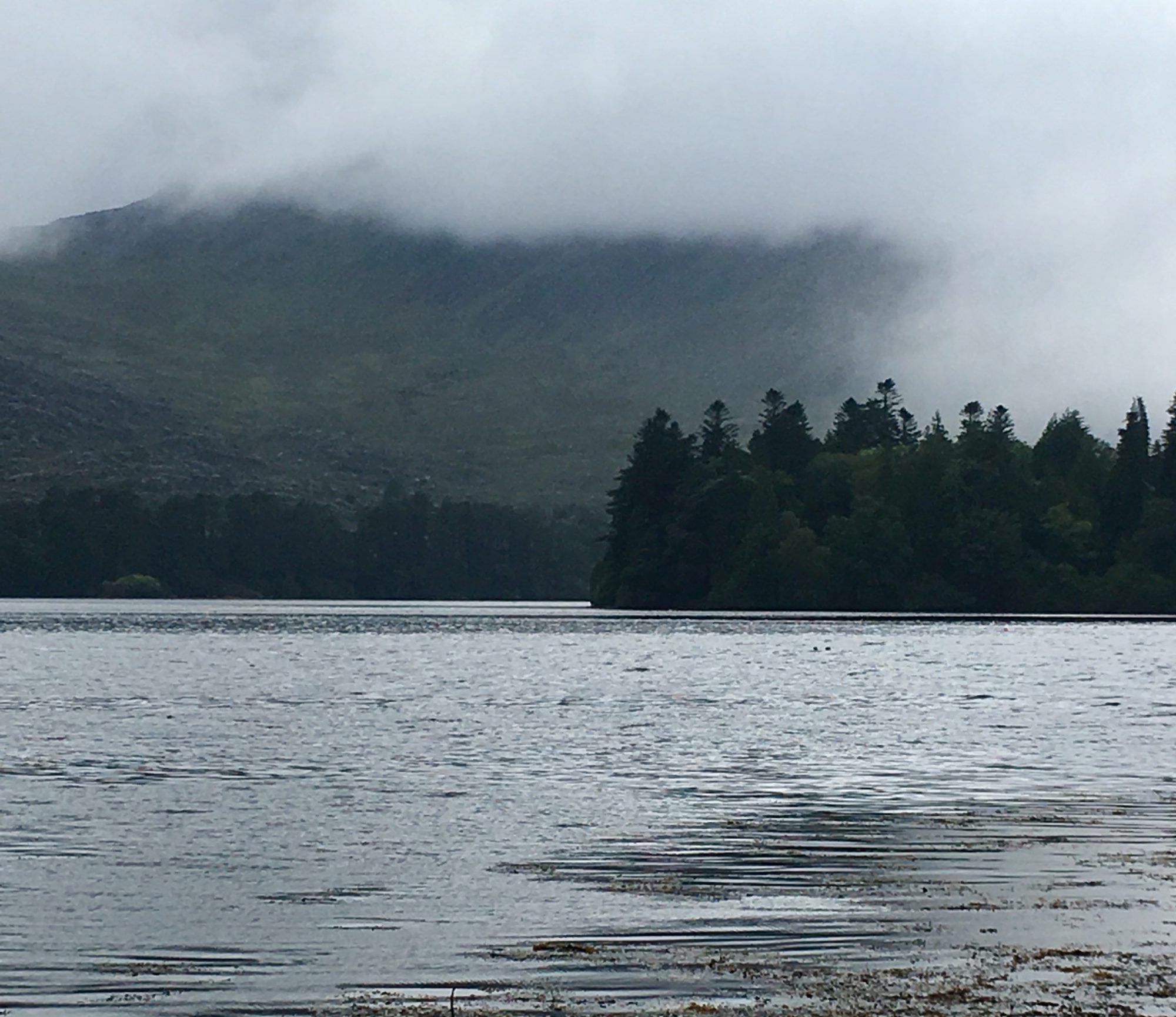
Perspectives on Walking

This slideshow requires JavaScript.

I love finding scenic places near where I live that I’ve never been before.  David and I are still walking, getting ready for that trek across England, and today we walked through Northwood State Park, crossed Old Mountain Road, and took the Parsonage Lot trail up Saddleback Mountain.   This part of the walk was familiar, but when we got to the first summit of Saddleback, we kept going, past the sign that said “To Deerfield,” a continuation of the trail I’d never walked before.

Thankfully someone has done what looks like a recent marking of the trail with orange arrows on brown boards, because this part of the trail was far less traveled and hard to see.  We pitched down a steep slope on a soft pine needle forest floor, passed through an old stone wall, and crossed granite ledge outcroppings green with moss.  Along the edges of the ledges were small hardwoods, furry with catkins.  It was lovely, and I’d never seen it before.  And maybe best of all, we didn’t get to see where the trail ends (we suspect it goes to the road on the other side of Saddleback that leads to the radio tower) because we had to turn around.  So I get to go back and see more closeby landscape I haven’t seen before.

Yesterday I went for a walk with Adrienne and Alison and Emilio, and got another new perspective on walking.  Coming back down Canterbury Road, Emilio was motoring along, his belly out, his arms pumping, his little legs lifting and cruising on the pavement.  At one point he got to the side of the road, where a solid band of sandy gravel has collected.  He slowed down, looked at his feet on the different surface, and bent his ear down to listen to the crunchy sound of his shoes on the gravel.  Then he walked purposefully back on to the pavement, watching his feet and listening.  Back to the gravel, more steps, more watching and listening.  Then back to the pavement and motoring along.  How cool, to watch that big baby brain figuring out what his feet sound like on different road surfaces.  And then go back to walking.

Early Crocuses

This slideshow requires JavaScript.

The crocuses are up early across the Northeast this year, the year with more or less no winter.  I saw crocuses weeks ago in New York, and now they’re here in New Hampshire. Helen’s crocuses, a carpet of spring  color on a neighbor’s lawn, planted decades ago by Helen Johnson when she was still alive, most likely long before I knew her when she was young, are blooming.  I wrote about the crocuses on this blog last year, including the poem about Helen and her flowers that was published in my chapbook of poetry, Fever of Unknown Origin.

Here’s another poem from Fever of Unknown Origin, this one about Norm Johnson, Helen’s husband.  Norm was a wonderful neighbor and a good friend.  He would pull his jeep over to the side of the road when he saw me in my garden and I’d go stand at his window and we’d chat.  Helen and Norman both died many years ago, but I think of them often as I look around my neighborhood, a lovely farm landscape they helped create and maintain throughout their lives.

And one interesting note, you can buy a copy of Fever of Unknown Origin on Amazon, for $3.00, or $66.00 or for $161.62.  If you want the $166.62 copy, let me know and I’ll make a deal with you.

Some Days

Stakes sawed raw at the point
slit the earth, hitting frost
only once all day, a good day,
for a body yanked by years
to this stiff heave from the cart
to help hold the barbed wire taut.

Most days are spent in a seat –
bucket loader, tractor, dump truck, mower,
these days mostly the jeep –
chatting with neighbors, napping, watching
one day as the milk herd is loaded into trailers
strangers drive away.

The Angle of Light

How is the memory of traumatic events triggered?  I’m thinking about this again, because it’s the time of year when Eric began to feel the back pain and other symptoms that we would later learn was metastatic ocular melanoma.  I remember him saying to me, in February of 2006, “I feel like I have the flu or something most of the time.”  We both agreed he was probably just tired from working too much.

Then one morning in early March when we went out for our morning run, he tapped himself on the chest and said, “I think I pulled a muscle here swimming yesterday, because it hurts.”  I remember thinking, “No one pulls muscles in their chest,” but I let the thought slide by.   Then he started to have back pain, and as it got worse and worse through March, and he had less appetite and energy, I let any thoughts about what could be going on other than a strained back and too much work also slip by.  Eric and I both knew if the ocular melanoma he’d been treated for 3 years before metastasized there would be no treatment available.  That would be it.

And that was it.  By the beginning of April Eric was still getting himself to work every day, but sleeping through much of the weekends and hardly eating.  By the beginning of the second week of April, I insisted Eric go back to his doctor (he’d had a check up just weeks before and everything had seemed fine, other than his back pain) to see if something more than a sprained back was going on.  Eric finally had the blood work he’d been postponing since his doctor’s appointment, and he got an immediate call to come back and get admitted to the hospital.  His liver and kidney functions and calcium levels were all off.  Way off.  Within 24 hours we had results from all the scans and knew his body and bones were full of tumors.  He died on May 7.

So now when the days get longer and bird song accelerates and pussy willows start to break out, I remember how all of that was happening as Eric first began to get sick.  I start to relive the days, sometimes remembering exactly what was happening on this same day, now six years ago, and it’s not easy.  The second year after Eric’s death I was talking to one of my brothers-in-law about the power of the memories as the anniversary of Eric’s death approached.

“I think some of it may have to do with the angle of the light from the sun hitting your eyes,” he said.  “It triggers the memories and brings you back to that time.”  So here I am, six years later, watching the angle of light shift as the sun gets higher in the sky each day. Today I got a card from my Temple that a couple just made a donation in Eric’s memory.  I love knowing that others are remembering him too.

Walking, A Lot of Walking

This slideshow requires JavaScript.

David and I are planning to walk across England this summer with a group of friends.  We’ll be doing Wainwright’s Walk,  a coast to coast, 192 mile path in Northern England.  To get ready for two weeks of walking between 10 and 25 miles a day, David and I have started training by doing long walks, so far walks that we can start out our door.

Yesterday we walked up roads to the top of Blake’s Hill, a rise to the south of our house.  From there we took a five-mile hiking trail created by the Northwood Area Land Management Collaborative, or NALMC, a local organization “working together across our stone walls.”  NALMC was created in part through inspiration from Aldo Leopold, a pioneer in the conservation movement and a proponent of a  “land ethic,” a holistic consideration of our actions as humans on the entire system of the environment, not just the land itself but all the animals and plants connected to it.

Getting ready for the walk, I pulled out an article I’d saved from the local free paper that announced the opening of the trail, along with a map.  It was dated July, 2008.  I’ve been waiting a long time to hike this trail.

I wasn’t disappointed.  The trail crosses beautiful open fields of Harmony Hill Farm then crosses into Northwood Meadows State Park.  The open fields rise up and down, then the trail passes through pines and hardwoods, loops around Betty Meadow Pond to the main road of the State Park, then finishes on old Mountain Road, crossing over a stream that flows out of the head waters of the Lamprey River.

When we got back to our house we had logged almost 10 miles.  I was happy to sit in the sun on the porch and enjoy a beer, getting ready for this same sequence three months from now in England.

Brooks and Prompts

Narrows Brook runs behind my house and I see it from the upstairs bathroom window, the kitchen sink window and the back bedroom windows.   I can hear the water hum from my deck or on summer nights through the screened windows.  I take a lot of photographs of this brook because I run by it almost every day I run.  I write a lot about this brook, because I’m so often prompted into my poetry through my senses, most commonly what I see, with what I hear coming in second.

In the last several months, I’ve been in a few gatherings of poets where we work with prompts — everyone throwing out two words to use in a poem, or describing the relationship between randomly selected objects, or bouncing out of someone else’s poem to write our own take on the subject.  I’m loving this.  It’s getting me out of my own fairly self-limited point of view and helping me write poems that stretch subject, perspective, images and language.

Which brings me back to Narrows Brook.  I live near it, so it shows up a lot in my poetry, and when I see it and start thinking about a poem in response, I say to myself, “it’s the same damn brook.”  Here is that line, from a poem that’s in The Truth About Death, but this last stanza didn’t make the cut.  On the blog, not in the book.  Still the same brook.

I am dutiful, it scares me, the 3. definition of demon
is zealous, skillful, diligent. I can’t stop, one for two.
It’s a choice, the dropping of the dam in spring,
the brook is full and beautiful, it’s the same damn brook.

More Moon

This slideshow requires JavaScript.

As we walked up the old wood’s road towards the beaver pond, a stream of warm air came up over us.  “Where did that come from?” Alison said and she and I backed up and tried walking into that spot again, to see if we could figure out where the warmth was coming from.  We couldn’t, but as we made our way along the new trail to the pond, the full moon through thin clouds lighting our way, more warm winds blew over us.  It felt like spring washing in.

The mild night grew brighter and brighter, as the moon got above the clouds.  At the beaver pond the moon was high above the trees and the Neville Peak ridge to our east, reflecting off the soft ice.  John identified Mars sitting to the left of the moon and we sat and walked around and chatted and delighted in being outdoors on a warm night, in a bowl of silver light.

Winter Woods

This slideshow requires JavaScript.

We haven’t had much of a winter, so there has been very little time this season to enjoy the beauty of winter woods — snow-draped hemlocks, the monochrome world of white on dark-almost-black pines, the painting of tree trunks on the wind side of a storm.  But it finally happened last week — a snowstorm.

I enjoyed it thoroughly.  I skied twice on Thursday and twice again on Friday, and yesterday David and I went snowshoeing, our first time this year.  There was barely enough snow to need snowshoes, and the storm’s drapery had melted and run off in the warm temperatures and rain on Saturday, but it was still wonderful to be out, to be sinking into the lull that comes from one foot in front of the other among trees.

We took a quick side trail off our path down to a little gorge, where the Narrows Brook curls around a steep bank.  I always marvel at this spot, because it’s less than a half mile from my house, but I didn’t find it until I’d lived here for over 20 years.  There used to be a small wooden bench here, which has since fallen over and disappeared into the wetness of this dark but beautiful spot.  Eric and I would walk or ski or snowshoe here and sit on the bench.  This lovely corner of my world shows up in one of the poems from The Truth About Death.

A Trick

Now you are the gate in, as you were the path back
to my life when I saw you after my crash, minutes
of my life I will never remember, scars I didn’t notice
when you were alive. Your eyes have moved into mine,
we notice details – a twig on snow, lichen on an oak,
gray barely begun to be green, sap running again,
a predictable trick, the course of a brook through marsh
and meadow, around shaly cliffs of a hill of hemlocks,
gravity always in play, my fall from the bike, my lost
teeth, your death, my life, prizes we never expected.

A New Relationship With Time

I think it’s happening.  My relationship with time is changing, which if you’ve been reading this blog since the winter solstice, you may remember was my wish for the new season of increasing light.

For the last decade at least, my relationship with time has not been friendly.  Time would move too fast, which seemed deliberate to me, as if the actual number of minutes and hours in a day was accelerated just so I couldn’t possibly get as much done as I needed.  And not that I didn’t get a lot done, because I did.  But mostly I did what I had to do, not what I wanted to do, though it wasn’t that I didn’t want to be doing what I was doing,  just that there was so much else I wanted to do.  What I wanted to do beyond what I had to do — write poetry and stories, read novels and memoirs and at least get a peek or two into the New Yorkers that poured into my house and mostly went unopened on the coffee table for a month or so before proceeding to the recycling pile, walk, sleep, spend unhurried time with family and friends — got squeezed in around the edges.  And very tight edges, measured in minutes if not seconds.

I can remember countless days, driving in to work, when I would say to myself, “I’ll go for a walk at lunchtime and pick up a few groceries at the Coop.”  The next time I’d notice a clock, it would be after 6:00, dark and cold, the day’s sunshine long gone, and I’d be starving and want to go home but would be facing an inbox full of unread messages.  Then a race would start, a race between me and the clock and email, seeing how much of the mass I could get through before I would give up, go home, eat a quick meal, crawl into bed and not sleep enough, and then start over again.

No wonder I sleep almost 10 hours almost every night.  I’m still exhausted.  But I can feel the pace changing if only in the fact that I have time to sleep that much.  I’m writing, a lot, even finished a novel and now I’m editing the memoir I finished 3 years ago and haven’t touched since.   My next book of poetry is taking shape in my head and in a file in my computer, and soon I’m going to be holding my first full length book of poetry in my hands.  I’m reading whole issues of the New Yorker and book after book after book.  I’m going for walks and seeing more of my family and friends than I have in years.

Now when I look up and am surprised at how much time has gone by, I don’t mind, because I’m not always working on something that has to be done right now!  Or ten minutes ago!  That horrible urgency that was like a cinder block in my chest has lifted, and I can let minute after minute after minute go by and it’s okay if I don’t get something done.  I can breathe.

Multiplicity

This slideshow requires JavaScript.

David and I did a quick tour of a few Chelsea art galleries on Wednesday, before leaving the city.  We walked into one gallery called ET Modern, with Edward Tufte books and articles and signs everywhere.   A nice man came up and handed us a booklet titled “Seeing Around Edward Tufte” and a flyer titled “Multiplicity.”

About a month ago, after hearing me talk about some of my current research interests and how to present information most effectively, David and John made sure I had The Visual Representation of Quantitative Information by Edward Tufte to read.  David has been a fan of Edward Tufte for years and has read two of his books.  A former professor at both Princeton and Yale, Tufte has been described by The New York Times as the “da Vinci of data” and by Business Week as the “Galileo of graphics.”

“Why all this Edward Tufte stuff?” David asked the two friendly men in the gallery.  “This is his work,” the man who had handed us the papers said.  “But what’s your connection with him?” David asked.  “This is his gallery,” the other man said.  “This is all his art.  This is his place.”  Delighted, David and I walked through the gallery, taking in the sculptures and video displays and installations.  I paid particular attention to the clear instructions on the wall.