
Chiming crickets swell
Under morning fog blanket
Memory of trees.
Words & Images
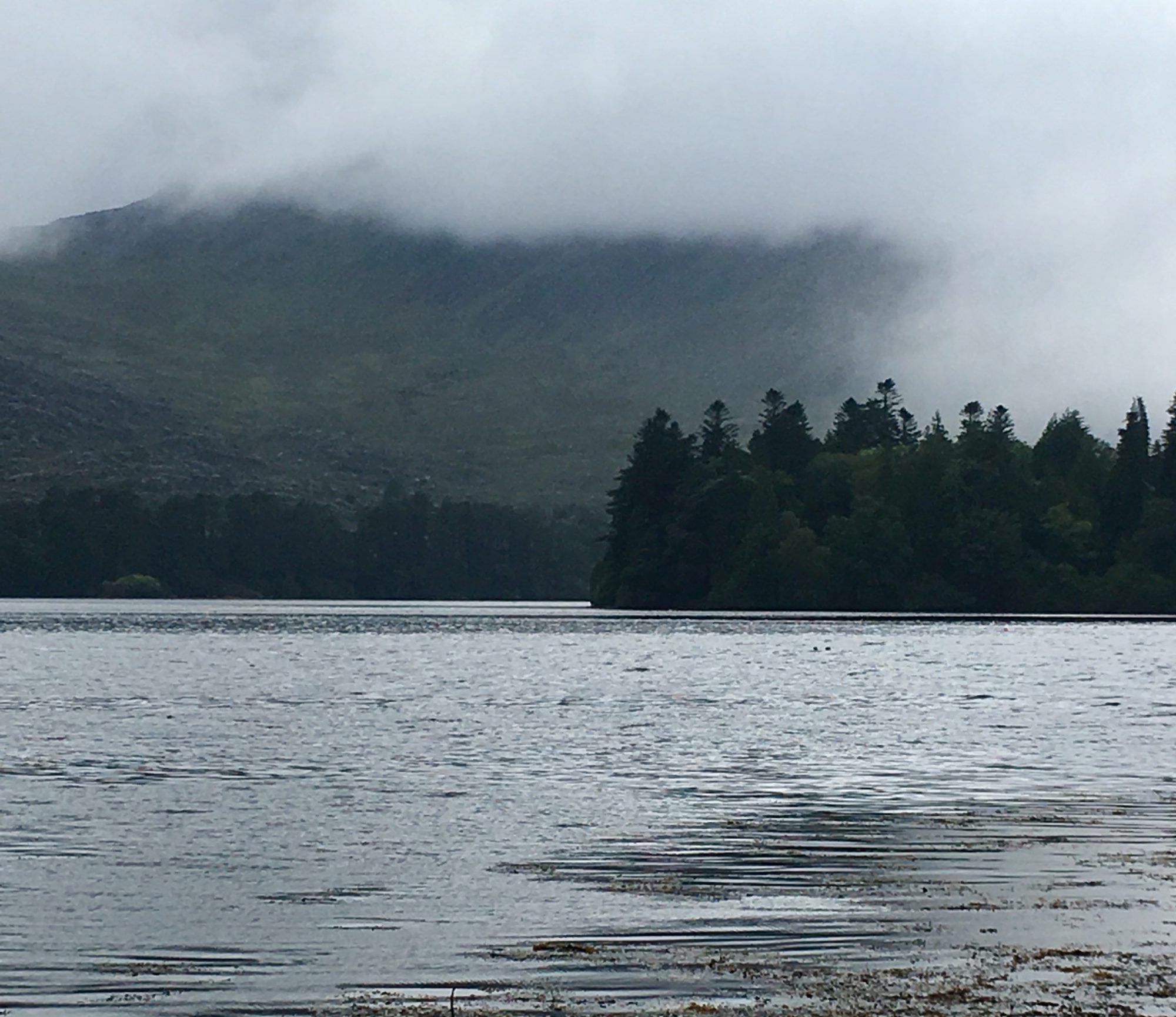
Chiming crickets swell
Under morning fog blanket
Memory of trees.
It’s still raining this morning, the third morning in a row I’ve sat on the porch with a veil of gray draping the yard, the pasture across the road, the tall maples and oaks around the cemetery that fills in the western horizon. The horses don’t seem to care, and continue to forage in the field for whatever is left to eat among the yellow ragweed and purple thistle. The distant call of a loon hovers into the morning from the lake, across the busy state road hidden by trees, so the long wail cuts through the hum of wet tires on pavement.
I’m four days into figuring out this new life of mine, a life that isn’t tightly bound on all sides by time given over to a demanding job. All the unexpected, and expected, events of this summer combined so that this is the first week I’ve had without appointments, plans, trips — all that’s kept me from seeing if I really can slow down and find a rhythm to my creative life. I made pizza dough last night for dinner, and as I was kneading the ball of sticky, gooey flour and water threads into a stretchy mass that shone and rolled under the heels of my hands, the body memory of making bread and handling a yeast dough came back to me. It’s been decades since I had time to make dough.
David’s boat, which he kept on Lake Winnepausauke when his children were young, was called The New Life. When he moved into this house over two years ago, he hung the sign he’d made for the boat in the barn. Now that his new studio in the barn is finished, with shelves and desk tops and a counter getting installed this week, the sign has moved. It’s nailed onto the barn wall, over the wide double doors that face west. It’s announcement of what is, every day, no matter the circumstances we find ourselves in, is so true. This moment is always the new life, and in this life time is getting stretchy under my working hands and beginning to shine.
I cleaned up my old “ericgrace”email account. I’ve hung on to the account Eric and I created more than a decade ago because of my attachment to the ericgrace tag, and when I switched to gmail, wanted that for my address, but of course it wasn’t available. So today when I needed to open the account to get a friend’s address to email her about my manuscript, I finally admitted to myself that I don’t have an “ericgrace” life anymore, and that old account is so spammed out it’s mostly just annoying. So, I made sure I had all the addresses I wanted from the old account, forwarded emails I’ve saved to my gmail account that tell stories I may want to get back to telling and the emails will be good reminders, if not good sources of some already-written work, scanned the 1,000 + emails that have come into that account since I last opened it (in early July) to find online accounts I needed to switch to my gmail account, and then did that. This was not a glamorous creative-life task, though it was working on getting my manuscript ready for the publisher that led me to it. This was cleaning up life details that have been ignored for too long. But now that big box in my head that said “clean up and close your old email account” has a check next to it. Good-bye “ericgrace.” I still love you.
Last October I wrote about our unsuccessful attempt to summit Mt. Katahdin. As difficult and tiring as it was, David and I both loved the expansive views of the tablelands on the Katahdin ridge, the deliberately undeveloped and unspoiled wildness of Baxter State Park, and the idea that this year we would have time to fit in a trip to hike Baxter Peak, the highest point of Katahdin, almost any time, given our plans to leave our jobs.
After the summer we’ve had, any plan we make, like the three days we just had at Baxter State Park, that we’re able to keep, is a gift. Tropical storm Irene whipped the bad weather out of the Northeast over the weekend, and we had clear, dry skies (except for a bit of rain which woke us up pinging the top of the tent Tuesday night) for our trip.
We set off Wednesday morning to climb Baxter Peak by the Chimney Pond and Saddle trails, reportedly the easiest way to get to the top. As we drove north, I talked with a friend who hiked Katahdin in July, and she assured me that once we got up to Baxter Peak via the Saddle Trail, we’d want to do the Knife Edge, the trail over a serrated ridge of Katahdin with steep pitches of rock and cliff off to each side. Anyone who hikes Katahdin talks about the Knife Edge, as it presents the most exposed alpine hiking in the east. As we made our we up the tough scramble of the Saddle slide, I couldn’t imagine a need to do any tougher hike.
And then we made it to the top. Katahdin is a tough mountain to climb, but it’s glorious, and just getting to the top was glory enough for me. Looking at the Knife Edge made me dizzy. There were a number of hikers at the peak who had arrived around the same time as us, who were heading on to take the Knife Edge as part of their route down. “I can’t imagine looking at that and wanting to hike it,” I said to one couple. The young woman said back, “I can’t imaging looking at that and not wanting to hike it.”
The hike down, even on the Saddle and Chimney Pond trails, was plenty hard enough for us. Eleven miles, eleven hours of scrambling up and over boulders, stepping around roots and rocks, and navigating a gnarly, uneven trail. On the long hike out the Chimney Pond trail, I started counting my steps, just to keep myself moving and keep my mind occupied with something other than a focus on how much my feet hurt. It was 1,500 steps from when I started counting until I finally came to a trail junction a tenth of a mile from the campground.
Yesterday morning, in the campground, we talked to two people who got back to their tent sites after 10:00 p.m. One man had done the Knife Edge with his daughter and it took them over 15 hours to finish their hike. As I said to another group of hikers on Baxter Peak, “Getting to the summit of Katahdin was on my bucket list. Doing the Knife Edge isn’t.”
The evening after I’d talked to Sharon Olds about getting together to write poetry, there was a meeting of my poetry group, the Yogurt Poets, or YoPos. Only Nancy and I were there and so had plenty of time to chat. I told her about the poetry gathering I was planning and asked if she could join us, as Sharon had invited me to invite someone. Nancy couldn’t make it, but I told her I’d let her know about it.
A week ago, I sent her the link to the Poetry Play post and she used the list of words to generate her own poem, before reading my poem.
Done Waiting
when released
counterweighted
like a pumpjack
my head rocks
into place
on the back
of my neck
and my sun visor
naturally lifted
no longer blocks
my view
of one blueberry
a gibbous orb
who’s own
tenuous existence
provokes a closer
inspection
as I step from dry
cobble to cobble
through marshy land
at the low end
of this oblong field
and pick and eat
am satisfied.
— Nancy Stewart
“Isn’t it remarkable how different our use of the word-list is?” she wrote, after reading my poem, after writing hers. Yes, indeed.
PS The blog formatting isn’t taking the indentation of every other line that Nancy did in her poem. Sorry — it really adds something to the poem, so you’ll just have to imagine it.
Two weekends ago Sam, Marianna, Adrienne, Matt, Emilio, and David’s brother Doug were all here for the weekend. When David and I got up on Saturday morning, Sam and Marianna were up with Emilio, letting Adrienne and Matt get some extra morning sleep. David and I were both still under the spell of the poetry play we’d done the day before, and asked Sam and Marianna to help us generate a list of words to serve as writing prompts for the day. The list: green, lush, blue, constitutional monarchy (that’s Sam), stare, oar, amble. I was too busy cooking and playing with Emilio and being in the middle of day full of family to write a poem, but David did, and here it is.
The Laws of Nature
There are equations for the road’s convergence,
edges crossing the height of land to have
the last word before leaving the scene.
Those rules of perspective were worked out long ago
when people could still stare at things without moving.
Once there was one world,
a ruler came straight from the sun
and measurement was by the monarch’s foot.
Now lush governance has overgrown the arch.
The seen is changed by being seen.
No thing is any one thing and time has no place.
The wind sweeps oars through the grasses,
their bending reeds,
the light greening gold
then bruising the shadows blue,
darting for the bait beneath
the arc of a shallow sun.
A turkey can fly,
but tonight it falls out of the tree.
David hadn’t yet sent his poem from the morning with Sharon Olds to the others who were there, and when he did send that poem, he included this one. Bill wrote back to David, with the following comments on this poem.
I really like The Laws of Nature. You’ve captured something essential about what feels to me like the shift from the Newtonian universe to the relativistic world that came with Einstein and Heldelberg and modern physics and art.What I find even more intriguing is that last part, with the imagery of the grasses and the shadows, because for me it opens a door to a third possibility–the world that indigenous people knew, before abstract language, where there was one world but a much different kind of physics, much more fluid and connected. I’ve come across some work in the shamanic traditions that tries to convey what that world was like, and how to revive it in some ways for putting our broken world together again.
So your piece has invited me to look deeper in that third realm. I’ll let you know what I find there.
I love what Bill says about David’s poem and take it as confirmation of what I’ve thought about David as a poet since I met him. He’s a natural. He’s spent very little of his adult life writing poetry, yet he has a true ear and great sense of detail, movement and how to make surprising shifts and turns. What fun for me.
Sandpipers scurry
Bobbing beaks poking wet sand
Water washing wind.
First, today has been a total 10 on a 1 – 10 scale of perfection. The sun is clear, hot and sparkling on the water of the bay, the air is cool with a light breeze, and I’m in a waterfront house with only a tiny bit of work to do. And there was an earthquake today! Sitting on the deck eating lunch, I felt everything start to move back and forth. For a minute, I thought there was something wrong with me, some inner balance suddenly gone so that the world was now a shifting quiver. I looked up at David in the kitchen and said, “Is there an earthquake going on?” “I think so,” he answered, and then the quaking stopped. Thankfully, it appears to have done little damage, even near the epicenter.
So, here is the poem David wrote almost two weeks ago, during our morning of poetry play. The word prompts were the same that gave me the poem I posted two days ago: ruffle, marshy, sun visor, visible, tenuous, waiting, cobble, gibbous, orb, oblong. Tomorrow will be another poem from David, using words we had our family generate following day. Lots of poetry in my life right now, which is a very good thing.
Sargent and the Four Daughters
There must have been a gibbous moon unmasked
the feathering of the Earth
softening the chill edge into that curtain
drawn deep across the shadows of the painting.
One is barely visible in the darker folds,
her sister more forward in the brushed light
before the bright one in ruffles
who draws the eye naturally.
I cannot see the fourth I know is there
somewhere else
searching for words in the road.
I know I said today I’d post David’s poem from our morning of poetry play, but I’m going to do that the next tomorrow. Today we went to Wildwood, the next town south from Stone Harbor, and outside of being another beach town, about as different as it could be. Wildwood has an enormous boardwalk, three piers of amusement park rides, water parks, motels that looked completely unchanged since the 50’s, scads of people, monster truck rides, and a complete lack of the kind of intellectual preoccupations David and I often spend our days slipping around in.
For example, this morning on our walk along the beach, David did his book report style recounting of the concepts about human evolution and the development of the cooperative brain through trade and specialization of skill from Matt Ridley’s The Rational Optimist. Earlier, I’d shown him the latest draft of one of the three poems I’m working on right now, and he helped me edit out a few more words, generally a good move in any poem.
But this afternoon we went to Wildwood and lost ourselves in the sights and sounds and sun. This slide show doesn’t do the experience justice, because you can’t hear all the amplified voices telling you “We have barbecued chicken, we have fried flounder, come eat here,” and “Two for the price of one, two for the price of one, come in and buy.” We walked and looked and listened until we were thirsty and hungry and tired, went to have dinner at a Mexican restaurant run by a family David’s second cousin in St. John knows (it’s such a small world), came back to the house and watched a royally brilliant sunset. There’s a tiny bit of pink left in the quickly darkening sky, and the first star is out. Time for a wish.
Last week we came home from swimming and there was a message on the answering machine. “Hi, Grace,” a cheery voice said. “This is (too blurry to understand) and I have an idea. Give me a call,” and the voice left a number. I was about to play the message again when David came in the room and said, “That was Sharon Olds.”
Sharon Olds is a poet David and I have both greatly admired for years. She’s now a neighbor of mine, living with Carl, a farmer I’ve known for decades (our children went to Temple School together), who owns an old camp on Wild Goose Pond and has turned a few of the cabins into lovely, rural retreats. Carl is deeply involved with land conservation and local implementation of the “land ethic” first described by Aldo Leopold, a pioneer of conservation. David and I have crossed paths with Sharon and Carl numerous times in the last year or more — at poetry readings, at a screening of Green Fire, a movie about Aldo Leopold, at Yom Kippur services — and have talked about getting together.
I called Sharon back. “I have an idea,” Sharon said, and went on to describe her recent week at the Squaw Valley Poetry Workshop. The intent is to generate new work using word prompts, and with a guest at one of the Graylag cabins who writes poetry, Sharon wondered if David and I would like to be part of a morning poetry gathering. Oh yes, we certainly would!
Bill, the Graylag guest, his friend Sharon (yes, two Sharons), David, Sharon Olds and I met at 9:00 a.m. in the community cabin at Graylag. Sharon Olds’ deep connection with art and poetry creation was evident. She talked about making space for poetry, about inviting in the spirit of others, such as Aldo Leopold, and then asked us each to contribute two or three words to serve as prompts for our writing. Our words: ruffle, marshy, sun visor, visible, tenuous, waiting, cobble, gibbous, orb, oblong. We then all went outside and picked up an object that spoke to us in some way. When we gathered again in the cabin, we passed our objects to the person on our right. Then we went off for a half hour to write.
We came back a bit later than a half hour and took turns reading our poems. Sharon asked us to “share what is most alive to us,” in each poem. “We’re too new together to offer critiques,” she said. We talked about the poems, about poetry, about the spell we each worked under with an awareness of our chosen woods and objects from the piney woods and pondside. “We are a tribe of five, and this is our language,” Sharon said. Here is the poem I wrote, with no editing yet. Tomorrow, David’s poem.
Gathering
The fallen branch becomes complex
in her hands, white orbs of fungus
sucking the bark, trapping old brown
ash leaves, the plucked vine of fresh green
shot with white veins passed
to the next person in the circle.
Last night we discussed the origins
of gibbous, loving the moon
for just how it wavered, tenuous
chill coming into the evening,
the corner of another season unmasked,
visible in the one read leaf
I find floating no matter how summer
the day. This wild pond wears
its marshy crown of reeds and lilies
without desire for fealty, tiny wind
ruffles painting the water black
and blue that hurries into each flicker,
the cliché of sparkle. Oblong
passion rests in our words,
the trees and tumble of forest
reminding us that today is today
the unvisored sun before us
as we sit beside each other.
 Grace Mattern