The Next Great Photographic Artist

This slideshow requires JavaScript.

We took Emilio to a “Go See” in Manhattan today.  Adrienne signed him up with an agent who handles baby models many months ago, and he periodically gets called to go have a couple of quick photos taken for different customers — Huggies Prints in this case — so the client can see if they’re interested in using Emilio for an ad.

On the way into Manhattan I sat in the back seat with Emilio (of course) and chattered with him and let him play with my iPhone.  When I got it back from him, I saw that he’d shot a number of photographs and his first bit of film.  He’s clearly exploring the interplay of light and dark, and how textures break up our visual comfort, encouraging our minds to move between the left hemisphere and the right.  His mastery of flow, sound, shadow and motion is amazing. Yes, he’s a genius.  His photographs are here for you to see, and you can follow this link to see his film.  It’s called “Crossing Into the Light, Letting Go of the Refrigerator and Standing On My Own.” 

Jardin Botanique de Montréal

This slideshow requires JavaScript.

The botanical garden in Montreal is spectacular.  It’s considered one of the most important botanical gardens in the world, due to the extent of its gardens and plant collections, and is also one of the largest.  With over 181 acres, 10 greenhouses, more than 26,000 species of plants, arranged in stunning thematic gardens, it’s a mind-boggling treasure.  Every path David and I followed took us to another visual delight.

While we were taking photographs of the trumpet like seed heads of water lilies in the Chinese garden pool, a man came up behind us and said, “It’s so beautiful.  You could go all the way to China and not see anything as beautiful as this.”  As I agreed he asked if we’d seen the bonsai collection around the corner, which we hadn’t.  We followed a path around another corner, and there was miniature grandeur, perfectly shaped and sculpted tiny trees, some older than 100 years.  The living art of plants exemplified by the bonsai trees spoke for all that this botanical garden represents — finding and holding beauty so that it can speak its own language.


Crossing Art Boundaries

My friend Andi was touched by my Yom Kippur post, and sent it to several of her relatives.  Her Uncle Jerry tried to comment on my post, but had trouble making that work, and sent me an email instead.  His comments about my blog are wonderfully flattering and complimentary, and I’m copying what he wrote here not just because it’s so positive (although that’s certainly part of it), but also because he draws a connection between what he read in my words and his own art of photography.  “Here is a truly brilliant and sensitive human being who has honed her craft by education, insight and the mystical gift of genetics to paint spectacular images with her words.  She is indeed an artist and we have so much more to learn by seeing the world through her eyes. In Japan they have individuals with exceptional talents that are declared national treasures by the government.  Grace certainly qualifies for that accolade. In photography I continually search for new ways of “seeing” but never thought of looking to a poet for guidance. In the words of Marcel Proust:  ‘The real voyage of discovery consists not in finding new landscapes but in having new eyes.'”

While I love the idea of being a “national treasure,” I’m most flattered that my writing speaks to how he tries to capture images through photography.  (Check out his photographs at his website.)  When I was at Vermont Studio Center in the summer of 2007, one of the most nourishing aspects of my time there were the conversations with visual artists.  Over lunch one day a painter said to me, “I think poetry and painting are the most closely related arts,” and we talked about that for an hour.  One evening after an artist’s slide show, a young man and I talked at length about how we do, or don’t, put ourselves in our art, what is self-referential, how do we make that universal, what exactly is art?

Whatever it is, art feeds art in unexpected and important ways.  Last week two friends from my writing group came here so we could all work on some visual art, as a way to use a different part of our brains than writing taps into, hoping to open that writing tap in new ways.  Anne painted her dog, Pat made a 3-D collage, I worked on an altered book collage (using the pages of an existing book for collage, writing, drawing, structural cut-outs) and David worked on photographic images at his computer.  We went from a lively, chatty dinner into the studio, turned to our art, and were silent.  For over an hour we were all absorbed in our creation, intent and focused, bringing something out of our brains and into the world.

I love that my writing can bring something out of my brain, then explode into new ideas and creativity in someone else’s brain.  Art, whether painting or writing, photography or collage, sculpture or ceramics or drawing, is best when it brings us to a new understanding, whether of the world and how to see it, or a puzzle in our own minds.  Whether or not we articulate that new insight through words or painting or collage doesn’t matter, it only matters that we let the expression into the world, and see what it can make happen.

One Window

This slideshow requires JavaScript.

Fifteen years ago Eric and I went to Italy with our friends Alison and John.  The visual extravagance of Italy can not be overstated.  Everything was beautiful.  On one of our first days there, in Venice, John and I were standing together looking in the window of a glass shop.  There were blown glass jars, paperweights swirled with color, tiny glass animals, bottles, birds, butterflies.

“You could spend the rest of your life just looking in this window,” John said and I agreed.  “And yet there’s a whole city of these windows.  And then a whole country beyond that.”

Not to mention the country we live in, and the wonder that is NYC.  While not as astonishingly ornate and decorative as Venice, Manhattan is just as rich in visual variety, which is just one of the senses that pop into prominence when I’m there, as I was on Tuesday.

David and I had planned to go to MOMA, but MOMA is closed on Tuesdays, so we headed to the Metropolitan Museum.  Walking into the great hall that is the entrance to the American Wing is like walking into an enormous display case.  The western wall and ceiling are all glass, and there are two balconies of glass, full of glass cases, full of glass and pottery.  I felt like I was in Venice again.  I could spend a life time sitting in the great glass hall, or staring into one glass case.

But not really.  What I did was move from case to case, letting the views behind the views shift into a kaleidoscope of color and layers of glass.  And then there was all I’d seen earlier in the day.  David sat and sketched the head of a sculpture, and I finally sat beside him and let the saturation of color and form and texture sink into me, late afternoon light falling through the glass wall and ceiling, through bottles and pots and cases, into my rebounding memory.

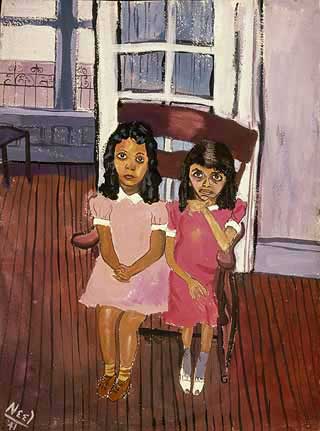
Alice Neel

1941 Two Girls in Spanish Harlem Watercolour on Paper 20 1/2 x 15 1/2 inches / 52 x 39.4 cm Schomburg Center for Research in Black Culture, Art and Artifacts Division, The New York Public Library

Last week Anne suggested our writing group go to a local screening of the film “Alice Neel.”  She had seen three of Neel’s paintings at the National Portrait Gallery the week before, and was astonished by their power and vibrancy.  None of us had heard of Alice Neel, but we agreed it would be fine way to spend an evening meant to nurture creativity, to see a movie about a woman who devoted her life to her art.

The film was directed by Andrew Neel, Alice’s grandson, and “it explores her struggles as an artist and a single mother from the Depression era until her death in 1984.”  There is extensive commentary from Neel’s two sons, who grew up with a mother clearly possessed by her art and not always as focused on parenting as women of that era were expected to be.  Having lived through my own possession by a poetry demon (my language for that intense year) when I wrote The Truth About Death after Eric died, I have a tiny idea of what an entire life ruled by that kind of need to create can be like.

The film was excellent, and as Anne had said, Alice Neel’s paintings even as seen in a documentary, were powerful, direct and “fresh,” as one of her artist friends in the film said.  Now I need to see some of her paintings in real life — there is one at the MFA in Boston — and I want more people to know about this extraordinary woman and painter.  Thus this post.  Click on the link above and check her out.

Syllables of Time

Two weeks ago David and I went to the opening of a show of Catherine Tuttle’s paintings at McGowan’s Art Gallery.  The paintings were vividly interpreted landscapes of the White Mountains, seen from a hiker’s perspective.  A few of our hiking friends were also at the opening, and we had fun showing each other which paintings we’d love to own, to have a favorite view at home with us all the time.  David’s friend Bob, another painter, was also at the opening, and the three of us were talking about establishing a practice of art.

“I’m painting every day,” Bob said.

“I’ve started writing a haiku every day,” I said.  “It’s a way to have at least 17 syllables of time a day that isn’t about working.”

“Why did you say syllables of time?” Bob asked.  “Why would you say time?”

“Because that’s how I think of it,” I answered.  Bob talked about a recent book by a local author, Turn and Jump: How Time and Place Fell Apart.  Bob had read the book and its essays on how time and place were closely connected in the past, when small towns set their own pace by the rising and falling of the sun, before the frenetic calculation of every minute of most days by schedules and appointments and things that have to be done right now.  I’ve been exploring the theme of time in my poetry for decades, and have an entire manuscript of poems that is mostly a mediation on time, physics, and the immutable laws of the physical world that underlie the mystery of consciousness.  Where does time exist?  It can’t be measured, but we all experience its passing.  It has no physical dimension, but controls how we move through our day every day.  Just the word move implies time, as any change in physical location, awareness, feeling, consciousness, anything, requires the passage of time to be perceived.  Something is one way or in one place, and then it’s not.  That takes time.

“I think part of being retired,” Bob said, and he is, “is reconnecting time and place.”  I need to read that book.  Today’s Haiku:

Dark morning, dark day
Rain stripping the last brown oaks
Syllables of time.

Country Weekend

This slideshow requires JavaScript.

“I’ve been practicing Noel Coward quips all week,” David said as he, Mackenzie, Daisy and I drove west on the Mass Pike.  “I’m going to be a country weekend house guest!”  We were on our way to spend a  weekend at Daisy’s Dad and his girlfriend’s country house, in the Berkshires.  They’re from Manhattan.  We’re from the country.  We spend a lot of weekends in the country, but not in the country house of a New York couple.  We have people come spend country weekends in our house.

As soon as we arrived, Daisy’s Dad came out to greet us.  Dad’s girlfriend came to the door, then out onto the brick walkway, lined with boxwoods and hydrangeas.  There behind them was the house, a country dream.  An antique colonial, the house sat with an aged authority on its patch of meadow.  We went in to examine and admire the original plaster and paint on the walls and woodwork, the artfully hung art, the fireplaces and mantles with age softened colors, and windows with glass so authentically old and rippled none of the windows open in the main part of the house.  The former owners who restored the house didn’t want to risk breaking any of the old glass by making the windows functional.

The “new room” was built from old carriage sheds that formed an ell at the back of the house.  At the end of the room, on either side of the fireplace, were full wall windows.  The seed heads of ornamental grasses flagged in the wind just outside the glass, with a meadow beyond the garden, then trees and then the line of one mountain dipping into the next drawing the horizon.  A living masterpiece. 

Sunday morning we got up to coffee and the NY Times at the thick, wooden kitchen table.  David and I went for a walk, past the dairy farm next door, down the slope of a field to the winding river, the mountains darkening as rain spit in fits.  Then a rainbow arched over the clouds ahead and disappeared into the blue-black clouds to the west.  We talked about children and parents, love and loss, ambition and expectation, and the tangled twist of family we’ve found ourselves in, moving together through a meet the parents weekend without a full set of parents among us.  Yet there is no tangle, just simple threads of love and connection and a weekend built around talking, looking at books of poetry and art, and eating together. 

Daisy has been learning the art of bread baking and brought a cinnamon loaf and the dough for baguettes.  Saturday night, before dinner, Daisy baked the baguettes.  They came out with a perfectly crisp and chewy crust and smooth and light on the inside.  We gathered in the kitchen, artisan cheeses, a rose of roasted figs in a grape leaf and sliced pear on a platter, and broke bread together.  A blessing slipped through me and went out into the country air.

Al’s Gardens

This slideshow requires JavaScript.

Today was the annual Deerfield Arts Tour.  Eighteen artists and craftspeople in Deerfield open their studios for the weekend, showing their painting, photography, custom furniture and woodworking, ceramics and jewelry.  Last year David and I only got to two of the studios, my friends Kathy and Al.  I had talked about both Al and Kathy to David, as they’re both accomplished ceramic artists with unique styles, and I knew David would connect with their creative sensibilities. 

But last year it was a cold, dismal and rainy day so I didn’t get to show David Al’s garden.  Today was glorious — cloudless and crisp.   We drove under yellow and orange maples and russet oaks along the half mile woods road Al built to get back far enough into the woods to create his home.  Along the road are occassional ceramic houses and tiny castles that Al crafted, sitting atop granite outcroppings as the road twists and climbs up to his open land.  Decades ago Al cleared these acres, creating fields that ripple over the hummocked landscape.  He’s built two houses (the first one burned), a studio, numerous sheds, and now has a large kiln building.

But most spectacular is his garden.  With hand stacked stone walls reminiscent of the high walls in Wales, arches built from curved tree limbs and woven branch trellises, walking by and through Al’s garden is a delight.  Form, function, variety, and the obvious hand of long attention and eye for composition makes Al’s garden, yard, terraced walkways and plantings of trees a whole piece of art in itself.

“This is a life I didn’t live,” David said as we walked up towards the walled vegetable and flower garden.  When we arrived, David had stood on the slight rise where the cars were parked, looking over the expanse of slope down to the stone walls and then up to the house on a higher hill.  A maple tree was screaming red against the blue sky.  “This is what staying in one place can create.”

We opened the gate in the stone wall and walked along the central path of the garden.  A trellis heavy with grape vines created a green tunnel, led into the open, and then under the curved arch entrance on the other side.  We walked up the hill to the studio to find Al and look at his ceramics.  When Al saw me I got a big smile and a bigger hug.  Then he turned to David.  “You’re still together?” he said, smiling more.  “I’ve been wondering all year.”

“Yes,” I said, “and you?” 

“My David is downstairs,” he said and now I was smiling.  Last year when David and I arrived I introduced the two of them and Al said, “I have a David too, he just left.”  Al and his David had just met weeks before, and Al was obviously happy to have a partner again.  Like me.

Today we all went out in the yard behind the studio so Al could show us the path to the high ridge on his land that looks down on his pond.  The shade was cool, the sun warm.  Al told us about the trip he and his David are taking in two weeks to Spain.  I stood in the sun, running my hand along the curved and twisted rim of a three foot clay vessel standing on a stump.  It had rain water in the bottom, colored leaves floating on the surface. 

Art, sun, leaves, another year of love and a life in a garden.  It was a good afternoon.  We bought two mugs for our morning capuccinno.