Nine Bouquets

IMG_3759

Being part of the support team for someone in hospice is a hard business, but nothing that comes anywhere near what it must be like to be the one who’s dying.  I watched Eric do it, and now I’m watching my sister be taken further and further away from any control over her body and mind as metastatic cancer gets the upper hand in every measure of balance in her life.  It looks excruciating, and she’s told me as much.

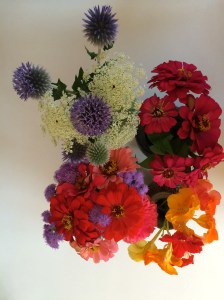
Last Friday evening I came home after another few days of being with Chris, holding her hand and talking to her, propping her head upright as my brother-in-law fed her slices of fresh tomato (which she clearly enjoyed), cooking, shopping, reorganizing photo albums that were uncovered when clearing the den to make way for a hospital bed, chatting with visitors, walking to the end of the street to a small field planted with a riot of annuals to pick a bouquet for her kitchen.  I was exhausted by Friday, and because this isn’t happening to me, or to my life partner, I could afford to take a break.

So I did.  I weeded my gardens and froze fresh peaches, grilled veggies for dinner and went kayaking, sat on the porch with David and watched rain clouds move across the sky, slept and read and visited a friend.  But the first thing I did on Saturday was pick flowers, eight bouquets for the house and the porch.
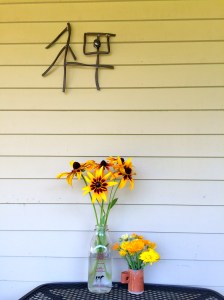
During a time of such hardness, surrounding myself with the New England summer bounty of beauty wherever I am makes a difference.  I know Chris found being in the present to enjoy flowers important, as she wrote in one of the essays on her blog:  Not knowing how long I have to live, but being warned to make my end of life decisions, my goal each day is to live in the present.  Appreciate what you can, like the foliage I planted in my deck boxes coming up with beautiful, delicate, lavender blossoms.  I didn’t even know that they flowered.  I like to go out to my front porch each day to look at the plant on my porch with so many pinkish red blossoms they are hard to count.          

Nine bouquets for both of us, though Chris will never see eight of them.       
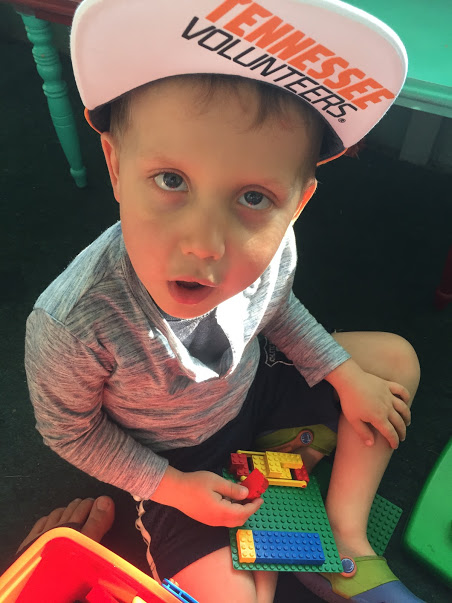
Three at Four


IMG_2599

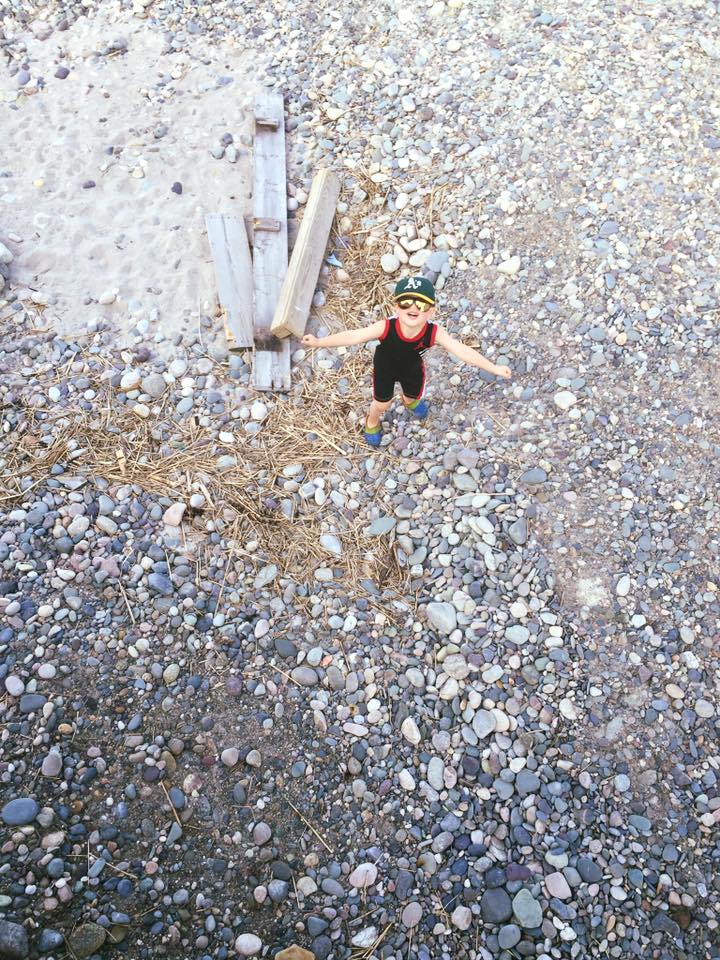
“I don’t want to drive back to the house, I want to walk.”  Emilio stood in the driveway with his hands at his sides, declaring his four-year-old determination. Adrienne and Matt were going back to our house for a mid-afternoon rest from the busy cottage we rented on Jenness Pond last week for a big family vacation. Emilio wanted to go with his parents, but he was “sick of the long car ride” (3.3 miles, about 5 minutes) between the two houses. He wanted to walk.


“It’s really far, Bud,” Matt said.  “Do you really want to walk that far?”

“Yes.”

“Are you sure?”

“Yes!”

“Okay,” I said.  “I’ll walk with you.”  We went in to the cottage to let everyone know where we were going.  There were lots of questions.  “Emilio is walking back to the house?”  “Do you have a phone with you?”  “Has he ever walked that far?”

David looked at Emilio’s feet.  “Do you have some shoes with you?  Sneakers?  Some socks?”

“No,” Emilio said.  “I’m wearing Crocs.”  As if everyone takes the longest walk of their life so far in Crocs and of couse no one wears socks with Crocs.

Emilio took my hand and we started off with me telling Emilio about the walk across England David and I did three years ago.  When I’d finished the story he asked if we were close to the house yet.  “I’d have to tell about 20 more stories like that before we got to the house,” I said.

“Well, then tell me another story.”

Which I did.  Then he told some stories, we stopped to look at the map on my phone so he could see where we were and where we were going, we walked through a rain shower that was mostly blocked by the canopy of trees above the road, he kept holding my hand and stepped off the road every time a car went by, we found a dead frog and poked at it with a stick, we walked up and down hills and looked at the other ponds we passed, we picked Queen Anne’s lace for him to give Adrienne when we got back to the house.  Once, more than half way, he stopped and said his feet were tired and he needed to rest.  About five seconds later, he started to walk again.

An hour and a half later, we reached the house.  Over three miles by a four year old.  As we walked in to the yard Emilio looked up at me.

“Was that a good walk for you, Mimi?”

A Beginning

photo (6)

The rain on the porch roof makes a new sound.  We’ve had gutters installed and now instead of a curtain of drops dripping off the edge of the porch there’s a metallic ping and rush of water flowing down the drain in the corner.  The view out to the yard is clear, coreopsis still blooming, silver-sheened balls of globe thistle getting ready to pop out their tiny purple flowers, uneven and unruly grass, rudbeckia blazing yellow in clumps from the garden to the line of yew bushes, the burn pile for this fall getting lost in the tall weeds and wildflowers of the field.  Summer.

Which this week means a house filling up with children and grandchildren and friends. Sam arrived after we’d all gone to bed last night and we woke up to an assortment of Tennessee hats arranged on a counter in the kitchen.  There are dog food bowls and leashes and a crate lined with blankets and a chair full of dog toys.  Extra shoes and wallets and car keys, laptops on every table.  A stuffed refrigerator that will empty and get stuffed again and empty and get stuffed again and empty and get stuffed and empty.

But I don’t want to go there yet, to the empty.  Right now we’re at the beginning of a week of family gathering and everything is full and messy and rich.  Empty is later.

Becoming and Being

Chris Sitting On Her Memorial Bench

My sister, who I’ve introduced before through her blog, A Cancer Journey With Chris, is very sick. She hasn’t put up a new post on her blog since April because living with metastatic cancer has become more than a full-time job for her, it’s 24/7, it’s exhausting, it’s the central, all-encompassing reality for her and for those of us who love her, it’s at the point that her illness is a globe of existence we move into when we’re with her because when you’re with someone this close to the end of life, someone trying to make sense of the hard truth that soon the mystery of time is going to become a closed absolute, everything except figuring out the next meal and a trip to the doctor and helping her up and down the stairs and into the bathroom and rubbing her back while she cries drops away.  I know.  I’ve been here before.

In Chris’s last blog post she shared a piece she’d written in a journaling class — “Pay attention to the space you are in but stay open to all the possibilities to come.  It is the small things that matter.  It is the becoming that becomes the being.  Always becoming.  Pay attention to the process; that is who you are.”

The cancer in Chris’s central nervous system is creating pressure on her brain that makes her cognition fluctuate but she’s still working hard at paying attention to the process. Sometimes she can keep track of what’s going on and then she’s sad, because she understands that she may very well have come to the end of her extraordinary span of beating the odds.  Twenty four years ago, when she was first diagnosed with breast cancer, her doctors said she had a 10% chance of living five more years.  Two and a half years ago, when the cancer was found in the lining of her spinal column and her brain, her doctors told her to make her final plans.  Soon.

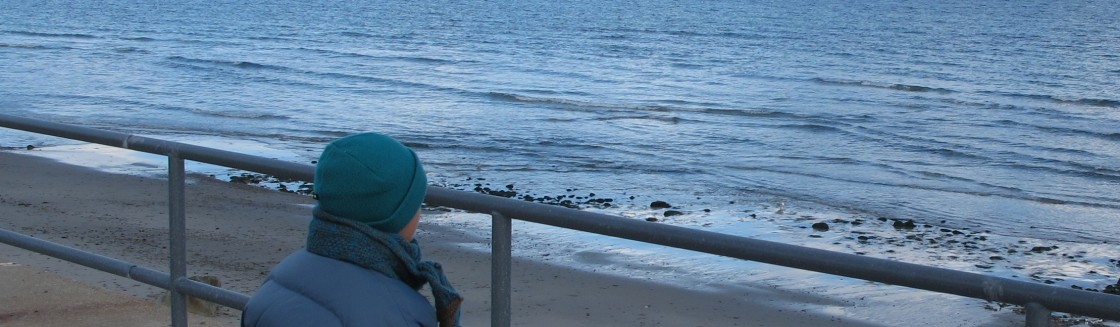
She spent a few months planning her memorial service, talking to her family about what was coming, writing letters to those she loves for them to read after she dies, writing an essay to be read at her service, having a memorial bench installed on the beach in Scituate, Massachusetts where we grew up.  Done getting ready to die, she then spent two years living with a close attention to what brought her joy — family and friends, colors, bright blossoms, the ocean, writing, meditation, movies, qigong.  She was becoming and being. She sat on her bench

I’ve been spending a lot of time with her and am in awe of her remarkable spirit and the full life she’s created in the face of debilitating illness.  Who knows how much time she has left.  I do know that I want to spend as much of that time with her as possible.

Predictions

humarock
Emilio on the beach

I get obsessed with weather predictions when I have a vacation coming up and the obsession carries right into the vacation.  Moving from one weather website to the next, I check forecasts compulsively.  Will it rain?  At what time?  How warm will it be?  What will the cloud coverage be at 2:00 p.m. on Thursday?

Last week I spent eight days at Humarock Beach, a long, thin peninsula of ocean-tossed rocks and sand south of Boston.  Surrounded by water — the cold Atlantic to the east and tidal rivers and marshes to the west — there’s no hiding from the weather.  The houses are on ten foot pilings so the ocean can roll right under and across to the marsh on the other side during strong storms, and winter Nor’easters often leave the central road on the northern tip of the peninsula covered with fist-sized rocks.

But as I found out last week, as I find out through all my vacation weather obsessions, forecasts are rarely right if made any more than a couple of days ahead, and the weather really doesn’t matter anyway.  What matters are the uninterrupted hours and shared meals with family, the jumble of four generations putting together dinner and playing games over days instead of just hours, the rhythm of living in the same house with children and grandchildren.

It did rain during our vacation and it was too cold for the beach many of the days we were in Humarock.  When it rained we played games and watched movies and read and talked and cooked and ate.  When it was too cold and windy to sit on the ocean side deck we sat in the sun on the river side, tucked out of the wind and looking over a marsh flooded with high tide or drained to a small ribbon of river snaking through sloped banks of mud.

With so much family gathered — my parents, all three of my sisters, my children and grandchildren and nieces and nephews and partners — my phone was much busier than usual with beach and dinner planning texts and phone calls.  At one point as David was driving to the grocery store I was texting with my sister Meg, figuring out what we needed to pick up for dinner.  Somehow, as David and I were talking about a song that was playing, my phone got switched to the microphone for text, and when I looked down to read what Meg had sent I saw a message my phone was ready to send.  The predictive text picked up from the song and our conversation was about as accurate as a weather forecast, and as meaningless when it comes to having a sweet week with my family.

There’s a loser husband in case this homeless replacing the work job pound some loose and this is the song I know the song.

The song of making sure you have time with the people you love most.


Triple Silence Broken


child-abuse-silence

“I have a story, but I need someone to write it,” a friend said to me recently. Here’s the story, some details imagined and names changed but the facts are all true.

“I know why Cassie is having such a hard time.” Jean wasn’t surprised by the phone call from her ex-sister-in-law, but she was surprised Alice thought she knew what was wrong with Jean’s daughter.  Cassie had been hospitalized for a suicide attempt, which came after years of struggling with alcohol and drugs.

“You do?”

“My brother molested her,” Alice said and suddenly everything made sense to Jean. She’d been divorced from her husband, Cassie’s father, for over ten years, but during those years when her children came back from visits with him they often had trouble sleeping and behaved erratically. Jean hadn’t known then what she did now about abuse of children, and even with what she knew, she still hadn’t thought something from Cassie’s childhood might be driving her terrifying behavior as a young adult.

“How do you know?”

“Because he molested me,” Alice said. “I’d like to see you to talk about it.”

Jean and Alice agreed to meet and Jean called her best friend Elizabeth to ask her to come along. Jean was anxious and scared, and while she believed Alice and had always gotten along with her, she felt like she needed the support of Elizabeth who she’d known since childhood.

Jean, Alice and Elizabeth met at a dark bar near where they’d all grown up. They ordered drinks and Alice began talking first.

“I’ve never told anyone about Michael, that he molested me when I was a kid. But watching what Cassie’s been through I had to tell you. I see how she’s struggling and recognize the struggles I’ve had. If finally talking about what happened to me can help her, then it’s worth it. And it will help me too.”

Elizabeth watched Jean as she began to cry, then Elizabeth started to cry. “I was molested by my brother too,” Elizabeth said, almost whispering. “I’ve never told anyone either.”

Jean was stunned. “Me too,” she said. “My brother abused me and I never told anyone.”

The three women looked at each other, all in the 40’s, all successful, educated, capable women. Jean and Elizabeth were best friends. They told each other everything. Alice had been part of Jean’s life through her years of marriage to Michael and even since they’d split up. Jean had always considered her a friend, someone she could trust.

But none of them had ever trusted themselves or the world enough to tell each other or anyone else that their brothers had sexually abused them.

Now their silence was broken and together they could figure out how to make their secrets a strength.

This happened years ago. Cassie is fine now, a mother herself. She and Jean work hard to make sure the children are safe.

Nachas

11024736_10206368938610417_5925431246814310338_n

“You have so much nachas ahead,” the rabbi said to me when I went to see him after Eric died.  I was reading a lot by then, and death was my constant topic, whether what actually happens when we die (How We Die by Sherwin Nuland) or trying to cope with grief (A Grief Observed by C.S. Lewis), which I was learning felt like an unremittingly slow slog through the bottom of the sadness bucket which was turning out to be a really, really big bucket.  The rabbi, I assumed, would have an answer to my question of what Jewish writing would be most helpful, or most instructive anyway.

At the time I could hardly understand what the rabbi meant, because looking at the future was too painful, but he was right.  (He refered me to the Memorial Service in the siddur for the Days of Awe, which I didn’t find that useful at the time but which I continue to read on Yom Kippur every year).  The rabbi was trying to give me a glimpse of all the happy occasions to come in my life, because he knew my children and believed there would be many and there have been — weddings, graduations, jobs, family vacations, the simple pleasure of all being together on the porch on a summer evening telling stories and laughing.  Eric not being here to experience all these moments is such a given at this point it’s become a much smaller wave in my mood.

Last Friday night was a nachas moment — Ava being named in the Reform Temple of Forest Hills, where Matt’s parents Carrie and Tim are members.  Aharonah Tziporah. Aharonah for Matt’s grandfather, Aaron, Tziporah, which means little bird, because Ava was chirping as she was born and kept up a constant stream of chatter for over an hour as if commenting on all the newness — What?  What just happened? What is all this light?  And the smells?  Noise!  And wait!  Breath in my lungs?

Ava is still a chatterbox, chirping and cooing and even starting to laugh.  Like her big brother Emilio, she’s a joy magnet.  Almost nine years ago now my rabbi could look at the blessings in my life and see there were many more to come.  Given the perspective of grief, I couldn’t see it, but I hung on to that hope and it helped.

(So what is nachas?  Yiddish for joy and pride, especially from children and grandchildren.)


Another Story

IMG_3537

A flock of robins has been flapping around my yard this week, lifting off from the maple outside my study window to fly to the garden and pick at shriveled globs that used to be apples, still hanging from bare branches.  They’re also eating the berries on the barberry bushes, leaving bright red splotches of bird droppings in the snow under the maple tree. Puffed up against the frigid temperatures and wild wind, as if making their feathers into bulky coats, their orange breasts are a welcome touch of color in the monochrome landscape of bare trees, white pines harboring darkness under their boughs and snow.

Anyone who lives in the southeastern part of New Hampshire knows that snow and snow and then more snow has been our story for the last couple of weeks.  I went to a Martin Luther King Day Commerative at the University of New Hampshire last week, to hear Natasha Trethewey deliver the Commerative Presentation, which turned out to be her talking about how she came to write her poems, a selection of which she then read. Stunning.  And encouraging to realize a woman of color could be so highly celebrated, even appointed U.S. Poet Laureate, for writing direct and accessible poems about our country’s history of racism and power imbalances.

So what does that have to do with robins and snow?  One of the speakers before Trethewey said that courage has been called the willingness to tell your story wholeheartedly.  That got me thinking about stories, in particular my story, or stories, as I think about the next steps in my writing projects — getting back to my novel to get it in shape for readers, and then reengaging with my memoir.  I was at a meeting a couple of weeks ago and we were discussing someone who had mentioned she was writing a memoir.

“She’s writing a memoir?” a woman at the meeting said.  “As if her life is that interesting.”

“I’m writing a memor,” I said and the woman replied with something about my life being interesting enough to write about.  She was covering herself, because she hardly knows me and has no idea what my story is, or what part of my story I’m putting in the memoir.

And it also made me think about this blog and the blogs I follow.  They tell stories, some large, some tiny, the most successful translating some part of a life into a narrative interesting enough that others want to read it.

So what is today’s story, or the story of the last couple of weeks when I haven’t managed to post anything on my blog?  I’ve been busy being Mimi to another new baby.


IMG_3522

I’ve been working on both volunteer and consulting projects that always seem to chew up more time than they should.  I’ve not been writing much (as evidenced by the lack of blog posts) but I did go to a party with bigger-than-life-size super hero balloons and spent time batting Spider Man up in to the air to float above me.  That was a first.


IMG_3488

I’ve been skiing every day I can and shoveling snow every day I have to, which has been most days.

IMG_3532

I’ve been watching the robins try to make it through this very wintry weather and anthropromorphisizing their regret at not having migrated this year.  Does this make a story?  It’s made for a very full couple of weeks anyway.


Cooked

Gratuitous Mimi Love Photo of Ava Having Little To Do With the Blog Post

“You need to find a sucker who’ll cook for you,” Isabella said.  There was the usual assortment of painters and sculptors and mixed media artists and writers sitting around a long wooden table in the dining hall of Vermont Studio Center, and we were all wondering how we were going to manage returning to our every day lives after almost four weeks of a residency, and specifically, how were we going to manage making meals again?  All we had to do to get fed at VSC was show up at meal time, fill our plates, and bus them when we were done.  We were all doing a residency in order to focus on our creative expressions without the distractions and chores of every day life.  That’s what residencies are for.

“I’m the sucker in my house,” I said.  “I do the cooking.”

Isabella didn’t really mean that someone who cooks is a sucker, what she meant is how much time attending to the daily tasks of life can suck out of a creative focus. How could we recreate the freedom from every day tasks once we got home and continue to concentrate on our creative goals for what felt like almost unlimited hours every day?

We couldn’t, and in powerful ways, that’s okay.  In the spirit of the Zen saying, “Chop the wood, carry the water,” there’s a balance that attention and absorption in every day tasks brings to life.  If I had unlimited time for creative expression every day I’d undoubtedly freak out, as I did for close to the first week at Vermont Studio Center last March.  Not that the residency wasn’t fantastic and that I didn’t get a lot done, because it was and I did.  But that kind of unlimited time for creation, ungrounded in the details of life, wouldn’t work for me forever.  My creativity needs to sit in the center of a life attentive to dailiness if it’s going to be connected to life in a grander sense.  Yes, there’s an ongoing need to value my writing and make space and time for it, to believe it matters, but there’s also a need to take care of daily chores and believe that matters too.

Which is exactly what Michael Pollan talks about in his book Cooked.  Cooking matters. Preparing our own food, from real ingredients we’ve grown or chosen ourselves, connects us to our bodies and our place in the world.  We nourish ourselves and those we feed in ways that go beyond the nutritional elements of the food we prepare.  If we can chop an onion with presence and attention and allow ourselves to value and be patient with the entire process of creating a meal, we can then bring that nourishment, attention and patience to the task of writing a novel (though right now it’s editing a novel I’m trying to get a handle on) or painting a picture or playing the guitar or spinning clay into a bowl.

David read Cooked also and is now joining me in the kitchen more, chopping onions and frying eggs and stirring the pot of chili.  Are we both suckers?  No, we’re feeding ourselves.

Birth and Death

It’s been over a week since I posted “Sex,” a poem from The Truth About Death which was one of the four that addressed “the more universal, the more silence.”  I said I’d post the other three by the end of the week, but instead I was awakened early Thursday morning by a call from Adrienne, letting me know her labor had started.

At 9:30 that night, Ava was born, a pink package of baby life finally slipping free of the birth canal (lots of heroic pushing on Adrienne’s part) and seeming to fly up to Adrienne’s chest. I know it was the midwife who caught Ava and guided her up to Adrienne, but from my vantage, looking over Adrienne’s shoulder as I helped her hold up her head and shoulders to curl around her womb and push, it looked like a magic dance, a bright red face then chest then wormy body suddenly in the world and then snuggled against Adrienne as the cord pulsed between them.

So what does a birth and a new baby mean in the context of a poem about death, a poem written when I was entirely absorbed in the exit from life rather than the entrance?  It means it takes me over a week to write a new post, because my days have been full with being an extra set of hands for Adrienne and Matt and Emilio — shopping, cooking, cleaning up, washing and folding laundry, holding Ava, walking and rocking Ava, driving Adrienne and Ava to appointments, sleeping with Ava sleeping on my chest.  Right now she’s cuddled up against me in a fabric sling, squeaking and squealing, those tiny baby noises that come back in a flood of memory once I hear them again.  Her breath is so quick and shallow it feels like there’s a bird at my breast.

But it’s a person.  A birth.  So far from what was happening in my life when I wrote the poem “Death.”

Death

You took the crash course, and me along with you
because where else would I be except beside
you? Now I study death with the deliberate
focus you loved. People are afraid of me,
especially couples. I smoke on the porch
in your jacket, making the brown moleskin smell,
watching planes cross the dark sky as they fly
in and out of the airport to the south. I think
about quitting. What do we each know now
that the other doesn’t? And our children,
think of all they know that we didn’t.