Birth and Death

It’s been over a week since I posted “Sex,” a poem from The Truth About Death which was one of the four that addressed “the more universal, the more silence.”  I said I’d post the other three by the end of the week, but instead I was awakened early Thursday morning by a call from Adrienne, letting me know her labor had started.

At 9:30 that night, Ava was born, a pink package of baby life finally slipping free of the birth canal (lots of heroic pushing on Adrienne’s part) and seeming to fly up to Adrienne’s chest. I know it was the midwife who caught Ava and guided her up to Adrienne, but from my vantage, looking over Adrienne’s shoulder as I helped her hold up her head and shoulders to curl around her womb and push, it looked like a magic dance, a bright red face then chest then wormy body suddenly in the world and then snuggled against Adrienne as the cord pulsed between them.

So what does a birth and a new baby mean in the context of a poem about death, a poem written when I was entirely absorbed in the exit from life rather than the entrance?  It means it takes me over a week to write a new post, because my days have been full with being an extra set of hands for Adrienne and Matt and Emilio — shopping, cooking, cleaning up, washing and folding laundry, holding Ava, walking and rocking Ava, driving Adrienne and Ava to appointments, sleeping with Ava sleeping on my chest.  Right now she’s cuddled up against me in a fabric sling, squeaking and squealing, those tiny baby noises that come back in a flood of memory once I hear them again.  Her breath is so quick and shallow it feels like there’s a bird at my breast.

But it’s a person.  A birth.  So far from what was happening in my life when I wrote the poem “Death.”

Death

You took the crash course, and me along with you
because where else would I be except beside
you? Now I study death with the deliberate
focus you loved. People are afraid of me,
especially couples. I smoke on the porch
in your jacket, making the brown moleskin smell,
watching planes cross the dark sky as they fly
in and out of the airport to the south. I think
about quitting. What do we each know now
that the other doesn’t? And our children,
think of all they know that we didn’t.
The View From Here and Now

IMG_3142

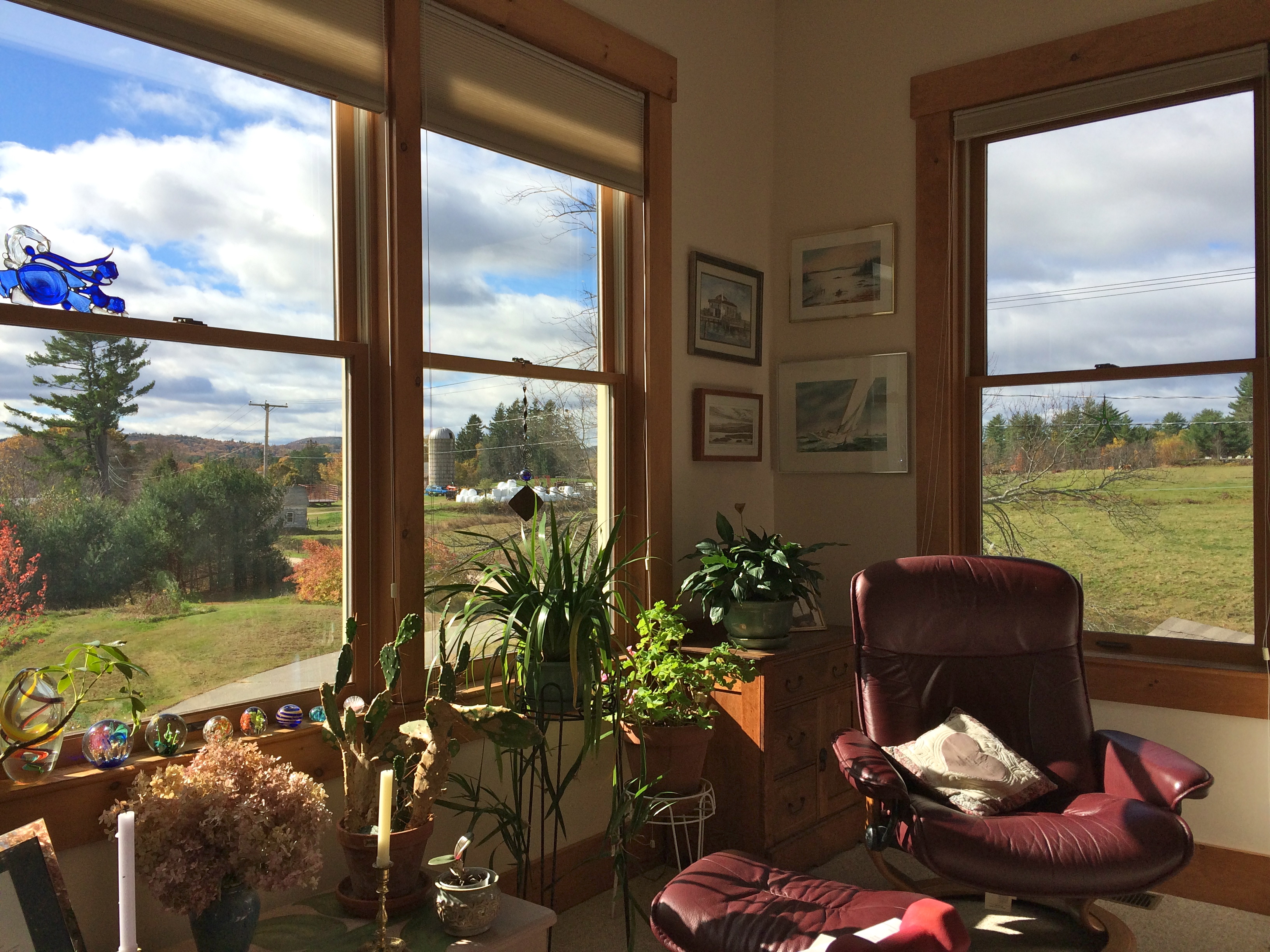
My study is a room with a view, full of light.  Three big windows face south and one faces west, all looking over pastures and the remains of a dairy farm, with the mountains of Epsom as a backdrop.  When Eric was alive, this was his favorite room, with the TV in the corner and his stylish Danish recliner positioned for a view out the windows or at the television screen. When Eric was dying this is where we put a bed for him to spend his last weeks.  That was partly because of the television so he could watch Red Sox games or his favorite movies, but it was also because this was, essentially, his room.

It remained his room for years after he died.  No one spent much time here during those years.  A new, large, flat screen TV had been installed in the family room, part of the finished upstairs of the barn, and the “tower room” as we called it then, the second story of the tower we built to connect the upstairs of the house with the rooms over the barn, served as a passage between rooms, not as a place anyone hung out.  There was still too much sorrow in the room, too much weighted memory.

Six years ago, when I first started to think about moving my study in to this room, my friend Marsie was over for a visit.  I brought her upstairs to show her how I might change the room in to a study and she stood by the western window for a few moments.  “There’s still a lot of Eric’s energy here, but Eric is getting ready for this to become your room,” she said.  “Talk to him about it and the energy will clear.”

Even though I’m not sure what I believe about how the energy of loved ones who’ve died manifests in this world, Marsie’s advice made sense to me.  I spent time in the tower room, thinking about Eric and all the changes in my life since he’d died.  I let him know I was going to transform the room, and six months later I did.

Now I have a glorious study with a view of trees snapping in a brisk wind and a hillside of russet and ochre oaks.  As I sit at my desk, I’m less than a foot from where Eric died.  He sits here with me and I sit here by myself.  I look out the windows and then look at the fall of sunlight in to the room.  I’m grateful and warm and reminded not to take any moment of this day for granted.  I’m here now.

Yom Kippur #9

IMG_3120

Life has been full of dailiness since my return home from our European travels.  There was mail to sort, arriving in piles for days after we got back — hardly a personal piece in any of it — plants to water, laundry, shopping and cooking, driving to visit all the family we’d missed, spending time with friends we’d missed, watching the trees turn and turn again to bare, meetings to attend, dump runs, doing dishes, running and recovering from running.

Staying present to all this dailiness, in the way I was to the unfolding amazement of traveling in beautiful places, when my only occupation was to see and think and absorb, has been easier than I’d expected.

I’d actually been surprised I was able to be so present during our trip — there was hardly a moment of overthinking about the luxury and privilege of comfortable travel or worry about someone back home.  Not that I didn’t think about how lucky I was to have the time and resources to enjoy Europe for weeks, or worry about friends and family back home. But those thoughts didn’t turn into feelings of unworthiness and my worries, mostly, didn’t get in the way.  I let myself sink in to the experiences: drinking wine on a leaf-shadowed patio in France, hiking in the Alps, sitting around a breakfast table in a garden in Italy, drinking coffee and chatting with European friends.

Really, what I’m saying is that I haven’t been anxious, the most common reason for me to lose track of my connection to each moment.  Was it the magic of travel that kept my anxiety at bay?  Meditation?  Medication?  Whatever the reason, I’m thankful my ability to be present to myself and what’s before me hasn’t shifted, even now that much more of what’s before me is the routine maintenance of life.

This is a long way of explaining why I’m several days behind in my annual Yom Kippur post.  Services were lovely — good sermons and outstanding music — and connecting with friends was sweet.  As usual I thought a lot about forgiveness and the knot of unforgiven hurt that still comes up for me every year.  I thought a lot about Eric — this is Yom Kippur #9 without him — and could picture him beside me through both services.  David and I told each other what our intentions were for behaving closer to the ideals we pray about on Yom Kippur.

Now it’s a bright autumn afternoon and I’m enjoying the light gleaming on the leaves of the plants in my study’s tall windows.  I know time is passing because otherwise nine years couldn’t have gone by.  But I also know there is stillness in the center of time, in the center of everything, and somehow I’m getting better at living in that stillness.  Centered.  Maybe it’s just a function of slowing down as I get older.  No matter.  It’s a pleasure to be here.

Cairn Rock

IMG_2273

“I have something I need to talk to you about,” my neighbor said, stepping out of his truck’s cab.  He’d stopped at the end of my driveway when he saw me heading out for a run this morning.  He looked upset and I was immediately worried.

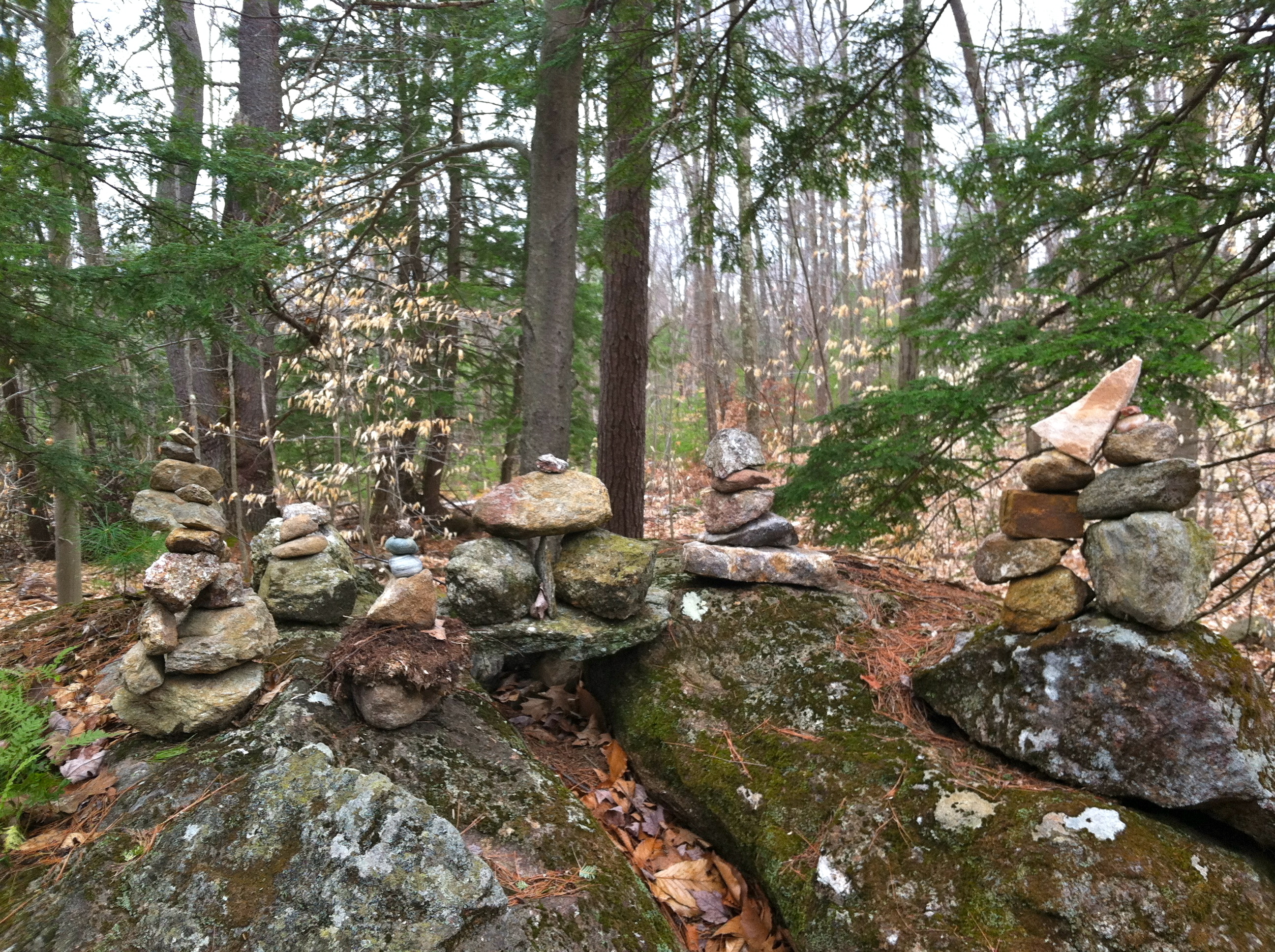
“You know we’re doing a lot of logging out the road,” he said and I said of course, we see a dozen or more large trucks a day going by our house, making the sharp left turn to climb the small hill of Canterbury Road up through the fields and then into the woods. The same road I’ve written about before, the road I walk to a large set of rocks where I’ve been building cairns for Eric since he died.  The closed trailer trucks come back out the road packed with mulch; the open bed trailers with tall steel side supports roar by stacked with huge logs of oak.

David and I walk out there often and have been watching the progress of the loggers cleaning up blown down trees from the tornado in 2008, shredding them into mulch, and cutting tall oaks for lumber.   It’s the most action our street has seen since I’ve lived here.  It’s made the road surface in the woods much smoother for walking and we’ve been assuming the blockage in the road, that keeps us from getting to the cairn rock, will be cleared once all the lumbering in done.

“I told the logger I hired one thing he had to be sure to to be careful of,” my neighbor said, still looking worried through all my talking about how much work he’s getting done on his land and how much better the road in the woods is now for running.  “I didn’t want anything to happen to the rock where you make stone piles.”

“Oh,” I said, finally understanding why he looked upset.

“But there was a new young man working out there last week and he pulled trees over the rock and now everything is knocked down.  I’m really sorry.”

“That’s okay,” I said.  “I build those cairns for Eric, but I don’t mind rebuilding them.  I often have to pick up fallen rocks.  It’s fine.”

“I know the rocks are for Eric.  That’s why I really didn’t want them disturbed.  I feel so badly.  I’m going to clean out all the brush and bark that got left there and once the old road is open again you’ll be able to get to the rock and it will be all fixed.  I’m so sorry.” He was holding his hand to his heart.

“It’s really okay,” I said.  “It’s so sweet of you to be that concerned, but please don’t worry about it.  You’re completely forgiven.  I’m fine about rebuilding the cairns.”

“When I realized you were making those rock piles for Eric, I started doing it for my Dad.  He used to take me out there when I was a kid, and now it’s a place I go to remember him.”  His father died four years ago.

“It’s a good spot,” I said, nodding.

“I have photographs of it so you can see what it was like before it all got knocked down.  And I’m going to make it even better.  I’ve gotten a granite cross I’m going to put out there.”  Now I knew where the cross made of lashed together branches that appeared on the rock this spring came from.

“Oh, that’s so nice,” I said.  “You’re so kind to stop and tell me all this, but really, it’s completely fine.  It will be a pleasure to rebuild the cairns.”

Eric would be delighted by the sequence of events that have led to a granite cross marking his remembrance rock.  I’ll make a Star of David with lashed together branches and put that next to the cross.

Journal Journey

IMG_2294

The journal is beautiful.  Covered with textured paper and bound with string, its large pages are thick and creamy, flecked with fibers.  When I couldn’t sleep one night almost six years ago, staying with David at a friend’s camp on Bear Island in Lake Winnipesaukee, I got up to write.  As I sat down and opened this journal, which David had recently given me, I thought to myself, “I’m going to write a book, in this journal, and only write it on islands.”  I filled that journal over the next eight months, always writing on islands, and have since filled many more pages on many other islands in other journals and on my computer.

When I started writing that night, I had no idea where my intention would lead and certainly never thought I would soon be recording another difficult life passage, as untimely cancer death bumped up close again within weeks of our time on Bear Island.  Turning that original island journal into a full story, into the book I’d imagined, has also meant going back to my life with Eric and how losing him reverberated in so many unexpected and disorienting ways.

That’s the memoir I’ve been working on over the last several months, starting with my time at Vermont Studio Center.  Several blog posts lately have talked about the difficulty of revisiting such turbulent times in my life, but there’s more to it than how hard it sometimes is.  It’s also necessary.

As one writer friend said to me, when I told her there are days I start to hate this book, “You have a story to tell and this is your story.”  She shrugged.  Another writer friend asked, “Why are you writing this book,” not to challenge me, but to understand why I’m engaging with a subject that’s clearly hard for me.  “It’s a story that resonates with people, that I want more people to hear,” I said.  “It’s about recovering and getting past something you feel you can’t get past and learning how to go on.”  She nodded.  She understood.

I understand too.  I need to do this, which is why I’m sticking with this book, even when it makes me uncomfortable.  How could I have known opening this lovely journal on a summer night six years ago it would lead me here?

Eight Years


Eric Schain1

What does eight years feel like? The grain of memory runs against the rushing train of time, and too many mornings of sun through the windows as I first walk into the kitchen get crushed into today. For the first two years after Eric died the early sun made me cry.  “Why do you do that to yourself?” my therapist asked me and all I could think of was the river I was swimming across and how some days the river seemed to widen into infinite water. The sun was in my eyes.

“You won’t always wake up to the slap of it,” a friend told me in the months afterwards.  She knew, because it had happened to her, that every morning when I woke the first thing I felt was the truth of Eric’s absence in my gut, as if I was being hit with a 2×4.  Hard.  My friend was right.  One day I woke up to sadness, but it had softened.

“It will change between the second and third year,” another friend who lost her partner told me and again, she was right.  There was no day or week or hour or moment I could point to and say, “there, that’s when it changed.”  But at the third year “deathaversary” the grief had spread out into a quieter pool.  I could touch the shore on the other side of the river.

I still tell time by before and after Eric, but now that it’s been eight years it’s more events than emotions I can track.  One morning last week he visited me in a dream, walking into the house with a brown paper bag under his arm.  What was in the bag?  Peanut M&Ms and Twizzlers, his favorites?  A bottle of single malt scotch?  Milk for coffee in the morning?  His appearance was so ordinary and extraordinary.  I was glad to see him.

It’s been eight years.


The Train of Memory

IMG_2271

Passover is over, the train of memory that carried me into this year’s observance has moved on.  Working on the memoir I’m writing has meant living in the present moment (or as close to being present to the present as I can get) while on some level reliving the turbulent years that are at the center of the book.  Part of the book’s story is Eric’s illness and death.  Eric’s metastatic disease was first diagnosed just before Passover in 2006, and Passover this year was almost exactly the same time as that year.  It makes sense that the overlay of date and season, along with significant immersion in my experience of that period of my life, would make this Passover carry an extra weight of memory and grief.

One thing I’ve discovered in working on the memoir is how much of the story of Eric’s illness I was telling David two years later, shortly after we met.  Many days in April of 2008 I was writing emails and letters to David, telling him what had been happening on that day two years before — this is the weekend Eric first slept all weekend and hardly ate, this is the day he went back to the doctor and ended up at the hospital, and on and on.  I couldn’t help reliving everything and writing it down helped make it easier to carry. Having David to write it to made it easier still.

I’m having another one of those years.  Because I’m writing about and reading about remembering each day as if overlaid with that day in 2006, I found myself back on the train of memory.  Here is a letter I wrote to David on April 13, 2008:
Eric’s diagnosis came just before Passover, the Jewish calendar is lunar so the dates float across the Roman calendar. Two years ago tonight was the night we were going to host a Seder here with our NH Jewish friends, a Seder tradition dating back to when we first moved to NH.  I was so delusional in the face of Eric’s mounting illness I’d shopped for the big Seder the weekend before even while knowing on some level it would never happen.  So two years ago Eric was just home from the hospital and we did a little Seder with just the family. Eric told the Passover story, gave a short history on the tradition of the Seder, and Matt told Adrienne later that it had been great to listen to Eric, he’d learned so much, he wished he’d have more Passovers with Eric. Adrienne told Eric Matt had said that, then Eric said to me (so much circular conversation!) “Well, that’s a reason to stay alive for another year. To teach Matt more.” And Eric was dead in three weeks. Yikes. I’ve been crying a lot tonight.

But time is on its constant track, so even as I remember sad times from eight years ago, or remember remembering six years ago, today is today and we had a wonderful Seder last week with some of those same friends.


Still Snowing

IMG_2202

I love snow, and woke to a world full of it this morning, snow piled to the railings on the back deck, a huge white hood covering the grill.  Sitting by the wood stove with my cup of coffee, the kindling I’d set on the coals flicked into flame, a burst of light through the glass door. The blush of color ringing the dawn horizon deepened and caught fire also.

All the snow in the past few weeks, the storms and the skiing, and my obsessive checking of weather forecasts, reminds me of so many winters, so many treks through deep snow, so many outdoor adventures reveling in the way a great storm transforms the fields and forests into a cross-country skiing paradise.

In the year after Eric died, I couldn’t bring myself to ski or enjoy winter.  Snow storms made me sad.  Skiing had been such a part of our lives together, it didn’t feel right to ski without Eric.  I spent that first winter watching storms, rather than celebrating them.

Recognizing how far I’ve moved from that place of paralyzed grief, I remembered this poem from The Truth About Death, which I wrote just about exactly 8 years ago.  Eric would be happy knowing I’m back to celebrating explosions of snow like the storm that rode through New Hampshire yesterday.  He would have loved this winter.  Let it snow.

Valentine’s Day

The first real storm washes out the little color
in the landscape, the barn and shed and silo
weathered to the gray of a cut snow bank.
Sparrows peck in the perennial bed, tall stems
and seed heads clustered through snow. Small storms
of snow blow up off the roof of the hay shed,
sweep past. We would ski at midnight to catch
the pure snow before the storm slipped over to sleet.
So much happens every day, I need a wagon to hold
the hole. Last night I lay on the kitchen floor,
where our cat slept for her last year, her old body
bony, weightless. I noticed the narrow maple
floor boards running under the hutch, thinking
the world is flat even as I know it is round.

Day 14: The Next Season

Gratuitous Mimi Pride Photo Having Nothing To Do With the Blog Post

12:11 p.m.  Winter solstice, the moment of the shift.  Earlier today, as David and I drove to yoga class, the sun was a huge ball of fuzz in a cloudy sky, a ring of blurred light much bigger than itself.  Then the day sank into a gray dimness. Now the sun is out again, snow is dripping from the roof and I’m on the porch as I write, fingers bare on the keyboard.  A bit of spring on a day that will soon be dark again.

Can I celebrate the darkness?  That was the focus today in yoga class, to find the impulse inside for what is coming next, what is going to grow, how the stillness of this season, when so much of nature has quieted, can let us go deep enough to find what needs to emerge.

Mostly I feel like I endure the growing darkness and steel myself to get through the days of diminishing light, reaching towards this point, when the earth’s orbit starts to tilt us closer to the sun again.  But I know there are many more months of darkness to come, and that this is just the beginning of a season, even if the light is changing.

So I’m going to focus on making darkness my ally.  Cultivating a capacity for stillness is completely new for me.  Sitting still, concentrating on my breath, and listening to a teacher talk about finding balance in my mind, body and spirit is something I always thought I wanted to do, but never thought I would actually do.  Now I am.

Wherever embrace of the darkness and a focus on inner impulses leads me, I’m ready.  Tomorrow night when we gather with friends to celebrate the solstice, lighting candles and making wishes for the coming year, I’m going to welcome the darkness, rather than try to race through it.  Slow down, breathe, listen, and let what needs to emerge come to the surface.  I’ll say hello, most likely write about whatever it is, and move through it.  Namaste.

Day 7: Balance

IMG_2021

I cry during yoga.  The first time it happened was the first time I went to a yoga class in my latest attempt to bring a regular practice into my life.  When we settled in for shavasana, the lying pose at the end focused on relaxation, the teacher talked about gratitude for the chance to practice yoga, and being aware of what we could let go as we sunk our backs deeper into the floor, scanning our bodies for any places that still needed to release tension.  I felt a surge of tears rise and then quickly subside.  What was I letting go?

Then it happened again a couple of yoga classes later, and this week it’s happened every time I’ve gone.  Thankfully, that’s been a lot.  I’ve been telling myself I should start practicing yoga for almost a decade, and lately I seem to be doing just that.  I’ve been to yoga three times this week and am enjoying it and looking forward to it so much I’m hoping it’s going to flow right into being a regular part of my life.  Finally.

Today the teacher had us begin in crocodile pose, face down on our mats, our heads resting on our hands.  She wanted us to be able to feel our breath fill our bellies, pushing against the floor.  What I felt were tears rising again.  “We carry stories in our bodies,” the teacher said as we settled into an awareness of our breath.  “If we can make the stories not personal, if we can leave the drama and hurt that might go with the stories behind, we can work on accepting where our bodies are right now.”

Is it finally sitting still with mindfulness that’s letting some sadness rise to the surface for me?  Is it the practice of yoga itself, with its focus on the balance of mind, body and spirit, that’s pulling an unbalanced part of my mind and spirit back into a softer place?

The sun has been riding through the wall of gray storm clouds to the south all morning, sinking into a hint of light then brightening again into a broad halo.  By late afternoon it should be snowing and the world will be all gray and white and black.   Something is sinker deeper in me right now, or something deeply sunk is rising.  Or maybe both, a knot of sadness that’s surfing the stillness I’m cultivating.