Be Happier

1378488_759276826206_1352928517_nThe unveiling of Natalie’s tombstone was Sunday at the Hebrew United Cemetery in Waterbury, CT. David and I met Adrienne, Matt, Emilio and Sam early for bagels (I think Waterbury has been the center of my bagel-eating life), then went to the cemetery to meet up with Eric’s brother and sister and cousin.  We’d all been to this cemetery many times, for the burials and unveilings of Eric’s parents and an aunt and uncle.  But we’d never been there in anything but inclement weather, either so frigid it was painful to stay until all the dirt had been shoveled back into the grave (a mitzvah the Rabbi had excused us from at Natalie’s funeral, saying it was dangerously cold) or so hot retreating to shade was the only sensible thing to do as soon as the service and burial were completed.

But Sunday we had over an hour in the cemetery before the unveiling, so we walked far from the corner where Eric’s parents and Aunt Belle and Uncle Babe are buried, into an expansive and attractive cemetery we hadn’t even known was there.  There were tombstones shaped like tree stumps, in a variety of thicknesses and heights, iron-fenced enclosures, and tall hard wood trees filtering sunlight through red and yellow leaves. Lovely.

When the Rabbi arrived and began the ceremony, he started by talking about Natalie’s legacy.  “What we all learned from Natalie was to try to be gentler, be kinder, be happier and be friendlier.”  Yes, I thought.  Exactly.

Because you can decide to be happier.  The field of positive psychology is burgeoning and is full of research about how to be happier, including tryng to be happy.  Concentrating on the positive aspects of life, celebrating all successes, however small, and focusing on what there is to be grateful for all contribute to a more satisfied state of mind.

When David and I saw the movie “Lincoln” last year, we looked at each other during the scene when Abe turns to Mary and says, “We must try to be happier. We must. Both of us. We’ve been so miserable for so long.”  David and I felt like Abe was talking to us.

Want to try being happier?  Read about The Habits of Supremely Happy People.  “Martin Seligman, the father of positive psychology, theorizes that while 60 percent of happiness is determined by our genetics and environment, the remaining 40 percent is up to us.” I’m working on that 40% and it’s working.

Too Hot to Blog

This slideshow requires JavaScript.

I’ve been busy, not that being busy is in any way unusual for me, but there have been deadlines to some of what I’d had to do this past week (consulting work), and getting things done that require paying attention, sitting at a desk, in a hot house, has not been easy.  Normally, I spend an hour or three at a time at my desk, whether writing a grant as a consultant, or doing a webinar, or doing my own work, editing poetry or writing an essay or pulling something together for one of the boards I’m on.  When I get restless, which happens a lot, I go outside and weed my garden for a while, go for a bike ride, a swim, a walk, or pick some of the abundance of wild blueberries this year, something outside and direct and physical.

Not this week.  When I needed a break from my work, I just walked around looking for a cooler space in the house.   Being outside during the day was impossibly uncomfortable and hot.  I did go swimming, but not much else.  I got my work done, went for a swim, then sat on the back deck at the end of the day with David, both of us basically panting, trying to stay cool enough to get through dinner and get into bed with multiple fans blowing on us.  My brain was on semi-permanent melt — work, eat, collapse.  What was there to say that would be interesting for a blog?

But I was paying attention to the forecast (another thing that is not in any way unusual for me) and kept seeing the temperatures predicted for Friday as being the highest of the week.  Early in my week of work, I decided to get what I needed done completed by Thursday afternoon so David and I could have a summer vacation day on Friday.

We did.  We got up yesterday morning and put the kayak racks on the car for the first time this summer, then loaded up the kayaks and a cooler of snacks, and headed for Squam Lake.  Squam Lake is a special place for me.  It was our family vacation spot for all the years from when Sam was a year old until two years after Eric died — 21 years. Kayaking on Squam was Eric’s favorite thing to do, the lake his favorite place in the world.  The day Eric died, as we were trying to figure out how to prepare his body for pick up by the funeral home, Adrienne, Sam, John and I agreed that nothing would be so fitting as dressing Eric in his kayak shorts and water shoes.  We considered putting a paddle beside him, to be tucked into the coffin and buried with him, but knew Eric would object to that as a waste of good equipment.

As David and I turned onto Metcalf Road yesterday, headed for the kayak launch spot on Squaw Cove, a wave of memory passed through me, bringing back all the years of getting ready for a week on the lake, all the years of Eric and I kayaking to favorite spots to swim and pick berries and relax, all the years of dipping our paddles into the clear lake water as we watched the march of the Sandwich Range mountains fading into the haze of summer days on the north shore.

Yesterday on the lake was perfect.  It was viciously hot in most of the country, but fine sitting on the fine white sand beaches of Squam Lake, half-submerged in water.  David and I paddled and swam and read and had a picnic and I wrote in my Island Journal, a memoir I’m writing that I can only write while on islands (more on that in a later post). We went to three islands yesterday.  At one point I asked David how he was doing (not an easy week for either or us, for reasons as easy to ascribe to the heat as anything else) and he said, “I’m great.  This is the essential ‘us.’  Getting out into the world and moving and being and enjoying”

We didn’t leave the lake until dinner time, driven back to our car by hunger.  We picked up sandwiches in Holderness and ate sitting on a dock, watching the light fade over the water.  Yes, maybe it was a week too hot for blogging, a week to hot for anything but getting done what had to be done.  But it was an evening cool enough for imagination, after a week soaked in the sweat of real life and obligation.  Time to let go.  Time to float into a weekend as the cooler air moved in.

Razor Life: Seven Years Later

IMG_1352

Seven years ago today Eric died, on a glorious, sun-drenched day.  The forsythia was blazing, warm air drifted through the open windows and the maple buds were dropping their red skin to let the green leaves out.

Six years ago I wrote this poem, on another day of spring sunshine, the forsythia bushes in the neighborhood bringing me full circle to the season of loss.  Finally, I was understanding Eric was really gone, and that holding on to life, while honoring his loss, might just be possible.  “Razor Life” is the penultimate poem in The Truth About Death.  It’s not an easy poem, it’s not an easy book, but it’s the truth as I lived it.  A sister poet recently reviewed the book on Amazon and Goodreads and said “grief is palpable, yes, but so is the skill of the poet . . . this is not a romantic look at death, but rather a blunt and powerfully raw assessment.”

That assessment now includes knowing the rawness of grief does ease, the razor edge softens, and days march on and on whether we can keep up with their beauty or not.  A few days ago I came upstairs to find a swallow flapping in front of the big windows in my study, the room where Eric died.  It had flown in the small opening of our shaded bedroom window and moved towards the light.  David helped it fly out without any harm.

I still watch swallows  against the sky and the cows are already out in the pasture across the road.  Everything changes; so many essentials stay the same.

Razor Life

The pastures are green again, right on cue,
the cows will be out in days. I steal lost time
to meet you, where the train runs into the river,
it’s dark and we move fast, forsythia flashes
gold in our yard, the neighbors’ yard, the bush
in the cemetery on the hill, the catbird who sang
above the blooming lilac in the weeks of desperation
on the porch after you died, you died, you did,
swallows high in the blue, their bellies white
as they turn. I am back to watching the sky,
we still have a car for everyone, we drive a lot,
I talk all the time, the machine is working,
it’s everything will be okay and ah fuck
at the same time, all the time, my razor life.

Last Ski

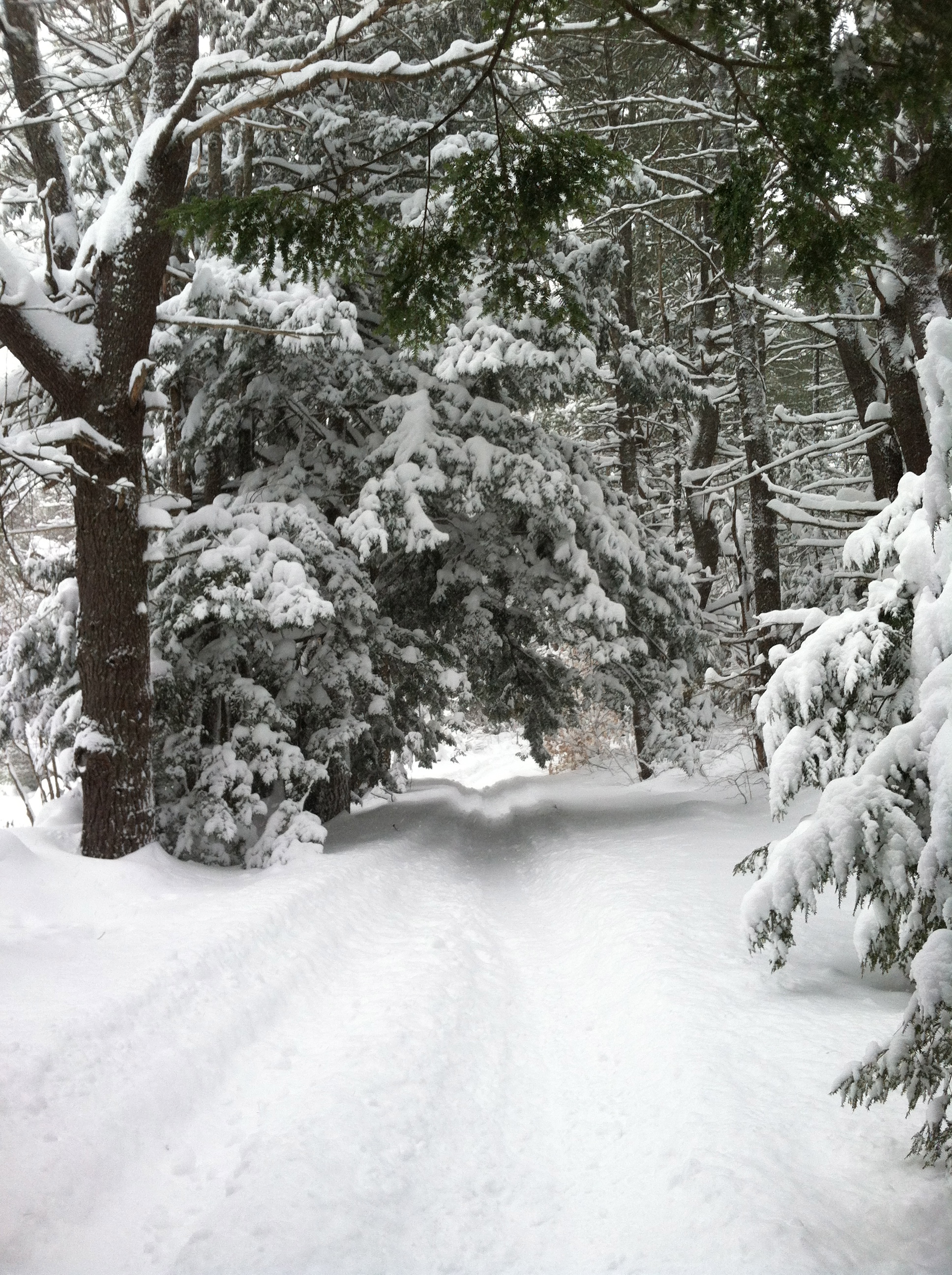
Alison and I did a last ski of the season on Sunday.  Okay, maybe it wasn’t classic skiing.  It was more like walking in the woods with skis attached to our boots, including literally walking in big ski steps across the open parts of the trail.  At the height of our climb up Tarleton Road, just below the steep pitch to Neville Peak, there was still a good bit of snow, though it was very soft and wet.

IMG_1270

But further down the trail, there were many spots where the snow was gone, so we skied around grass and sticks and rocks.  At one point coming down a hill, one of my skis was gliding through the wet snow, the other slipping through a mud puddle.  But we were skiing, celebrating a great season of snow.

IMG_1271

A good ski year is always a reason to be grateful, and this year I’m also grateful on behalf of someone I love who has most likely had her last ski, period.  As in she is so sick she most likely won’t be here during ski season next year, and if she is, she won’t be skiing.  She could barely ski this year.  I carry that reality with me, grateful for what I have and what I can do, and holding on to awareness of those I bring with me, those who can’t be out kicking and gliding through the frozen world themselves.

Generations of Jewelry

IMG_1244There was a package in the mail on Saturday, with the return address of my Aunt Muriel, and big $2 stamps plastered on the front.  Aunt Muriel is a writer, and for years we’ve exchanged news of our writing when we exchange holiday cards.  She was delighted when The Truth About Death was published, and I cheered for her when she had stories selected in local writing competitions and published in local papers.  It’s been a relationship of letters that I’ve valued, even though I haven’t seen her for 30 years or more.  I didn’t know what to expect in the package, since it’s past the usual holiday card exchange time frame.

Inside I found an ancient looking jewelry box, and a card.  The card read, “I have enjoyed keeping in touch with you and reading and empathizing with your work.  I am getting near the end of my life, and I have been going through and deciding what to do with different things and ‘treasures.’  I came across this piece that was made from Grandma McKinlay’s necklaces and I thought you might like to have it.  I hope having it will please you.”  I opened the box, which had been carefully taped shut, to find a necklace of shell beads.

Delighted with the gift, I brought the box and card to show Alison the next day, when we met to go skiing.  “Just look how old this box is.  What, maybe 50 years old?”

“Wait, I have a box just like that,” Alison said and went upstairs, coming back with a box that, though a big larger, was indeed very like the box Aunt Muriel sent me.  Alison opened the box to a pink and silver pin.

“My Aunt Jean gave me this at the end of her life,” Alison said.  “It’s a pin my mother gave her, and that she thought I’d like to have.”  Alison’s mother died when she was a child, and her Aunt Jean knew it would mean a lot to Alison to have something from her mother.  “There’s even a card,” Alison said, pulling out the small card behind the pin.  “My mother gave this to Aunt Jean for a birthday, and told her it would look good with her black and white dress.”

The fact that Alison and I will most likely never wear the jewelry our elderly aunts gave us doesn’t matter.  We both have “treasures” that we may pass along some day ourselves.

Blizzard

IMG_1176I couldn’t ski the winter after Eric died.  He had once said about me, “Grace would choose cross-country skiing above everything except her children,” and he’d been right.  Though I had started as a downhill skier (I cut insignias and racing numbers out of sticky cloth for my father’s sail making business as a young teen, 5 cents a number, saving to buy myself inexpensive downhill skis and skiing lessons at the ridiculously small, but still skiable, Blue Hill Ski Area outside Boston) from the first time I cross-country skied I was in love.

My parents gave me wooden Bona skis for Christmas in 1977.  Eric and I were living with friends in Williamstown, MA, and there was an abundance of snow and hills.  I went out into the sloping fields across the street from our house one afternoon and came home and told Eric he needed to buy skis.  He did, though he’d never done any kind of skiing before, and gamely followed me up and down hills, learning to snowplow, learning to turn, learning to glide.  That was the beginning of almost 30 years of skiing together.  When I was first faced with skiing without him, I just couldn’t do it.

Then the next winter came, and I realized that not skiing, because Eric couldn’t ski, wasn’t doing anyone any good, least of all me.  “Get over yourself and get out there,” I said to myself, and I did.

When the grand dump of snow blew in to New Hampshire at the end of last week I was delighted.  The idea of a blizzard, as long as people could be safe and warm and dry, was exciting.  Waking up Saturday to continued snow and drifts up to my hips all I could think about was getting out skiing.  Which made me think about Eric.  “Active with glide,” was how Eric described his favorite outdoor activities — skiing, kayaking, biking, swimming.

I was in touch with Adrienne and Sam Saturday morning, both of them wanting to ski as much as me, but too far away to join me.  And my sister, who loves to ski but can’t manage it right now due to health challenges, had told me to ski for her.  So I had a whole pack skiing in my head this past weekend, gliding along for the ride.

Lucky

I ran into a friend last night while out with David.  “How are you two?” she asked.  “I hope things are settling down.  When I saw your last blog post I thought ‘No, not more tough stuff.'”

She’s right.  Enough tough stuff.  One afternoon shortly after Eric was first diagnosed with metastatic ocular melanoma, and we realized how very sick he was and how little time he had left, we were lying on the bed together talking.  “We’re the luckiest unlucky people in the world,” Eric said, and I agreed.  The cancer was enormous bad luck, but we were so lucky in so many ways — our love and marriage, our children, our family and friends, our comfortable and privileged life.

After Eric’s original diagnosis, three years before, I’d thought a lot about the concept of luck, and how often we only perceive our good fortune in contrast to what could have been worse.  Here’s the poem I wrote then.  I’m still as lucky as ever.

LUCKY

to be alive after an accident,
after a grave illness, to be able
to recover and comprehend
all that could have gone wrong

the wrongness that happened
the reference for all that’s left intact.
Why do we need misfortune
to remind us how full the bucket

of luck is, each moment unfolding, one
glow after another, out in the silver
dawn, out in the indigo dusk, hauling
our luck around with us, holding on.

Darkness and Light and Sweetness

This slideshow requires JavaScript.

Last Sunday evening Adrienne, Matt, Melia, Emilio and I went to the Rise of the Jack O’ Lanterns at Old Westbury Gardens, near where Adrienne and Matt live.  The advertised 5,000 or more hand carved Jack O’Lanterns were not disappointing.  Rather, they were a visual delight, glowing in long rows along the dark path, many with intricate paintings and carvings of flowers, trees, butterflies and celebrities.  Emilio was very excited to see Kermit and Frankenstein.  “Kermit, again?”

But the best part of the evening was when we were leaving.  As we walked to the car we passed a large pedestal with an eagle sculpture on top and pointed it out to Emilio.  Looking back at it Emilio said, “Bye-bye, Eagle.”  Then as we drove out of the Gardens, settled back in his car seat, Emilio said, “Bye-bye, Jack O’ Lanterns.  Bye-bye, Pumpkins.” No tantrum about leaving, no fussing and whining.  Just a sweet moment of Emilio letting life pass along on its swift track, ready for whatever was next.

Life’s Left Turns

Navigating the unexpected left turns in life is no easy thing.  Taking a left turn is always tricky — assessing the oncoming traffic, making sure there’s space for you to cross lanes, moving swiftly but confidently in the face of not being quite sure what might pop up in front of you.

After Eric died, I read a good bit of Pema Chodron, and was very attracted to her messages about embracing groundlessness — letting go of our expectation that life always has to be happy and perfect and planned, and realizing that life is a process unfolding in unpredictable ways that bring both joy and pain, loss and gain, grief and acceptance.  Being truly present in each moment of my life, and understanding that that’s really all there is, was a lesson I learned through my grief process, and one I have to keep relearning.  Remembering that my attachment to the idea that I know exactly where I am and where I’m going is an illusion, and that the groundlessness of life is going to catch up with me over and over again is helpful.  Get back into this moment, because really, that’s all there is.

It’s warm enough to be on the porch writing this afternoon, and I’m grateful for the soft air and the shelter that lets me be outside as intermittent showers veil the fields surrounding me.  The maples that still have leaves are yellow, and the oaks are amber behind the gray rain.  This is a moment to savor as I spin the wheel to the left.

A New Year

Today is the fourth day of Rosh Hashanah, the Jewish New Year.  This year I was given the honor of delivering the D’var Torah during the second day services; it’s a tradition at Temple Beth Jacob for a member of the congregation to be the guest speaker on the second day.  A D’var Torah is a talk related to a portion of the Torah (first five books of the Jewish Bible), usually that week’s portion to be read during services, often including life lessons and commentary.  A sermon, in other words.

Eric was deeply involved with Temple Beth Jacob, and had written five different D’var Torah commentaries over the years, for different occasions.  I read them all, trying to plan what to say.  It was wonderful to reconnect with Eric in that way, to remember his commitment to Judaism and to sustaining a strong Jewish community.  I didn’t end up with a plan about how to focus my D’var Torah, but I did end up talking about the Yiddish saying, “One plans, God laughs,” and how planning can be laughable, in both a discouraging, and encouraging way.  Because our plans often get interrupted by unfortunate events, but we also often end up in fortunate places without any planning on our parts.

My talk went well, and those at services on Tuesday were uniformly positive in responding to my talk (I talked a lot, also, about Eric, and David, and the twists and turns of life and death and moving on — I’d put the talk up here, but it’s too long for a blog post).

But best of all is the herons I’ve seen every day since the beginning of the New Year.  Great Blue Herons were Eric’s favorite bird, and I see him when I see a heron.  The last two mornings, out for my morning run, a heron has lifted out of the brook I was running past and slowly flapped its long wings to cruise along the course of the water.  “Hey, Eric, Shana Tova,” I thought and heard Eric saying back to me, “Good job.”