Petal Salt

This slideshow requires JavaScript.

The early blossoming trees and bushes are ringed with color, their pink and white petals fallen like petticoats that have been dropped into the grass.  I first saw this a few weeks ago in Tennessee, where the azaleas were finishing up their blooming circle and dropping their blaze of colors.  Now I see it here in New Hampshire, again with azaleas and apple and cherry trees.  I love the richness of color in the landscape now, trees at their peak of showing off.  Here is a poem from long ago that comes to mind every year at this time.

Rising

What is the weight of a flower, the weight
of a tree bearing such blatant intent?
Every mass of blossoms, snow cloud,
exclamation, exuberance of fruit
to come, has a future, a history,

a moment of abandon, petals
splayed wide, drawing pollen to the core.
The wilt and decay towards apple
is hidden in new leaves, riches spent,
riches returned, petals salting the grass.

New Season Budding

David and I landed back in New Hampshire yesterday afternoon, after a week away. Having been in Tennessee, we were used to fully leafed out trees and flowering azaleas and roses and peonies.  But coming home to a week’s worth of bud growth on the trees here, the growing grass, the violets popping up in my yard and garden, was a welcome scene.  Trees are like grand flowers in NH this time of year, as their buds break into catkins and furry pods of unfurling leaves, blurring the landscape with red and gold.  I wrote this poem about 15 years ago, but still remember it every year at this point in the season.


Habitat

I don’t inhabit my skin.
Here’s a story that hasn’t been told
about the trees, first budding,

branch tips tinting the horizon.
Trees don’t inhabit their bark;
all parts are one wisdom, one being

translated through one set of roots,
fibers drinking from the same soil,
then feeding that soil when dead.

Afternoons cloud over as expected,
dimming the sunlight that torches
those reds, oranges, yellows

of leaf buds splitting open to green.
Now begins gradual disappearance —
the long view constricts to the brevity

of the yard. And on this side
I disappear, my skin and stories
coming with me.

Fast Forward Season

This slideshow requires JavaScript.

I’m sitting on a patio in a backyard of a suburban neighborhood in Knoxville.  Beyond the line of trees and low bushes that block this yard from the next I can hear a basketball bouncing and occasional voices of children.  The air is cool but comfortable against my skin.  Yesterday walking along the Tennessee River the sun was summer hot.  The roses in the front of the house are dimming in the light and the white fence that encloses the patio gleams in the dusk.  It’s past 8:30 and just now getting dark.  Traveling south and west this time of year is delightful, bringing me further into the warming and day-lengthening season.  I’m relishing this fast forward season.

Early Crocuses

This slideshow requires JavaScript.

The crocuses are up early across the Northeast this year, the year with more or less no winter.  I saw crocuses weeks ago in New York, and now they’re here in New Hampshire. Helen’s crocuses, a carpet of spring  color on a neighbor’s lawn, planted decades ago by Helen Johnson when she was still alive, most likely long before I knew her when she was young, are blooming.  I wrote about the crocuses on this blog last year, including the poem about Helen and her flowers that was published in my chapbook of poetry, Fever of Unknown Origin.

Here’s another poem from Fever of Unknown Origin, this one about Norm Johnson, Helen’s husband.  Norm was a wonderful neighbor and a good friend.  He would pull his jeep over to the side of the road when he saw me in my garden and I’d go stand at his window and we’d chat.  Helen and Norman both died many years ago, but I think of them often as I look around my neighborhood, a lovely farm landscape they helped create and maintain throughout their lives.

And one interesting note, you can buy a copy of Fever of Unknown Origin on Amazon, for $3.00, or $66.00 or for $161.62.  If you want the $166.62 copy, let me know and I’ll make a deal with you.

Some Days

Stakes sawed raw at the point
slit the earth, hitting frost
only once all day, a good day,
for a body yanked by years
to this stiff heave from the cart
to help hold the barbed wire taut.

Most days are spent in a seat –
bucket loader, tractor, dump truck, mower,
these days mostly the jeep –
chatting with neighbors, napping, watching
one day as the milk herd is loaded into trailers
strangers drive away.

More Moon

This slideshow requires JavaScript.

As we walked up the old wood’s road towards the beaver pond, a stream of warm air came up over us.  “Where did that come from?” Alison said and she and I backed up and tried walking into that spot again, to see if we could figure out where the warmth was coming from.  We couldn’t, but as we made our way along the new trail to the pond, the full moon through thin clouds lighting our way, more warm winds blew over us.  It felt like spring washing in.

The mild night grew brighter and brighter, as the moon got above the clouds.  At the beaver pond the moon was high above the trees and the Neville Peak ridge to our east, reflecting off the soft ice.  John identified Mars sitting to the left of the moon and we sat and walked around and chatted and delighted in being outdoors on a warm night, in a bowl of silver light.

Winter Woods

This slideshow requires JavaScript.

We haven’t had much of a winter, so there has been very little time this season to enjoy the beauty of winter woods — snow-draped hemlocks, the monochrome world of white on dark-almost-black pines, the painting of tree trunks on the wind side of a storm.  But it finally happened last week — a snowstorm.

I enjoyed it thoroughly.  I skied twice on Thursday and twice again on Friday, and yesterday David and I went snowshoeing, our first time this year.  There was barely enough snow to need snowshoes, and the storm’s drapery had melted and run off in the warm temperatures and rain on Saturday, but it was still wonderful to be out, to be sinking into the lull that comes from one foot in front of the other among trees.

We took a quick side trail off our path down to a little gorge, where the Narrows Brook curls around a steep bank.  I always marvel at this spot, because it’s less than a half mile from my house, but I didn’t find it until I’d lived here for over 20 years.  There used to be a small wooden bench here, which has since fallen over and disappeared into the wetness of this dark but beautiful spot.  Eric and I would walk or ski or snowshoe here and sit on the bench.  This lovely corner of my world shows up in one of the poems from The Truth About Death.

A Trick

Now you are the gate in, as you were the path back
to my life when I saw you after my crash, minutes
of my life I will never remember, scars I didn’t notice
when you were alive. Your eyes have moved into mine,
we notice details – a twig on snow, lichen on an oak,
gray barely begun to be green, sap running again,
a predictable trick, the course of a brook through marsh
and meadow, around shaly cliffs of a hill of hemlocks,
gravity always in play, my fall from the bike, my lost
teeth, your death, my life, prizes we never expected.
Yesterday’s Haiku

I like the idea of being a day behind.  As I wrote two months ago, one of my hopes for the coming season of ascending light (it was at a solstice gathering) was to change my relationship with time.  Having always been focused on getting things done (and mostly on some deadline of some sort), and having managed anxiety by making sure I’m always very, very busy, I’m working on letting what comes to me, at least in my creative pursuits, come to me, and making sure I have enough open time for the surprises of the muse to get through.

So getting yesterday’s haiku up on my blog today is fine.

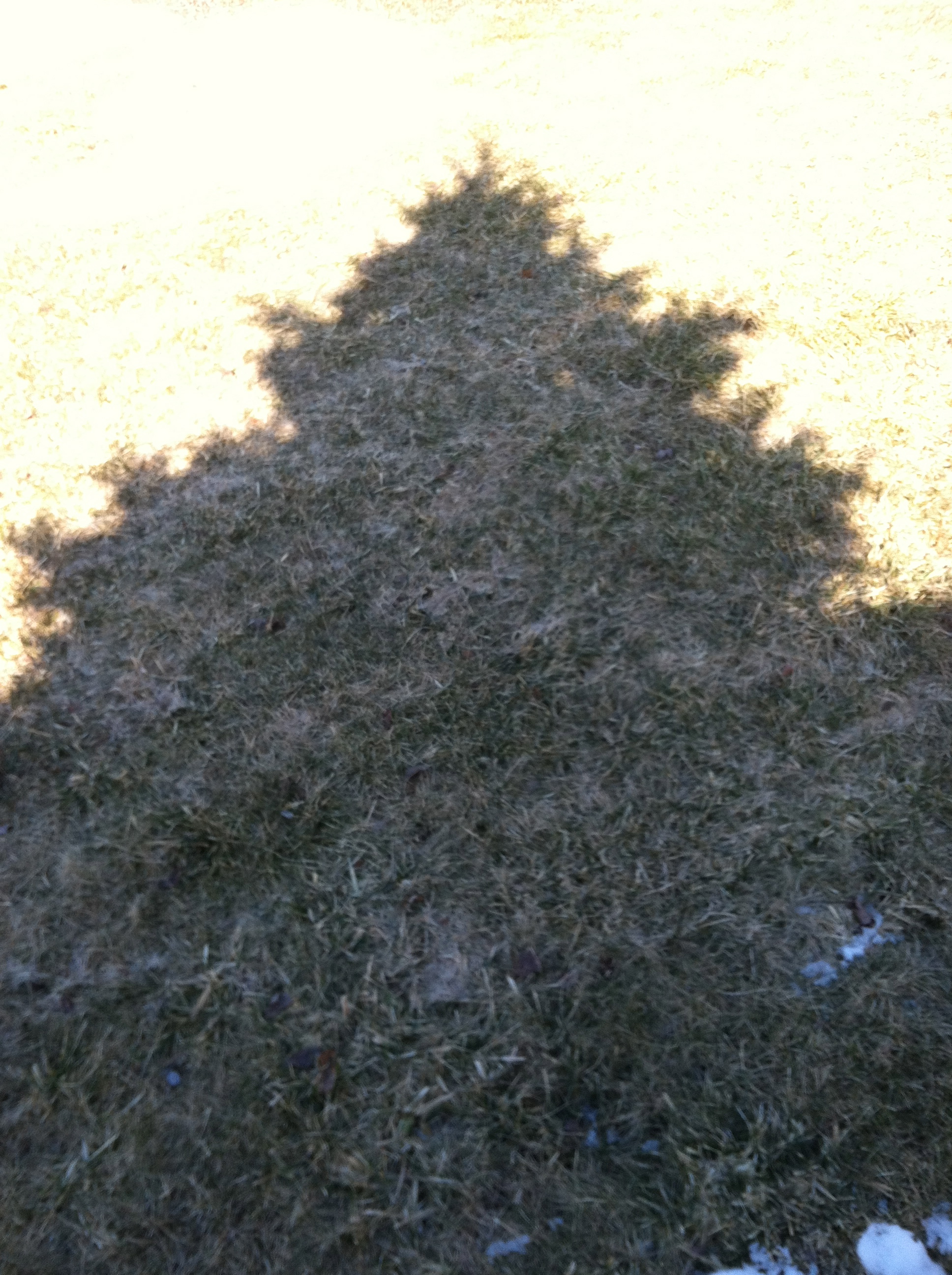
Low winter sun draws
Spruce shadow a spruce again
Barren season bared.

Silver Stone

We woke to snow this morning, pulled up the shades and got back in bed, letting the silver light fill the room.  In spite of predictions of a change to sleet and rain, the snow kept up.  We went for a walk, the cold wind numbing our faces the way the last week of new loss has left us feeling numb and dumb and clumsy.  I don’t even know what I did yesterday, but I do know I managed to grocery shop and cook and work on a poem and go to Yogurt Poets last night.  Is that enough for one day?

Then I went for a ski, my first ski of the season, so I said a Shehechiyanu blessing (for more on that see this previous post) and thought of Eric’s mother.  Eric always said a Shehechiyanu when he did something for the first time each year — like the first chance to cross-country ski or the first kayak of spring.  It wasn’t until after he died that I found out Eric learned that from his mother, Natalie.  We were at a Passover Seder together three years ago and she talked about how often she says the Shehechiyanu blessing and all the opportunities there are in a year to bless the return to a favored place or activity.

Now Natalie is in a hospital, recovering from a bad bout of shingles.  More worry.  But back to skiing, to being in the woods, my tracks leading back into the trees, snow draping the branches and quieting the inner chatter.  Blessed.