The Next Adventure

IMG_1687

“So you’re in the adventure phase of your life,” Joanne said to me.  I met her yesterday at a meeting I was facilitating in Phoenix, and at the lunch break she asked me about my decision to leave my job two years ago.  She was curious about the consulting work I’ve been doing and asked what kind of writing I do.  It was after I described all the unexpected experiences of the last two years, beyond the writing and consulting, that she made the comment about adventure.  “Yes,” I said to her.  “That’s a great way to describe what my life feels like.”

And now David and I are on what is labeled on my calendar as our Southwest Adventure. Tonight we’re in Santa Fe, visiting our friend Marsie, and tomorrow we head off to Arizona, then southern Utah, then back to Santa Fe, for a couple of weeks of hiking and taking in the stunningly scenic geography of this area of the country.

We started our adventure this morning with a short hike.  Afterwards we had lunch at the roof top cafe of the La Fonda Hotel, overlooking downtown Santa Fe, then meandered through the Plaza and some galleries.  When we got back to Marsie’s house, David sat out back on the patio, writing.  He read some of what he’d written to Marsie and me as we were preparing dinner, and I asked if I could use it here.  He said yes, so here it is, an amazing description of an amazing hike.

We hiked in Hyde Memorial State Park, northeast of Santa Fe, taking a 3 mile route, climbing 1000 feet to 9400 feet in the first mile, tasting high altitude for the first time and knowing we were quickly working at our limits of oxygenation.  Resting, slowing our pace, hydrating, all helped and it was a good way to start, lovely to climb on trails of bark mulch and graded pebbles, away from the road and into the sharpened focus of dry air. The edges of everything are razored clean, and the open space between trees, their undressed branches weave muscled lines of bonsai against the sky, the shimmering needles.  The blue is so deep and bottomless as to be flat.  It appears in the same plane as everything in the foreground, but is so obviously vast and distant, literally out of this world, that it stops the mind, effortlessly arresting the chatter.   The breezes, the temperature, the immediacy of the sun on our bodies heighten a sense of being in two places at once.  Something turns inside out on itself before this sky.  — David 
Wedding in Asheville

IMG_1586

We finally fell into bed at 2:oo a.m. Saturday in Asheville, NC for a wedding later in the day.  It had been an exhausting night of travel, and at that moment, the late planes, long car ride, and late late late to bed didn’t feel like it could be worth it.  I hardly knew the parents of the bride (long-time friends of David), had never met the bride or her sister (childhood best friends of Melia) and was struggling to contain all the sad thoughts that a wedding brings up for me at this stage in my life.  How do you mix the joy of young love with the awareness of lost and about-to-be-lost loved ones who will never get to be at the weddings of their children, and a too recent reminder that what seem to be heartfelt wedding promises can be betrayed?

Then I got to the wedding.  The wedding website had said that if it was raining, we’d all just wait on the porch drinking beer until it cleared.  So we did.  This summer has been even wetter in the mountains of North Carolina than it has been in New Hampshire, and thunderstorms and heavy rain showers had been moving through all day.  At 4:00 p.m., the set wedding time, it was pouring, and 200+ guests were standing on the porch of the historic Old Sherrill’s Inn, the Blue Ridge Mountains hiding behind the sheets of rain and the low clouds.  The beer was coming out of the keg with a thick head of foam, and the young man pouring it was telling us to plunge our finger in, to “kill the foam.”  It didn’t.

The first building at Old Sherrill’s Inn went up in the late 17oos, with most of the building construction dating to the first half of the 1800s.  The house is a fascinating maze of antique-packed rooms; the study was the original log cabin, the first dwelling built on the site, and a front parlor has walls of murals painted by the grandmother of the current owner depicting the history of the Inn.  But the best history of the Inn came from talking to the husband of the woman whose family bought the Inn almost 100 years ago.

There was a long enough break in the rain that the wedding ceremony, in a tree-lined bower up through boxwood paths that had me thinking of the “walks in the shubbery” from my recent re-reading of Jane Austen, had been able to proceed and was as sweet and natural as I’d expected, given what I knew of this family.  As we listened to the music and vows and prayers, swallowtail butterflies flew in and out of the leaves far above our heads.   After a huge group photo, guests gathered under the tent and began to eat and drink in earnest as a few early dancers tested the wet dance floor, set up under strings of lights and whatever stars might come out.

I walked down to the porch to get another view of the mountains to the north, hoping to have the porch to myself to sit quietly for a few minutes.  Instead, I met a delightful couple and talked with them about life and art and creative pursuits, just the sort of unexpected conversations that make weddings, with their focus on celebrating love and connection, so remarkable.  That’s when John, one of the owners of Old Sherrill’s Inn, came out on the porch, and told us stories.  And stories and stories.

His wife’s grandparents traveled to the mountains of North Carolina on their honeymoon, having married outside of Chicago.  They arrived at the Inn in 1916, and met the current owner, an 80-year-old man, and his wife, an 18-year-old woman.  The newlyweds expressed an interest in relocating to North Carolina and buying property, and the 18-year-old started crying.  “I’m the loneliest, most miserable young woman in the county,” she said.  “Please buy this farm so I can move into town and have some friends.”

They bought the farm and their descendents live there still.  John didn’t tell us what happened to the 18 year-old wife, but I can imagine.

The clouds had lifted and the ridge of mountains to the north were settling into a deep blue haze.  Stories floated off the porch and into the evening.  The rain came and went a couple more times throughout the evening, but there was plenty of time for dancing under the strung and unstrung stars.

Monhegan Island Retreat

IMG_1545

David and I are working hard.  He’s in a week-long plein air painting class, I’m intent on completing a first draft of my island journal, a memoir I started five years ago, meant to be written only on islands.  David’s gone from 9:00 until after 5:00 every day, and comes back to the cottage we’re renting with a painting or two, depleted from a day of concentrating on capturing the clouds or the ocean or a grove of trees in paint on canvas. I’m writing and walking the many miles of trails through woods and along ocean cliffs, and reading journals from years before, sinking back into the world I was inhabiting five years ago when I wrote the first of this book I’m trying to finish.

It was a difficult time in our lives, rich with new love and terrifying with the approach of another untimely death from fast-moving cancer.  Adrienne was getting married, and our family was managing the reality that Eric wasn’t going to be at her wedding, a wedding he and I had been planning in our fantasies for her for years.  I was trying to sort out how or if to respond to the best friend I’d lost in the previous year who was reaching out and trying to reconnect, in spite of the boundary violations that had led to us breaking up (and yes, you can break up with a best friend, it doesn’t have to be a lover) never having been resolved or completely understood by either of us.

Going back to that summer, to write about it, hasn’t been easy.

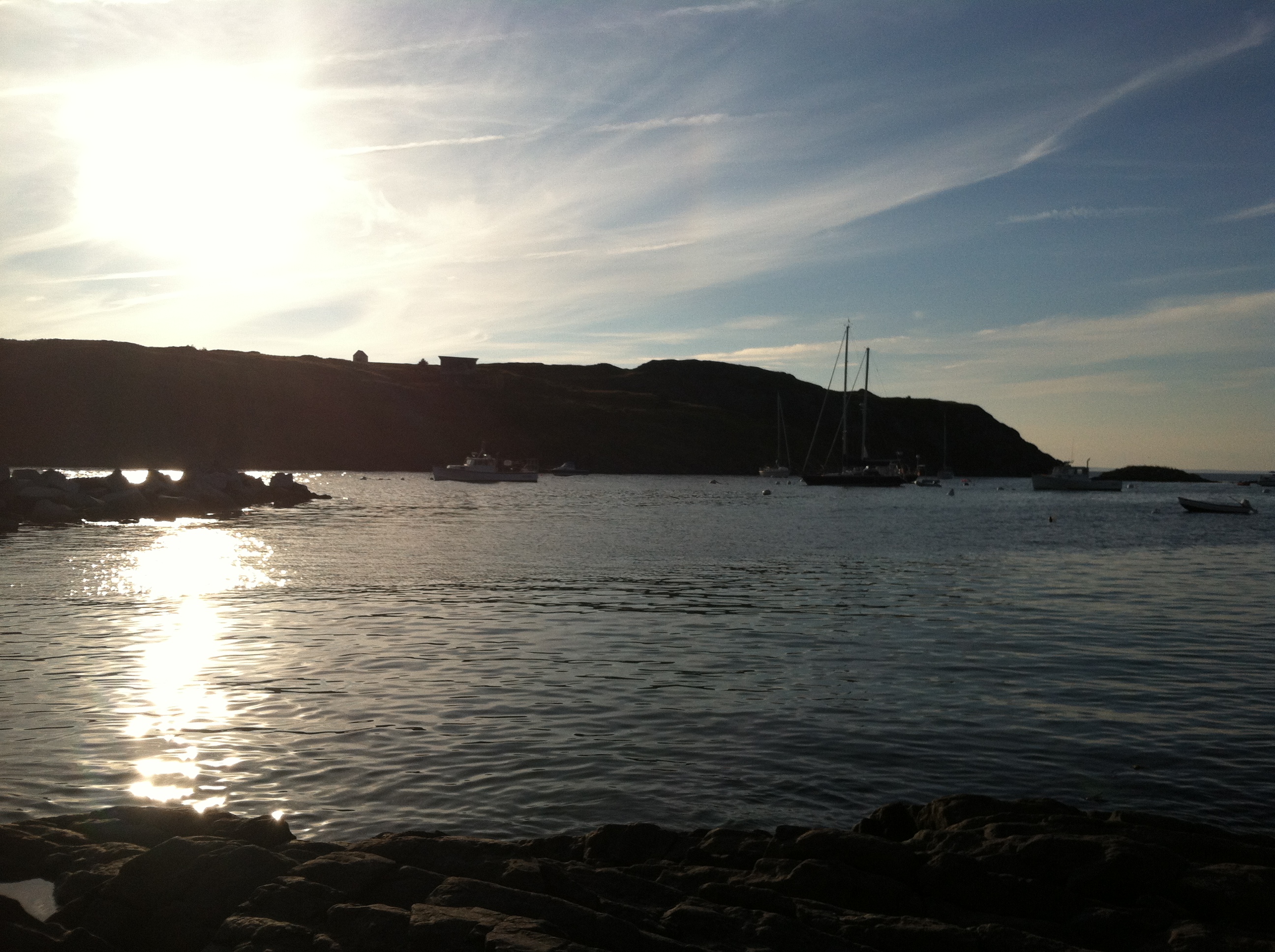
We met the painting group for a lobster dinner at the Fish House last night, a shack on Fish Beach that serves seafood across a wooden counter, with seating at sand-planted picnic tables overlooking the harbor.  Which is a pocket of water created by the rise of Manana Island, a small but tall hump of land off the western side of Monhegan.  Our first night here the harbor was full of fog.

IMG_1533

Last night it was clear.

IMG_1564

As the group talked about painting and writing and creative retreats, I was asked what my book is about.  “Love and death,” I said.  Five years ago when I was first working on the book Sam asked me what it was about.  “Death,” I said then and he said, “Well, that’s a new subject for you, Mom.”

At least now love is in the equation.

After dinner we walked back to our cottage, watching the contrails of all the jets (red-eyes to Europe we decided, coming out of New York and Boston and headed up over Greenland on their way to London or Paris or Amsterdam) bleed off into feathered lines of cloud.  The sun was reaching the water horizon, on the north side of Manana, and as we approached the Monhegan School House David mentioned that people had been talking about the good sunset views from behind it.  There was already a knot of people there watching.  One woman had binoculars, and after the sun was gone and we were all watching the after glow shift its pinks around the sky, she spotted a minke whale surfacing, out beyond a ledge of rocks.  Every few minutes we could see a bit of black break the surface of the water, then disappear again.

IMG_1568

A Tedious Habit of Introspection

IMG_1339

Albany is a city of contrasts.  Historic brick row houses line streets leading downtown, where the castle-like State Capitol building points its red-roofed turrets into the sky next to the stark, flat geometric shapes of the enormous Empire State Plaza.  “Albany is full of concrete,” Sam said to me when I told him David and I were headed there for his 40th medical school reunion.  Actually, it’s marble, not concrete, but the Empire State Plaza is a huge expanse of gray space, rimmed by tall gray buildings, and I could easily see why someone would remember Albany as a city full of concrete.  There’s even a giant gray Egg, a performing arts center that sits on the plaza like a space ship.

The highlight of the weekend was spending time with Harry, David’s good friend, and driving west out of Albany to a small town to find the farmhouse David rented for three of the years he was in medical school.  On the way there, David was talking about some recent issues that had been bothering him, and Harry said, “Your problem is your tedious habit of introspection.”

David and I laughed and nodded in agreement immediately.  Harry meant tedious to David, and in laughing and nodding in agreement, I was acknowledging how tedious my own habit of introspection is to me.  “You intellectuals think and talk too much,” another friend said to me years ago.

Yes, David and I are introspective and we talk about that introspection a lot.  In fact this blog post is going up a day later than I’d planned because we got caught in a long, tedious and deeply introspective cycle of talk yesterday.

But that’s okay.  We’re both old enough to be able to ride along with who we essentially are and make our way to the moments of appreciation and peace that the tedious process of introspection makes possible.

And how does this all relate to Albany other than Harry having made the comment there?  The contrasts in that city between ornate historic buildings and vast modern buildings remind me of what it’s like inside my brain.  Grand and multi-faceted, gray and flat, tall and wide, big in scope and rich in detail, simple and complex, all cycling in a swirl that lets me laugh at my own tedious habits and relish what they make accessible at the same time.

Three Days, Three Cities, Interrupted

IMG_1299

Yesterday David and I spent a few hours in Manhattan.  We dropped Emilio off at daycare, took the train to Penn Station, and went for a walk — 7 miles, through the Greenmarket at Union Square, then down the Bowery through Chinatown and Little Italy and back up Broadway with a two-bags-full stop at the Strand Book Store.  As we walked, I thought about our plans to spend today in Boston, ending with my reading with other WordTech poets at Boston Public Library.  Then on Wednesday we had plans to spend time with Melia in Portland.  Three days, three cities.  Sweet.

Except yesterday ended in sorrow and dismay, and today was not what we planned, not what thousands of people in the Boston area had planned.  There is so much sadness in the world due to natural causes, why does anyone do anything to add to it?  I know that sounds ridiculously naive and innocent, but it’s a time of year that generates sadness as I move into the zone where I remember everything that was happening from seven years ago, as Eric’s grave illness was diagnosed and he got sicker and sicker.  That grief gets layered with other losses and struggles of people I love dearly who are very close to me, people I care about who are a little further out, people I don’t know well but whose difficulties cross my path and send in ripples of sadness, people I don’t know at all, but whose losses happen in the public sphere and so we all know about it almost instantly and feel a flash of their pain.  As we did yesterday.

Tomorrow we’re still planning to go to Portland, so it will be two cities in three days, with a swim through sorrow in between.

Asking For Help

I’ve been traveling through cities a good bit lately, mostly because I’m working and that means travel and meetings in cities. Walking the streets of DC Friday morning I got asked for spare change by a man sitting on a stoop shaking a paper coffee cup.

I didn’t stop and give him anything, but I did remember my two trips through Boston’s South Station in the last two weeks. The first time I was sitting on a bench outside, eating lunch and enjoying the sunshine and city energy. A young woman approached me and said, “I’m not a scumbag, really. Really, I’m not.  But I’m stuck and need $7 for a ticket home to Vermont.  I never do this but if you could just help me out I’ll pay you back, I promise.” I gave her $20 and she hurried off towards the bus terminal.

Sunday night I was sitting inside the bus station waiting for the last bus to Concord when a young man came up to me. “Excuse me,” he said. “My mother would kill me if she knew I was doing this, but I lost my wallet on my last bus trip, and now I don’t have the $15 I need for a ticket back to New York City.  Could you help me out?”

“Why are you asking me?” I said.  “Because I was here a week ago and got basically the exact same story.  Why me?”  The young man shrugged and said, “You’re sitting near the ticket counter.  I just thought I’d ask you.”  I told him to ask some other people and come back to me if he didn’t have any luck.

In Manhattan two weeks ago, waiting on the sidewalk for the BoltBus, people kept coming up to me to ask, “Is this the line for the bus to Boston?”  There’s no sign, people just line up near the TicToc Diner on the corner of the block with the New Yorker hotel.  I’d asked if it was the right spot myself, and trusting the people who’d told me it was, I reassured person after person who asked that this was the place to wait (it was).  After the fourth or fifth person who came up to a long line of people and picked out me to ask, the young man standing behind me said, “People like to ask you, don’t they?”  I nodded.  “I guess so, must be something about my face.”

The young man at the South Station bus station came back about 15 minutes later.  “No luck,” he said and I gave him $20.  “Let me pay you back,” he said, taking out his phone.  “Give me your email and I swear, I’ll be in touch.  Really, I never do this.”

I just shook my head.  “No, it’s fine,” I said.  “Have a good trip home.”

Where I’ve Been Instead

This slideshow requires JavaScript.

Today I was scheduled to be in New Orleans, for the grand opening of the newly relocated Family Justice Center there, planned to coincide with the 7 year anniversary of Hurricane Katrina and the five-year anniversary of the creation of a Family Justice Center.  The day was meant to recognize all the work a core group of committed people have done to make a safer city for victims of domestic and sexual violence, and it was going to be a chance for me to meet many of the people I’ll be working with there over the next year.  Instead, New Orleans is preparing for the arrival of Isaac, and I’m on my way home.

This trip was to be the first of many I’ll be making to New Orleans, to work on a U.S. Department of Justice sponsored project to create an effective Sexual Assault Response Team (SART) and protocol for the city.  I was looking forward to starting this job, which will undoubtedly be a challenge, as developing an effective SART anywhere is a challenge (think of all the systems you need to get to work together — law enforcement, advocacy, medical, prosecution — each understanding and valuing the others’ roles, and everyone supporting and not blaming and prejudging the victim).  But it will be a challenge in a city of survivors, people who know how to face enormous challenges and keep moving forward.  I expect to learn a lot, even as I’m bringing my own expertise in facilitation and sexual violence response to the table.

I thought about New Orleans all day today as I traveled home.  Instead of waking up in Louisiana, ready to start this new job with a celebration, I woke up to a drizzly Long Island morning.  I took the train with Adrienne into New York to get a bus home, and spent 45 minutes waiting on the corner of 34th and 8th, watching the Manhattan world flowing by.  When I arrived in Boston I had over an hour to wait for my bus to New Hampshire, so I got a sandwich and sat in the sun, thinking about the clouds in New Orleans.

I came home to a safe, dry house, a garden full of ripe tomatoes, and my flower pots on the porch still pumping out blossoms.  It was a day of city images, but certainly not the city images I expected.  I feel blessed, and I’m sending some of those blessings to New Orleans, hoping that Isaac delivers a gentle anniversary.

Thoughts on Obsession and Being On the Road Again

This slideshow requires JavaScript.

Vermont last week, Chicago now, New Orleans next week, D.C. the week after.  My goodness, you’d think I was working again, which I am, though I try to tell myself that consulting jobs that add up to 10 or so hours a week isn’t really working.  And compared to my life as the Executive Director of the NH Coalition Against Domestic and Sexual Violence, it is very different.

But then I realize I’m on the road four weeks in a row and traveling makes the work a good bit more than 10 hours a week, and I wonder how I’m going to fit in an obsession with the memoir I’m working on.  Because becoming obsessed is my new assignment.

I do well with assignments, which I told Robin Hemley, the terrific writer and teacher I worked with last week at the Vermont College Postgraduate Writers’ Conference, so he gave me one.  Forget the book on the history of the movement to end violence against women that I’ve been planning to write for years (I’d asked him for some ideas about how to structure the book).  Forget the next volume of poetry I’m starting to shape in my head and on the page, steadily revising poems.  Forget the novel I wrote last year and haven’t looked at since, and the cycle of short stories, also partially in my head and partially on the page (or the computer’s hard drive).

“I’m not saying a book about ending violence against women wouldn’t be important, because of course that’s important,” he said.  “But this book (the memoir I brought to the conference for workshopping and feedback) is important.  Get obsessed and get it done.  This book could make a difference for a lot of people.”

“Really?” I said.  “I feel like I have writer’s ADHD.  I keep trying to work on all these different projects at once.”

Robin shook his head.  “No, you need to focus on this one book and get obsessed.  I live for obsession, the full engagement with creativity.”

He’s right.  The one book I’ve been truly obsessed with, The Truth About Death, is the one I’ve had published.  So how do I get obsessed as I travel for the next three weeks for various consulting jobs?  That’s a puzzle I haven’t quite figured out yet, but for now, I’m taking advantage of being in Chicago.

David and I went for a walk yesterday afternoon, first through Millenium Park, enjoying the Lurie Garden bursting with a wild variety of vegetation against a background of skyscrapers.  Then we walked over to the giant kidney bean of reflecting grass, called the Cloud Gate, which throws back looped and curving reflections.  Next were the glass brick tower waterfalls that create a flat pool perfect for splashing kids and barefoot tourists.  As we walked up Michigan Avenue to the Magnificent Mile we let all the sights and spectacles and smells of a great city wash over us, the lines of buildings and the curves of flower pots, poles and doorways and windows, sidewalk grates and bridges and towers and the river and the giant sprays of coleus that seem to be every where this summer.

I’m immersing myself in this experience, trusting that everything feeds my creativity and the energy I can bring to any obsession.

Hike-U’s

Throwing our rocks from the Irish Sea into the North Sea after 200 miles.

“What are the syllables in a haiku,” Peter asked me, somewhere on the walk between Keld and Reeth.  I gave him a fairly lengthy reply, explaining that the 5-7-5 syllable scheme is decidedly Western, as traditional Japanese haiku have 17 on, in the 5-7-5 pattern, but on and syllables are not the same.  (What exactly an on is can be hard to explain.  Wikipedia says it’s a mora and then tries to explain that.)  Traditionally there is a seasonal reference in a haiku, and most critically there is a cutting word, or juxtaposed images, a turn, of some sort, often between the second and third lines.

Several miles later Peter said, “Okay, I have one.”  And he recited a haiku he’d written in his head as he walked.

Dry boots, full bellies
Bad weather route to a pub
Bog only to knee. — Peter

So then I wrote one and recited it to him, and we both recited ours to everyone else, probably backed up at another kissing gate (only one person can go through at a time) or a stile up to an almost impossibly narrow gap in the top half of one of the many, many, many 5 foot stone walls, clamped off by a small, springy wooden gate (only one person can go through at a time).

Up and down the line of the 8 of us walking, we started counting out syllables in our heads or with our fingers or our footfalls, then reciting the haikus we came up with. At one point David said, “We’re writing hike-u’s (and spelled it out). Get it?” We chuckled. When we stopped for lunch at a tea room (the pub wasn’t serving food, and we needed food more than pints), I wrote down what everyone had come up with. Here are a couple more (and more to come).

Boggy boots hosed clean
Hair-dryer miracle dry
Next day happy feet. — Anne

Homemade giant fish fingers
With salad and chips 8.50
Walkers welcome. — Betsy

Walking in Sunshine

David and I went for our first walk since getting home yesterday.  We headed out on the trail across the hay meadows at the top of Blake’s Hill, then down into Northwood State Park to walk around Betty Meadow Pond.  As we followed the path through the first meadow, two turkeys flapped up out of the deep grass beside us and flew off ahead.  Moments later a dozen small, fuzzy feathered turkeys lifted out of the grass and flew off after the adults.

As we walked, I noticed how similar the plants were to our walks through meadows in England.  The same small daisies and Queen Anne’s Lace and toadflax (or butter-and-egg as I called it as a kid) flowers flecked the fields.  But there was one striking difference.  We were walking in sunshine, it was hot, and there was no mud.  We’re back in summer and it feels great.