“Retirement” Passages

When people ask me how retirement is going, I respond that I haven’t “retired.”  I left my job of 30 years, with every intention of continuing to work.  The difference is that my work is now going to be more self-directed — writing, editing what I’ve already written, doing consulting work.  That’s the plan anyway.

But three months into this new journey, I’m not at all sure what I should be doing with myself from day to day.  I’m getting my manuscript ready for the publisher, which includes formatting the book, putting together a mailing list for people to receive a promotional flyer, and getting blurbs from other poets.  I’m writing a lot of poems but mostly not working on them.  I’ve started a novel and am reading a lot of novels to see if I can figure out how to get more than six pages of the one in my head down on paper, or onto the computer’s screen and thus hard drive.  I’m training for a half marathon in November which means running more, I’m slowly putting my garden to bed, I’m visiting with lots of family and friends, and I’m working on three consulting jobs.

Is this the creative life I imagined?  The storage pod is finally out of the driveway and David’s studio is done and he’s mostly moved in.  Yesterday he created the first of his art to come out of the studio — beautiful cards for friends who came for a multi-birthday dinner last night.  His creative life seems to be cranking into action.

I had lunch two weeks ago with a friend who’s a few months in front of me on the retirement path, though her path is more truly retirement. In an email exchange after our lunch, when I talked again about the anxiety that dogs me some days, she wrote back, “the most important thing that I have learned in the last few months is that this thing called retirement is a process.  Be gentle with yourself.”

Last Saturday we hiked with a friend who’s several years ahead of David and me on the full-on professional life “retirement” exit into a creative life path.  He talked to both of us about finding a creative community to support us in our new life.  “You don’t get many kudos for pursuing your creative art,” he said.  “It’s not like being at a job every day when people tell you what a good job you’re doing.”

And it’s not like I have a calendar with appointments for writing poetry, or working on my novel, or editing The Island Journal, a memoir I finished over two years ago and have done nothing with but type into my computer since.

So what am I going to do right now, on this wet and still Saturday morning?  Go for a run, maybe then I’ll be able to sit at my computer for a while and catch a glimpse of my new path.
Next Poem

Two weekends ago Sam, Marianna, Adrienne, Matt, Emilio, and David’s brother Doug were all here for the weekend.  When David and I got up on Saturday morning, Sam and Marianna were up with Emilio, letting Adrienne and Matt get some extra morning sleep. David and I were both still under the spell of the poetry play we’d done the day before, and asked Sam and Marianna to help us generate a list of words to serve as writing prompts for the day.  The list:  green, lush, blue, constitutional monarchy (that’s Sam), stare, oar, amble.  I was too busy cooking and playing with Emilio and being in the middle of day full of family to write a poem, but David did, and here it is.

The Laws of Nature

There are equations for the road’s convergence,
edges crossing the height of land to have
the last word before leaving the scene.
Those rules of perspective were worked out long ago
when people could still stare at things without moving.
Once there was one world,
a ruler came straight from the sun
and measurement was by the monarch’s foot.
Now lush governance has overgrown the arch.
The seen is changed by being seen.
No thing is any one thing and time has no place.
The wind sweeps oars through the grasses,
their bending reeds,
the light greening gold
then bruising the shadows blue,
darting for the bait beneath
the arc of a shallow sun.
A turkey can fly,
but tonight it falls out of the tree.

David hadn’t yet sent his poem from the morning with Sharon Olds to the others who were there, and when he did send that poem, he included this one.  Bill wrote back to David, with the following comments on this poem.

I really like The Laws of Nature. You’ve captured something essential about what feels to me like the shift from the Newtonian universe to the relativistic world that came with Einstein and Heldelberg and modern physics and art.

What I find even more intriguing is that last part, with the imagery of the grasses and the shadows, because for me it opens a door to a third possibility–the world that indigenous people knew, before abstract language, where there was one world but a much different kind of physics, much more fluid and connected. I’ve come across some work in the shamanic traditions that tries to convey what that world was like, and how to revive it in some ways for putting our broken world together again.

So your piece has invited me to look deeper in that third realm. I’ll let you know what I find there.

I love what Bill says about David’s poem and take it as confirmation of what I’ve thought about David as a poet since I met him.  He’s a natural.  He’s spent very little of his adult life writing poetry, yet he has a true ear and great sense of detail, movement and how to make surprising shifts and turns. What fun for me.

Poetry Play

Last week we came home from swimming and there was a message on the answering machine.  “Hi, Grace,” a cheery voice said.  “This is (too blurry to understand) and I have an idea.  Give me a call,” and the voice left a number.  I was about to play the message again when David came in the room and said, “That was Sharon Olds.”

Sharon Olds is a poet David and I have both greatly admired for years.  She’s now a neighbor of mine, living with Carl, a farmer I’ve known for decades (our children went to Temple School together), who owns an old camp on Wild Goose Pond and has turned a few of the cabins into lovely, rural retreats.  Carl is deeply involved with land conservation and local implementation of the “land ethic” first described by Aldo Leopold, a pioneer of conservation.  David and I have crossed paths with Sharon and Carl numerous times in the last year or more — at poetry readings, at a screening of Green Fire, a movie about Aldo Leopold, at Yom Kippur services — and have talked about getting together.

I called Sharon back.  “I have an idea,” Sharon said, and went on to describe her recent week at the Squaw Valley Poetry Workshop.  The intent is to generate new work using word prompts, and with a guest at one of the Graylag cabins who writes poetry, Sharon wondered if David and I would like to be part of a morning poetry gathering.  Oh yes, we certainly would!

Bill, the Graylag guest, his friend Sharon (yes, two Sharons), David, Sharon Olds and I met at 9:00 a.m. in the community cabin at Graylag.  Sharon Olds’ deep connection with art and poetry creation was evident.  She talked about making space for poetry, about inviting in the spirit of others, such as Aldo Leopold, and then asked us each to contribute two or three words to serve as prompts for our writing.  Our words:  ruffle, marshy, sun visor, visible, tenuous, waiting, cobble, gibbous, orb, oblong.  We then all went outside and picked up an object that spoke to us in some way.  When we gathered again in the cabin, we passed our objects to the person on our right.  Then we went off for a half hour to write.

We came back a bit later than a half hour and took turns reading our poems.  Sharon asked us to “share what is most alive to us,” in each poem.  “We’re too new together to offer critiques,” she said.  We talked about the poems, about poetry, about the spell we each worked under with an awareness of our chosen woods and objects from the piney woods and pondside.  “We are a tribe of five, and this is our language,” Sharon said.  Here is the poem I wrote, with no editing yet.  Tomorrow, David’s poem.

Gathering

The fallen branch becomes complex
in her hands, white orbs of fungus
sucking the bark, trapping old brown
ash leaves, the plucked vine of fresh green
shot with white veins passed
to the next person in the circle.

Last night we discussed the origins
of gibbous, loving the moon
for just how it wavered, tenuous
chill coming into the evening,
the corner of another season unmasked,
visible in the one read leaf

I find floating no matter how summer
the day. This wild pond wears
its marshy crown of reeds and lilies
without desire for fealty, tiny wind
ruffles painting the water black
and blue that hurries into each flicker,

the cliché of sparkle. Oblong
passion rests in our words,
the trees and tumble of forest
reminding us that today is today
the unvisored sun before us
as we sit beside each other.

One Drawer A Day

This is the second night in a row I haven’t been able to fall asleep, in spite of exhaustion that seems to be melting my body into a puddle. And my usual trick of taking extra vitamin K and eating cereal and/or corn chips didn’t work, so I’m up again, trying writing, though the extra meds are making me woozy and distractable and getting the corn chips into my mouth seems more important than getting the words on the screen.

A friend asked me recently what it feels like to write. I couldn’t really answer, other than to say that there’s a release as all that’s been built up in the writing channel gets let go. But I don’t feel it, it just is. I asked some writer friends, and they were as stumped as me by the question. None of us feels as if we write. We are instruments for expressions that are just there. Not that we don’t work hard at our writing. The will involved in shaping words into their most coherent, lively, exact and punchy shape takes attention and revision, but it’s still just there, waiting for us to find it.

And perhaps my insomnia is because I’m not writing about the enormity of what David and I are in the midst of. Again, it’s late, I’m up while David sleeps and no one else is here in this big house. David can’t remember ever being alone in this house before. There is a hoarded, piled mess to be sorted through where his mother has sat for the last several years, mostly lost in her wanderings through magazines and calatalogues and books and bags.

Today we found 19 boxes of tissues that had been lost among the stacks of magazines and newspapers and books. I haven’t counted the Vera Bradley bags but there must be a dozen at least, all stuffed with further bags and newspaper plastic sleeves folded and paperclipped then wrapped with papertowel and tucked in an inside pocket. In one bag I found a tissue box cut into different size squares and held together by a clip. I’m using a piece as a book marker.

There are 22 caes of Coke Classic in cans in the garage, 19 gallons of windshield washer fluid and two cases of tissue paper. There is a case of Cheezits on the porch and 10 jars of instant coffee. 69 cans of soup. And these are just the big, visible things. We opened one drawer last night and found such a wide and varied assortment of items we thought of starting a blog – One Drawer A Day.  Each day we’ll open another drawer and recount the contents.

So tomorrow, the contents of one drawer. And there must be 100 drawers in this house.

The Spin Cycle

I wrote about the spin cycle in March, while reading Margaret Roach’s book and I shall have some peace there.  In Roach’s book, which chronicles her time after stepping out of a super-busy, mega-Manhattan career life, she talks about the spin cycle in washing machines.  Once that drum is spinning, it doesn’t matter if you turn the washing machine off.  It doesn’t matter if you unplug the machine, the momentum keeps that heavy drum spinning and spinning.

I’m 8 days into my post NHCADSV-ED life, and the drum is spinning.  It’s making me feel dizzy and sloshy and a bit unbalanced.  But I got a sweet reminder last night that I wasn’t always on this cycle.

David and I went to see Greg Brown — excellent show, including an opening set by Jason Wilbur, who deserves mention and recognition.  He was great on his own, and then playing with Greg Brown, double delight.  At the show, I saw an old friend, Tim, who I hadn’t seen for at least a decade.  Probably more like 15 years.

“I heard about Eric,” he said, and held his hands to his heart.  “How are you?  How’s your writing going?”  I told him I’d just left my job and my plan was to start writing more again.  “Did you choose to leave?  What happened?”  I realized he knew a more balanced me, the me who had being a writer as a central identity, the me who was raising children and who gardened and hung out with groups of friends and worked part-time.  He had no sense of me as the Executive Director of the Coalition, no idea of how big my job had gotten, how much of me it was taking up, how it had crowded out other identities.

“Every time I go into Gibson’s book store I look to see if there are any books by you,” he said.  I’m keeping that idea of me in mind today, watching it spinning by on the drum.

Another Haiku

So, I didn’t stop at 100.  I’m still working, I’m still getting up every day and rushing to get out running, come back and make breakfast and lunch to bring to work, get in the car and drive to arrive on time at some meeting.  The imagined days of waking whenever my body wants, slowly sipping my cappuccino and contemplating what to do with the waves of time washing over me have yet to come.  In this still-hurried life, haikus work.  The bit of creative space they carve out in my brain is just right.  So, another.


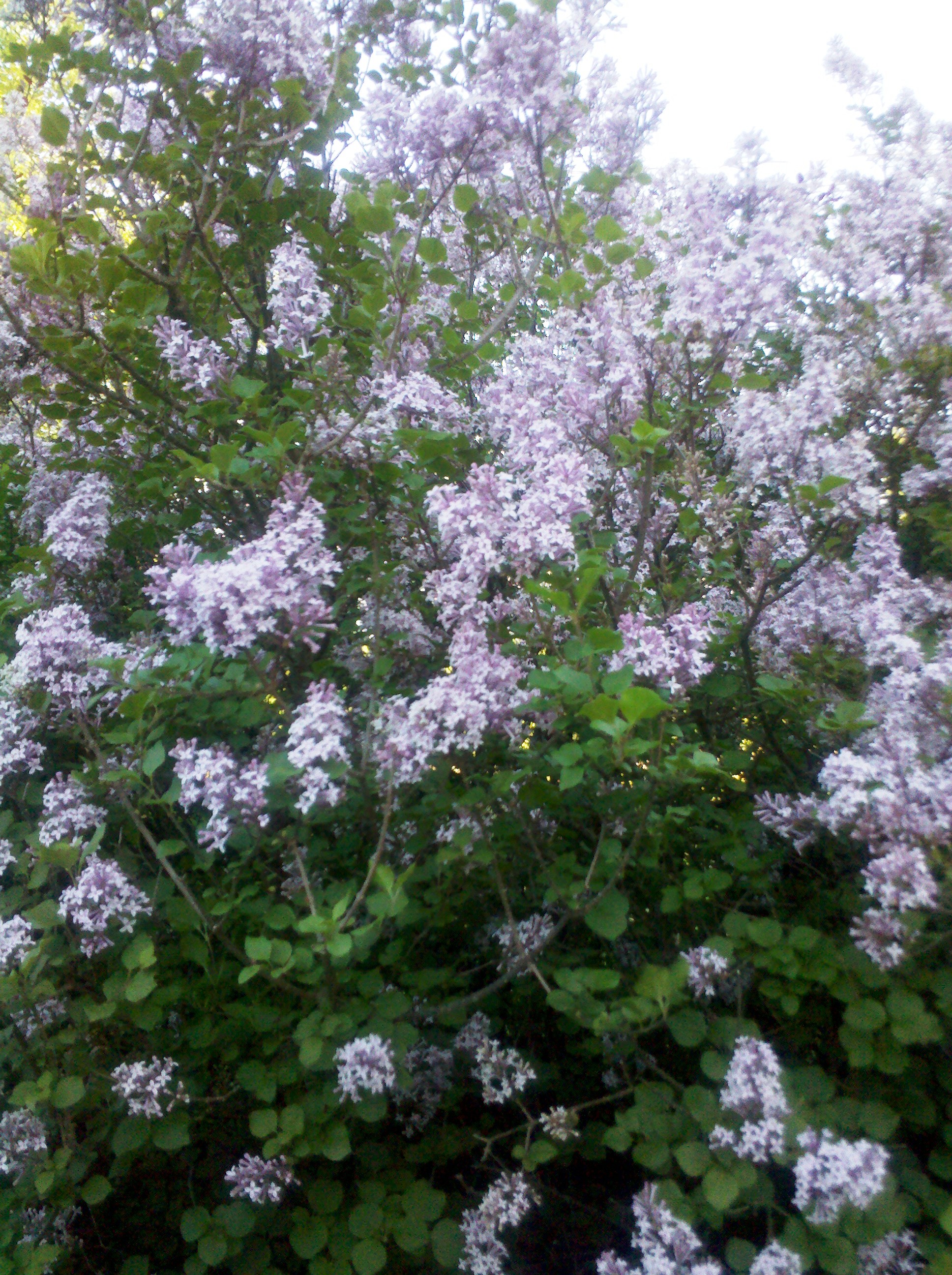
Korean lilac
Smaller and later to bloom
Fragrance to savor.

Haiku C

I wrote over a week ago that I was only going to take the daily (though they have been far less frequent than that lately) haikus to 100.  Have I gone five days without a post because I don’t want to stop the haikus?  Maybe I won’t.

When I started the haiku-a-day, it was a way to organize my writing ideas so that something came every day, even if only those 17 syllables.  And there were many days the syllabic beats would come to me out running in the morning, touched off by something I’d see, and stay with me through the work day, sorting themselves into the freshest and best language I could muster through the hectic pace my life has been for as long as I can remember.  So it worked, the idea, the discipline, the practice.

That won’t end.  In fact, I’m expecting my writing practice to get more focused than ever after June 15.  For now, here’s Haiku C.

Suddenly summer
Perfect point in the cycle
To pretend to end.

Channels 100 and 17

The tag line for my twitter profile is “I have 140 channels in my brain.”  There is a lot going on in there.

I’ve decided, in the poetry channel of my brain, or maybe it’s a haiku channel, that I’m going to take the haiku posts to 100.  I’m at 98.  Why stop at 100?  I’m not sure. Haiku is a stream in the poetry channel and that’s what the stream is murmuring to me.

In the countdown-to-the-end-of-my-job channel, I’m very aware that I have 17 days of work left.  Seventeen is my favorite number, because it’s attractive (that sloping 7 pointing back towards the 1) it’s a prime number (I love prime numbers though I can’t explain why) and mostly because 17 was John Havlicek’s shirt number when he played for the Celtics during my childhood.  My father was, and still is, an avid Celtics fan, and I grew up watching them play.  Havlicek was handsome and brilliant and captivated me.  I was twelve on April 15, 1965 when I got to listen live to one of the most famous play-by-play calls in NBA history, when Celtics broadcaster Johnny Most exclaimed “Havlicek steals it! Havlicek stole the ball!” after Havlicek intercepted an inbound pass to clinch the Eastern Conference Championship against the Philadelphia 76ers.

I have since moved in and out of being a sports fan of various sorts, and since Eric died, have been out of that zone.  The sports channels are more or less dormant.  But I’ve always hung on to number 17, and can still remember the thrill of a stolen basketball, a clutch play, an over-the-top excited sports announcer’s voice rumbling out of the radio, perfect awareness of a perfect moment.   Humming in channel 17.

National Poetry Month

Knopf will email you a poem a day during April, National Poetry Month. (April is also Sexual Assault Awareness Month, but that’s another story all together.) I’ve been signed up for the poem-a-day for years, and in the past generally felt too harried to read the poems — too much email to deal with at work, and I didn’t want to come home and read more on my home email account. But now I have gmail, which I get on my Droid and have set up on my igoogle homepage, which I check a few times during the day, needing brief respites from the intensity of focus I maintain during work.  And there is my gmail, and there are the poems from Knopf, so this month I’ve been taking a few moments and reading them. I’m trying to learn how to take breaks because I’m about to take a bit of a break for good.

Yesterday’s poem was “Wellfleet Shabbat” by Marge Piercy, a fiction writer I’ve admired but I’ve never been a fan of her poetry. This poem confirmed why. The poem is over-written and in spite of its central metaphor, unimaginative in its language. I sent it to David to read and see if he agreed. Not only did he agree, he wrote a brilliant Haikuification in response. So, below is the Haiku and the poem. See what you think. Sincere apologies to Marge Piercy should it ever come to her attention that I blogged about not liking her poem. I devoured her novels in the 70’s.

David’s Haiku

Moon never meets sea
No hawk no red no muscle
Only Shekinah

Wellfleet Shabbat by Marge Piercy

The hawk eye of the sun slowly shuts.
The breast of the bay is softly feathered
dove grey. The sky is barred like the sand
when the tide trickles out.

The great doors of Shabbat are swinging
open over the ocean, loosing the moon
floating up slow distorted vast, a copper
balloon just sailing free.

The wind slides over the waves, patting
them with its giant hand, and the sea
stretches its muscles in the deep,
purrs and rolls over.

The sweet beeswax candles flicker
and sigh, standing between the phlox
and the roast chicken. The wine shines
its red lantern of joy.

Here on this piney sandspit, the Shekinah
comes on the short strong wings of the seaside
sparrow raising her song and bringing
down the fresh clean night.

The Writing Switch

Where is the writing switch in my brain?  It’s been tripped to the “on” position in the last few days.  I do keep up some level of writing, almost daily, as this blog proves, even if it is only 17 syllables matched to some visual image I’ve come across.  Sometimes, though less often, the haiku starts and I go looking for the image, though I have at least one reader who can tell when I’ve snagged a photograph off a google search, rather than taken the photo myself.

But the last few days the full-out, constant visual feed to language framing switch has been on.  I notice how the fields on the drive home this evening have only patches of snow left, as if some giant in the sky has been splattering down goopy white frosting on the dull brown grass.  The puddle in the dip of the road before I drive up to my mailbox has split in two, making two lungs of water across the broad chest of the road.  Yesterday morning the mist rising off the many small brooks and streams around my house, and those glops of snow still on the fields, had frozen into crystalline icing on every brush twig and branch, glinting in the sun, which was finally rising, in spite of our tinkering with the clocks.

This doesn’t stop, the writing channel on unending flow.  I see anything and I begin to fashion that image in language.  And then what is the meaning under that language, how do I translate this set of words, derived from this image, into a connection with the reader that will make something bigger happen.  “I explode inside my own brain, I want other brains to explode,” is part of a poem from my manuscript about the year of grief after Eric died. What I meant there, is that I want what I write to explode in the reader’s mind, I want whatever is churning out of that online-all-the-time channel of mine to get so big it infiltrates and creates its own set of meanings in the brain space of the reader.

Did validation turn on the writing switch?  I got an email on Sunday that my poetry manuscript, The Truth About Death, has been accepted by Turning Point Books, an imprint of WordTech Communications.  I have a publication date and a contract, from a very legitimate poetry publisher!

Let the words flow on.