The Gravitational Pull of Work and Haiku Habit II

This slideshow requires JavaScript.

Two months ago I recognized how much my consulting jobs have cut into my time and whatever space I was finding in my mind for writing and creative concentration.  I remembered that while I was still working at the Coalition I started the practice of writing a haiku everyday as a way to stay in touch, however briefly, with daily creativity.  Not that my work in the movement to end violence against women hasn’t always had a strong element of creativity, but it’s not the same as writing down the constant scroll of language translating experience in my mind.

Two months later I’m admitting to myself that the gravitational pull of work has landed me back in a place where much of my mental energy is expended helping organizations and projects further their work to address domestic and sexual violence.  It’s not a surprise.  No one is emailing me and calling me asking for the next poem or essay or book.  People are emailing and calling and asking me to do consulting work.  I get paid, I get praised, I get absorbed.

So back to that Haiku Habit idea from two months ago.  I’ve hardly written a haiku since, but today as I got ready to be away traveling for a job, knowing that the first real frost may finally arrive while I’m gone, I decided to let the turn of the season turn me back to at least a small space for poetry in my head every day.  I hope it lasts.

Haiku Habit II

Late garden basket
Last cascade of summer porch
Frost’s chapter opens.

More Truth About Death

Having The Truth About Death published was an accomplishment that meant a lot to me, not just because it felt great to have my first full length book of poetry published, but also because I believe in the story it tells, the chronicle of grief it provides, and its truth about death.  Or the truth as I experienced it.   Still, this summer I purposely let myself focus on other things — travel, family, gardening, ramping up on a couple of consulting jobs — rather than feel like I had to maintain a constant focus on promoting my book.

So I’ve been delighted twice recently when, without any prompting or focus on my part, good things have come back to me about the book.  I brought copies with me to the Vermont College of Fine Arts Writers’ Conference this summer, figuring I’d sell a few copies there, which I did.  And a week after the conference I got this wonderful email from a participant who’d bought a copy:  “I have just finished reading your book, The Truth About Death. I simply could not put it down; I read it in one day. It is so beautiful and moving and agonizing that I hardly know what to say, except that it has changed me: I feel ripped open and sewn back together. This is what I hope to find in writing, in any genre; I ask to be fundamentally altered in ways I can’t adequately describe. I am afraid to explore the topic of losing a partner. Your poems made me look at the visceral truths of such a loss, and I am grateful for that. I know this is a book I’ll read many times, finding something new in each reading. Thank you.”

“Wow!” I thought.  So it’s working.  People are experiencing the book in the way I’d hoped.  Then a couple of weeks later I got this email from a good friend:  “I thought you might like to know how your work moves around. I gave a copy of your book to my friend Jim who is now teaching for NYU in Abu Dhabi. One of his courses is called Ghastly Beauty, and deals with art as ‘a repository and record of human emotion’. He is using some of your poems in  the class. Since the students come from all over the world, they will take some of your work with them when they go.”

And tomorrow night I’ll be reading once again from The Truth About Death.  David and I are the featured readers at tomorrow night’s Portsmouth Poetry Hoot.  So, the book keeps going out into the world and coming back to me in unexpected ways.  May the magic of that continue.

Thoughts on Obsession and Being On the Road Again

This slideshow requires JavaScript.

Vermont last week, Chicago now, New Orleans next week, D.C. the week after.  My goodness, you’d think I was working again, which I am, though I try to tell myself that consulting jobs that add up to 10 or so hours a week isn’t really working.  And compared to my life as the Executive Director of the NH Coalition Against Domestic and Sexual Violence, it is very different.

But then I realize I’m on the road four weeks in a row and traveling makes the work a good bit more than 10 hours a week, and I wonder how I’m going to fit in an obsession with the memoir I’m working on.  Because becoming obsessed is my new assignment.

I do well with assignments, which I told Robin Hemley, the terrific writer and teacher I worked with last week at the Vermont College Postgraduate Writers’ Conference, so he gave me one.  Forget the book on the history of the movement to end violence against women that I’ve been planning to write for years (I’d asked him for some ideas about how to structure the book).  Forget the next volume of poetry I’m starting to shape in my head and on the page, steadily revising poems.  Forget the novel I wrote last year and haven’t looked at since, and the cycle of short stories, also partially in my head and partially on the page (or the computer’s hard drive).

“I’m not saying a book about ending violence against women wouldn’t be important, because of course that’s important,” he said.  “But this book (the memoir I brought to the conference for workshopping and feedback) is important.  Get obsessed and get it done.  This book could make a difference for a lot of people.”

“Really?” I said.  “I feel like I have writer’s ADHD.  I keep trying to work on all these different projects at once.”

Robin shook his head.  “No, you need to focus on this one book and get obsessed.  I live for obsession, the full engagement with creativity.”

He’s right.  The one book I’ve been truly obsessed with, The Truth About Death, is the one I’ve had published.  So how do I get obsessed as I travel for the next three weeks for various consulting jobs?  That’s a puzzle I haven’t quite figured out yet, but for now, I’m taking advantage of being in Chicago.

David and I went for a walk yesterday afternoon, first through Millenium Park, enjoying the Lurie Garden bursting with a wild variety of vegetation against a background of skyscrapers.  Then we walked over to the giant kidney bean of reflecting grass, called the Cloud Gate, which throws back looped and curving reflections.  Next were the glass brick tower waterfalls that create a flat pool perfect for splashing kids and barefoot tourists.  As we walked up Michigan Avenue to the Magnificent Mile we let all the sights and spectacles and smells of a great city wash over us, the lines of buildings and the curves of flower pots, poles and doorways and windows, sidewalk grates and bridges and towers and the river and the giant sprays of coleus that seem to be every where this summer.

I’m immersing myself in this experience, trusting that everything feeds my creativity and the energy I can bring to any obsession.
Immersion

“Nothing like a few elegies to get a party going,” Matthew Dickman said, to begin his poetry reading, which was the opening reading of the Vermont College of Fine Arts Postgraduate Writers’ Conference.  I’m here to immerse myself in the writing life for a week, along with about 100 other writers, including participants and faculty.  I went downstairs to the dining room for dinner, sat at a table with two women I’ve never met, and within 5 minutes we were deep into a discussion of our writing life — what we’re working on, who we’re working with here, what books we’ve written, all the books we want to write.

If you don’t know who Matthew Dickman is check him out.  A young, uniquely imaginative and funny poet.  He read a series of elegiac poems from his forthcoming book about his older brother.  The elegies actually were a great way to start the party of a week of writing, talking about writing, being with writers, workshopping writing, because they were excellent poems, delivered with grace and humor, and he thanked us all for listening to him.

At one point in his reading, Matthew asked who in the room reads the poet Bob Kaufman. Four people raised their hands.  “Oh wonderful,” he said.  “Now the rest of you can go google him and read his poems and your lives will be changed forever.  You’ll be Kaufmaned.”  So that’s what I’m going to do next.

Haiku Habit

For quite a while in my last year as the Executive Director of the NH Coalition Against Domestic and Sexual Violence, I wrote a haiku every day and posted it on this blog.  My thinking at the time was that I needed a bit of thinking each day that wasn’t about work, some encroaching deadline or knotty personnel problem, thinking that was creative and ruled by syllables and expression, not by external demands.  I began carrying my phone with me on my morning runs so I could capture the visual that often set me off into haiku composition, reordering words and phrases as I ran.

This morning I walked out of the house and there were the three cows that are pastured across the street from my porch this summer.  I know their movements across the field most likely have nothing to do with me, but whenever I see them in my corner, I feel lucky, like they’ve come to greet me.

Looking at the cows a haiku started in my head and I realized, even in this post-intense-daily-job life I’m now living, I’m still so busy I’m rarely writing in the way I’d imagined I would be 14 months after leaving my job.  Part of the problem is that I’m still working, and even though the work is consulting jobs that leave plenty of time to fit other things around the edges of the billable hours I put in, those other things include many things besides writing.

So, what about a new haiku habit?  I don’t need to read another article that tells me the only way to write is to just sit down and write.  I know that, and I am writing, it’s just not the sustained, focused level of creation I’d imagined.  So what if I commit to a haiku a day, just that space of 17 syllables (okay, I know it’s on in Japanese, not the same as syllables, as I wrote here less than a month ago, but the syllable scheme works for me), those minutes of capturing a moment?  That could lead to more minutes, more focus, more creation.

I doubt all the haikus will end up on this blog, but here’s a start to the habit.

Three cows this season
Working stubble for fresh green
In my own corner.

Blessings

“I am struck by how available everything is that is wonderful if you abandon the notion that you have to live on the edge of it,” David said as we sat on the porch on Friday night, watching the few clouds in the sky take on the pinks and mauves of the lowering light.  We were talking about all the places we love to be — on the water, in the woods, on a mountain top.

“I’m really pleased that these boots were made in Italy and not China,” he went on, looking at the boots he finally decided on, after weeks of boot research and boot trying-on in preparation for our walk across England.

“Is it a blessing or a curse that everything I experience is translated into language to be written down?” I asked.  “It’s a blessing,” David said.  And so it is, and here I am, writing it down.

Reactions to the Truth

“Your poems were beautiful, but I can’t buy your book,” a woman said to me after my first reading from The Truth About Death.  “Sure you can,” I said.  “Just read one poem at a time if you have to,” I urged her.  Because I do want to sell the book, and because I do think it tells the truth about death.  I know that’s hard for many people.  “No,” she said.  “I just can’t even have it in the house.  I can’t handle it.”

In contrast, a woman I know through work came to that first reading and bought two books, one for herself, and one for friends who recently lost an adult son, as she did almost two years ago.  “I have never been to a reading before so it was nice to meet people who do write poetry,” she wrote to me two days later.  She went on, “I truly enjoyed reading your book.  I am just amazed at how profoundly honest you are with your thoughts and feelings, and of course only someone who has faced death can even begin to write about it as you have.  Losing  someone can be such a lonely and sad journey so I did find reading your book makes you realize you are not alone.”

I did a training in Rhode Island the week before last, and my good friend Deb, the Executive Director of the Coalition there bought a book.  She also wrote to me a few days later with the subject line of the email “blown away.”  “I just wanted to tell you how phenomenal your poems are…. I am ‘enjoying’ them, as emotionally brutal as they are, and savoring each one.”  Deb has never known me as a poet, only as a sister Coalition Director, so it meant a lot to me to hear from her about my poetry.

And just this morning, another widow who leaves nearby emailed me about the copy of the book she bought earlier this week.  She sent me a passage from her journal.  “The book has not been disappointing. Waited for it for months.  The Truth About Death.  I think it could be named The Truth about Love. Soulful, riveting language and content, so intimate, sexy. Painful. Her relationships are so rich. She says so much with so little. Her grounding in the wilderness where she lives gives me pause. I rave about where I live but do I inhabit these woods the way she and her Eric did?  I could not stop writing in my travel journal as I read it through the first time. Always a sign I am reading something terrific when it makes me crazy to write myself. Revised a few poems tonight and wrote two short new ones. It has been like taking a crash poetry workshop. I like her use of coma, no conjunctions. The coupling of things not usually put together as all my favorite poets do. The way the mind actually works, I think, before we squash our thoughts and refine them for public use.”

I realize this post could be taken as shameless self-promotion, and of course as I said, I do want to sell books.  But not just because they’re my books.  I believe in this book and its power to affect people in the ways my friends have written to tell me.  The truth is I want this book in the hands of people who need to hear this truth.

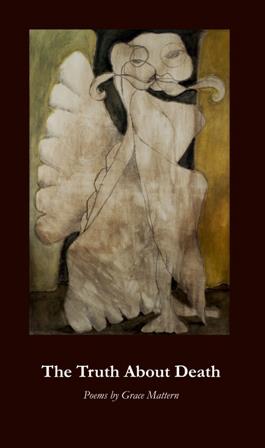
The Truth About Death

It’s getting close!  The page proofs and cover of the book have gone through multiple sets of corrections and checks and are all done.  Soon, the book will go to print.  I have readings set up and just added a page to this blog about the book, am changing over to my own domain (www.gracemattern.com) and will be figuring out (not easy!) how to make this blog into a website that can support both my writing efforts, and my consulting business, when and if I decide I want to expand that.

For now, check out the book tab.  And mark your calendar for one of the readings, most especially the Book Launch Party at Gibson’s Bookstore in Concord at 7:00 on April 26.

Grief

Today’s prompt on the NaHaiWriMo Facebook page is grief.  “Good grief,” I thought, “I’ve certainly had my share to say about grief.”  After all, the title of my book is The Truth About Death, which is that we all die, and that for almost everyone, that causes a good number of people a lot of pain.  “Grief is a tough beast,” I now write often to people, when I write sympathy cards, because it’s a beast I’ve wrestled with myself and I know its toughness.

And then I thought about that expression, “Good grief!”  Where does it come from?  Answers at Yahoo rated this as the best answer to that question:  “Euphemisms are words we say that are more socially acceptable than what we would otherwise choose to say. “Good grief!”, is an expression that means we are very irritated or upset about something. The “…grief” part of the expression refers to the emotional sense of being irritated or upset; grieving about what has happened. The “Good…” part of the expression is a reference to God which is intended to add emphasis and impact to the expression. Many people do not like to say the word God in public conversations so they often substitute the word “Good” instead.

Regardless, here is today’s haiku:

Unusual softness
Winter air brought down by sun
Your bones still cold.

Yesterday’s Haiku

I like the idea of being a day behind.  As I wrote two months ago, one of my hopes for the coming season of ascending light (it was at a solstice gathering) was to change my relationship with time.  Having always been focused on getting things done (and mostly on some deadline of some sort), and having managed anxiety by making sure I’m always very, very busy, I’m working on letting what comes to me, at least in my creative pursuits, come to me, and making sure I have enough open time for the surprises of the muse to get through.

So getting yesterday’s haiku up on my blog today is fine.

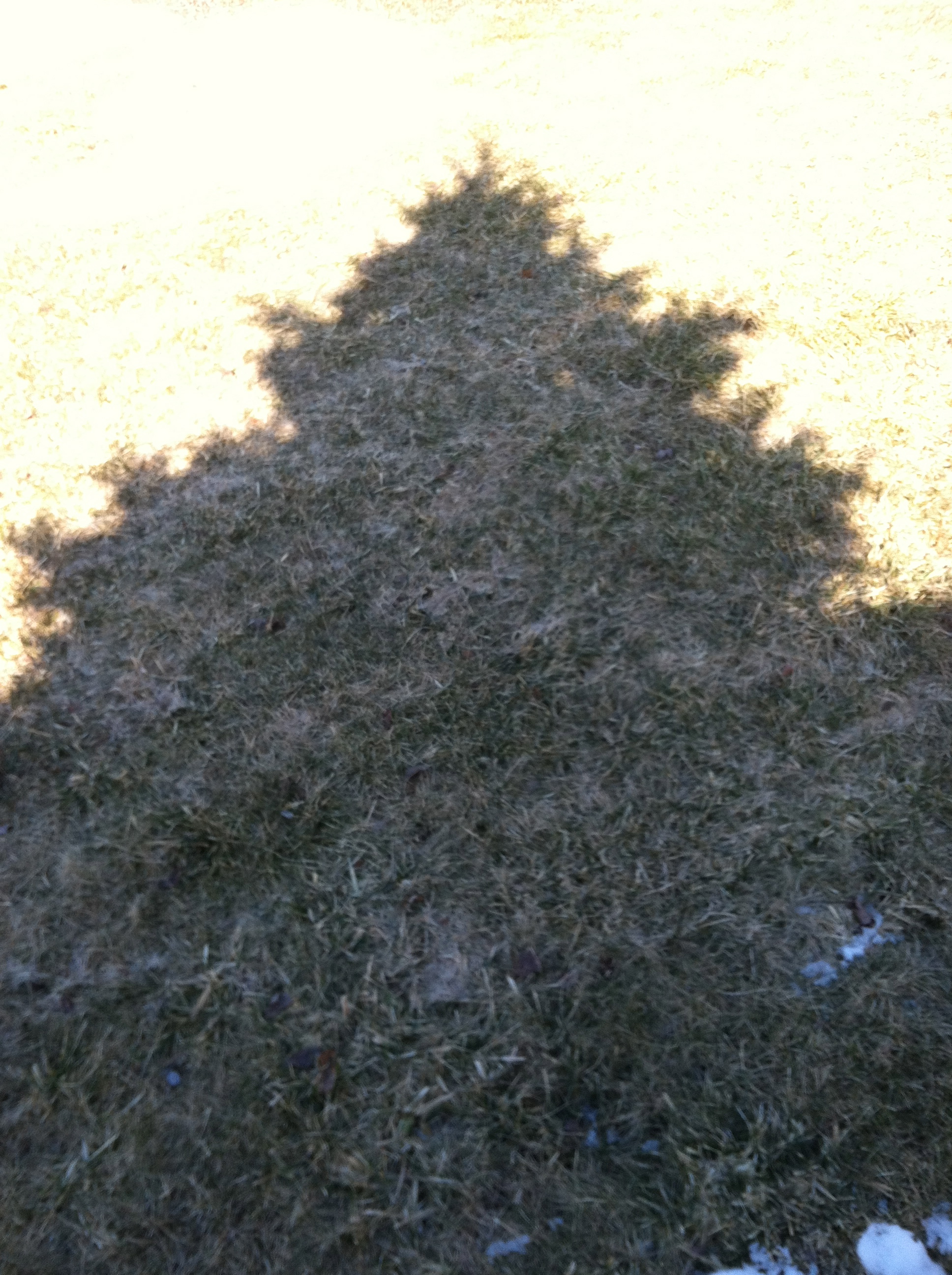
Low winter sun draws
Spruce shadow a spruce again
Barren season bared.