Time moves horizontally, a train that passes on tracks and drags along minutes then weeks and months and years. A station approaches, a dot in the distance at first, then gets bigger until it fills the entire window when the train stops.
Time stretches into a balloon of stillness then unfolds into a fan with a story on each rib.
A rocket shoots past the gravity of time and moments pass so quickly we don’t inhabit them, we only know time has passed by looking at an outside measure, a clock.
What if we didn’t measure time? If the passing of the sun across the dome above us meant only what angle of shadow we could expect, and when it would be warmest, when our skin could burn and when we should rise and go to sleep?
Time? How can the dimension of life that rules everything be nothing? It’s consciousness itself, only the awareness of is and was and will be that moves the train, inflates the balloon, fires the rocket.
So it’s been a week and a half since I’ve written here and what is it that’s kept me away? I’ve been right here, just not in this definition of this time. We work hard to be here now, in this moment, because we know it’s all there is. But is it?
The wind was fierce yesterday and I felt sorry for the potted flowers on the porch, the onion greens all bending to the east, the zinnias putting out their first leggy blossoms into such a powerful force. Today the branches of the old maple in the front yard are still twitching and the grass of the pasture across the street ripples with wind, the seed heads bowing and rising in waves that move on and come again.
I’ve been writing, I’ve planted vegetables and flowers and mulched the garden beds. I ran for a long time in the rain and sucked up the endorphins. I drew vessels and peonies and worked on shading, then scribbled the creases in my cupped hand without ever looking at what I was doing. I glued and colored. A lot of time has been spent with friends and seeing people I haven’t seen for a long time.
A long time? What is that?
A poem from 2002. So much time thinking about time.
South Twin Mountain
The land has a lot to teach –
rocks, roots, gullies, water’s
effect visible everywhere; land
hauls us into the exact
moment we are in, musings
about the nature of time gone,
how the asymmetrical arrow
measures in only one direction,
how time cannot be experienced
by any of our senses.
What would time smell like,
how would it feel
in our hands? For now, we can see
light, taste the wind, hear earth
crash as we walk along its borders
in to the next valley.
The cows are back in the pasture, the pond is warm enough to swim, laundry goes out on the clothesline rather than in the dryer, I wake to birdsong and light already in the sky, the back deck is a private enclave enclosed by leafy trees, the woods are full of blossoms, there are pots of flowers on the porch and the screen door is up in the kitchen. All the pleasures of the new season to be enjoyed again.
I’ve written about Shehechiyanu before, the Jewish blessing giving thanks for being alive to complete another year’s cycle, coming around again to a festival or holiday or favored event — the first outdoor swim of the season, the peonies first open blossom, the cows crowding the corner of the field across the street on their first day out.
I thought I’d posted the poem I wrote many years ago imagining the blessing for the cows. If I did post this before, the WordPress search function doesn’t think so. Here it is.
Shehechiyanu
The cows are back
in the pasture, random
black and white a foreign
light in the field of green
tipped with a sheen
of moisture from rain
that fell last night
steadying the grass
in its surge of growth
sufficient to allow
the cows’ return
to fresh fodder.
Does a cow bless,
once again, far fences
after winter’s pen,
silage and hay,
open air a tickle
in a fold of her teats
just past where her tail
could reach?
Today Chris would have celebrated her 65th birthday. Instead, those of us who love her are remembering her and honoring her, as sad as we are.
But she’s also still here. Chris was a committed practitioner of Qigong — postures, movement and breathing to bring life force in to your being for health and vitality. The name comes from two Chinese words: qi (or ch’i or chi) means the life force or energy that flows through all of us and everything, and gong means skill cultivated through practice.
Chris thought a lot about chi, about the life force, about how we’re all connected. When she died, her chi didn’t disappear because her energy wasn’t bound by her body. It flowed in to the life force that’s everywhere. I used some of that chi today.
Sam did a 20k trail run two weekends ago — that’s over 18 miles, up and down mountains, on scrambly trails, not an easy run. When he called, excited by how well he’d done, he told me how he uses chi when he runs — his own version of chi running. When he’s in the flow and feeling good, he stores chi to use later if some part of him starts to hurt or if he’s lagging. If someone passes him, moving smooth and fast and clearly in a good zone, Sam thinks, “Well that person has some chi to spare. I’ll take a bit of that.” Then he uses stored chi or borrowed chi to send to an aching knee or tired legs.
I loved the idea and thought of it today, just under 8 miles in to what I hoped would be at least a 10 mile run. My knee hasn’t completely healed from whatever made it so cranky during the NYC half-marathon in March, and though I have another half-marathon to run in a little over a week, I haven’t been running much, wanting to give my knee time to rest.
The rest has been working. Last week I was able to run over 7 miles without knee pain, the first time I’ve run more than 3 or 4 miles in many weeks. I wanted to add 3 miles to that today, thinking that would mean only adding another 3 next weekend to do the half-marathon.
Heading into that 8th mile my legs were tired and my knee was cranking up. And then I thought about it being Chris’s birthday and the energy she left behind, so much life force still to be used, and I concentrated on pulling her chi into me. I felt a tingling rush of warmth through my body and Chris was right there, hovering over me as I ran another 2 miles — 10.2 miles, exactly what I’d hoped to do.
I’ve been texting with my sisters Meg and Jeanne today, touching base on this sad and happy day (the 6th birthday of one of Jeanne’s grandsons), and when I told them about my run my sister Meg reminded me it’s everyone’s chi. Universal energy. “We are all one,” as it says on Chris’s memorial bench.
At this point, not having heard from the editors at The New Yorker, I assume they aren’t going to print the letter I sent in response to an article published in the April 11 issue. The Voyeur’s Motel by Gay Talese is a disturbing piece about Talese’s long association with Gerald Foos, a man who bought and retrofitted a motel decades ago so he could watch his customers having sex. Apparently the article is an excerpt from an entire book Talese has written on this subject.
Knowing how difficult it is to have a letter published in The Mail section of The New Yorker, I listed all my professional affiliations, hoping my credibility in the movement to end violence against women might help get my letter attention. But I seem to have remained unplucked from the slush pile.
Very disappointing, not because it means I won’t appear in The New Yorker, but because it means the editors there don’t get it. They published an article that reinforces rape culture at a time when there is finally starting to be some serious public attention paid to how male privilege and assumption of entitlement to sexual gratification leads to sexual assault, and what can be done to prevent that. The piece highlights, without challenging, how Foos and Talese participated in sexual exploitation from positions of privilege. Foos had the money to buy and modify a hotel to be able to satisfy his sexual needs. Talese wielded privilege from his position as an established journalist to justify participating in Foos criminal behavior and not intervene.
So I’m going the self-publishing route. Here is my letter — you actually don’t need to read the Talese piece. It’s meritless.
Who Is the Voyeur?
While Gay Talese has no trouble finding fault with Gerald Foos for his lack of self-awareness and easy justifications for decades of voyeurism, he appears blind to the ways in which he is very like Mr. Foos (“The Voyeur’s Motel,” April 11). Talese does, at one point, ask, “Where was I in all this?” He goes on to give possible answers but never settles on one and continues, “Still, whenever an envelope from Foos arrived, I opened it.” It’s apparent he opened the letters because he’s a voyeur also. He has hidden his voyeurism behind a successful career as a journalist, but he still climbed the ladder with Foos and watched a couple engage in oral sex from the attic of the Manor House Motel.
Perhaps Talese feels he has a stronger moral compass than Foos because the murder Foos witnessed and helped initiate bothers him more than it does Foos. But what about the rapes and sexual exploitation, undoubtedly perpetrated against people with less privilege than financially secure white men? Foos also reported these to Talese over the years, yet Talese gives them only a passing glance. Where is the concern about those crimes and Foos doing nothing to stop or prevent them? Where is his correspondence with Foos imploring him to act?
Mr. Talese must not know about the growing body of evidence that bystander intervention to stop or prevent sexual crimes can be an effective deterrent. Voyeurism was a crime in Colorado under the Unlawful Sexual Contact statute when Talese received the first letter from Foos. Talese had countless opportunities to intervene with Foss from the very beginning, without creating any conflict arising from confidentiality agreements or journalistic considerations, however self-serving they may have been. He had a critical responsibility to intervene that deepened with every new revelation from Foos.
Claiming a journalistic interest in Foos’ “research” does not change the criminality of both men’s behavior. Talese could more usefully employ his journalism skills reporting on ways to prevent sexual crimes, including those Foos perpetrated and witnessed. Talese may argue that his interest had nothing to do with his own titillation from Foos’ reports of sex and sex crimes. But Talese can’t deny his role as a bystander nor avoid the evidence that he finds satisfaction in observing and judging others, just like Foos.
Grace Mattern
32 West Street
Northwood, NH 03261
603.828.6218
Advisory Council, National Sexual Violence Resource Center
Research to Practice Specialist, Prevention Innovations Research Center, University of New Hampshire
Former Executive Director, New Hampshire Coalition Against Domestic and Sexual Violence
My mother is still alive, a great blessing, though no easy thing for her. Even healthy, being 91 takes a lot of courage — all the losses, the disobedient body that keeps getting older, the inevitable contraction of life as energy and mobility shrink.
But this is the first Mother’s Day without a mother for a number of people I love. My kids and I called each approaching milestone in the year after losing Eric “another fucking first.” Father’s Day, my birthday, our anniversary, the High Holidays, his birthday, Passover and then the first year was done, we were on to the sucky seconds.
The firsts are tough. There’s all the navigation of the hole the missing person has left, “the space we leave behind” as my sister Chris said. She asked us all to try not to miss her, to let life keep coming in to our hearts and not be worried about our love for her being pushed aside. Because there’s room for all of it.
But there isn’t another mother for her sons, or for the baby who lost her mother just over a week ago, or for lots and lots of people I care about who’ve lost their mothers, many of them much younger than any of us think is fair.
Chris and Eric both believed fairness has nothing to do with it. Shit happens, destructive cells get a foothold and go wild and bring down a healthy body, we lose people we love.
To all the people I love having a fucking first today, I’m sorry. The first year can be so hard. But you’ll get to the seconds and then the thirds and incredibly the tenth one day. And beyond, but today I’m thinking about the firsts and tenths. Ten still hurts but a whole lot less.
Anthropomorphising cancer? Right now it’s working for me. The world lost a beautiful young woman today, way way too young. She had a beautiful family, a wonderful husband, an adorable one year old daughter. She lived less than a year from her diagnosis. Cancer sucks and is mean as shit.
My daughter, however, is awesome and very kind and wrote a beautiful blog post about this terrible loss. Check it out: Too Short.
It’s coming up on eight years since I started writing the memoir that’s been occupying most of my writing attention for the past three months. What started in the summer of 2008 as a book I decided I was only going to write on islands, and only in a journal covered with crinkled brown paper that David had bought for me in London, is finally revealing its structure, which has nothing to do with islands or writing in one particular journal.
But that conceit — writing my “Island Journal” as I called it — is what got me started and the most important lesson I’ve learned over these past eight years as I’ve been trying to master the craft of creative nonfiction is that where you start is very likely not where you end up.
Last summer at the Vermont College of Fine Arts writing conference both Andre Dubus III and Joan Wickersham talked about years of failed attempts to write a story from their lives as a novel. Years and years of writing that didn’t work. Both of them finally got their stories right as a memoir — Townie for Dubus and The Suicide Index for Wickersham. Both are terrific (read them if you haven’t).
I went to the VCFA conference to workshop the novel I wrote last winter, which was a much needed break from the intensity of my work the previous spring on the memoir. I did learn a lot about writing a novel and sustaining a story across many many many more words than I’m used to managing in poems. But mostly I learned to let go, as Dubus and Wickersham had. I understood that I needed to go home and stop trying to wedge that original island journal into the memoir I was trying to write about the years when I lost Eric, lost my best friend, lost track of myself, lost faith in my parenting, found David and then lost him as his family navigated its own terrible loss, lost myself again and then found myself again, not surprisingly right where I’d been all along.
Now I’m back to revising the memoir. I don’t even know what number draft to call this, because its form has changed so radically. Given what else was going on in my life and my family last summer and fall I didn’t have a chance to use what I’d learned at VCFA to start revising the memoir until January and I started by taking it apart. I’ve been struggling with how to put it back together — deleting island journal passages, writing a new thread of story to weave in, getting rid of scenes that don’t move the narrative forward, rearranging. How could I carry the story across the arc it deserves?
And now I know. I don’t remember exactly when or how, but sometime in the last few weeks the story began to unfold in a structure that so far continues to make sense as I move through each section. It’s exciting and energizing and makes me want to be at my desk more than anywhere else.
David and I were both getting ready to go out one day last week and I told him I planned to go right back to work on the memoir when I got home in the afternoon. “Of course,” he said. “You’re in a blessed place.”
Yes, it’s a blessing to be in a creative flow that’s smooth and open, without the nagging voice that asks why are you doing this, does it matter, is this any good? I’m listening to the book right now and liking what it says.
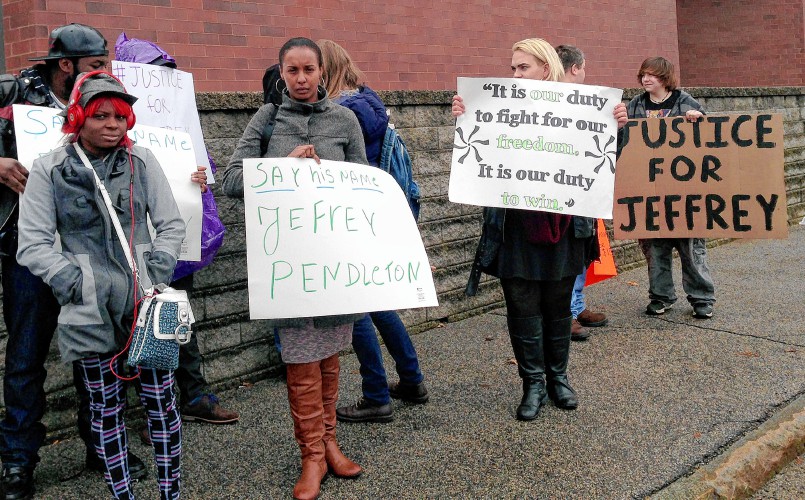
Activists and coworkers of Jeffrey Pendleton protest outside the Hillsborough County House of Corrections Friday, March 25, 2016, in Manchester, N.H., where he died Sunday after he was unable to post $100 bail. Jeffrey Pendleton, 26, was being held on a marijuana possession charge when he died Sunday. The Manchester Police Department is investigating Pendleton’s death, and the state medical examiner’s office says it is awaiting toxicology reports to determine the cause of death. (AP Photo/Kathleen Ronayne)
Yesterday afternoon I sat on the porch and began a draft of a blog post about the writing I’ve been engaged in for the last couple of months. “Deep In” to another revision of my memoir, I’m excited because the structure I’m using this time is working. I’m making progress.
My plan was to put up that post this morning, and I was in my study early, ready for many hours at my desk today. I went downstairs to make a cup of tea and noticed Jonathan Baird’s OpEd in today’s Concord Monitor. Waiting for my water to boil and tea to seep, I read the article.
I’d read the Monitor editorial last Sunday about Jeffrey Pendleton and thought, what, a black man died in the Valley Street Jail and this is all the coverage there’s been? Then I forgot about it and spent the week absorbed in my very privileged and very rich life. I spent days in my study working on the memoir and making collages. I did some volunteer board work. I sat on my porch when the sun was warm enough and the wind still enough. I listened to the birds nesting in the blue spruce and yews, chattering songs all day.
When I read Baird’s piece today I thought, okay, enough about me. Spread the story.
Where is the outrage for Jeffrey Pendleton?
By JONATHAN P. BAIRD
For the Monitor
Thursday, April 14, 2016
Over the last couple years, these names have come into our collective lives: Sandra Bland, Eric Garner and Tamir Rice. There are quite a few others who experienced the same fate I am not naming. All were African-American and all died in police custody or at the hands of the police in circumstances that could best be described as questionable.
The deaths contributed to the creation of the national movement known as Black Lives Matter. The people who died lived in places all over the United States. None, however, were from New Hampshire – until now.
Now we have the little-known, terrible story of a New Hampshire man, Jeffrey Pendleton, which has received scant local media attention. Pendleton’s story is New Hampshire’s version of Sandra Bland, the black woman who was pulled over by a policeman in Texas for a lane change and who inexplicably died in jail a few days later. Like Bland, Pendleton was wrongly jailed and he died mysteriously in his jail cell. No credible explanation for his death has yet been offered.
The question has to be asked: Where is the outrage? Why so little reaction to Pendleton’s death?
Found In His Cell
On March 13, Pendleton, a 26-year-old, homeless, African-American man from Nashua was found dead in a cell at the Valley Street jail in Manchester. Pendleton had been in jail for five days when he died. He had been arrested March 8 on a misdemeanor charge of marijuana possession. The Nashua District Court had set Pendleton’s bail at $100 cash, an amount he could not afford to pay. As a result, he went to jail.
No one seems to have any explanation for why he died. State and prison officials have had precious little to say. A Union Leader article quotes a Nashua police captain who says the Nashua police did everything correctly in the case.
Dr. Jenny Duval, deputy chief medical examiner for New Hampshire, performed an autopsy and said from her examination there was no evidence of any natural disease or physical trauma. The exam found no needle marks. Dr. Duval looked into Pendleton’s medical history and she said that he had appeared to be in good health.
Dr. Duval ordered additional tests and hoped that test results will determine the cause and manner of death.
Why was he jailed?
While for me the Pendleton case prompts many reactions, I would begin by asking: Why was he in jail? And why would an apparently healthy young man suddenly die there?
The jailing of Pendleton for failing to pay $100 bail on the pot charge is all too typical of the callous and uncaring way poor people are treated in New Hampshire. No way would most people be going to jail for that. They would come up with $100. Pendleton was jailed for being too poor to pay $100. Why is the state using such a harsh penalty, jail time, for such a minimal charge? The cost of incarceration, housing and feeding, far exceeds the charged offense.
Pendleton’s case is a good example of the criminalization of poverty. He was not a flight risk nor did he pose a danger to others, the reasons typically invoked for bail. I would also point out that pot is now legal in multiple states and when our state decides to enter the 21st century, it will be legal here. New Hampshire remains the only state in New England that has not decriminalized marijuana possession. It’s only a matter of time.
It is both sad and wrong that Pendleton was jailed for a non-violent activity that would not have been punished at all in multiple jurisdictions.
One prominent New Hampshire defense attorney told me that he thought if Pendleton had not died he would have served 30 days. Then, when he appeared in court, he would have been released on time served, and the case would have gone away.
Penalized for poverty
Across the country, people are increasingly penalized because they are poor. Money-based bail regularly means that poor defendants are punished before they get their day in court. Probably poor people end up doing more time than if they had a court hearing and were convicted immediately. Imposing high bail on a poor person who faces a minimal charge is equivalent to a conviction.
The consequences of this form of pre-trial detention can also be dire. Going to jail can mean job loss, eviction from an apartment and possible loss of child custody. And those things can happen before a hearing on the merits of a case.
The day after Jeffrey Pendleton died, the U.S. Justice Department released a letter to state chief justices and court administrators across the country suggesting they change their practices on fees and fines. The letter explicitly stated:
“Courts must not employ bail or bond practices that cause indigent defendants to remain incarcerated solely because they cannot afford to pay for their release.”
The letter came a day too late for Jeffrey Pendleton. How does the state plan to make amends to a dead man? I don’t see anybody jumping up to take responsibility.
Ever since the events in Ferguson, Mo., awareness has increased about the broader problem that many courts in America have been imposing exorbitant fees and fines on people who have committed relatively petty offenses. It is and remains modern-day debtors’ prison.
Too many cities and towns are relying on court fines and fees to pay down municipal debt. In a report released by the White House’s Council of Economic Advisors on Fees, Fines, and Bail, the authors note the increasing municipal reliance on these fines in America. The report states that in 1986, 12 percent of those incarcerated nationally were also fined. In 2004, the number had climbed to 37 percent.
Plaintiff in suits
Prior to his death, Jeffrey Pendleton was not some marginal, unknown homeless person. He had been a plaintiff in two lawsuits brought by the American Civil Liberties Union of New Hampshire. In the first case, in March 2015, the court forced the town of Hudson to pay damages for the unconstitutional and illegal way they treated people who were peaceful panhandlers. In the second case, Pendleton spent 33 days in jail for walking in a park adjacent to the Nashua Public Library. The police charged him with criminal trespassing for walking through the park after he allegedly violated a verbal “no trespass” order. Nashua had to pay Pendleton and his attorneys for violation of his constitutional rights.
At this point, it is impossible to know if Pendleton’s activism played any role in what happened to him. I would hope that a thorough and fair investigation will get to the bottom of Pendleton’s tragic death. It is hard to fathom how and why a 26-year-old man spontaneously dies – if that is what happened.
The New York Times reported that Pendleton had arrived in Nashua in 2009. He had worked low-wage jobs in fast food restaurants. After a divorce in 2013, he became homeless and he started sleeping in the woods. He spent the winter of 2013-14 outside in a tent.
$8.50 an hour
Pendleton worked at a Burger King in Nashua. In the press, a co-worker was quoted saying he made $8.50 an hour at most. That money is a little above New Hampshire’s paltry minimum wage of $7.25 an hour, far and away the lowest in New England. The money Pendleton earned was not enough for him to rent an apartment or to pay bail.
In February, Pendleton had participated in the Fight for $15 campaign, which advocates for a higher minimum wage. He had demonstrated outside the Burger King where he worked. Maybe if Pendleton had been making a higher wage, none of these events would have happened.
In an article that appeared in the Huffington Post, Attorney Gilles Bissonnette, the legal director of the ACLU of New Hampshire and Pendleton’s lawyer, described Pendleton as a “really sweet” and “kind” person, whose troubles with the law were primarily a result of his poverty. Attorney Bissonnette also said the following:
“(Pendleton) got involved in these cases not because he thought he would obtain some sort of financial windfall but because he believed these cases could bring relief to other poor people who were struggling to get by and who were having interactions with law enforcement. He cared about how the cases that we were handling could potentially change police practices in the future.”
I must say I remain puzzled by how little coverage Pendleton’s death has received in New Hampshire media since March 13. Most of the stories that have been done come from outside news outlets like the New York Times and the Guardian. I did hear one story on New Hampshire Public Radio and the Monitor did an editorial. When I have asked friends and acquaintances about Pendleton’s death, they have invariably not heard about it.
There have been a lot of stories about bobcats and also about the St. Paul’s preppy and the tragedy of his temporary detour from Harvard, but almost nothing about a dead young black man. Based on the coverage, maybe poor and black lives don’t matter.
(Jonathan P. Baird of Wilmot works at the Social Security Administration. His column reflects his own views and not those of his employer.)
A friend once said “your poems are like photographs.” What I see goes in to words, translated through what I think, how I sort language to get the image I want on paper. Now I’m trying it without words. And loving it.
A not uncommon conversation for me over the years: What are you going to do with your journals when you die, or before you die? What instructions will you leave for whether or not they can be read, by whom, when, what can be shared? Or will you destroy them all at some point?
A poet friend records current events and notable weather in her journals, because she plans to leave them to be read and she figures that’s what people will want to know about — what was happening in the world, not in her head.
Which is what my journals are full of. There’s some recounting of events, but much of it is I’m anxious, I’m worried, I’m upset. . . blah, blah, blah. Another poet friend admits the same. “My journals are blah, blah, blah over and over.” Not that the blah isn’t important, it is to us, that’s why we’re writing it. But it probably would be boring to most other people, and would paint a false picture, anyway.
When my mood is mostly even and good I don’t journal much, I do it when I’m confused, when something is upsetting me and I need to figure it out. I write in my journal when I’m anxious because the act of getting worrisome thoughts on paper loosens their uncomfortable grip a bit. I’m honest in my journals about all the ways I’m quirky and irritable and over think the shit out of way too much.
So do I want anyone to read all of that? Would anyone want to? I’m talking serious numbers of journals — 82, including my blue plastic bound Ponytail Dear Diary with a brass lock (key long gone) from grade school.
Jon brought me three of Chris’s journals last week. He wondered if I wanted to read them. He doesn’t want to right now, though he wants to keep the journals. Do I want to read them? Should I? I’ve peeked in to them and so far haven’t read anything that I didn’t hear Chris talk about or haven’t read in her essays. Chris didn’t hide her feelings and worries and struggles. I loved that about her, her honesty about all of life, the joy and the hard road of living with metastatic cancer.
Chris took journaling classes in her last years, and in one she made a cover for the journal she was using. It’s beautiful. Right now it’s at the top of the journal stack on the side of my desk. I love looking at it. I don’t know if I’ll read it.