Day Thirteen — Blessings of Boys


The world is full of light this morning – sharp, bright, cold finally.  I woke late, the sky already gray with dawn, sounds coming up from the kitchen. Last night watching Snapchat stories for Sam and Will I suspected they had started their drive north, and here they were, Sam plugging in Sylvia, the espresso machine, Will smiling.

“Why are you making coffee? Weren’t you up all night driving?”  They were, but they took turns napping, they wanted to get in a round of disc golf at Beauty Hill before crashing – they’d played a sunset round in Johnson City before starting their drive yesterday, they were excited about following that with a sunrise round.

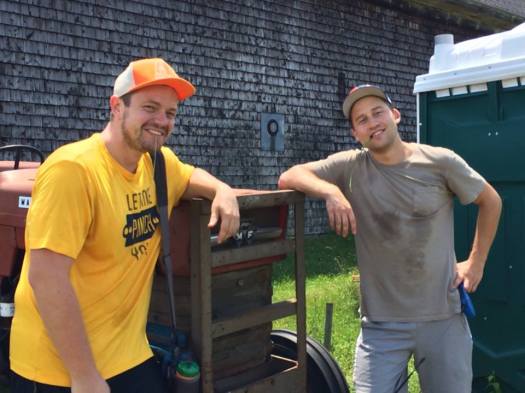
Will would have napped but was willing to be swept along in the stream of Sam. Mike arrived, they all drank coffee, they left to play. These beautiful young men who’ve been in and out of this house since they were boys.  Twenty years. Such a blessing.

2015-12-22 11.42.38

Eleven, Twelve — Double

IMG_4111

December 18

Guitar music comes up the stairs. David is playing.  He hasn’t painted since April. I’m building a standing art desk next to my writing desk, a space to turn and make things with materials, not words, colored papers and pens and boxes of cards and catalogues I’ve been collecting for years to use for collages.

Which means emptying a book case so I can run the new desk into the corner. Already my date books are in a box in the barn.  Next go my journals. What do they say?

March 6, 1979: I confront Jim, a nasty and misogynistic roommate who lived with Eric and me in a house we rented from Lynne Cherry in Marlborough, CT. Lynne sometimes spent a night or two there, had slept with Jim one weekend, but now she was angry at him, he hadn’t paid his rent.  She asks us to talk to him so I do.

I don’t back down when he tries to placate me. At one point I just kept talking back at him, wouldn’t shut up – making him face my anger & he told me to leave his room – we had a stare down & he couldn’t budge me – I loved it.

One journal has no date on the cover and my entries don’t even have the day of the month: saturday evening, sunday evening, thursday, saturday early afternoon, friday, the next tuesday may 24 – ah, a date. Still no year and no upper case letters. I think it was 1977. Who needed to know the day of the month in 1977? Not me.

I write a lot about writing. Needing to get possessed. Art desk.

December 19, 2015

When I sit on the end of my bed to put on my shoes, I see a Great Blue Heron on the other side of the far farm pond in the cow pasture. A really big one.

Then I quick catch yet again that it’s not a heron. It’s not Eric. It’s the tall stump of a small tree that blew over two years ago, the wood bent forward in a thick figure of a heron.  Eric isn’t in every heron, though seeing a heron fly overhead or standing in water makes me think of him.

This summer when I was home from being with Chris for a few days a heron stood in the intersection of Canterbury Road and West Street for about 30 minutes. It didn’t move, other than to swivel it’s head. A car went by, in the lower part of the intersection several yards from the heron. The car stopped, then went on.

I kept watching. The heron stayed so long I stopped watching. Then I decided I wanted a photo and went to get my phone and a truck came and needed to make the turn up Canterbury Road and the bird lifted and flew away.

Chris has a story on her blog about a heron seeming to follow her one day, and thinking about herons are how Eric comes to me. The winter she learned she had cancer in the lining of her brain she was scared, but she told me Eric had visited her and been close and that felt comforting to her.  She wonders about magic — Birds are special; they can fly, they can soar and they can also put their feet on the ground.  Birds connect heaven and earth.  
 

Day Ten — Why I Cry When I Cook

IMG_1501

The boys are making lasagna for Christmas dinner, Chris’s boys. Chris has been hosting Christmas dinner for many years, and Jon wants to continue the tradition of the family gathering there and knew his boys would help with the cooking.

Which they are. But thinking about Matt making lasagna makes me cry. In early July we made our first trip to Stow to help, right after Jon emailed David and me to ask for advice about how to handle Chris’s growing infirmity and lack of awareness of how her illness was advancing. Our advice was our presence. David and I both knew you don’t do what Jon was doing alone.

Matt arrived two days after us.  Chris was still walking, though barely and mostly with someone beside her and helping her get up and down from her chair, where she spent most of the day.  She was having trouble hanging on to what was happening around her.

Jon and Matt and I had decided to make lasagna for dinner, and Matt and his girlfriend were putting it together as David and I got ready to go for a swim at the local lake, our regular release on those hot afternoons of confusion and sadness. Watching my hands plunge in to the green water below me, over and over, right then left then right then left then right brought me back to myself.  Or to familiar bilateral motion anyway.

“What’s going on?” Chris asked, because she could see the activity in the kitchen and it was confusing not to be part of it.  That was what she did, put together meals.  Why was it happening without her?

A couple of hours later, when she shuffled to the table where her other boys had gathered with their girlfriends, her face was blank. She was quiet, fallen out of the present, her eyes fixed, looking at another world.

It was light then, the summer evening still too hot, windows open to any breeze. Now it’s so dark and so hard to think about that blankness, how Chris disappeared before she disappeared.


Day Nine — Inside Out

IMG_4099

The day is folding itself back inside. When I got home early this afternoon there was no wind and bright sun, a good combination on my porch. I had lunch at the porch table. The weather may be scary warm, but that doesn’t mean I can’t enjoy it.

So I moved my afternoon projects out to the porch, origami sailboats first. As the sun got lower and spent more and more time behind clouds, the reality of December started to chill my fingers. But by then I’d mastered the reverse fold of the two boat designs I was using and I kept going, folding and unfolding and pushing the paper back on itself so a valley fold tucked in to a mountain fold and the inside of the paper made white sails hoisted in a colored boat.

Origami is full of reverse folds, and you have to learn to trust that what looks backwards is going to turn into what you want. It’s not intuitive and I mess around until I can make it work, then do it again, and again. Training my fingers to ignore my brain telling me it’s wrong.

Now the day is doing the same thing. The sun is long gone below the horizon and it’s cold. It’s black out my windows, as it is when I get up in the morning, as it is for two thirds of the cycle that makes a day. This is the fold that shoves the pocket back in to the dark. Tomorrow it will turn inside out again. The pocket will be empty, but it will be open and the light will last until the next fold, whether I know how to make it or not.

IMG_4103

Day Eight — Left Turns

left_turn_only-1024x680

The unexpected left turns of life can be dangerous. You have to cross a lane of traffic so hope for a quiet road without too much to dodge. But life is a busy road as a good friend found out last week, suddenly navigating a turn she didn’t see coming, hanging on to the wheel and weaving through the potential collisions, steering for safety.

I know what it’s like to be in the hospital room where a sudden medical crisis landed her, sitting for hours listening to the beeping of monitors and watching the line of heart beats on a screen. I’ve spent the night drifting in and out of sleep in a reclining chair, ears alert for any change in the rhythm of machines tracking vital signs. Waking up and waiting. Waiting for the doctor to come in and deliver the latest news. Waiting for the results of scans and blood tests. Waiting for the day to pass because then it will be night and maybe everyone will sleep better and tomorrow will be better.

Then tomorrow is worse.   And still getting shorter and darker.

Last night, driving home from visiting my friend I had a couple of close calls. A truck made a left turn in front of me, drifting across my lane as if I wasn’t there. Then a car pulled out where I was turning left, making a wide arc that cut in to my lane. It was dark and I had trouble seeing the road once I’d made my turn.

Right.  My headlights weren’t on. So I was as invisible as I felt.

We are all so small and invisible. So I pay attention to the road, to what’s coming at me, and to everyone I love who’s riding out a scary turn.

Day Seven — Building Bridges

IMG_4088

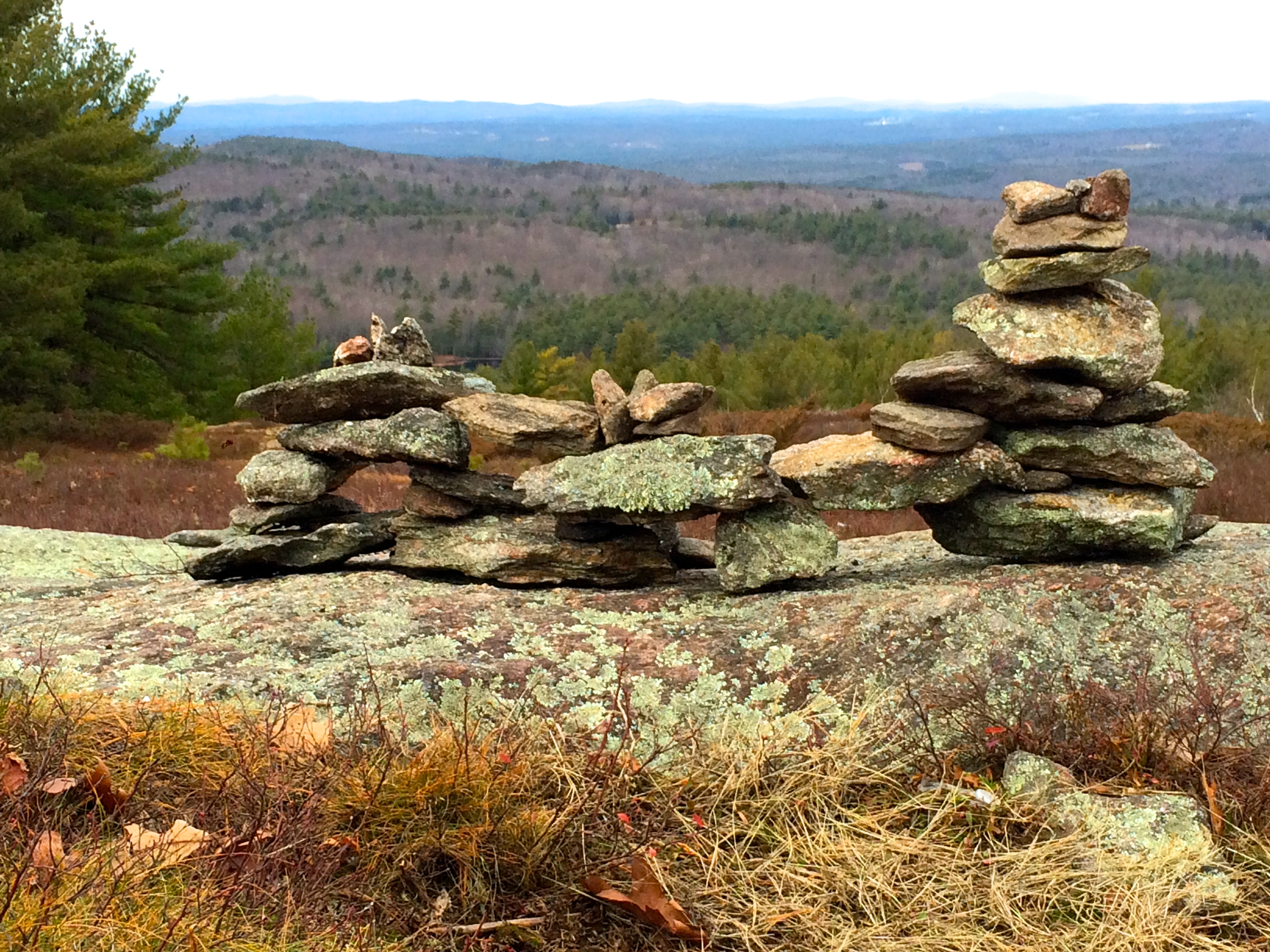
Eric and I used to call short hikes up the small mountains around Northwood, more than a walk but less than a several thousand foot ascent, hikettes. Climbing to Neville Peak, an open knob on the ridge of Nottingham Mt. in Epsom, is one of my favorite hikettes.  On a clear day the peak of Mt. Washington, 100 miles to the north, is visible, a white cap behind the horizon of closer mountains in winter.

For the decades I’ve been hiking to Neville Peak it’s been mostly deserted.  Now, with a new trail reopened by an Eagle Scout and my friend Alison’s efforts to publicize this local treasure in the Epsom Town Forest, we often meet one or two people on the trail, and when I got to the peak a few months ago was surprised to find a collection of cairns scattered across the open ledge.

Though my friends and I have been climbing to this spot for decades, we’ve never built cairns. As much as I like piling and balancing rocks, and always add to cairns when I find them on a mountain top, it had never occurred to me to build them on Neville, even though the open ledge is scattered with all sizes of loose rock, mostly granite.

When I was on Neville a few weeks ago I used a long flat rock to make a bridge between two square rocks and then started a pile on both the bridge and each end. Yesterday when I was there a new bridge was balanced on the edge of the ridge, framing the horizon of mountains.

Mt. Washington wasn’t visible but there was a garden of communal sculptures at my feet.


Day Six — Checking & Keeping Track

IMG_4097

“How many times do you check things?” I asked a group of my colleagues about ten years ago, other Executive Directors of state domestic and sexual violence coalitions. We went around the table, out for dinner after a day of meetings. One friend talked about the 79 potted plants on her porch that she needs to water every day in the summer, making sure she gets to them all. Everyone double, triple, quadruple-checked something — sums on budgets, spreadsheets, brochures about to go to print, sensitive emails. I checked that my medication was in my luggage at least three times before I would get on a plane.

“How much checking is OCD, and how much is what makes us good at our jobs?” I asked.

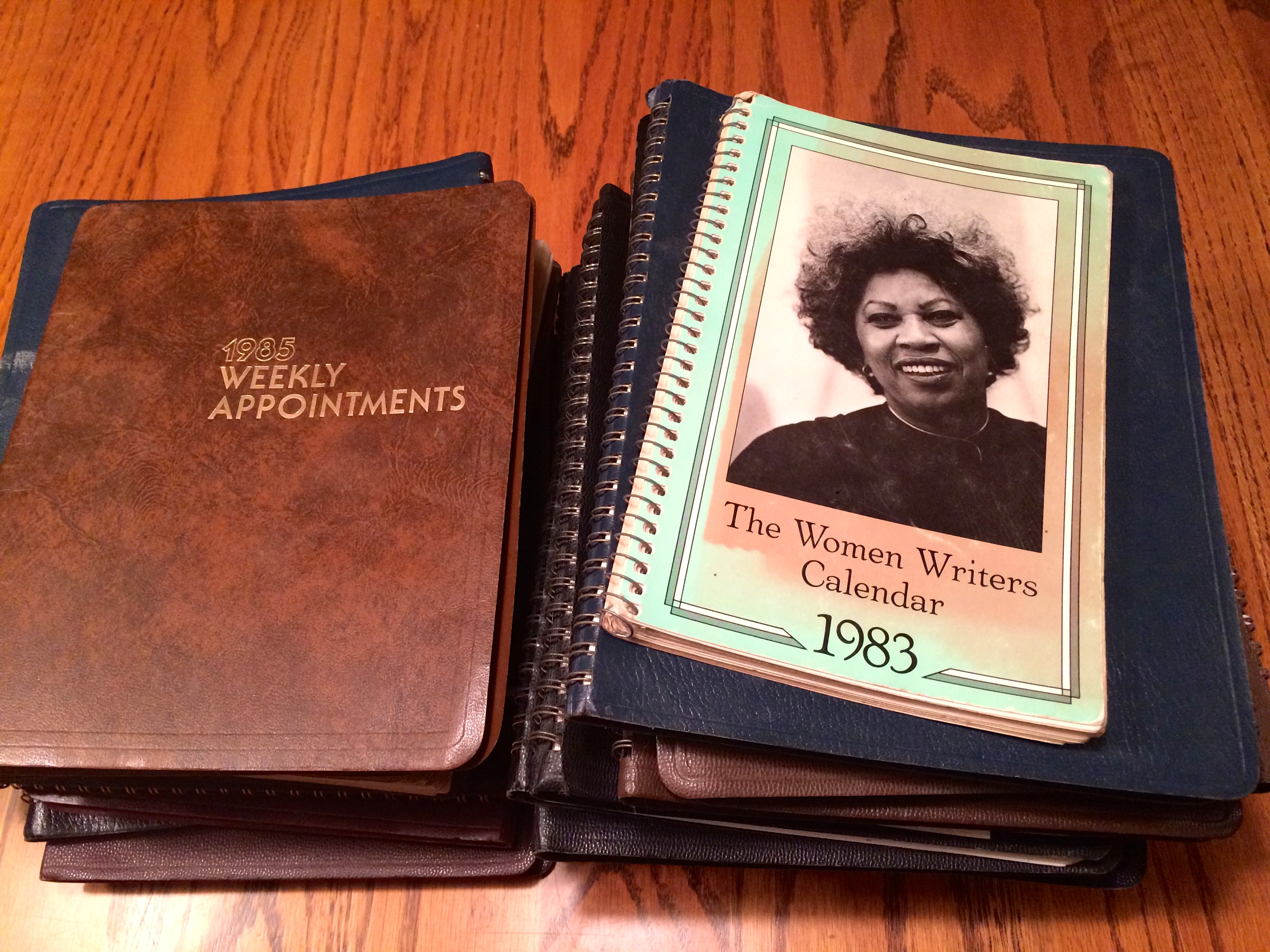
I still don’t know the answer to that, but Saturday night, after hours of eating and drinking with a group of these old friends, the topic of checking and keeping track came up, different but related habits.  One of my friends keeps a log book of her bike rides.  Another wears a FitBit and makes sure she walks 10,000 steps at least six days a week.  I write down my exercise every day in my calendar, and apparently have been back to 1988, as I can see in the old, spiral bound Note-a-Date Weekly Business Appointments for that year. I had my old calendars out, considering whether to dump them in the process of rearranging my study — they take up a lot of shelf space (though far less than all my journals, which is another whole story).  But tracking exercise isn’t so uncommon — I have numerous friends who record their daily workouts and some compare what they’ve done each day against what they did a year ago.

Then the topic of tracking periods came up and I remembered I did that from my late teens until well in to my 40’s.  In the 1985 date book I found small back-of-the-book calendars from 1983, 1984 and 1985 taped to the inside back cover. The dates of my periods are circled, as they are in all of the date books.  Tucked in to 1985 is a piece of paper that graphs my basal body temperature and the quantity and consistency of my cervical mucus for the month of June. Tracking my fertility cycles.  After the beginning of June there are no more circles in the 1985 calendar.

Sam was born in March 1986.


Day Five — Counting

Image via Wikimedia Commons

I count in my head and have for as long as I can remember. When I swim in Long Pond in the summer, I count 20 strokes breathing to the right, then switch, 20 to the left. When I cut carrots for salad I count the chops of the knife — one, two, three, four, five. I memorize the numbers on license plates of cars in front of me. I count the holes I poke in the dirt with my finger, getting ready to plant beans. I count stitches as I knit. I track my runs and walks and bike rides with an app on my phone then write down the distance on my calendar. I count my inhales and exhales when I meditate, when I hold a pose during yoga.

What does this say about me? That I’m a poet who pays attention to the rhythms in my life? One summer several years ago I wrote 14 sonnets, because a sonnet has 14 lines and I wanted to create the symmetry of 14 x 14. Working in the traditional form, I counted beats in the lines. I spent much of the summer tapping with my fingers as I moved through my day repeating lines from the poems in my head, working to get each line to ten syllables of iambic pentameter. I can’t write a poem without some order to the number of lines in each stanza. Really, I can’t. If a poem just won’t take that shape, I take out the stanza breaks and let the poem run on.

What does that say about me? I like order but I also like disorder. Writing a poem orders the world and also enters the disordered perceptions that make up a moment, roaming among the associations that make meaning of a collection of words. Adherence to a form, even if it’s a form I’m imposing rather than a traditional sonnet or sestina or villanelle or triolet, makes me work harder to make the sense make sense.

I think. And now I’ve counted these words and I’m at the number I’ve decided I’m going to write each day for these two weeks. So I’m done.

Day Four — A Student


.

The window is black, a mirror of my morning, messy hair, dark glasses, the white light of the Apple logo on my computer the brightest spot in the reflection.

This is how I start, describing what I see — the sky, trees, the old silo on the horizon, a bluebird, a crow, the last johnny jump-up in the garden. Then I try to stretch the image to mean more than it says. That’s what poetry is, for me, pulling words past themselves, layering meaning so an image creates associations that reverberate in unexpected directions. I usually give some direction in my poems, a thread of narrative to help pull the reader along the arc of language, sometimes more directly than others. But there have to be leaps, moments when the reader crosses over from a literal reading to a sense of something more and know that whether that something is exactly what I, the poet, meant doesn’t matter. I explode/inside my own brain, I want other brains/to explode. Another line from The Truth About Death.

Crafting images that speak for more than themselves in prose isn’t any more difficult in individual images, but learning to do it effectively across a much longer and more linear narrative, in a novel or memoir or even essay, is more difficult for me, mostly, I hope, because I’ve done so much less of it. But I’m learning.

And that’s something I’ve loved about the new life I’ve created since leaving full-time work. I left my job to write, imagining myself as a full-time writer, forgetting how much else I do – mother, partner, friend, daughter, sister, board member, hiker, triathlete, runner and especially absorbing, grandmother. My imagined future of hour upon hour at my desk and books pouring out of me hasn’t happened but I do write more than I did and what I’ve loved is learning to write better, especially in genres I’d only dabbled in before.

Last summer I studied novel writing at the Vermont College of Fine Arts Postgraduate Writers’ Conference (with Andre Dubus III who was a terrific teacher) and was the person in the room with the least experience writing fiction. I loved it.  When I was working, I was never the person in the room with the least experience, and often was the person with the most. I was the teacher, leader, boss, presenter.

Now I’m the student and it’s exhilarating. It’s a relief, to learn and not teach.


Day Three — Warm December

unnamed

The cows are clustered around the hay rack in the pasture across the street, a low moan rising out of the one lying off by itself. A few are eating. A calf lies in the curve of a large cow’s body, both heads erect, wet noses glistening, breath steaming.

I can see all this so clearly because I’m outside, on the porch, low sun on my lap, almost hot. I’ve written about this before, there’s a poem in my book titled “Warm December,” another poem was written right here, warm when it should have been cold.

The Porch

This is where I come together, my feet
in white wool socks, the grass still patched
with green, open, a winter with no winter,
the warmest ever. Other people are scared
but I don’t care. Birds fly across the porch
under the grooved wooden ceiling, above
the railings. Small white pines are coming up
in the bit of pasture beyond the barbed wire
fence of the old calving pen where it doesn’t
get bush-hogged in August, the nature of nature.

That was eight years ago. The pattern continues. World leaders are in Paris trying to at least keep worse from happening, but this is going to be the warmest year ever, again. I think the world has always been this dire, the future, the violence, the inexplicable horrors that humans do to each other, or one does to another. We just know more about it, we know the full scope, information coming from everywhere all the time so our heads fill and fill with one tragedy and then the next, a massacre, a disaster, push notifications that ping my phone so I pick it up and read about the latest horrible thing.

I could shut off those notifications.

Last night poet friends gathered here and we ate and chatted and then all read what we’d written in response to a prompt David had come up with – Plagues We Have Known.We always have a prompt to write a poem for the Yogurt Poets holiday party, though past prompts have been gratitude, tradition, grace. Plagues was a whole new direction.

“What wonderful nerds are we?” said Hope as Kay talked about exploring the etymology of “plague.” Nancy had written 14 lines to each of the ten plagues visited on the Egyptians by God, Hope had written one line for each. David had used the metaphor of cell phones as progenitors of infection, a coming epidemic. Mary was happy to have been able to write anything.  I was happy to listen to what everyone had written. A group of creative souls who write for an audience as small as the dozen of us, as small as themselves, because we love the beauty of poetry.

Now the calf has moved to lie against the back of the cow who was moaning earlier. The world is hazy with moisture and inappropriate heat.