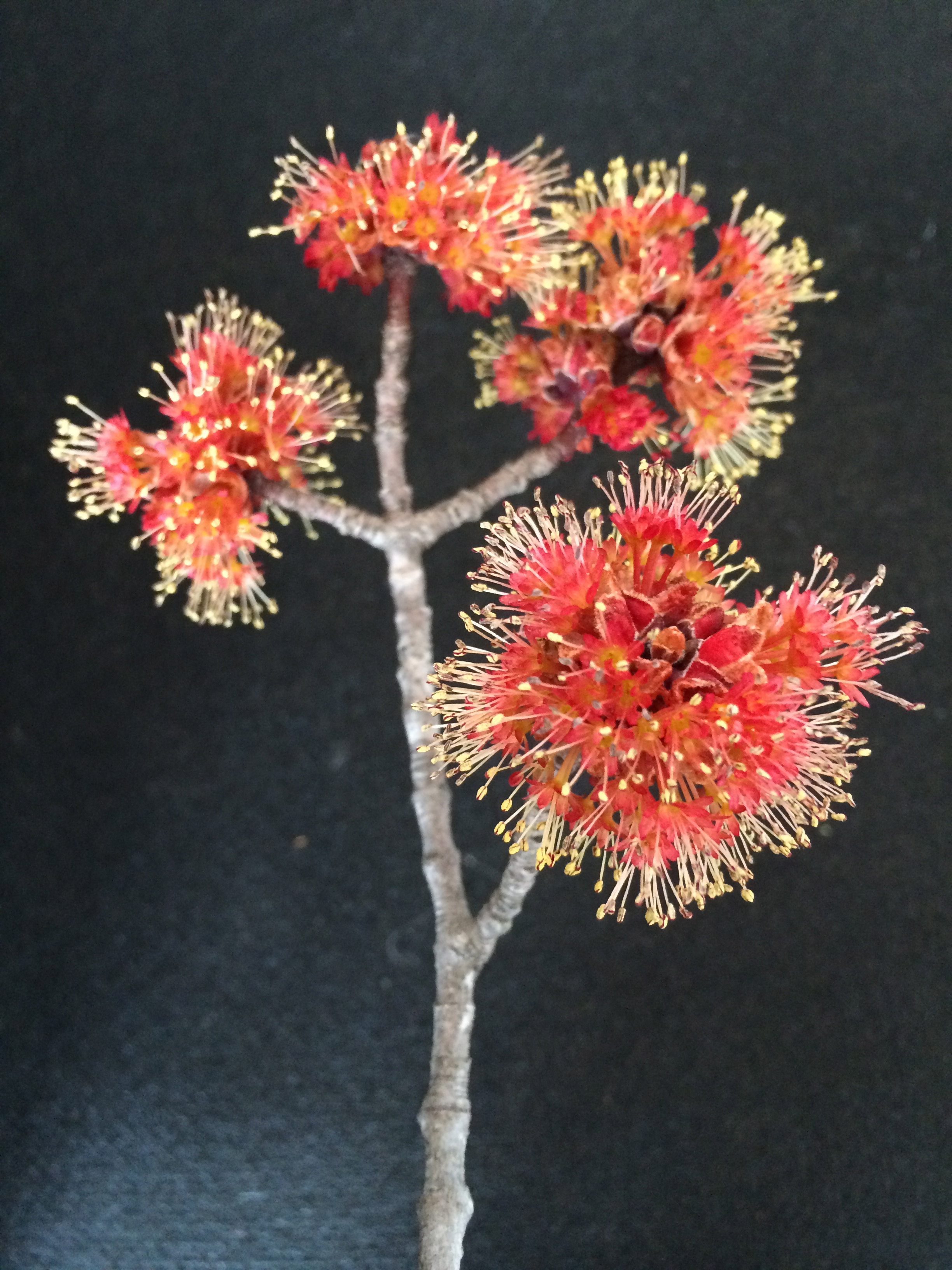
Maple Flowers

IMG_3647

David and I spent the weekend in New York and the streets there are lined with flowering cherry trees, crab apples, forsythia, magnolias.  Some hardwoods had tiny leaves emerging from their buds, lighting up their crowns and making the world feel softer.  The splashs of color and blossom were delightful; the evidence of spring growth was reassuring and made me happy.

Then home, to tighter buds, grayer days and temperatures that have me wearing wool again when I sit at my desk.  But from that desk I also look out the west window to some branches of the maple tree in our front yard, and every day I notice how much bigger the buds are on the tree, how the balls of red brighten the landscape.

Two days ago I went out to examine those buds and realized what I’ve been looking at are flowers, not buds.  Really gorgeous and even trippy flowers.  Balls of fuzz puzzling enough that David and I spent a good bit of time reading online about maple buds and blossoms.   We learned a lot.

Maples have both male and female flowers on the same tree, the male with the sperm needed to pollinate the female.  As the leaves start to emerge so do the seeds, wrapped in the papery-winged helicopters I stuck on my nose as a kid, peeling open the seed pocket and using the bit of juiciness to make it stick.  The seed pods — samaras — are shaped so they spin in wind and can travel, sometimes a long way.

Yesterday we were in Portland and there were no flowering trees, though the magnolias looked ready, long flutes of bud with just a slip of blossom showing on a few.  I missed the clouds of blossoms we’d seen lining the streets in New York.  Spring in cities can be so pretty, I wanted to see it again.

We went down to the waterfront and in the parking lot saw some maples flowering.  I went to get a closer look, these flowers tamer and less flamboyant than those on my tree, fewer stamens, less fuzz.  Today it’s gray again and not particularly warm, but the maple flowers are still popping and pollinating and getting the whole spring thing going.  Here it comes.


Quantifying Spring

IMG_3644


Yes, April can be a cruel month, with its tease of warm, sunny days followed by raw rain and wind that whips away any heat I manage to absorb from the sun.  But there’s steady evidence that the season is, indeed, changing.

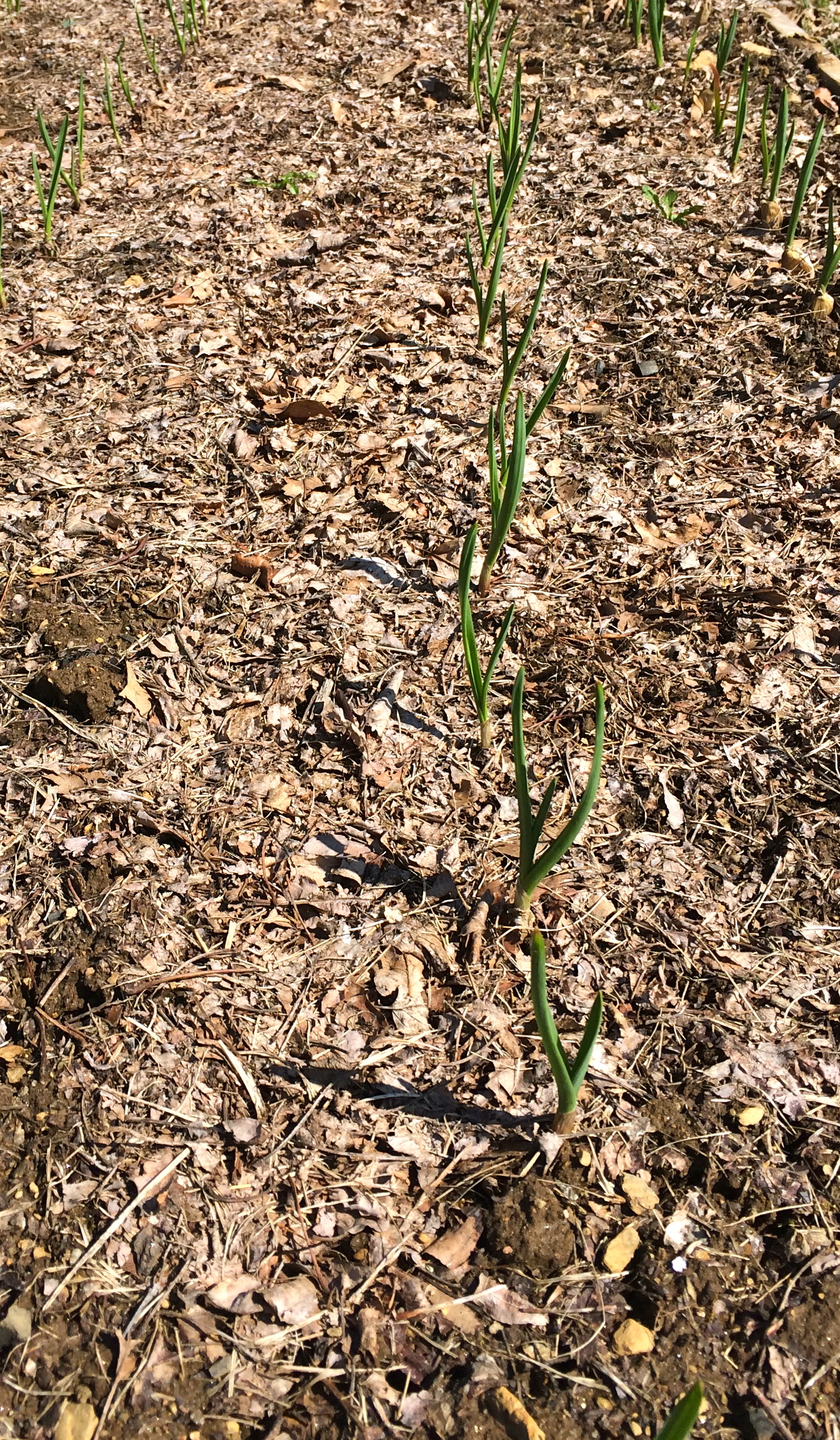
A week ago I looked out the kitchen window and saw that the garlic was up, four faint lines of green in the garden bed, shoots rising from the cloves I nestled in to the soil last fall. Also a week ago my sister Chris and her husband Jon came for an unexpected visit.  It was a clear day, but the wind was strong and chilly, and when the sun shifted so the back deck was in shadow, we moved to the front porch.  The porch was too windy. We tried the bit of lawn below the stone terraces, a low spot where the wind is blocked and the sun is strong.

Sitting in a circle chatting, I noticed how much taller the chives were.  I’d raked last year’s dried foliage off the clumps on Saturday, hoping to use some snippings for the dinner I was making that night for friends.  But the shoots were too small.  Now they were tall enough to cut and I wondered how fast they were growing; it seemed like they’d sprouted inches in just days.

So I measured both the chives and the garlic, two days apart.  The garlic grew an inch and the chives grew two.  An inch a day.  Solid evidence that summer is coming.  A few gray days, a raw day, a day of hard rain, doesn’t stop the seasons from following their course. When I feel a bit off course, I look out at my bed of garlic, green growing every day. Growth I can measure.

The Grind

writing image

Grind:  To crush or pulverize; to polish, sharpen or refine by friction; to rub or bear down on harshly; to oppress or weaken gradually; to operate by turning a crank; to produce mechanically and without inspiration; to instill or teach by persistent repitition.

Or, to write every day.  I’m Grinding this month for the fourth time.  The Grind is a commitment to writing something every day for a month and sending whatever you’ve written to your co-Grinders.  You can only get into the Grind via invitation, and you can only be invited by someone who has successfully done a full month of the Grind without missing a day.

Created by poet Ross White, the Grind creates a virtual writing accountability community. You get sent a link to a website where you sign up for the coming month and choose the category of writing you want to do:  new or revised poetry, new or revised prose, or manic mix, which means write whatever you want.

But you must write!  Ross organizes writers into groups of 10 or so according to genre, then emails out the group assignments.  There are only two rules: you must write something everyday and email it to the others in your group by midnight of whatever time zone you’re in, and you must not share any writing that’s sent to you without permission. This is not a feedback group.  You don’t critique what’s sent to you, you don’t even have to read it.  It’s just about writing and sending.

Simple, and profound.  I’ve never known anyone in my Grind groups, though I do read their bios, which come with the group assignments.  But I’m responsible to them — they are expecting something from me in their inbox every day, as I expect something from them.  Someone is paying attention to whether or not I write.  Or more importantly, I’m paying attention to whether or not I write every day, because I’ve made that commitment to a group of strangers.

I don’t think Grinding is producing “mechanically and without inspiration.”  I think it’s more teaching “by persistent repitition.”  Mostly it’s “to polish, sharpen or refine by friction.”  The friction of making sure I get some words on to the screen and out in to the world everyday.  Friends I’ve invited in to the Grind talk about the value of paying attention to language and creativity for at least a tiny part of each busy day.  One friend hasn’t missed a day of Grinding since January and talks about how it’s fundamentally changed her relationship to her practice of writing.

Grinding is practice and practice is essential to any craft.  So I polish, sharpen, refine, Grind.


Birdsong

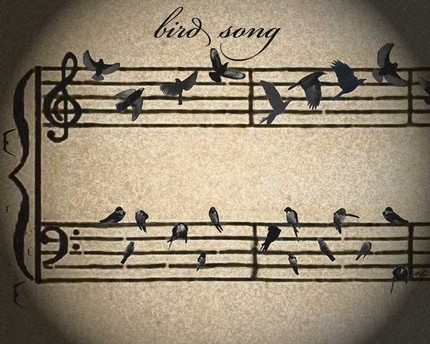
Artwork by Kenneth Rougeau

The first spring thing I notice is the birdsong when I step outside in the morning, going to bring in the newspaper. Sometime in late February there start to be chitters here and there.  In March, if I get up right at dawn, it starts as a single cheet, then escalates into trills and melodies and chatter.  Now the yard is wide awake and singing by the time I go out in the morning, and I listen to the background songs as I meditate, a constant chorus behind my mantra.

Because the rise in birdsong coincided with the rise in Eric’s cancer, though we were long in to spring before we realized why Eric was in so much pain and feeling so lousy, for the last nine years there’s been a tug of grief in the sound, another reminder.  But it’s also a reminder of the whole glorious mess that life is, with its cycles and renewals, pain and joy, gain and loss, despair and celebration.  “Life is so damn yin yang,” I said to David last night, as we drove home from visiting friends grappling with new grief.

All of which brings me to this poem, which opens The Truth About Death, as it should.

Birdsong

Now the song varies, mocking chains of notes,
the catbird flying from maple branch to fence post.
All spring I noticed the rise in birdsong
as we went out each morning, stronger chatter,
the brakes off, cells dividing and dooming themselves.
I sit in your chair, I wear your clothes, your ring.
I talk to your photographs. I watch the sky,
watch birds in the yard and realize how many flocks
I’d missed. For weeks I washed you, watched you,
lay next to you, all we could do was touch hands,
all you could do was whisper, your eyes black
morphine disks. Yet you turned back for me.

Petrichor

Photo from Downgraf.com

Two of my sisters and my niece, Amelia, and I email each other, on a rotating basis, a word of the week, every Sunday.  It was Amelia’s turn this week and her word — petrichor — was a revelation to me, a word for what I’ve been I’ve been trying to describe for years, the pleasant smell of rain after a long, dry spell.

A citrus tang layered over an earthy sigh of musk, a release of heat you can smell.  More than a dozen words to describe what can be said in a word. Petrichor.  

As the word sunk in I remembered I had two poems published in the Petrichor Review a year ago.  How did I not notice the meaning then?  I always study journals I submit to, carefully looking for a fit between my poems and what they publish.  I looked again and saw I hadn’t read past the etymology of the word on the website “about” tab:  “Petrichor (pronounced /ˈpɛtrɨkər/; from Greek petra “stone” + ichor the fluid that flows in the veins of the gods in Greek mythology)”

I missed “the scent of rain on dry earth.”  No wonder, after reading about a stone fluid in the veins of Greek gods.

The editors of the journal sent me the nicest acceptance email I’ve ever received, saying my poems are “an excellent exercise in poetic restraint; they’re succinct, unpretentious, and casually deep.”  (Okay, yes, a bit of brag there.)  And they’ve known all along about petrichor, a word I needed and didn’t know exists.  No wonder my poems fit in the Petrichor Review.

Nachas

11024736_10206368938610417_5925431246814310338_n

“You have so much nachas ahead,” the rabbi said to me when I went to see him after Eric died.  I was reading a lot by then, and death was my constant topic, whether what actually happens when we die (How We Die by Sherwin Nuland) or trying to cope with grief (A Grief Observed by C.S. Lewis), which I was learning felt like an unremittingly slow slog through the bottom of the sadness bucket which was turning out to be a really, really big bucket.  The rabbi, I assumed, would have an answer to my question of what Jewish writing would be most helpful, or most instructive anyway.

At the time I could hardly understand what the rabbi meant, because looking at the future was too painful, but he was right.  (He refered me to the Memorial Service in the siddur for the Days of Awe, which I didn’t find that useful at the time but which I continue to read on Yom Kippur every year).  The rabbi was trying to give me a glimpse of all the happy occasions to come in my life, because he knew my children and believed there would be many and there have been — weddings, graduations, jobs, family vacations, the simple pleasure of all being together on the porch on a summer evening telling stories and laughing.  Eric not being here to experience all these moments is such a given at this point it’s become a much smaller wave in my mood.

Last Friday night was a nachas moment — Ava being named in the Reform Temple of Forest Hills, where Matt’s parents Carrie and Tim are members.  Aharonah Tziporah. Aharonah for Matt’s grandfather, Aaron, Tziporah, which means little bird, because Ava was chirping as she was born and kept up a constant stream of chatter for over an hour as if commenting on all the newness — What?  What just happened? What is all this light?  And the smells?  Noise!  And wait!  Breath in my lungs?

Ava is still a chatterbox, chirping and cooing and even starting to laugh.  Like her big brother Emilio, she’s a joy magnet.  Almost nine years ago now my rabbi could look at the blessings in my life and see there were many more to come.  Given the perspective of grief, I couldn’t see it, but I hung on to that hope and it helped.

(So what is nachas?  Yiddish for joy and pride, especially from children and grandchildren.)


Snow Surprise

IMG_3632

This morning I woke to a new winter coat on the grime, the real dirt of living that’s been etched on snowbanks everywhere for the last week now hidden in a fresh, if wet, three inches.  I’ll take it, as long as it melts fast.

Driving home from Long Island yesterday afternoon we expected snow showers at the end of the drive but it wasn’t predicted to amount to much.  But by the time we got near Concord there was a steady, heavy snow that whipped into our faces when we stopped at a rest area.  Still, the snow was melting on the road, which was wet like it was raining, no problem.

Until we climbed the Chichester ridge to the east of Concord, headed to Northwood. Suddenly there was snow on the road at the top of the hill, and a good bit of it.  Three inches at least, and dense and sticking to everything.  The last 10 miles of the drive turned in to a slow moving train of cars as we all crawled along the slick road, snow still swirling. The car splashed up mud as I turned in to the driveway, but otherwise, uniform white.

It was a bright morning so I got out on the snowmobile trail to ski early, before the sun could warm the snow to too sticky, before the melting began.  There were spots of sticky snow, but there was also fresh powder on every branch and needle and twig, a wonderland of white again, a glimpse back at a spectacular winter of snow.  And then I was gliding along the tracks, maybe for the last time this year.


Kitchen Table Wisdom

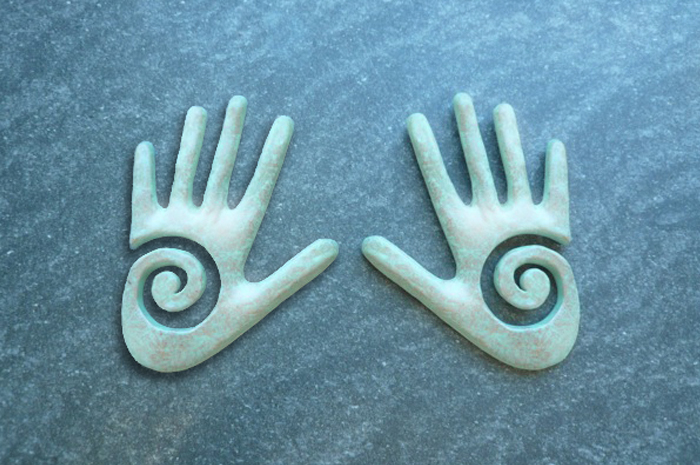
MedicineHands

“Can you read,” I asked my friend.  She recently lost her life partner of 34 years and I know how searingly painful acute grief can be, how the day can feel like an impossible bag of cement blocks you have to drag around, how hard it is to feel settled enough to read even though you’re exhausted.

“I can’t really focus,” my friend said and I knew exactly what she meant.  One of the things I remember most vividly after Eric died was my inability to read.

One of Adrienne’s childhood friends, Leila, came to the shiva service for Eric the week after he died. Leila had also lost her father to cancer, about a year before, and her mother, who I knew from all of our daughters’ years of play dates and high school events and parties, sent along a book for Leila to give me.  As another member of the widow club I’d just joined, she hoped it would be helpful to me.

But I was a reading snob in those days.  I read literature, not self-helpy feel good books like Kitchen Table Wisdom: Stories That Heal.  The book, by Rachel Naomi Remen, M.D., is a collection of very short, true stories about life written from Remen’s perespective as a pioneer in the mind/body health field, and told with an invitation to the reader to “listen from the soul.”

Scanning the book I saw chapters with titles like “Life Force,” “Opening the Heart,” “Embracing Life,” and “Mystery and Awe.”  I was grateful to Leila’s mother for thinking of me, but inwardly I scoffed.  I would never read a book like this I thought, which was comical on one level because at the time I wasn’t reading anything except emails, sympathy cards and snippets from a grief book a friend gave me.

From the tiny bit of reading I’d done I knew that not being able to read is common in early grief and I mourned that loss also.  There was no book to bury myself in, just moment after moment of the ever present absence of Eric.  I craved being taken away by a good novel or memoir, a story besides the sad one I was living, but I had no capacity to read one.

A few weeks later, when the post-death visiting and attention were beginning to die down and I found myself with more quiet evenings, I thought I’d try reading again.  I found Kitchen Table Wisdom on a book case and picked it up.  The first story in the book was only three pages.  Surely I could read that much.  I did.  The next story was five pages long. I read that story and the next and the next.  Well into the first chapter I realized I was reading a book.

I began to take the book to bed with me, reading before I fell asleep, a life long pleasure I’d lost along with Eric.  And here was that pleasure again and the book I was reading wasn’t literature.  It was a book from the Self Help section of a book store, a book I would never buy and certainly wouldn’t read.  Except I was reading it and enjoying it and it was actually making me feel a bit better.  It was helping.

The memorial service for my friend’s life partner is this week and I’m going to bring the book with me.  She may not like it and I don’t think it’s her kind of book, just like it isn’t my kind of book.  Except it was and it is.


First Thing Ski

photo (5)

Waking to 4″ of fresh, fluffy powder on the snowmobile trails that cross our yard calls for one thing, first thing.  A quick cross country ski, before the snowmobiles are out, while we have the trails to ourselves and get to make the first tracks.  Our skis catch the new snow just enough to climb the hills and then is slick and quick on our downhill runs.

David and I do double hills.  There are two good slopes on our regular route and as we climb each one we turn around then shoot back down. Climb again and continue our ski, then get to do the downhill again on our way home.

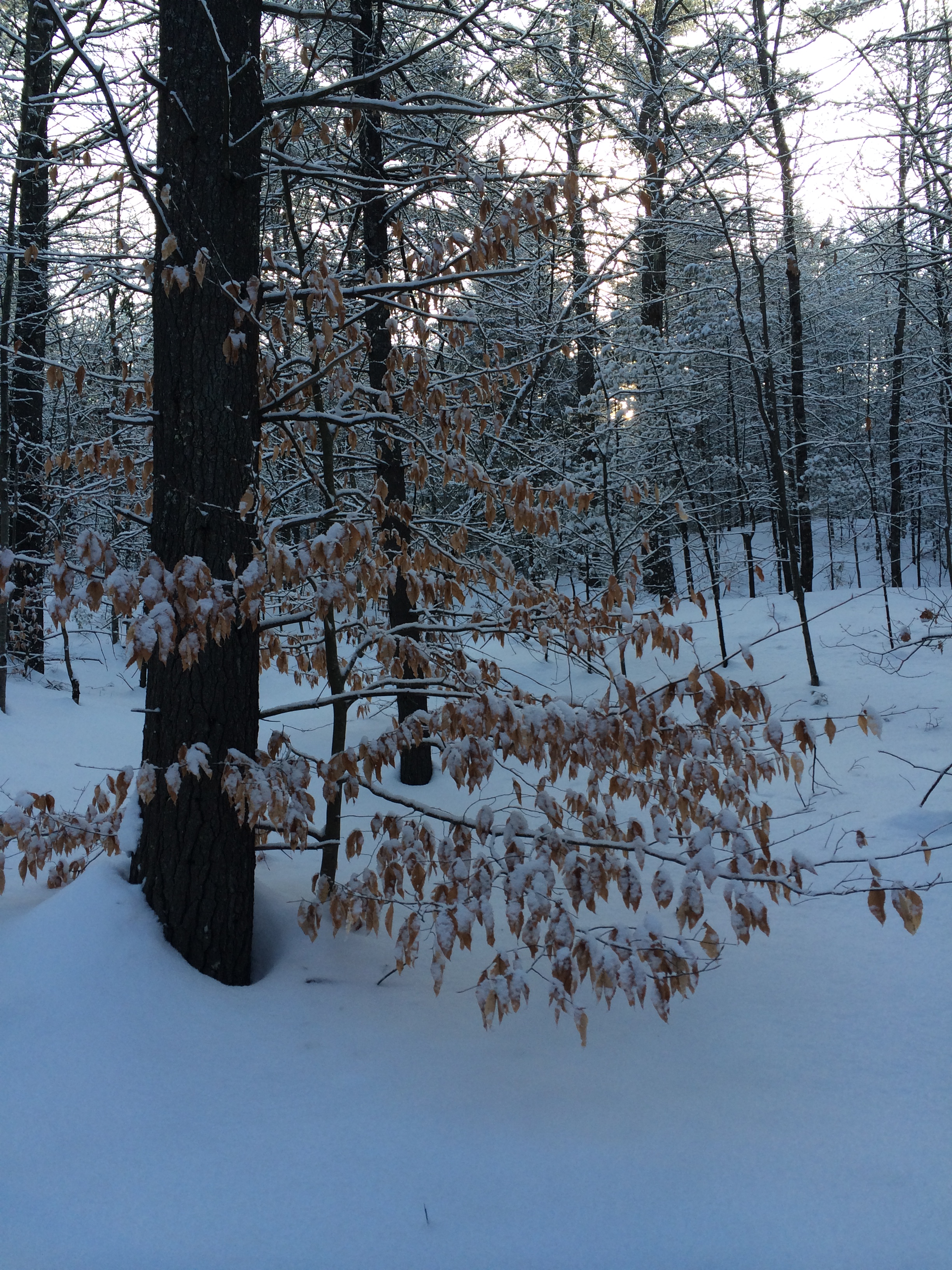
This morning we were out early enough that the sun was just starting to light the trees, a peach sky above the beech leaves that are still hanging on, hung with snow.

I have a lot going on right now (when don’t I?) with commitments and lists and tasks I have to get done on deadline.  But there needs to be room in my day for a ski, first thing.

Wind and Snow

photo (45)

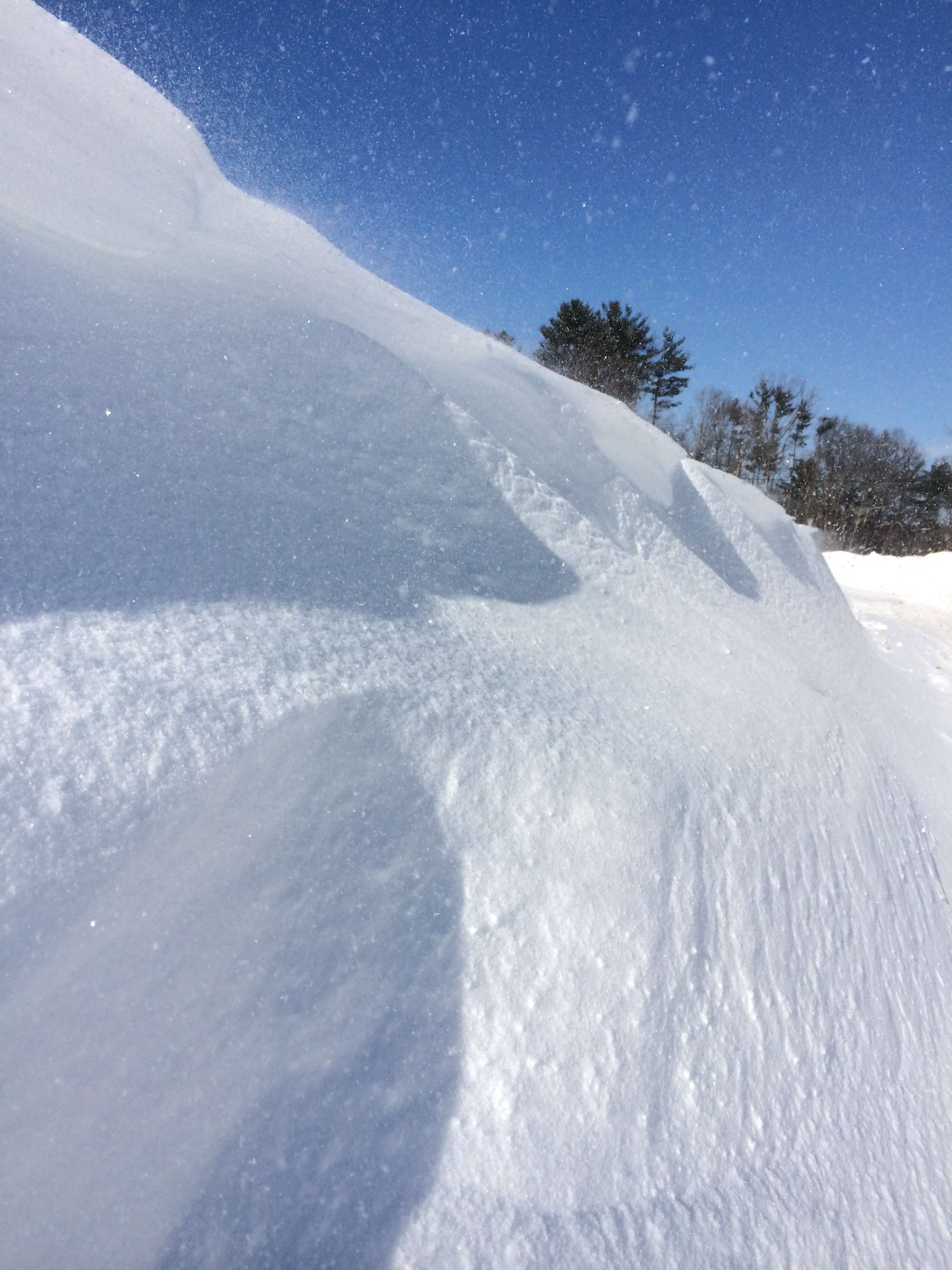
Clouds of loose snow blow across the fields and past the house.  As long as there’s any dry snow in the world to the west of me, it makes its way past my windows.  Every path I shovel gets packed with hard, dry drifts that lift like bricks as I shovel again. 

We came home late at night two weeks ago after a windy storm and a snake of drifted snow curled out of the walkway to where we parked the car.  I stepped over the first, knee-high drift on my way to the porch to get a shovel  The next ridge was waist high and I plunged up to my thighs.   It was impossible to tell from our yard how much snow had fallen in the storm.  It was all drifts and mounds and long lips along ridges of white.

Our ski tracks across the field filled in this morning in the hour we were out.  It wasn’t snowing, just blowing.  We’d skied though woods to the edge of another field where the wind had sculpted pockets around the trees where we stopped.

photo (44)

Now gusts grab chunks of packed snow from the roof and fling it down into the stream whipping through the yard.  The whistle and whisk of the wind turns into a long murmur and then a slap, slap, slap and bang as the shovels on the porch slip around.

The maple in the yard loses another dead branch.  The hills in the distance are foggy with their own wind storms and above it all the sun has come out, last night’s storm has swirled itself out to sea and here on the edge of the great circle the wind keeps turning the corner and scrubbing my world.