Zero Week

photo (1)
Greeting David at mile 8, 4th Ave. in Brooklyn.

As those of you on Facebook know, I successfully finished the NYC Marathon last Sunday. It was a long journey from my no-running months last winter, due to a sore knee, through physical therapy, 18 weeks of training and then the long trip on Sunday morning, starting with a 5:55 am train into Manhattan, a subway ride to the South Ferry station, and a ferry trip across the Hudson River with the many runners from other states and countries snapping shots of the Manhattan skyline as it receded behind us and the Statue of Liberty as we slapped through the wind-whipped water to Staten Island.

There I got in a long line of people slowly making their way to a long line of buses, waiting to take runners to the start village.  Once there I wandered through the tented areas offering coffee and Gatorade, Power Bars and bagels, waiting until the last minute before getting in my starting corral to shed the extra layers I’d worn to say warm in the early morning chill, made much chillier by a hard, cold wind.

At 10:55 the gun for Wave 4 boomed and the last group of starters shuffled in a mass towards the starting line.  By the time I stepped over the line the mass of runners had thinned out enough that I could actually start running across the Verrazano Bridge.  In spite of the pre-race instructions to leave extra warming clothes in the start village to be donated to charity (or have them transported to the finish line, an option no one seemed to be using) and not to drop them on the bridge, I was dodging sweaters and sweatshirts, hats and gloves, coats and scarves for the first several miles of the course.  In fact, there never stopped being discarded clothing for the entire race.  Why would someone drop gloves 24 miles into a marathon and not just carry them the last 2 miles?

After the fierce wind on the Verrazano Bridge, the sun came out and the buildings of New York did a good job of blocking the wind for much of the course.  I churned along, listening to podcasts and then switched to a running playlist Adrienne had made, and which I added to, at mile 13, in order to pump  myself up for the second half of the race.  The music helped a lot as I finished the long run through Brooklyn, a corner of Queens, and powered up the incline of the Queensboro bridge, then let myself cruise down to the turn up First Avenue in Manhattan.

First Avenue was the highlight for me.  As I started to head north, I looked up at the sea of runners before me, stretching for miles, and the crowds of people along the sides, cheering and shouting and holding signs.  Through the music I could hear “Way to go, Grace,” “Go Grace,” “You can do it, Grace.”  It was definitely a good move to write my name on duct tape across the front of my shirt so I could get personal encouragement.

Knowing I’d see David at miles 8, 16 and 24 helped too.  “Just another mile and David will be on the sidelines,” I would tell myself, and when I turned south on Fifth Avenue at 138th street I started counting the streets in my head, “Just 46 more streets until I see David at 92nd, just 20 more streets, just 5 . . .  .” and there he was, smiling and cheering and holding out a PowerBar in case I needed more to eat (which I didn’t).

As I neared the finish line in Central Park I realized I was really going to make it.  I’d thought all along I was going to be able to finish this marathon, that I’d prepared myself and trained for it.  In the last six miles of running I understood why the training program peaked at a 20 mile run.  The last six miles are pure will and grit — once at 20, I kept going by locking in the one-foot-then-the-next rhythm, focused on the music blasting in my ears, and just kept moving.  Now I could see the finish line and all I had to do was make sure I didn’t stop.

I didn’t.  But now I have.  The Hal Higdon training program that served me so well in preparing for the race has a post-marathon recovery program, and I’m now in Zero Week of that program.  As in Zero running.  The first three days say “No running!”  On Thursday and Saturday you can do a gentle jog if you really need to, but the advice is to take the week off.  Rest!  I’m not good at that but I’m doing it.  My toes are still too sore to do much moving yet anyway.

Going in to this marathon I told everyone, and myself, I was just doing this one because I’d decided doing a marathon was on my bucket list.  Now I’m not sure I’m going to stop at one.  Running 26.2 miles seems like a good deal for an endorphin high that lasts this long.

NaNoWriMo

Participant-2014-Web-Banner

Yes, I’m doing it again, participating in NaNoWriMo, or National Novel Writing Month. My first NaNoWriMo was in 2011, when I met the challenge of writing 50,000 words in the 30 days of November.  NaNoWriMo was launched in 1999 when a group of 21 writers got together and decided to each try to write a novel in a month.  The idea has been growing ever since and last year over 300,000 adults and almost 90,000 young writers participated.  Clearly, deadlines and a sense of community, even if virtual, works for writers. One of the best reasons the website listed for writing a novel when I took part three years ago was that finishing a novel allowed you to change your “I’ve always wanted to write a novel,” line at parties to “I wrote a novel.”  True, I’ve used that line.

I didn’t completely finish my novel in November 2011, though I wrote over 50,000 words, and I finished the novel a month later.  And it wasn’t exactly a novel either.  I wrote a very marginally fictionalized account of a family situation that had happened the summer before.  It felt more like transcribing an experience, with different names for the characters, than imagining and writing a story.  I suspect it’s not a particularly compelling novel, because I’ve never even read it myself.

Now I’m writing a novel that is completely fiction and it’s more fun than I could have imagined.  After the fairly soul-wrenching work of the memoir I spent much of the last six months pulling into shape, I needed a break.  A decent draft of the memoir is waiting for me to make the next set of edits.  But before I go back into the sad and anxious time in my life the memoir recounts, I wanted to write something like the well-crafted but decidedly not-heavy novel I read just as I was finishing the last draft of the memoir.  “That’s what I want to write next,” I said to myself when I finished The Storied Life of A.J. Fikry.

Before I left for Europe, I had the idea of writing a novel about a young woman traveling, visiting the places I went on my recent trip.  My idea of working on the novel while I was traveling and able to recount details of the places I stayed quickly fell aside in favor of just experiencing those places.  As a friend said to me in Europe, “You don’t need to be writing now.  You’re doing your research.”

That was a good enough excuse for me, and actually, it wasn’t an excuse.  Now as I’m writing, when I need facts and real experiences from Normandy or Amsterdam or Provence, my research brain is there to provide the details.

What’s fun about this novel is experiencing the delicious excitement of writing fiction, not fictionalized fact.  When I sit down at the computer every day to write the next few scenes, I don’t know what’s going to happen, what new secrets are going to pop out, what my characters will do and what they’ll say.  In fact, I’m just getting to know my protagonist and I’m 36,000 words in to the novel.  But that makes sense, right?  You don’t get to really know someone when you first meet her.  It takes awhile, like 36,000 words worth of awhile.

Being already 36,000 words in to the novel, does that mean I’m only going to write 14,000 words in November?  No, my plan is to write another 50,000 words, because that should be enough for me to finish the novel.  I want a first draft of the novel done by the end of December so I can get back to work on the memoir.  Trying to work on both isn’t working. My head is firmly in this novel — I think about the characters as I move through my day, plot ideas drift through my mind (though very rarely translate in to what actually happens when I sit down to write), and when I go in to my study and shut the door for my uninterrupted hours of writing, finding out what happens next to Cecelia and her friends Nina and Sally is all I want to do.

So, I’m doing it.  Fifty thousand words in 30 days, starting tomorrow.  I’ll let you know how it goes.

The View From Here and Now

IMG_3142

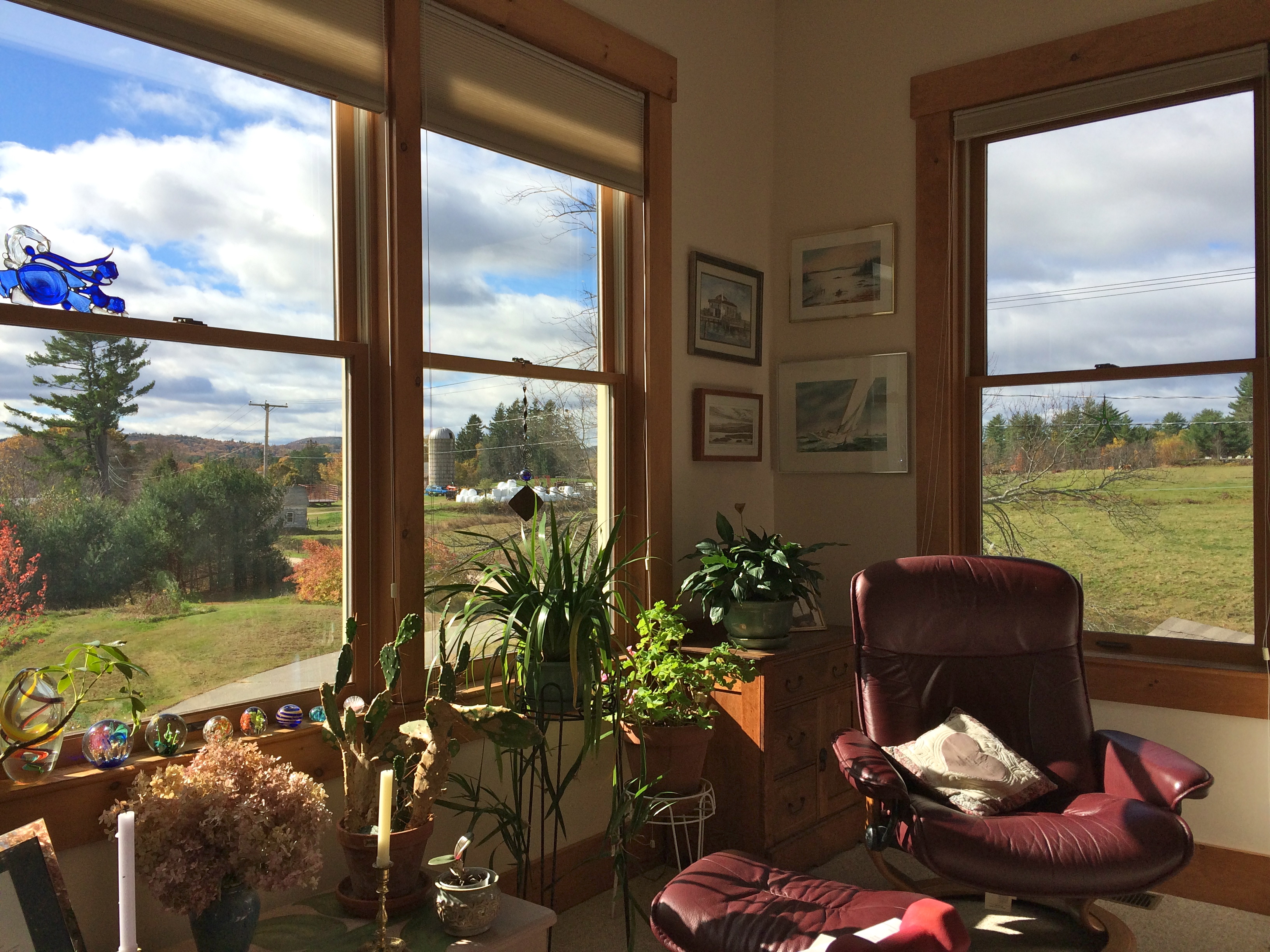
My study is a room with a view, full of light.  Three big windows face south and one faces west, all looking over pastures and the remains of a dairy farm, with the mountains of Epsom as a backdrop.  When Eric was alive, this was his favorite room, with the TV in the corner and his stylish Danish recliner positioned for a view out the windows or at the television screen. When Eric was dying this is where we put a bed for him to spend his last weeks.  That was partly because of the television so he could watch Red Sox games or his favorite movies, but it was also because this was, essentially, his room.

It remained his room for years after he died.  No one spent much time here during those years.  A new, large, flat screen TV had been installed in the family room, part of the finished upstairs of the barn, and the “tower room” as we called it then, the second story of the tower we built to connect the upstairs of the house with the rooms over the barn, served as a passage between rooms, not as a place anyone hung out.  There was still too much sorrow in the room, too much weighted memory.

Six years ago, when I first started to think about moving my study in to this room, my friend Marsie was over for a visit.  I brought her upstairs to show her how I might change the room in to a study and she stood by the western window for a few moments.  “There’s still a lot of Eric’s energy here, but Eric is getting ready for this to become your room,” she said.  “Talk to him about it and the energy will clear.”

Even though I’m not sure what I believe about how the energy of loved ones who’ve died manifests in this world, Marsie’s advice made sense to me.  I spent time in the tower room, thinking about Eric and all the changes in my life since he’d died.  I let him know I was going to transform the room, and six months later I did.

Now I have a glorious study with a view of trees snapping in a brisk wind and a hillside of russet and ochre oaks.  As I sit at my desk, I’m less than a foot from where Eric died.  He sits here with me and I sit here by myself.  I look out the windows and then look at the fall of sunlight in to the room.  I’m grateful and warm and reminded not to take any moment of this day for granted.  I’m here now.

Back At It

IMG_3124

Returning from long travels, there are many ways in the last three weeks that I’ve thought about being back at it.  Back at my desk, writing.  Back in the yard and garden, pulling out wasted plants and tidying the beds.  Back in the car, going to visit with family and friends. Back on familiar streets and dirt roads as I continue training for the NYC marathon.

And back to the always surprising beauty of autumn in New Hampshire because the trees are back at it too.  My favorite is running down a road transformed into a tunnel of color by the crowns of trees, yellow and orange and red, leaves knocked loose by wind showering down around me.  Even though I know this pocket of glory means the trees will soon be bare and I’ll be back in a gray world, with little light and color, I relish it while it’s here.  Maybe even more so because I know it’s passing on.

Here’s a poem from 15 years ago, which makes it clear I really am back at something I’ve written about before.

Center

The bluejays are busy
in the diminished sunflowers,
flopping over bent heads,
flapping as they gorge
on blisters of seed. Crows

cross the yard, ceaseless
feeders. Cricket shrill
encases the globe of air
where we sit, trees
in their revised colors

ringing this kernel
of glory. We stay still
for many moments, daring
to let time pass, to let
what unfolds also uncrease.

Yom Kippur #9

IMG_3120

Life has been full of dailiness since my return home from our European travels.  There was mail to sort, arriving in piles for days after we got back — hardly a personal piece in any of it — plants to water, laundry, shopping and cooking, driving to visit all the family we’d missed, spending time with friends we’d missed, watching the trees turn and turn again to bare, meetings to attend, dump runs, doing dishes, running and recovering from running.

Staying present to all this dailiness, in the way I was to the unfolding amazement of traveling in beautiful places, when my only occupation was to see and think and absorb, has been easier than I’d expected.

I’d actually been surprised I was able to be so present during our trip — there was hardly a moment of overthinking about the luxury and privilege of comfortable travel or worry about someone back home.  Not that I didn’t think about how lucky I was to have the time and resources to enjoy Europe for weeks, or worry about friends and family back home. But those thoughts didn’t turn into feelings of unworthiness and my worries, mostly, didn’t get in the way.  I let myself sink in to the experiences: drinking wine on a leaf-shadowed patio in France, hiking in the Alps, sitting around a breakfast table in a garden in Italy, drinking coffee and chatting with European friends.

Really, what I’m saying is that I haven’t been anxious, the most common reason for me to lose track of my connection to each moment.  Was it the magic of travel that kept my anxiety at bay?  Meditation?  Medication?  Whatever the reason, I’m thankful my ability to be present to myself and what’s before me hasn’t shifted, even now that much more of what’s before me is the routine maintenance of life.

This is a long way of explaining why I’m several days behind in my annual Yom Kippur post.  Services were lovely — good sermons and outstanding music — and connecting with friends was sweet.  As usual I thought a lot about forgiveness and the knot of unforgiven hurt that still comes up for me every year.  I thought a lot about Eric — this is Yom Kippur #9 without him — and could picture him beside me through both services.  David and I told each other what our intentions were for behaving closer to the ideals we pray about on Yom Kippur.

Now it’s a bright autumn afternoon and I’m enjoying the light gleaming on the leaves of the plants in my study’s tall windows.  I know time is passing because otherwise nine years couldn’t have gone by.  But I also know there is stillness in the center of time, in the center of everything, and somehow I’m getting better at living in that stillness.  Centered.  Maybe it’s just a function of slowing down as I get older.  No matter.  It’s a pleasure to be here.

Training

Screenshot 2014-10-02 06.06.56

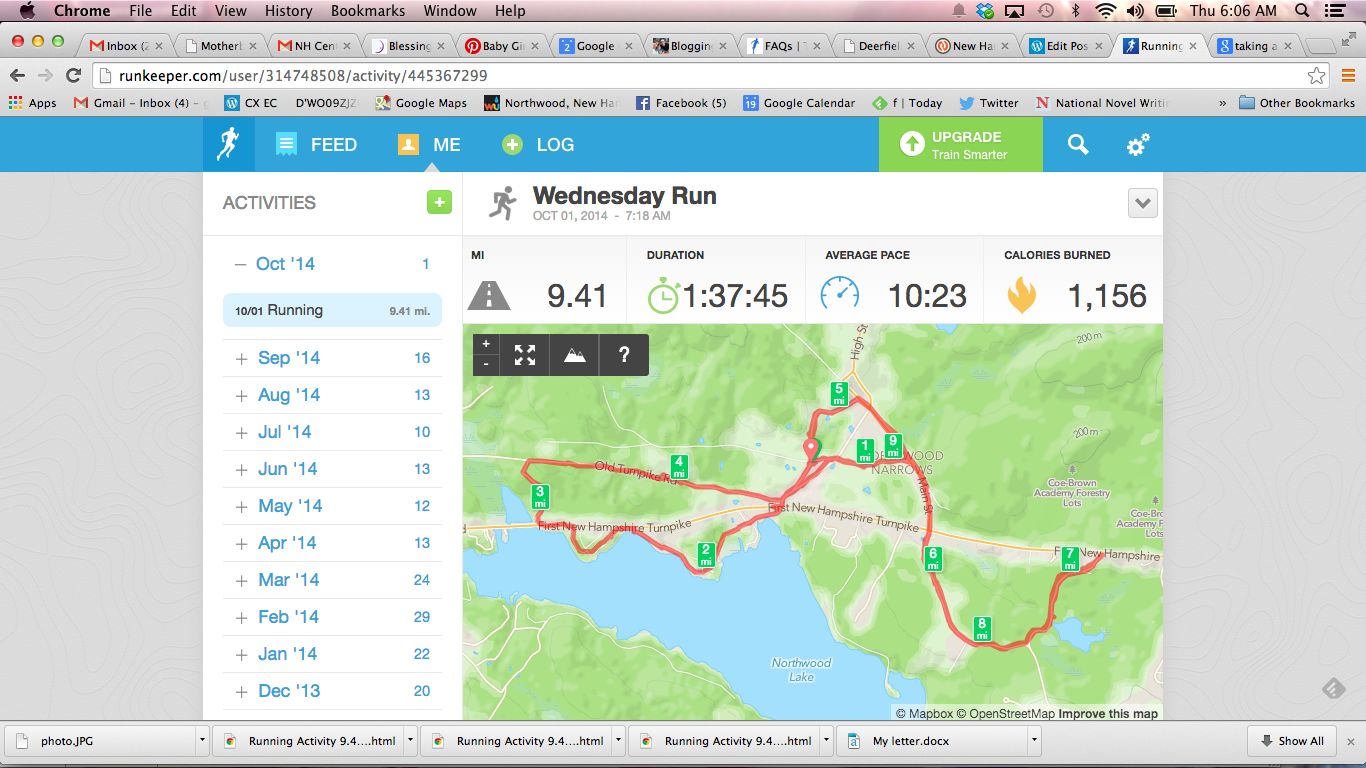
My son-in-law Matt is also training for the NYC marathon, but he’s using the Novice 2 training program by Hal Higdon, while I’m using the Novice 1 program.  Mostly what that means is he’s running a mile or two longer on long run days, so he did 18 miles two weeks before I did.  He told me when he finished he thought, “Yeah, I could do another 8 miles,” (which would bring him to the 26.2 miles of a marathon).

I did 18 miles last Saturday and when I finished I thought, “Yeah, I could throw up now.” Not encouraging.  What is encouraging, is that my 5 mile run yesterday felt like nothing, and my 9 mile run today was relatively easy — I even did an extra .4 mile.  Nine plus miles easy?  This is new for me.  The longest I’d ever run prior to this training was the 13.1 miles of the five half-marathons I’ve finished, and my training runs were never longer than 9 miles or so.  I didn’t follow any training program.  I’d just start adding a mile to my longest run on weekends for a month before the half-marathon, get up to 8 or 9 miles, then go push myself through the 13.1 I needed to run to finish the half.

But, as the orthopedic doctor I saw about my sore knees pointed out when he advised me against doing a marathon, a half-marathon is half of a marathon.  Right.  Which means it needs serious training.  So I’m training and I’m serious about it, which I need to be or I’d stop.  It’s really hard.

So why am I doing it?  Why did doing the NYC Marathon end up on my bucket list?  I’m not sure, I just know myself well enough to know that once I set myself a challenge, I’m going to keep moving towards the finish line unless there’s a serious reason not to.  Feeling stiff and depleted and nauseous after my last long run isn’t serious enough to stop.  It just makes me more determined than ever.

This weekend will be easy — only 14 miles for my long run, though how that’s going to fit in to observing Yom Kippur on Saturday and then traveling to visit family on Sunday I haven’t quite figured out yet.  But I will.

And then the next weekend is the longest run I’ll do — 20 miles.  I’m already planning my weekend around it, which is what following a marathon training program takes — lots of planning around the running, rather than fitting running in around the plans.  I’m planning to be ready to run (and most likely walk some to, which according to Hal Higdon is perfectly fine) 26.2 miles on November 2.

Attenzione! Silenzio!

IMG_3046

The Vatican Museum was mobbed, and I don’t mean just crowded, I mean Extreme Tourism in the number of other human beings moving through room after room of frescoed walls and ceilings and gilded moldings and marbled walls.  As David and I by-passed the thousands (it seemed like that many) of people waiting in line to get in to the museum, having bought tickets ahead of time online (a must for many of the museums we visited in Europe), we were thankful we at least didn’t have to wait.

But being inside, with all those thousands who had already gotten through the line, felt suffocating.  The crowd was so thick it was almost impossible to do anything but move from room to room with the mass, streaming along and then backing up and getting stuck at narrow doorways.  The museum map was the worst I’ve ever seen, so it was difficult to know where you were or how you might exit the mess.

IMG_3053

But we wanted to see the Sistene Chapel and the rooms of Raphael frescoes, so we kept moving.  The art was extraordinary, and we especially enjoyed the room of geography, mapping ancient Rome, as we could see the cities we’d visited in Provence.  And the Raphaels and Sistine Chapel were as terrific as we expected.

Except, because the Sistine Chapel is supposedly a sacred space, as determined by the Catholic Church, every five minutes or so, as the hum of thousands of people crammed into a small space would start to rise, a stern male voice would announce, “Attenzione!  Silenzio!”

Really?  The Catholic Church is letting this many people into a “sacred space,” and then expecting them not to be human?  To be totally silent?  For all the reasons I’m sure you can imagine yourself, I found it difficult to be told to be silent by the Vatican, after touring the on some level obscene riches of the Vatican.  Who was silenced to build the wealth of this church? How can they honestly reconcile inviting this many people into a chapel and then expect them not to make any noise?  How much money is the church making off this museum?

IMG_3081

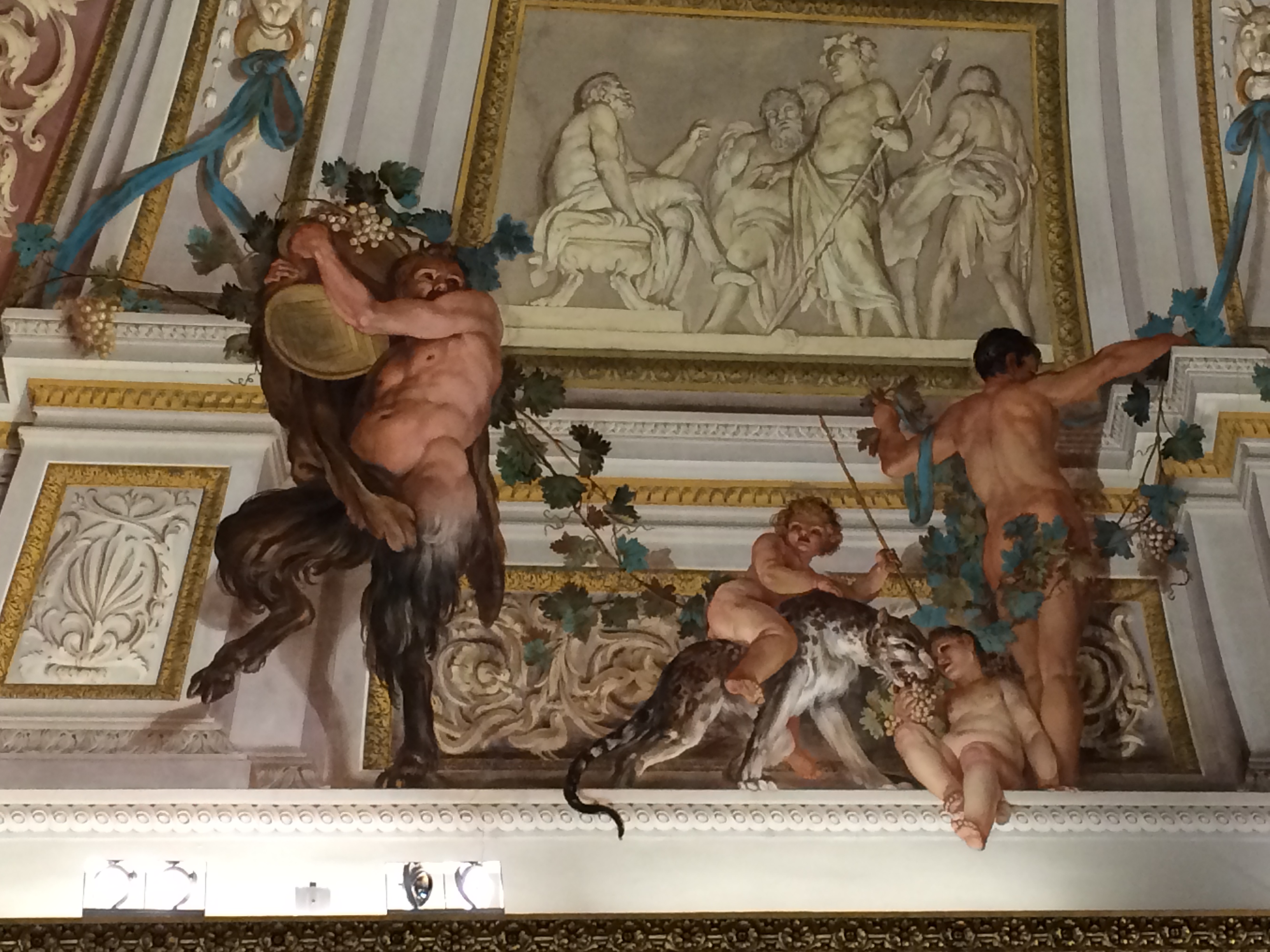
On a positive note, the Borghese Galleria was outstanding.  Again, it’s a museum showcasing the riches of the privileged, in this case the Borghese family, which extended its wealth in part because a member of the family became a Pope.  The smaller scope of the museum made it easier to take in, and aren’t all museums, to some degree, showcasing what the rich have collected?  Our advance purchase tickets gave us two hours, strictly timed, in the museum, so there were never too many people.  The Bernini sculptures were astounding, and the frescoes and decorated rooms and Caravaggio paintings were well worth a visit.

IMG_3088

And afterwards you can walk in the Borghese Gardens, a wonderful green space in Rome. Tomorrow I’ll be walking in my own garden, not an unwelcome thought.

Umbrian Gardens

IMG_3037
Garden in Panicale

Enough of Tuscany?  There’s always Umbria, where I went almost every day last week.  I’ve been continuing my marathon training on this trip (marathon training while traveling in Europe is certainly interesting), and had two 4 mile runs, an 8 and a 12 to do last week. Cetona is on the border between Tuscany and Umbria and running across the valley from the farmhouse where we were staying to Umbria was my best option for a flat route.   I’d walk down the steep, gravel road from the farm, then follow Via del Gore across the flat farm land of grape vines, corn and sunflowers until it ran into the bottom of the Umbrian hills we could see in the distance from the garden of the farmhouse.

IMG_3036
Roof Top Garden, Overlooking Umbria

On Friday David and I decided to explore a bit more of Umbria, especially the town we could clearly see as a long smudge of reddish buildings on the ridge directly across the valley from us — Citta della Pieve.  A lovely town of old brick buildings, winding streets and cafes that had at least as many locals as tourists, we found it delightful.  We’d visited some of the more popular Tuscan cities earlier in the week — Montepulciano, Pienza, Sienna — and found plenty to enjoy, but also bus loads of tourists.

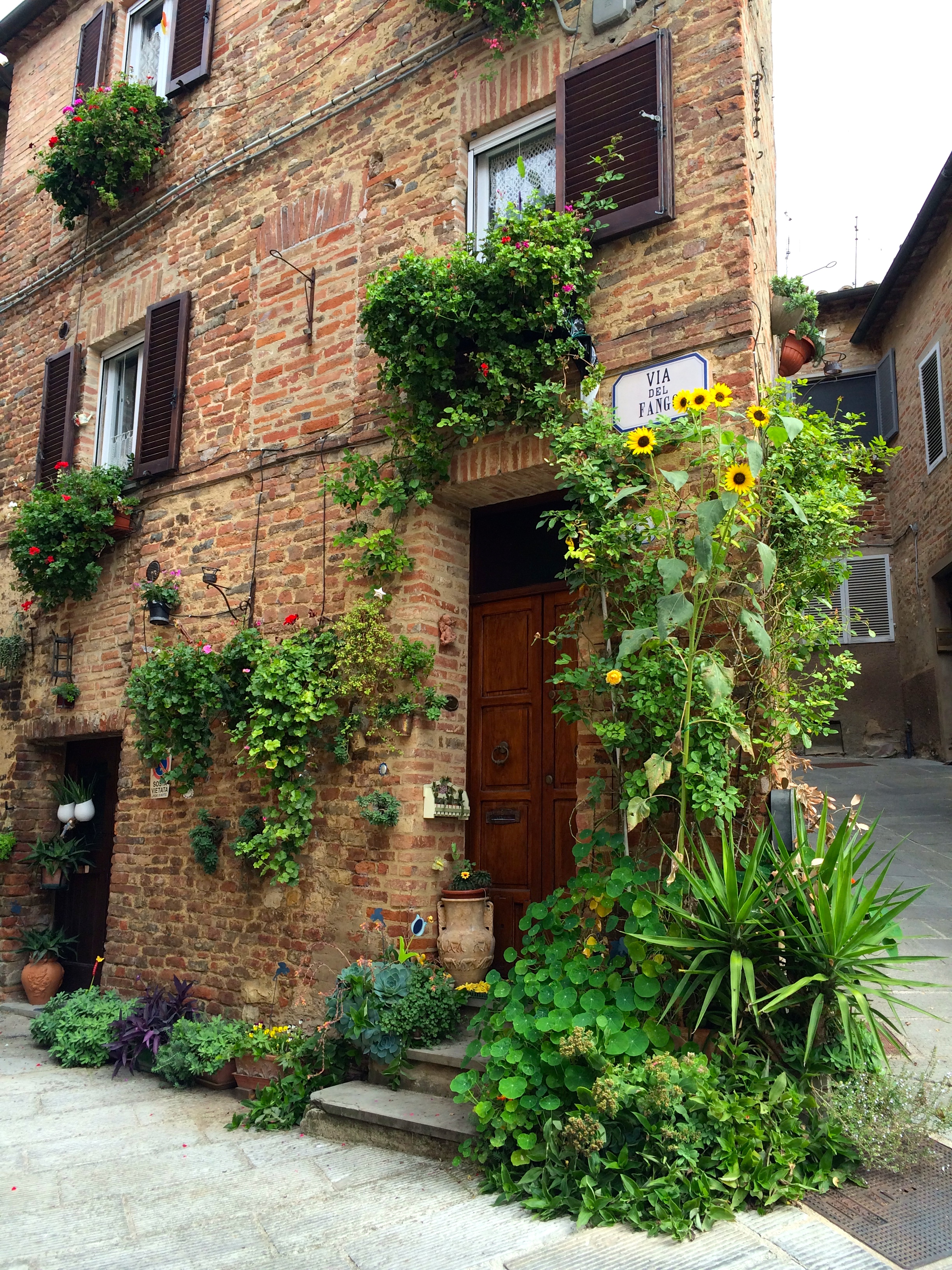
As we walked around Citta della Pieve, I looked for gardens created in the stone streets and around the brick buildings.

IMG_3031
Garden on a corner in Citta della Prieve

We drove on to Panicale, and again I took note of the many gardens created from potted plants or in tiny pockets of green between or on top of buildings.  I’d been enjoying potted gardens all week as we walked through many ancient hilltop villages, such a contrast from the large gardens and sprawling yard and pastures of the farmhouse where we were staying.

IMG_3034
Vertical Wall Garden

The most stunning gardens I saw were at the Monastery de San Francesco, a few kilometers up in the hills behind us at the farmhouse.  Now a rehabilitation center for young men with substance abuse problems, the church and former monastery is beautifully landscaped with cypress trees and hedges of rosemary, flowering pots of plants strung along the side of the road, and large vegetable gardens terraced on the hillside below.  We were given an enthusiastic tour of the church with frescoes that date from the 1400’s by a young Spanish man.  I marveled at it all, especially the peaceful and beautifully created landscape.

IMG_3038
Exterior of Monastery de San Francesco

Of all the cities and towns we explored during our week in Tuscany, we didn’t find any place we liked better than Cetona.  It’s charming, authentic, surrounded by a beautiful countryside, and, for me, has some good flat running routes outside of town.

IMG_3039
Cetona

Now we’re in Rome, the hills and gardens of Tuscany and Umbria behind us as we immerse ourselves in three days of frenetic antiquity before heading home on Thursday.


Lunch On Italian Time

IMG_2905
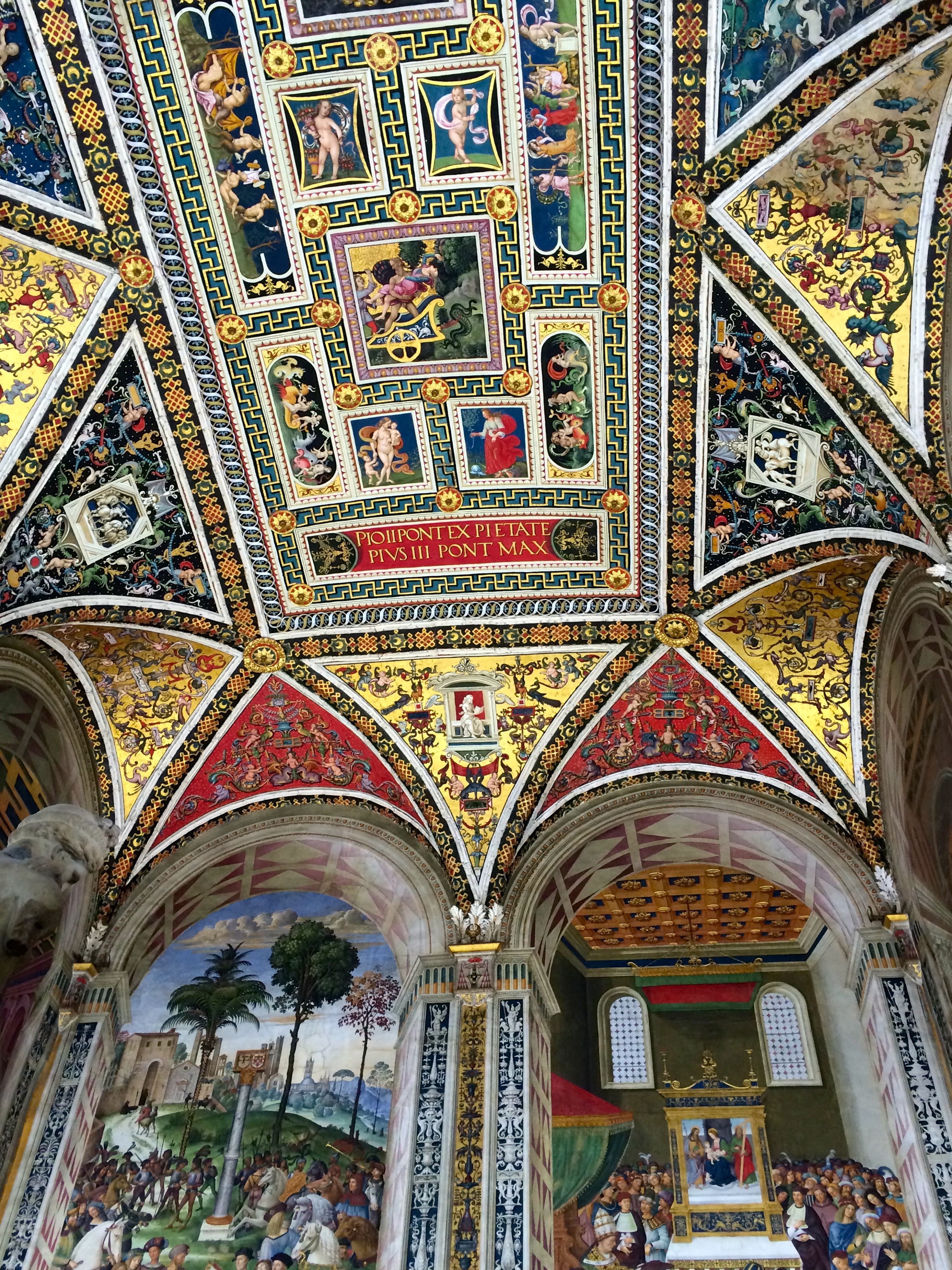
Restored Ceiling of a Chapel in Sienna Duomo

On Wednesday Alison and John, the hosts of this farmhouse gathering in Cetona, treated everyone (13 of us at that point) to a celebratory lunch at a restaurant on the Piazza Garibaldi in Cetona.  I’d gone to the restaurant with Alison on Monday morning so she could meet with the chef and plan the menu — we’re celebrating many birthdays, both recent and current, while here, and Wednesday’s lunch was one of very many celebratory eating events.

“We’re here to talk with Nilo about Wednesday’s lunch,” Alison said when we arrived at the restaurant.

“He’ll be back in a few minutes,” the waiter who speaks English told us.

“How many minutes,” I asked, wanting to know if we should come back later, if we should do some shopping, if we should just wait there.  “Five minutes, fifteen, an hour?”

The waiter smiled.  “Italian minutes.  How many?” he shrugged and gestured to the tables outside on the piazza.  “Take your coffee.  He will be here.”

So Alison and I sat with cups of cappuccino and soon John joined us, having walked in to town.  He had an espresso.  Before too long Nilo arrived and we began talking about the menu for lunch, with the waiter serving as translator.  We talked about four courses, antipasto, primo, secondo and dolce (appetizer, first course, main course and dessert), but decided that would be too much food and asked for only the antipasto, primo — which consisted of two pasta dishes we assumed would be split and served together as one — and dolce.  By that point, however, the translator was waiting on other customers, and I suspected Nilo thought we were still having the rabbit and chicken as a secondo.  But I decided not to say anything.  This was Alison and John’s party to plan, we’re all in Italy to relax and eat, why worry about it?

At lunch on Wednesday when the primo came out as two separate dishes — ravioli with tomato sauce and then pici with duck sauce — my suspicion of misunderstandings with Nilo about the menu got firmer.  By then every one was in a jolly mood, as new bottles of wine kept appearing on the table and the pace of service gave us plenty of time to talk about everyone’s various adventures in Tuscany so far and the delicious food being placed in front of us.  After the waiters cleared the pici dishes, Alison announced that next we would be having the apple cake with gelato.  Except the waiters gave everyone forks and knives again.

“I think we’re getting meat,” I said, and sure enough, plates with chicken, rabbit, potatoes and small spinach souffles were set in front of everyone.  Everyone who by then was more than full. We’d already been at the table eating and drinking and talking for hours — Italian hours. Now everyone was laughing.

So we did what we had to do.  We ate some more.  The waiters kindly gave us containers to take home leftovers, along with the apple cake.  But somehow we all found room to eat our gelato at the restaurant.

We finished those leftovers last night.  Good thing there’s a cook coming to the farmhouse tonight to create another delicious meal, and a new round of leftovers.

Here are some photos of what I’ve been doing besides eating.

This slideshow requires JavaScript.


In A Garden In Tuscany

IMG_2874

As if eight days in Provence wasn’t enough, now we’re at a farmhouse outside of Cetona, a hilltop village in southeastern Tuscany.  There are nine of us here this afternoon with another coming this evening and four more coming tomorrow.  Above is the table under a grape arbor in the garden where the action has been centered — lunch, French wine we brought with us from Provence vs. the Italian wine made here on this farm, snacks, seeing how many devices we can get on the internet at once with the extended wifi router from the house where the owners live and two pocket routers on the table.  Everyone seems mighty happy so far.

Entrance to Upper Ruins of Marquis de Sade Chateau

The rest of our week in Provence was as wonderful as the beginning.  We continued to embrace the concept of slow travel, and walked to Lacoste on Thursday (and toured the old chateau of the Marquis de Sade, now owned by Pierre Cardin), rather than do the usual tourist tour by driving from one adorable hilltop village to the next.  Finding a good walking route through the peach orchards and vineyards between our rental in Bonnieux and Lacoste wasn’t as easy as we’d thought it would be, but lucky for us we met Frank, a friendly British man who visits his friends in Provence as often as possible.  His favorite thing to do is walk.  We ran in to him going the wrong way on a small road, and he showed us the path up to Lacoste.  He also told us about the Gorges de la Veroncle, another beautiful canyon.  We walked up the canyon on Friday, past caves and ancient mills.

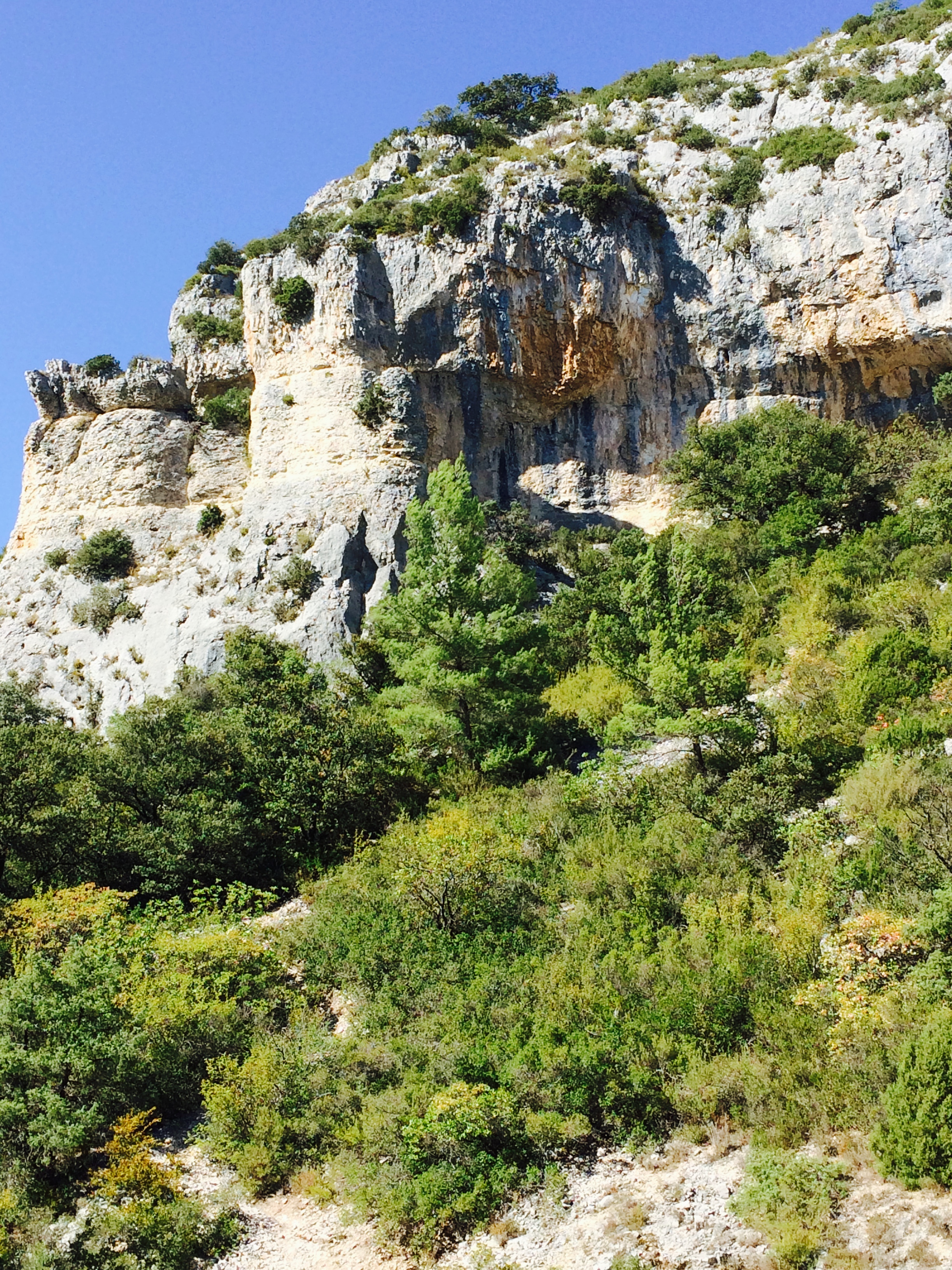
Cave in Gorges de la Veroncle
Gorges de la Veroncle
Abbaye Notre-Dame de Senanque
IMG_2848
Interior of Abbaye

We did visit some tourist spots, including the gorgeous Abbaye Notre-Dame de Senanque, a Cistercian monastery since 1148, and the restaurant made famous by Peter Mayles in his book A Year in Provence, Auberge de la Loube. It was a delightful meal and I can see why someone would want to spend a year in Provence.

IMG_2864

Now I get to see how Tuscany stacks up against all the other places I’ve visited on this trip where I could imagine spending a lot more time.

IMG_2868
Cetona
IMG_2865
Cetona