Day 10: Slow Down

IMG_2036

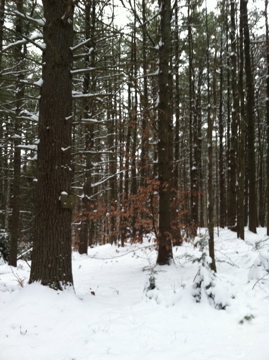
The sun kept burning a blur through the clouds for a couple of hours after the snow started.  At one point the day even brightened, the sun sharpened in the gray sky, and the snow picked up.  A paradox.  By the time David and I headed out across the fields for a quick ski before dark there was only snow and a flat, monotone sky.

Climbing a steep hill I heard a loud flutter and crash and looked up from working my skis in a herring bone pattern to counter the slope.  Turkeys, several of them lifting from high in the white pines, dark shapes moving between the tall trunks and settling back into the jumble of branches, disappearing again.  

I’d started my day frustrated and teary, getting lost on my way to a writers’ group meeting.  There was no reason to be lost.  I’ve been to this friend’s house many times, I’d looked at the directions again on-line before I left.  I even took the right turn, then told myself it didn’t look right and turned around.  For at least a few miles I knew I was going the wrong way but I didn’t stop to put the friend’s address into my phone and get directions.  I just kept driving.

It didn’t make sense, to keep going in the wrong direction because I was late and impatient and felt like I didn’t have time to stop and make sure I knew where I was.  And where I was going.  It all just made me even later.

Why do I have so much trouble slowing down?

Wild turkeys don’t think about where they’re going.  They heard David and me climbing the hill under where they were roosting, one of them flapped off its branch, which stirred the rest of them, and there was a commotion for a few moments.  Then quiet.

Where am I trying to go?

Wherever that might be, the late day ski helped me let go of my mistake and frustration.  One ski forward, then the next, my arms planting my poles into the snow in a regular pattern.  Left, right, up, down.  Movement.  I wasn’t trying to get anywhere other than into the woods, in the snow, in the falling light.  

Skiing back to the house the falling snow in dusk light made it look like we were moving underwater.

Day 9: Back to the Body

Moonlight Tree 2

Slice open the globe of night and inside is 1:00 a.m., sitting in the halo of the kitchen table lights, the line of glass shades reflected in the mirrors of window around me.  I saw a big moon out the east windows after dinner, imagining the glow that would fill the fields all night, snow reflections of a softer light, the night brilliance I used to play in when I was younger.  A full moon after a snow storm meant late night skiing, long shadows trailing us, pockets of darkness in the wrinkles of land we crossed unfolding into light as we skied into them.

Now I fall asleep just after we’ve cleaned up from dinner, the early rising and long day tugging me into bed.  But tonight that didn’t last, the long dark – less than a week before it starts to transform – felt like a weight on me when I awoke.  I got up into the stillness of a house that’s been full of extra people for weeks, everyone asleep right now, the boots piled by the door finally drying, snow mud streaking the tiles.

David and I fall asleep spooned around each other.  “Big spoon or little spoon?” our kids ask about people they know, couples mostly, or pairs of people.  In their relationship, who is the big spoon, who is little?  Or who is the hugger, who the huggee?

Does that matter, as long as the bodies fit together?  “You always come back to the body,” my friend Mimi said to me once decades ago, in a poetry workshop.  Once again I’d brought a poem that had some body awareness in it.  I’m in my body so fully so much of each day, I wasn’t surprised by what she said, but it wasn’t something I’d noticed in my own poems.  Then I wrote this:

Back to the Body

A sickle of moon
on the slice of brook
through bare oaks –
cup of sky
cup of water
our bodies cupped together
when I return to bed.

Now the moon has traveled halfway across the sky, into the western windows and the yard is silver, the far horizons of trees and silo all visible, flecks of ice in the snow sparking.  It’s almost as bright as some recent days have been.

Day 8: Active with Glide

IMG_2027

The snow was a heavy swirl around the flood light on the corner of the barn when I woke, white flashes in the black.  By the time there was enough light outside to see, the snow had slowed to small flecks.  By mid-morning there was a fine, freezing mist blurring the horizon, a cloud across the fields.  After lunch, David and I drove down the road looking for snowmobile tracks so we could cross-country ski.  I’d tried earlier and there was too much snow to track alone, over a foot, and getting heavier as the mist soaked into what had been fine, dry powder.  I kept losing my ski tips in the snow and couldn’t lift them to take the next step.  

Yes, tracks!  A snowmobile had come across Coe Farm, an old woods road, and continued up Canterbury where we wanted to ski.  As we got ready the sun finally came around some clouds, making a cathedral of light in the dense woods.  We snapped our boots into our bindings and kicked off.

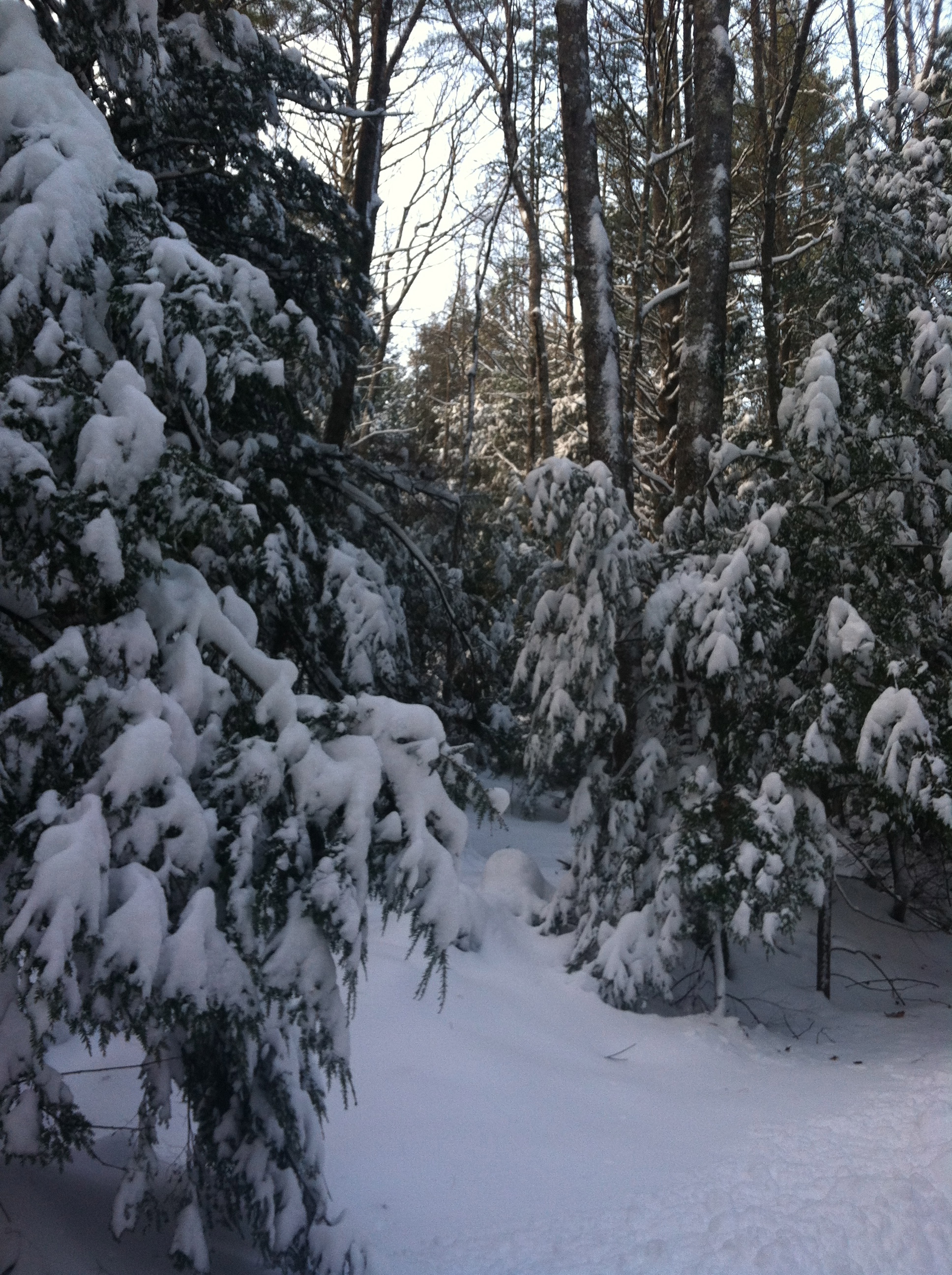
“Active with glide.”  That was how Eric described what he loved best, outdoor sports that translated his effort into a gliding motion – cross-country skiing, kayaking, biking.  I love it all too, and nothing better than skiing.  David had skied enough before I’d satisfied my craving, and after he drove home I followed the snowmobile track over Coe Farm Road, the day turned gray again.  Clouds, snow, dark pines and hemlocks, bare oaks and maples, and occasional beech saplings, still fluttering pale brown leaves.  Mostly a black and white world, even the needles of the pines muted under their drapes of snow.  Color isn’t what I come out into this world for.

I come out to play.  To kick and push and then glide.  After I’d skied up and over the hill of Coe Farm Road and come back, I climbed Canterbury Road again.  So I could ski down, so I could slip around the curves of the hills and feel the ground falling away underneath me, fast enough to have to pay attention to just this, the long slide, the metal sky above, the stone walls hidden in white mounds, the slick of the day moving into dusk, darkness coming, another round.

Day 7: Balance

IMG_2021

I cry during yoga.  The first time it happened was the first time I went to a yoga class in my latest attempt to bring a regular practice into my life.  When we settled in for shavasana, the lying pose at the end focused on relaxation, the teacher talked about gratitude for the chance to practice yoga, and being aware of what we could let go as we sunk our backs deeper into the floor, scanning our bodies for any places that still needed to release tension.  I felt a surge of tears rise and then quickly subside.  What was I letting go?

Then it happened again a couple of yoga classes later, and this week it’s happened every time I’ve gone.  Thankfully, that’s been a lot.  I’ve been telling myself I should start practicing yoga for almost a decade, and lately I seem to be doing just that.  I’ve been to yoga three times this week and am enjoying it and looking forward to it so much I’m hoping it’s going to flow right into being a regular part of my life.  Finally.

Today the teacher had us begin in crocodile pose, face down on our mats, our heads resting on our hands.  She wanted us to be able to feel our breath fill our bellies, pushing against the floor.  What I felt were tears rising again.  “We carry stories in our bodies,” the teacher said as we settled into an awareness of our breath.  “If we can make the stories not personal, if we can leave the drama and hurt that might go with the stories behind, we can work on accepting where our bodies are right now.”

Is it finally sitting still with mindfulness that’s letting some sadness rise to the surface for me?  Is it the practice of yoga itself, with its focus on the balance of mind, body and spirit, that’s pulling an unbalanced part of my mind and spirit back into a softer place?

The sun has been riding through the wall of gray storm clouds to the south all morning, sinking into a hint of light then brightening again into a broad halo.  By late afternoon it should be snowing and the world will be all gray and white and black.   Something is sinker deeper in me right now, or something deeply sunk is rising.  Or maybe both, a knot of sadness that’s surfing the stillness I’m cultivating.


Day 6: Jam on Toast

IMG_2009

I got out of bed in the dark and went to the kitchen, brewed a cup of coffee, and sat at the table, reading, writing, watching the day begin to leak some gray into the black of the windows.  By the time I stood up to get ready to run, sun was lighting a corner of the kitchen.  Two hours, from black to gold.  What happens in those morning hours?  Somehow they seem unaccountable, an awakening that exists outside of time, a stillness that follows me out of sleep until I’m pulled into what has to be done, or what I think I have to do.

David and I often talk during these early hours, I skim the newspaper, do the Jumble, edit poems, put up a blog post, make lists, look at Facebook, read other blogs.  But it feels foggy and unproductive.  I get up from the table to start my day, not crediting all of the day that’s already happened, all I’ve already done.

I remember talking to a woman years ago who did training for judges, and one of the things she stressed to them was that they needed to matter to themselves.  “It’s okay to sit down and eat some toast with jam in the morning,” she would tell them.  “You can listen to the birds, you can relax.  You deserve to start your day nourishing yourself.”  She wanted them to understand they had worth beyond their roles as judges, that they counted as individual human beings who might want an extra five minutes in the morning to eat breakfast, and that was okay.

Now that I have time many mornings to relax into the day I struggle with feeling like that’s legitimate.  Does paying attention to the movement of light help make it more acceptable?

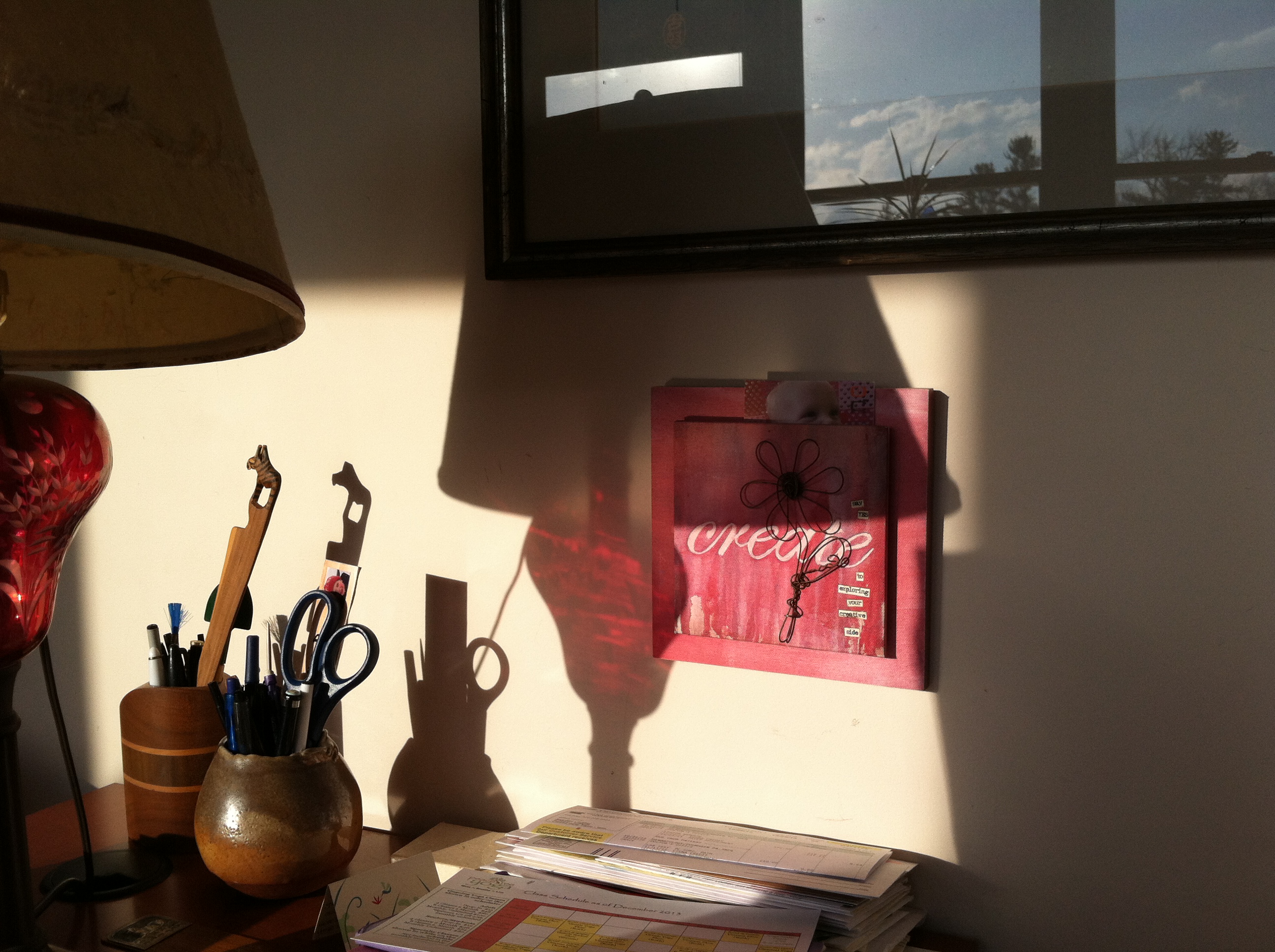
I think it might, because I’ve given myself this job of paying attention, of noticing.  Today the sun has come and gone, disappearing in snow showers, then making a hazy circle in the clouds, now hitting me right in the eyes, through my study windows, brightening my desk, shadows of my lamp and pens and letter-opener sharp on the wall, a rose heart where the light is filtered by the red glass of the lamp base.

That rose heart can be my jam on toast.

IMG_2011

Day 5: Pearl Light, Impossible Poems, Silence

IMG_1969

Pearl light, empty and cold.  Clumps of the off-and-on light snow from the last few days top the browned hydrangea blossoms.  The white lying across the fields and caught in hemlock needles bounces the day back up into itself, a bit of brilliance.  There won’t be many hours of light today, but at least what there is will be reflecting into the air, hard and dry.

David and I have been talking this morning, about the party we went to last night, a collection of poet friends, each of us quirky with creativity and the struggle to hold the making of poems, defenseless little expressions in such a chaotic world, as a primary focus in the face of enormous demands.  Each of us gathered last night have such huge loads to carry – challenging and time-gobbling jobs, or aging family members who require constant attention, or young adult children slipping their tires as they try to get traction in adult lives.  It’s a wonder any of us ever write anything.

Our holiday party tradition includes the hostess giving everyone a prompt to write a poem.  After eating, we each read our poem – or not, those too overwhelmed to write are easily excused – and we tell ourselves we’ll just listen to each other, it’s not a night for critiquing, it’s a party, not a workshop.  But we can’t help ourselves.  Reactions to the poems leak out.

“I wish we could let go of feeling we need to comment on the poems,” a new member of the group said to me as we were leaving.  This was her first holiday party.  “Did you notice the silence after each of us read, as we tried to figure out what to say that wasn’t a critique?”

Mostly I just noticed how much more silence there was after my poem.  Or did I imagine that?

The prompt: Traditions Made New.  My poem:

The Table

“The table comes first,” the French say
and our table fills, and fills again, golden

oak sliding open on gears, leaves unfolded.
A voice carries from the snowy road, lilt

of the neighbor calling her dog, a woman
who never left her house, who now walks

every day past the pruned apple trees
and boxes of frozen garden. Chairs move

in and out of rooms, go back up on hooks
in the barn. The house has nothing to prove.

Day 4: Create

IMG_1971

The morning comes up pink.  There’s going to be sun today and already the cast of the day has changed.  I anchor myself in what I see, the line of sky against the slopes of the fields to the east, the color behind the bare trees.  

David tells me I should engage my visual talents more.  My drawing has certainly improved over the last year, as I draw cows and horses and penguins for Emilio.  If I look at an object closely, I can draw a reasonable representation of it.  Collage work is completely engaging for me – someone else has already done the representational part of the work, I just need to arrange it in ways that remind me of arranging the language in a poem.  Two years ago, during one of our many visits to the Metropolitan Museum of Art, David and I walked through a small show of collage works, and there were two pieces by Anne Ryan, a writer, painter and printmaker who didn’t begin working in the medium of collage until the age of 58.  Before her death at 64, she created over 400 works.  She was inspired to take up collage work after attending an exhibition of Kurt Schwitters, a German poet and sculptor, as well as collagist.  “Since Anne Ryan was a poet, in Schwitters’s collages ‘she recognized the visual equivalent of her sonnets – discrete images packed together in an extremely compressed space.'”  

Why not me?  Why do I take out my box of cards and books with images I’ve saved for the possibility of collage, my papers and pens and colored pencils, for a day or two at a time, then pack it all up and put it back on the shelf?  I can be inspired too.

Permission to engage in visual expression is all mine.  I can create because I want to create, it doesn’t have to be useful.  My goodness, in what way is poetry useful?  In what way is any creative writing useful?  If I can tie working on something to an ambition to get it published, it might get me to the desk more often to work on it, but my focus, my stepping into the flow, is the same once I’m working on anything creative.  Without any realistic way to be ambitious about visual art, it gets pushed aside even more than writing.  So maybe I’ll start pushing my ambition aside and just create.  Drawing a cow for Emilio is enough because he wants to see the cow.  Moving a collection of images and ideas out of my head on to paper in the form of a collage or drawing, rather than a poem or essay or story, is a world I may let myself start stepping into more often.

Day 3: Finding Light

walking

Last night I went to a Kundalini Yoga class, my first time with that practice.  Lots of “fire breath,” quick in and out through the nose, while we held long poses that challenged my muscles’ strength, as much as their stretch.  Kundalini is based on the concept of moving the latent energy at the base of the spine up, through the higher chakras, into the brain. During our final sitting pose the teacher said “May our bodies be more open and our minds quieter.  May the light in me find the light in each of you.”

Finding light.  That’s one of the answers.

Eric and I had a well-established tradition of creating our own holiday cards, using a poem I’d written and an image we often got off the internet, or copied from another card.  In early December I would give Eric several poems I’d written in the previous year.  Almost always he would easily pick the poem he wanted to use, saying about the others, “these are too dark.”

The year after Eric died I picked a poem from the manuscript of The Truth About Death.  I ran it by Adrienne and she thought it was fine.  I paired it with a photo Adrienne had taken that fall, of Matt and Sam walking under the tall white pines further down our road, a tunnel of diminished light.  The poem references that spot.  Perfect.

Except when Sam saw the card, which I’d already printed and had ready to mail, he said, “You can’t use this as a holiday card.  The poem is too dark, the photo is dark.  There’s a suicide in here.”  I knew he was right.  I scrapped the cards and started over.

This morning as I ran under those trees in the dimness I thought about that card. I thought about yoga class last night.  I thought about getting more energy up into my higher charkas, my crown.  I thought about looking for light and as I ran back to the house I noticed frosted grasses along the edge of the road, a hint of sparkle in the thin morning light.

First and Last

Dawn has shifted. This morning wild turkeys
scurry among the tall white pines that shelter
the farm dump, a needled lane lined with tires,
piles of scrap wood, rusted stoves and refrigerators,
a baler. A neighbor shot himself here, in his car.
The turkeys are short ghosts, short soldiers,
upright between long trunks, ruined rectangles
behind them, nothing but frozen road before me.
At dusk another shift, an edge of steel falls
from the sky. I watch it fall, hard and familiar,
comfortable and cold. I can taste the metal.

Day 2: Two Weeks to the Turn II

IMG_1967

Dark when I wake.  Darkness wrapping the house and yard, blackness a soft touch on my shoulders.  The new clock, all white, with feathers for hands, points from its small circle base, a straight, bright line on the wall: 6:00 a.m.  No light on the horizon yet, the first light the embers in the wood stove that I pump to orange with the bellows.  The kindling pops up in flame, then a log.  I sit in front of the glow and the darkness sits around me. 

Anne P. commented on my blog last night.  The new you.  Comprised of the past, but not consumed by it. Surrounded by happiness, it shines through you.  As the darkness recedes, crests, retreats once more.  Left on the shore with a new wholeness.  Life, surfing the waves.

David and his brother and I drove to the coast on Saturday, old people going for a drive, because David’s brother’s back and hip are too sore to walk much.  That’s life surfing the waves, getting to the pulse of tide however we could.  Little Harbor was brimming, tide as high as I’ve seen it.  Driving north, after a loop around Rye Harbor, we passed a stretch of marsh, grass golden between the pools of hard blue water chopped up by a cold wind, a striking contrast.

Beauty is so often about how one visual bumps up against what is next to it.  “No one travels to see flat land,” someone once said to me and it seems true.  People travel to see mountains and cities.  Or great expanses of water, which are flat but fluid, the contrast between firm ground and a sloshing medium, all movement, wash and warble, come and go, in and out.  A shore where we find ourselves, before, after, now.

When the light comes it’s gray.


A New Look and A Return

New Photo Shot

A number of writer friends have been admonishing me for well over a year to change my photo on this blog.  Yes, it was an okay photo for my book, because after all The Truth About Death is just that and why wouldn’t I look grim on the back cover?  But this blog is about all of life, not just the sad passages, and surely I could find a better photo of who I am as a whole self.  One friend snapped some shots of me with her mini iPad the last time our writing group was gathered, figuring anything was better than what I had.

So I took that as motivation to get some real head shots done.  Which turned out to be easy when shortly after the iPad photo session I met a colleague of Adrienne’s, a talented photographer who was happy to snap a bunch of shots when I met her.  So thank you, Michelle Frantino, for the new look.

I’ve been admonishing myself about updating the overall look of the blog.  I’ve recently been redecorating my house, taking down paintings and prints and photographs I hung decades ago and putting up new pieces of art.  I’ve replaced light fixtures, rearranged furniture, and greatly reduced the cluttery stuff that accumulates on counters and sills and shelves like the dust all those tchotchkes collect.  My blog needs the same kind of attention, a bit of which I’ve started.  (Like the house redecorating, this is a process, not a once-and-done task.)

But one thing I’m repeating.  I’ve already written about my project last year of writing 300 – 400 words every day for the two weeks leading up to the winter solstice.  I’m doing it again, Two Weeks to the Turn II.  This year I’m going to put up at least some of each day’s writing on this blog, every day.  In the midst of the gathering darkness, and the frenzy of celebrating designed to push back against that very darkness, I’m going to find at least some time every day to focus on writing and try to find something worthwhile to share.  Here is a tiny bit from today, and it’s not even original.  It’s what one of my writer friends suggested was my real topic when I read a selection from last year’s Two Weeks to the Turn at our last group meeting.

The question is, how do David and I make happiness in the face of all the loss and heartache that brought us together?

I’ll be working on some answers.