Wedding in Asheville

IMG_1586

We finally fell into bed at 2:oo a.m. Saturday in Asheville, NC for a wedding later in the day.  It had been an exhausting night of travel, and at that moment, the late planes, long car ride, and late late late to bed didn’t feel like it could be worth it.  I hardly knew the parents of the bride (long-time friends of David), had never met the bride or her sister (childhood best friends of Melia) and was struggling to contain all the sad thoughts that a wedding brings up for me at this stage in my life.  How do you mix the joy of young love with the awareness of lost and about-to-be-lost loved ones who will never get to be at the weddings of their children, and a too recent reminder that what seem to be heartfelt wedding promises can be betrayed?

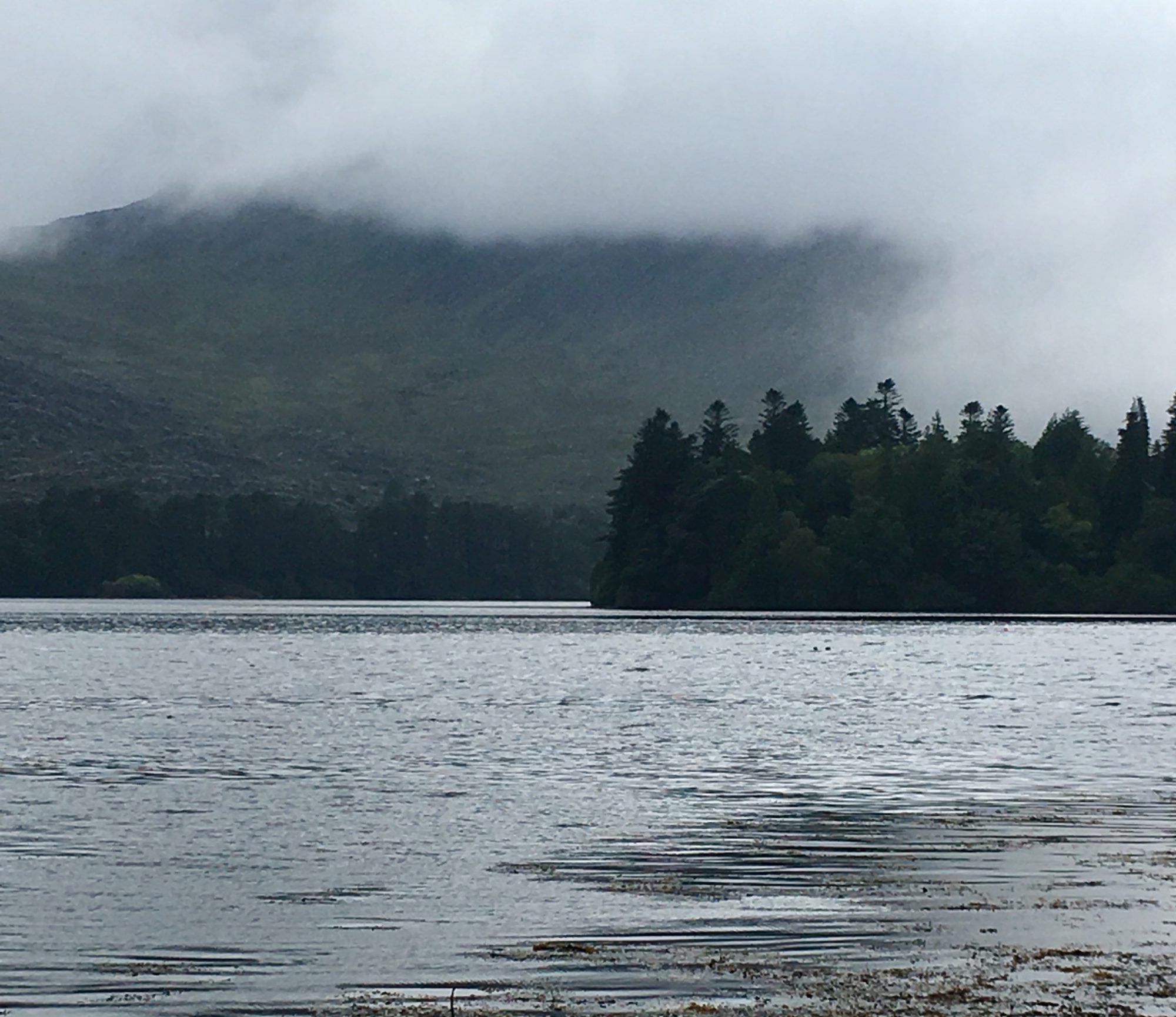
Then I got to the wedding.  The wedding website had said that if it was raining, we’d all just wait on the porch drinking beer until it cleared.  So we did.  This summer has been even wetter in the mountains of North Carolina than it has been in New Hampshire, and thunderstorms and heavy rain showers had been moving through all day.  At 4:00 p.m., the set wedding time, it was pouring, and 200+ guests were standing on the porch of the historic Old Sherrill’s Inn, the Blue Ridge Mountains hiding behind the sheets of rain and the low clouds.  The beer was coming out of the keg with a thick head of foam, and the young man pouring it was telling us to plunge our finger in, to “kill the foam.”  It didn’t.

The first building at Old Sherrill’s Inn went up in the late 17oos, with most of the building construction dating to the first half of the 1800s.  The house is a fascinating maze of antique-packed rooms; the study was the original log cabin, the first dwelling built on the site, and a front parlor has walls of murals painted by the grandmother of the current owner depicting the history of the Inn.  But the best history of the Inn came from talking to the husband of the woman whose family bought the Inn almost 100 years ago.

There was a long enough break in the rain that the wedding ceremony, in a tree-lined bower up through boxwood paths that had me thinking of the “walks in the shubbery” from my recent re-reading of Jane Austen, had been able to proceed and was as sweet and natural as I’d expected, given what I knew of this family.  As we listened to the music and vows and prayers, swallowtail butterflies flew in and out of the leaves far above our heads.   After a huge group photo, guests gathered under the tent and began to eat and drink in earnest as a few early dancers tested the wet dance floor, set up under strings of lights and whatever stars might come out.

I walked down to the porch to get another view of the mountains to the north, hoping to have the porch to myself to sit quietly for a few minutes.  Instead, I met a delightful couple and talked with them about life and art and creative pursuits, just the sort of unexpected conversations that make weddings, with their focus on celebrating love and connection, so remarkable.  That’s when John, one of the owners of Old Sherrill’s Inn, came out on the porch, and told us stories.  And stories and stories.

His wife’s grandparents traveled to the mountains of North Carolina on their honeymoon, having married outside of Chicago.  They arrived at the Inn in 1916, and met the current owner, an 80-year-old man, and his wife, an 18-year-old woman.  The newlyweds expressed an interest in relocating to North Carolina and buying property, and the 18-year-old started crying.  “I’m the loneliest, most miserable young woman in the county,” she said.  “Please buy this farm so I can move into town and have some friends.”

They bought the farm and their descendents live there still.  John didn’t tell us what happened to the 18 year-old wife, but I can imagine.

The clouds had lifted and the ridge of mountains to the north were settling into a deep blue haze.  Stories floated off the porch and into the evening.  The rain came and went a couple more times throughout the evening, but there was plenty of time for dancing under the strung and unstrung stars.
Monhegan Island Retreat

IMG_1545

David and I are working hard.  He’s in a week-long plein air painting class, I’m intent on completing a first draft of my island journal, a memoir I started five years ago, meant to be written only on islands.  David’s gone from 9:00 until after 5:00 every day, and comes back to the cottage we’re renting with a painting or two, depleted from a day of concentrating on capturing the clouds or the ocean or a grove of trees in paint on canvas. I’m writing and walking the many miles of trails through woods and along ocean cliffs, and reading journals from years before, sinking back into the world I was inhabiting five years ago when I wrote the first of this book I’m trying to finish.

It was a difficult time in our lives, rich with new love and terrifying with the approach of another untimely death from fast-moving cancer.  Adrienne was getting married, and our family was managing the reality that Eric wasn’t going to be at her wedding, a wedding he and I had been planning in our fantasies for her for years.  I was trying to sort out how or if to respond to the best friend I’d lost in the previous year who was reaching out and trying to reconnect, in spite of the boundary violations that had led to us breaking up (and yes, you can break up with a best friend, it doesn’t have to be a lover) never having been resolved or completely understood by either of us.

Going back to that summer, to write about it, hasn’t been easy.

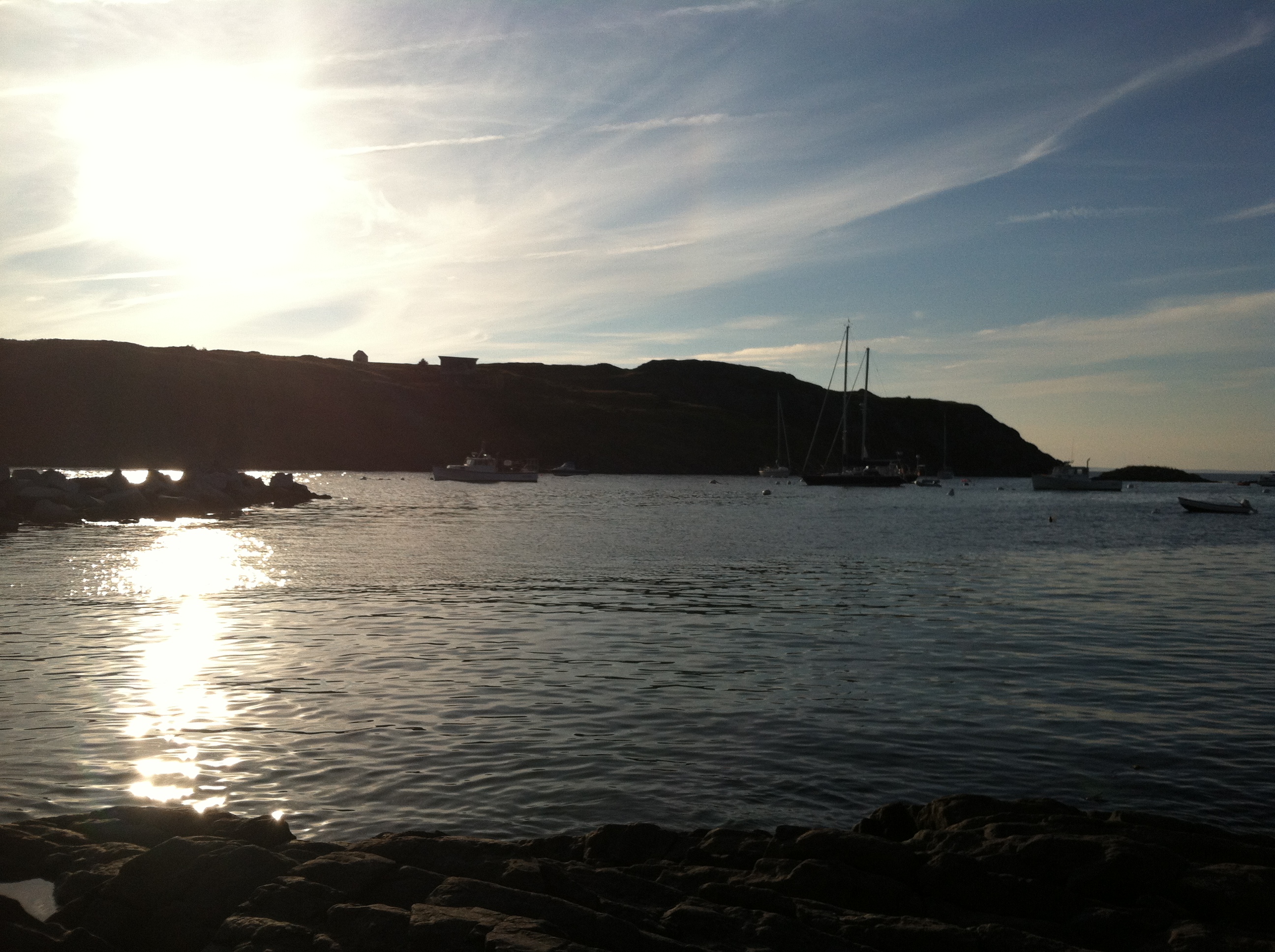
We met the painting group for a lobster dinner at the Fish House last night, a shack on Fish Beach that serves seafood across a wooden counter, with seating at sand-planted picnic tables overlooking the harbor.  Which is a pocket of water created by the rise of Manana Island, a small but tall hump of land off the western side of Monhegan.  Our first night here the harbor was full of fog.

IMG_1533

Last night it was clear.

IMG_1564

As the group talked about painting and writing and creative retreats, I was asked what my book is about.  “Love and death,” I said.  Five years ago when I was first working on the book Sam asked me what it was about.  “Death,” I said then and he said, “Well, that’s a new subject for you, Mom.”

At least now love is in the equation.

After dinner we walked back to our cottage, watching the contrails of all the jets (red-eyes to Europe we decided, coming out of New York and Boston and headed up over Greenland on their way to London or Paris or Amsterdam) bleed off into feathered lines of cloud.  The sun was reaching the water horizon, on the north side of Manana, and as we approached the Monhegan School House David mentioned that people had been talking about the good sunset views from behind it.  There was already a knot of people there watching.  One woman had binoculars, and after the sun was gone and we were all watching the after glow shift its pinks around the sky, she spotted a minke whale surfacing, out beyond a ledge of rocks.  Every few minutes we could see a bit of black break the surface of the water, then disappear again.

IMG_1568

Above Tree Line: July

IMG_1516

I’ve been a negligent blogger, for more reasons than could possibly be interesting or appropriate to describe, though one of those reasons is my near total absorption in Jane Austen’s complex prose and fascinating character development, thus the current partiality for complex prose myself, the willingness to go on and on like the ever-talkative Miss Bates, into as many subjects as can tolerably be imagined, and still hold onto the thread, as far stretched as it might get, and as many metaphors as might comfortably fit (not to mention commas), in a sentence; and for an excellent, modern example of deft and impressive sentence structure read Claire Messud‘s The Emperor’s Children.  And while you’re at it, read her new The Woman Upstairs, because it is a majorly brilliant book.

Over a week ago we fulfilled our July intention of getting above tree line.  David, Anne and I summited Mt. Eisenhower on a day of intermittent sun and clouds.  The wind was strong and cool enough to require our jackets, which was a great change and a greater relief after a too-hot week.  The Pemigewasset Wilderness ranges to our south folded away in blue layers, and we looked out over the long ridge formed by Mt. Bond and Bondcliff, imaging the 19.5 mile traverse we’re planning to do in August.  It’s not an easy hike, with over 3,700 feet of elevation besides the long mileage.  But it allows you to walk into and out of the wilderness, literally.

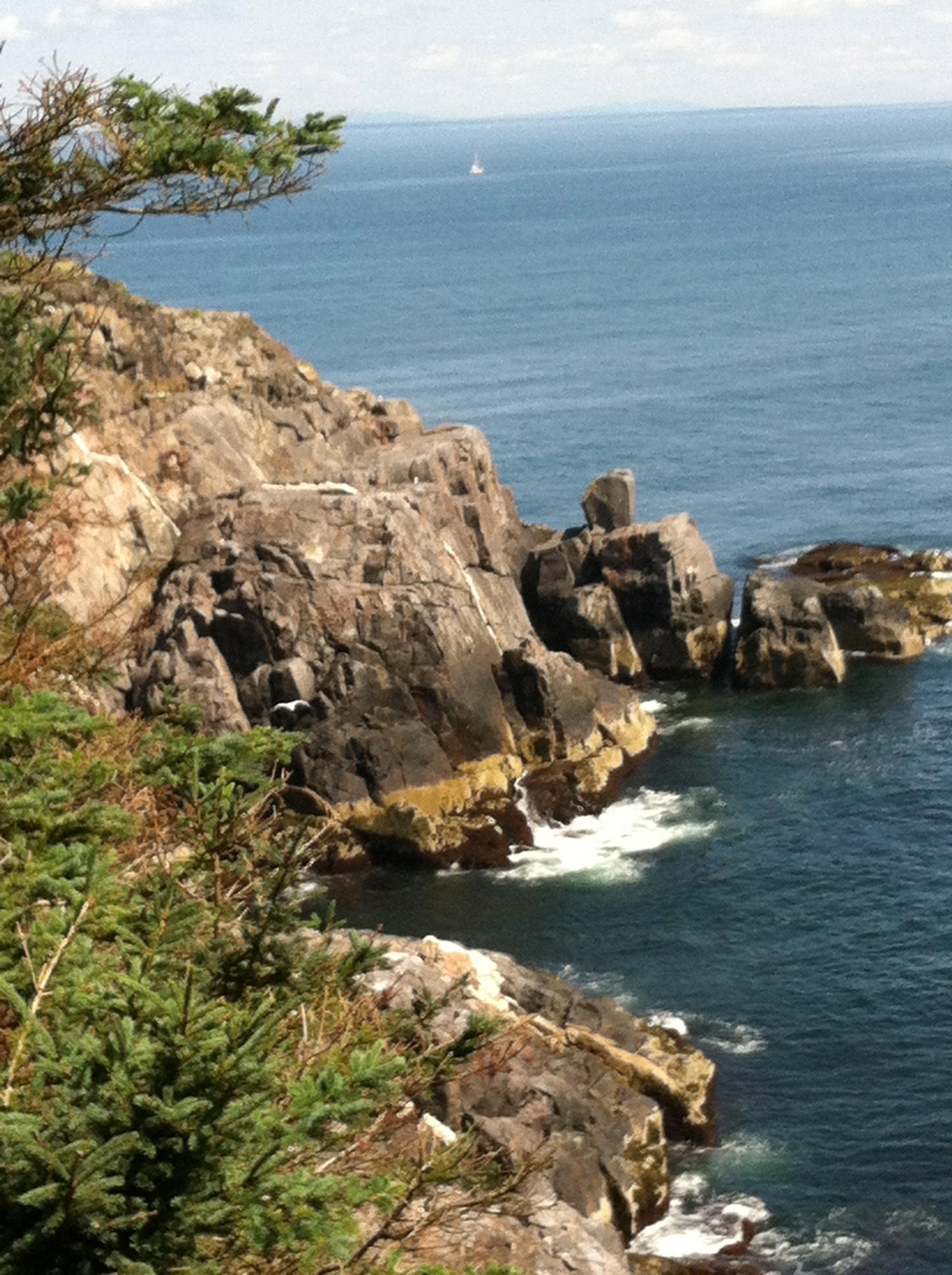
This week my training for both that long hike and an upcoming triathlon will be confined to an island, less than 2 miles long and 3/4 mile wide and 12 miles off the coast of Maine — Monhegan.  David and I walked a few of the supposed 17 (or 12, depends on which source you read) miles of trail yesterday evening, out to Burnt Head and White Head, steep cliffs overlooking the Atlantic.  He’s here to paint.  I’m writing.  Including my blog. More soon.

Too Hot to Blog

This slideshow requires JavaScript.

I’ve been busy, not that being busy is in any way unusual for me, but there have been deadlines to some of what I’d had to do this past week (consulting work), and getting things done that require paying attention, sitting at a desk, in a hot house, has not been easy.  Normally, I spend an hour or three at a time at my desk, whether writing a grant as a consultant, or doing a webinar, or doing my own work, editing poetry or writing an essay or pulling something together for one of the boards I’m on.  When I get restless, which happens a lot, I go outside and weed my garden for a while, go for a bike ride, a swim, a walk, or pick some of the abundance of wild blueberries this year, something outside and direct and physical.

Not this week.  When I needed a break from my work, I just walked around looking for a cooler space in the house.   Being outside during the day was impossibly uncomfortable and hot.  I did go swimming, but not much else.  I got my work done, went for a swim, then sat on the back deck at the end of the day with David, both of us basically panting, trying to stay cool enough to get through dinner and get into bed with multiple fans blowing on us.  My brain was on semi-permanent melt — work, eat, collapse.  What was there to say that would be interesting for a blog?

But I was paying attention to the forecast (another thing that is not in any way unusual for me) and kept seeing the temperatures predicted for Friday as being the highest of the week.  Early in my week of work, I decided to get what I needed done completed by Thursday afternoon so David and I could have a summer vacation day on Friday.

We did.  We got up yesterday morning and put the kayak racks on the car for the first time this summer, then loaded up the kayaks and a cooler of snacks, and headed for Squam Lake.  Squam Lake is a special place for me.  It was our family vacation spot for all the years from when Sam was a year old until two years after Eric died — 21 years. Kayaking on Squam was Eric’s favorite thing to do, the lake his favorite place in the world.  The day Eric died, as we were trying to figure out how to prepare his body for pick up by the funeral home, Adrienne, Sam, John and I agreed that nothing would be so fitting as dressing Eric in his kayak shorts and water shoes.  We considered putting a paddle beside him, to be tucked into the coffin and buried with him, but knew Eric would object to that as a waste of good equipment.

As David and I turned onto Metcalf Road yesterday, headed for the kayak launch spot on Squaw Cove, a wave of memory passed through me, bringing back all the years of getting ready for a week on the lake, all the years of Eric and I kayaking to favorite spots to swim and pick berries and relax, all the years of dipping our paddles into the clear lake water as we watched the march of the Sandwich Range mountains fading into the haze of summer days on the north shore.

Yesterday on the lake was perfect.  It was viciously hot in most of the country, but fine sitting on the fine white sand beaches of Squam Lake, half-submerged in water.  David and I paddled and swam and read and had a picnic and I wrote in my Island Journal, a memoir I’m writing that I can only write while on islands (more on that in a later post). We went to three islands yesterday.  At one point I asked David how he was doing (not an easy week for either or us, for reasons as easy to ascribe to the heat as anything else) and he said, “I’m great.  This is the essential ‘us.’  Getting out into the world and moving and being and enjoying”

We didn’t leave the lake until dinner time, driven back to our car by hunger.  We picked up sandwiches in Holderness and ate sitting on a dock, watching the light fade over the water.  Yes, maybe it was a week too hot for blogging, a week to hot for anything but getting done what had to be done.  But it was an evening cool enough for imagination, after a week soaked in the sweat of real life and obligation.  Time to let go.  Time to float into a weekend as the cooler air moved in.

Rereading Jane Austen

NPG 3630; Jane Austen by Cassandra Austen

Every decade since I was a teenager I’ve read all of Jane Austen’s novels — first in my late teens, then in my 20’s,  30’s and 40’s.  I’ve been wondering if I’d do it again in my 50’s, as my 60th birthday is later this summer, and during a recent visit to my parents’ house noted again the collection of Jane Austen my mother has in a bookshelf in the bedroom where David and I were sleeping.  I’d brought a few books with me to read on our long weekend of family beach time, but decided to pick up the volume that included Persuasion and Northanger Abbey.  Hours later I was well into Northanger Abbey, and within a few days had read both novels.  Now I’ve finished Sense and Sensibility, spending a good part of Monday reading, because at one point I couldn’t get anything done without knowing exactly how things turned out for sisters Elinor and Marianne, one so full of sense, one so open with her sensibilities.

“What is it about Jane Austen that makes you so eager to get to the end of a book you’re reading for the fifth time?” David asked me.

Yes, what is so satisfying about these novels?  Is it a reminder of my youth, when reading strong stories of young women’s aspirations and loves seemed a reflection of my own life, even if in a very different setting?  The focused attention on personality, temperament, kindness, manners and good sense, the well structured plots with just enough surprises to keep the action fresh, the well drawn characters who display every aspect of both admirable and abominable behavior, and the way in which all the heroines learn something about themselves before the satisfying conclusion of found love with a worthy man, makes a great read.  “Is Jane Austen the high-class precursor to chick lit?” David went on to ask.

Just before starting this latest immersion into the world of early 19th century England from the point of view of young women overcoming some disadvantage of fortune, sense, or family to shine as they should, I came across the blog of British writer Matt Haig.  In a wonderful entry titled Some Fucking Writing Tips (very funny and very indulgent of his yearning to drop f-bombs all over a blog), I particularly enjoyed tip #10. “Stories are fucking easy. PLOT OF EVERY BOOK EVER: Someone is looking for something. COMMERCIAL VERSION: They find it. LITERARY VERSION: They don’t find it. (That’s fucking it.)”

Talking with my friend John the next day, I mentioned I was reading Jane Austen again (he grimaced) and also told him the Matt Haig tip.  We talked about how Jane Austen’s work would be classified.  “I guess in Jane Austen’s novels the heroines do find what they’re looking for,” I said, “but not before they grow up.  Which makes the books both commercial and literary.”

Last night I started Mansfield Park.  While I don’t remember exactly what happens to young cousin Fanny as the book progresses, I’m sure she’s going to grow up, struggle with worries about love and fortune and her future, and in the end be rewarded with a life equal to her growing sense of herself, her understanding of what is right and wrong at the most central level of living as a righteous and caring person, and her kindness to others. Sounds like a bit of a grind, but it won’t be.  I love it already.

Prolonging Peony Happiness

IMG_1442

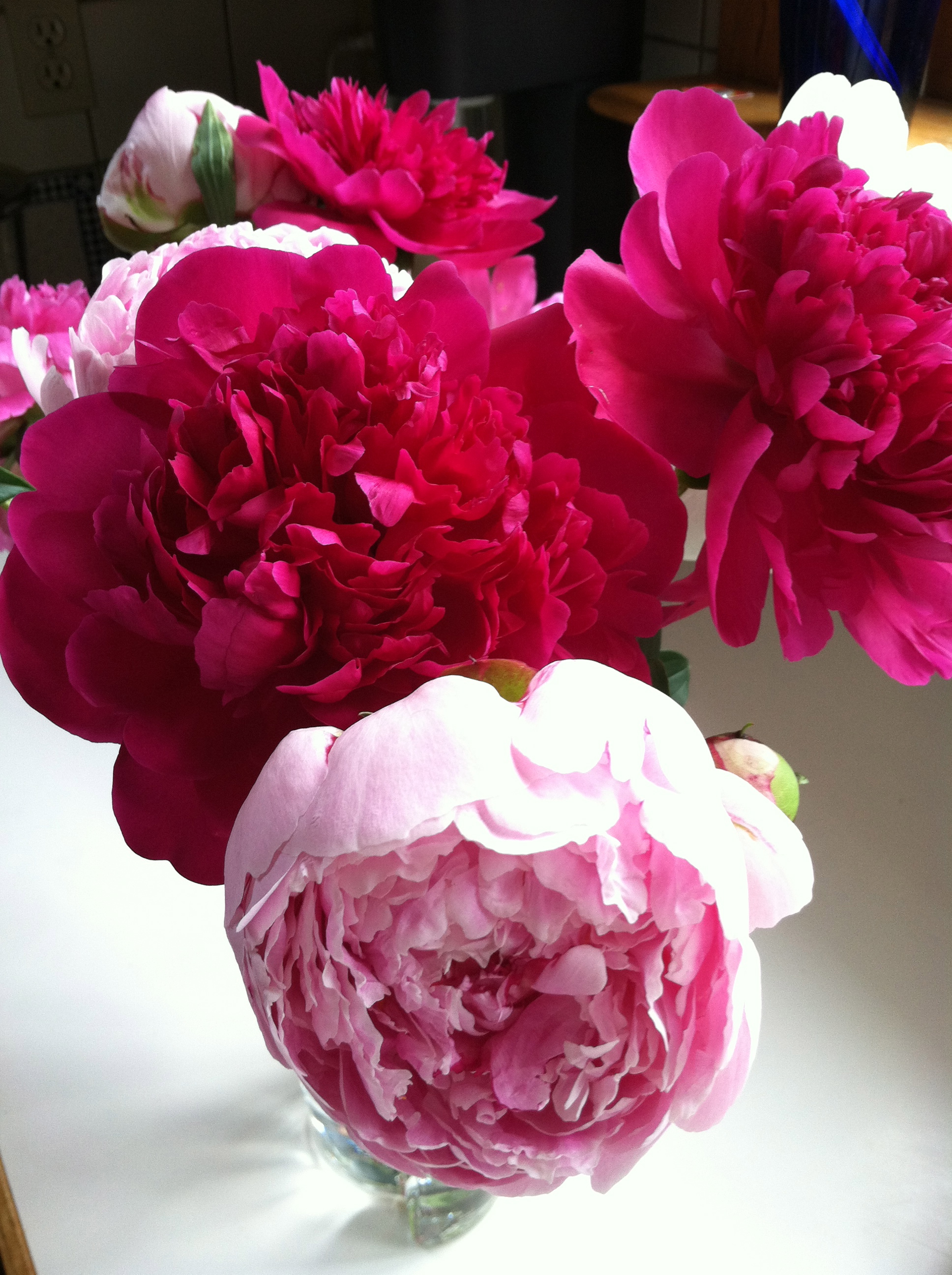
Like many people, I adore peonies.  Their lush blossoms and intense fragrance are intoxicating.  So when two recent family trips crossed into and right back out of peony season here, I was truly sorry to be leaving my peonies.

I mentioned this at a dinner with old friends just before the first trip, and Al told me a trick for prolonging the peony season. Cut peony buds when they’re still tight balls, wrap them in wet newspaper, store in the refrigerator for up to several weeks, then take them out, put the buds in a vase with water, and the blossoms will open and delight.

It works.  A week and a half ago, headed off for the second of the family beach gatherings, I picked two bouquets to take with me.  If I had to leave and there were open blossoms, why not cut them and bring them with me, one jar full for my mother’s house, one for my sister’s cottage at Humarock Beach.  And I cut a dozen stems with buds, wrapped them in newspaper, wet the paper under the faucet, put it all in a grocery store plastic bag, and stowed it on the bottom shelf of the refrigerator. I unwrapped the buds and put them in a vase on Tuesday.  Today, they are peony perfection.

IMG_1460

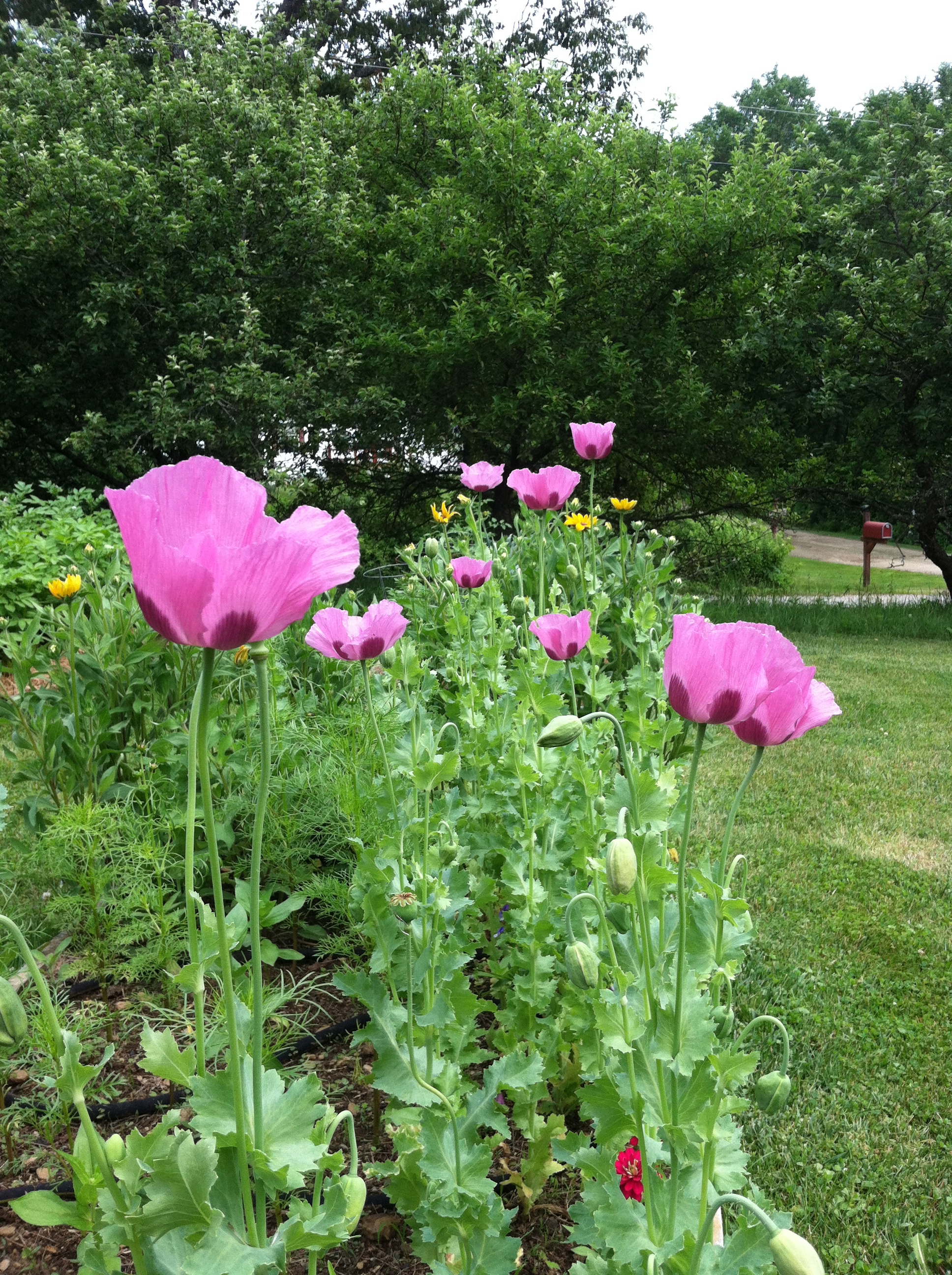
And now the annual poppies that volunteer all over my gardens are open, coming again and again from seeds I started 20 years ago.  The colors and shapes have intermixed, and now I get lavender and red and the pink carnation poppies with their shaggy blossoms which have migrated some genetic code over to ruffle the edges of other colors.  When the blossoms have frayed and left the bare poppy heads, I let a few of them dry on the stalk, break the seed head open and scatter the poppy seeds over my beds.  Next summer, poppies everywhere.

IMG_1462

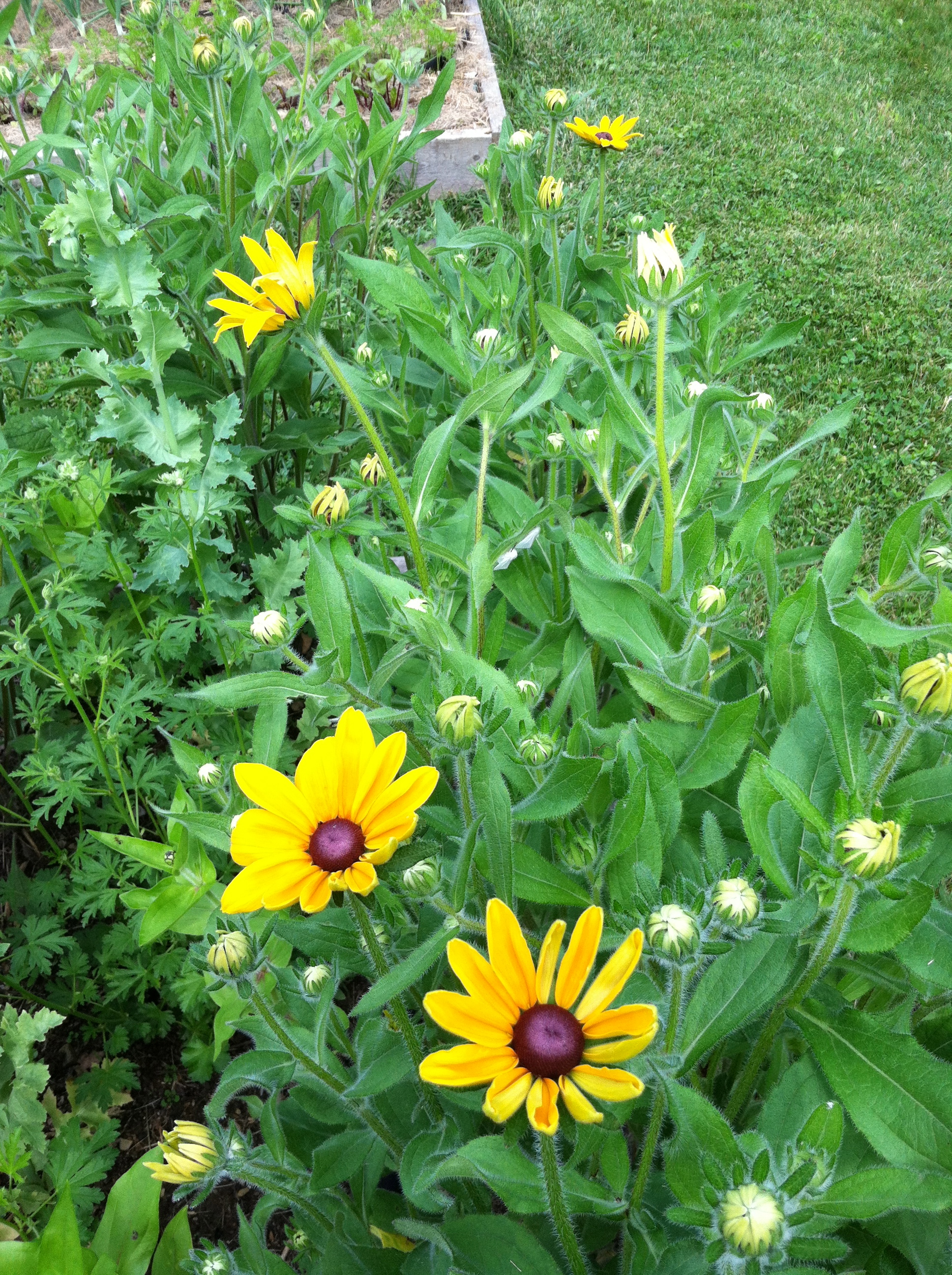
And here is the rudbeckia, also sowing itself into new clumps every time I weed another garden bed.  These flowers came from two clumps a friend dug me from her garden, and I in turn dig clumps and give them away.  I pull up and compost more than I can keep or gift.

IMG_1464

This all makes me happy.  When the big stuff in life gets a bit heavy to carry around day after day, making sure to appreciate the simple, little stuff gets more important.  Not that flowers are simple or little.  But they’re here and now and lovely.

Wildflowers

IMG_1435

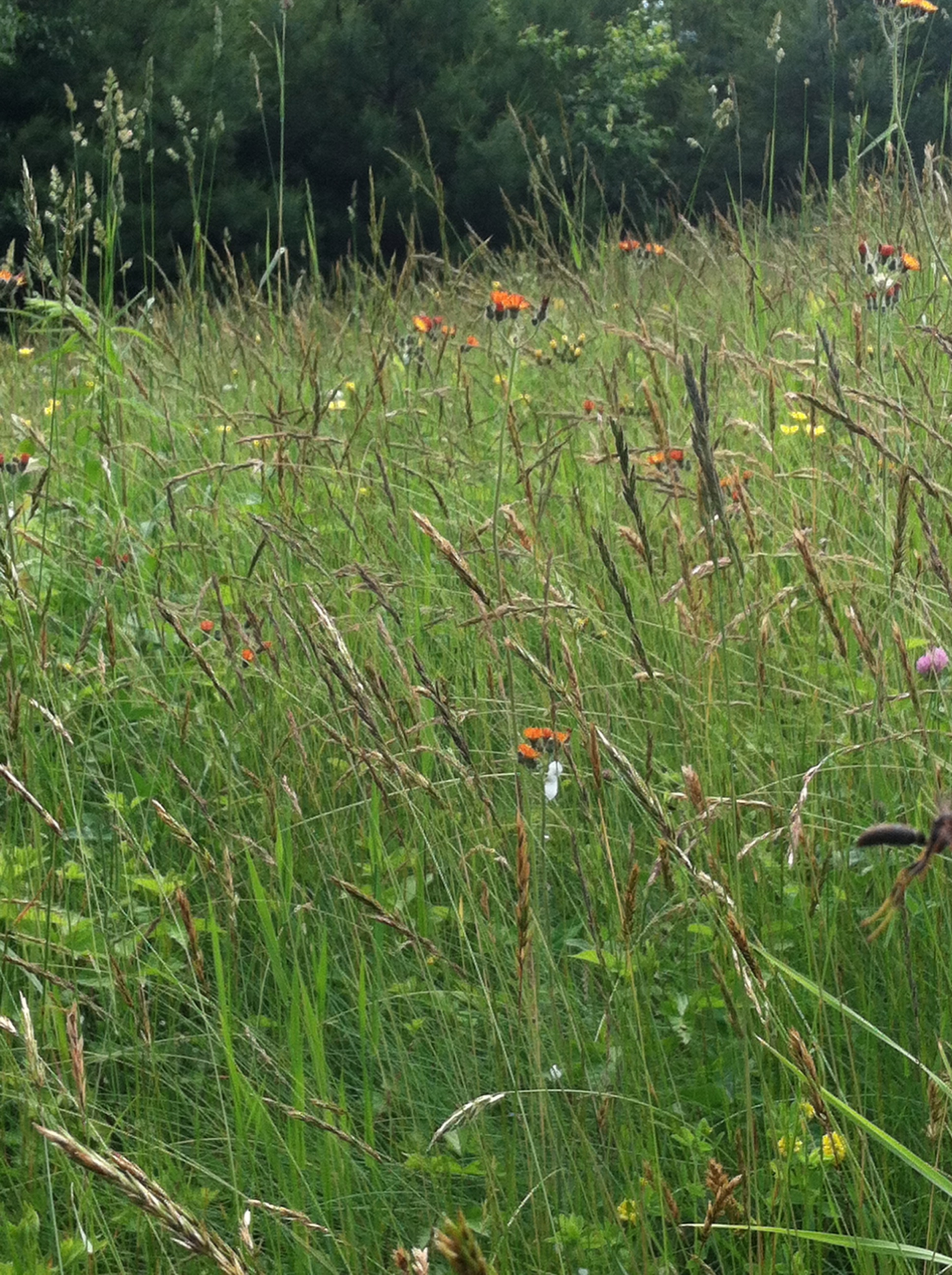
In my late teens and well into my twenties I loved to pick wildflower bouquets.  Noticing a field with daisies, or black-eyed Susans, or yarrow or asters, I would stop my car or my bike and wade into the tall grasses and flowers.  I sometimes thought about the people who owned the fields where I picked flowers, but I was living mostly in the country, and there were pastures everywhere, often no where near a house, and I couldn’t imagine any one would mind me taking home a free bouquet.  When Eric and I got married, our bouquets were made with wildflowers.

In June, 1981, Eric and our good friend Anne and I bought the house where I still live.  The house is surrounded by fields and hay meadows and pastures.  The day we moved in I walked into the small field on the south side of the house and looked at the flowers — daisies, vetch, clover, Indian paintbrushes, wild multiflora roses.  They were all blooming among the tall grasses with their full seed heads, nodding back and forth in the wind.  I sat down in the field, happy and overcome with the thought that I now had my own wildflowers to pick. It felt remarkable that I didn’t have to stop at the side of the road any more and pick someone else’s flowers.

Since then I’ve mostly created bouquets for my house from the flowers I grow in my garden — columbine and iris early in the season, then peonies and on to salvia and zinnias and cosmos and rudbekia.  But I still love a field in June, with its wild array of ever-changing flowers and its splashes of color — all, in many senses, for free.

Above the Trees: June

IMG_1419

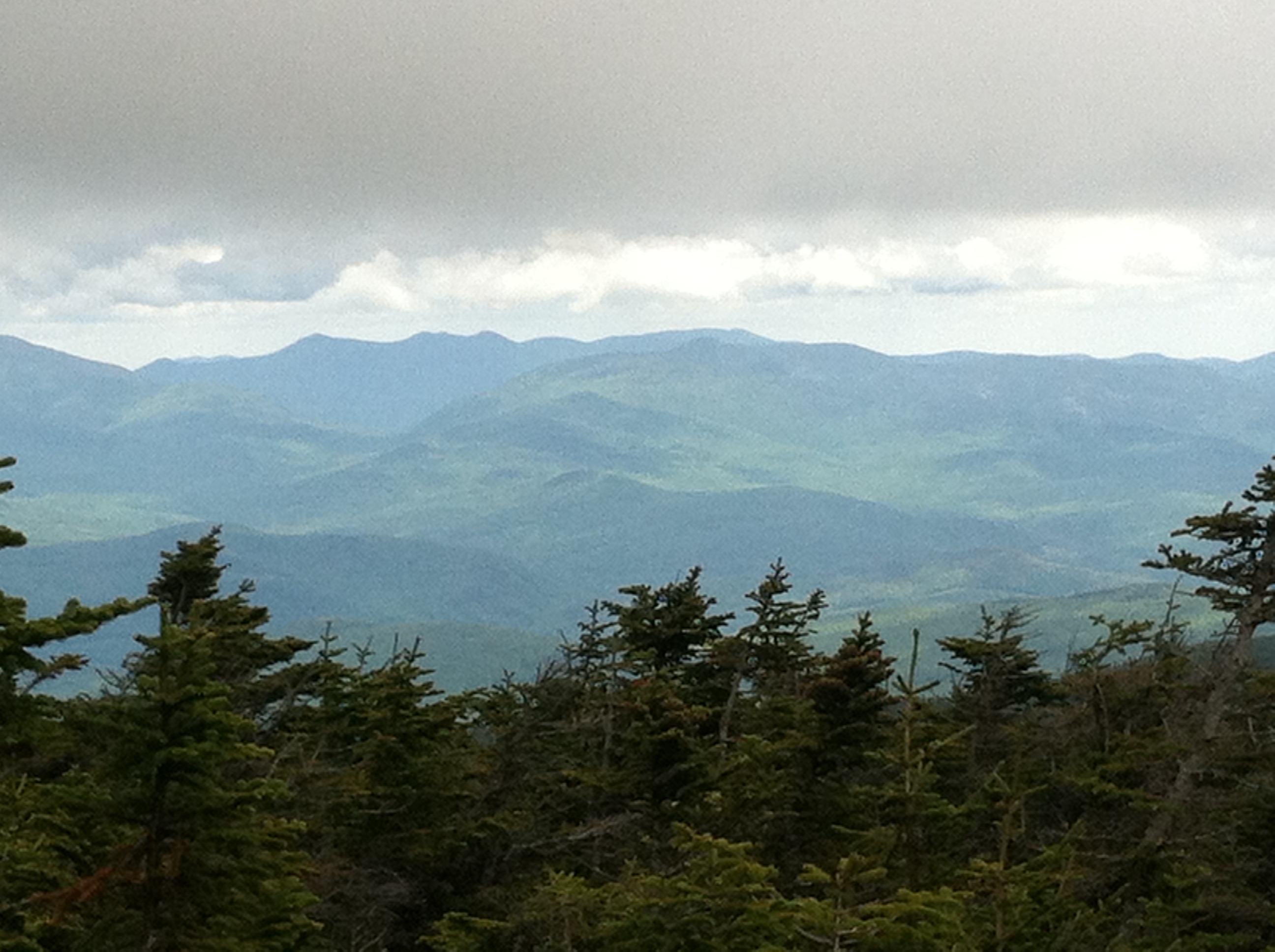
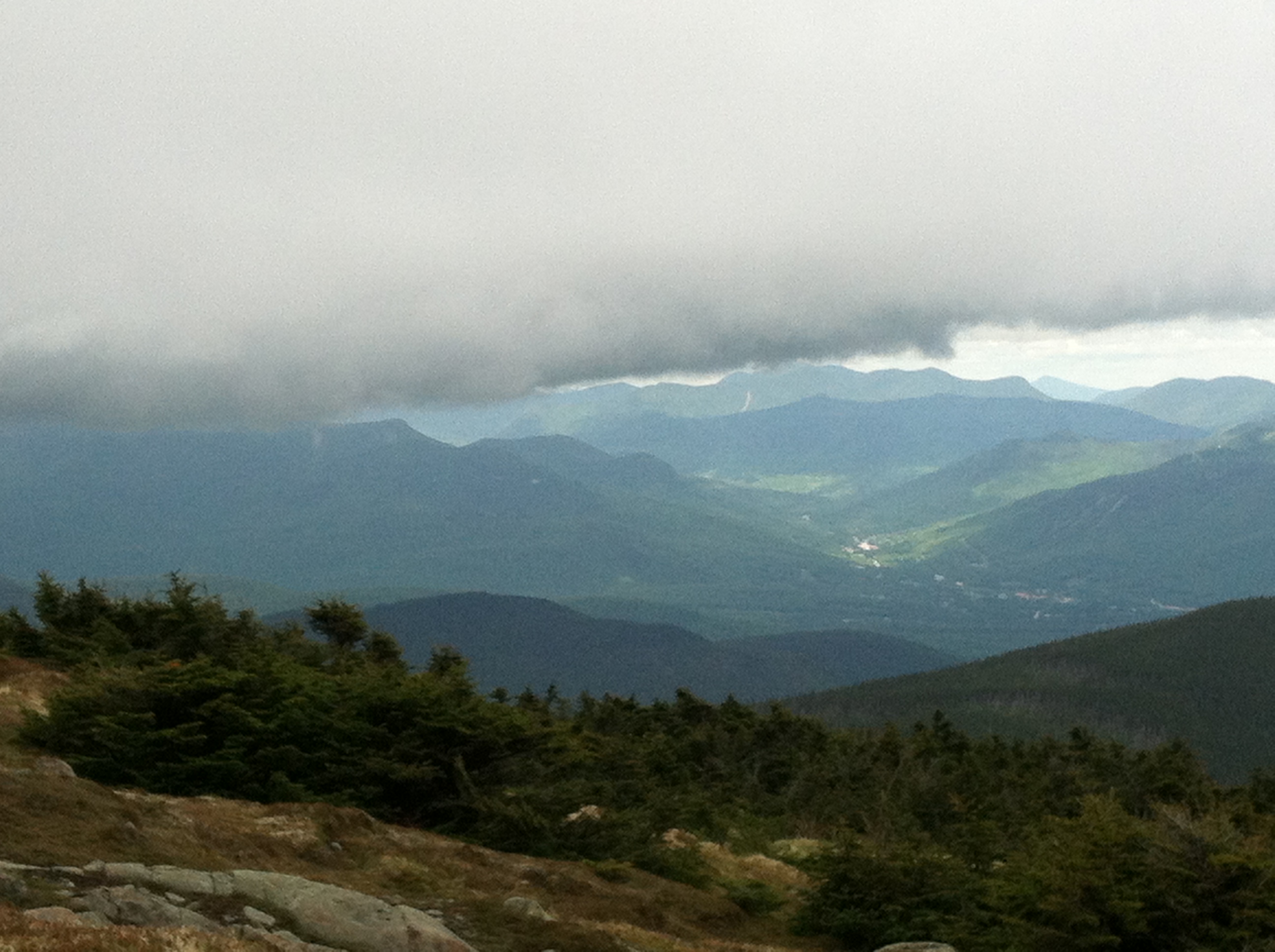
This month we not only got above the trees, we got above tree line.  And into the clouds. As we reached the summit of Mt. Moosilauke, the clouds that had been hiding the higher summits began to break into wind-blown sheets of mist, then lifted enough to open up a view of the mountains to the east.

IMG_1418

At one point a ceiling of cloud settled into the notch, between Moosilauke and Franconia Ridge, sunlight streaking the distant slopes.  Another day outside, another hike that reminded us why we committed to the intention of getting above the trees at least once a month this year.

IMG_1421


Retreat

IMG_1401

I’ve been on retreat, “an act of moving back or withdrawing,” or “a place of privacy or safety.” Retreating, or creating an actual retreat in the midst of every day life, is a powerful way to get creative priorities back in line. Or back to the beginning of the line.

When I left the Coalition almost two years ago, I’d imagined a life with writing as the organizing force, the central focus of what I had to do.  Everything else would fit in around it.  That has been so totally not true.  Valuing writing, valuing spending time  expressing my creative impulses whether or not that expression ever leads to publication, or praise, or whatever it is that might make it somehow count, is still unexpectedly difficult.

But at least I’m spending more time with other writers who all struggle to some extent with the difficulty of getting to the desk and getting words on paper.  I have lots of sympathy for my constant battle to push back the dailiness which can easily fill a life — grocery shopping, cooking, gardening, hanging photos and paintings up in the kitchen and hallway we had painted a year ago, visiting friends and family, training for the next tri, answering email, cleaning the old running shoes out of the bottom of my closet, a task I’d thought would be done within a week of leaving my job — and put my writing first.  “Writing is my job,” a novelist I met last summer told me.  “It comes first, every day, then I get to the other things that need attention.”  Good for her, but how do I do that?

Last week a group of my writer friends and I went on a writing retreat.  One of the women has a sister with a second home in Manchester, Vermont, who was happy to have us use it as a writing base.  After an afternoon and morning of more concentration on writing than I thought I could possibly muster, I said to one of my friends, “This is such a good reminder that going away to write, making space for that, getting to a place where all I have to do is write, really makes a difference for me.”  “It makes a difference for all of us,” she said.  “That’s why so many writers do it.”

Of course.  I keep thinking there isn’t any reason I can’t just sit down at my desk for four hours, or three hours, or five hours, or even 15 minutes, every single day.  But really, there are literally hundreds of reasons to keep me from doing that, every single day.

Sitting in a screened gazebo on a deck overlooking pastures sweeping down to the Battenkill River and up the Equinox Mt. ridge, I spent hours and hours last week, working on poetry.  I woke early the first morning we were there, after an afternoon of writing, and had to get out of bed and get to work.  I couldn’t wait to get to my poems.

Now I’ve been home a week and I’ve still been writing at least a bit every day, some days quite a lot.  Retreating at home is harder, but not impossible.  And one thing I fit in this week was making plans for the next actual retreat.

Being Mimi

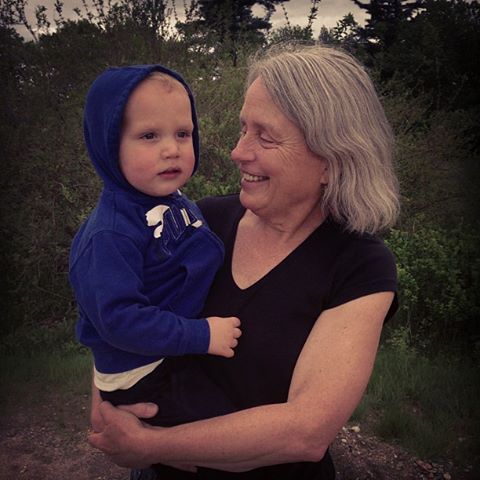
me and emilio

Friday night I was helping Emilio take off his clothes for his bath, kneeling next to him by the tub.  “Take off your glasses,” he said to me.  “I want to look into your eyes.”  I took off my glasses and he moved his face closer to mine.  “What color do they call your eyes?” he asked and put his face up to mine, looking directly into my eyes.  “Blue,” I said, “Everyone here in the house right now has blue eyes.”  “Oh,” he said, continuing to look at me from an inch away.

This from a toddler, a few months over 2.