Doing the Hospital Hang

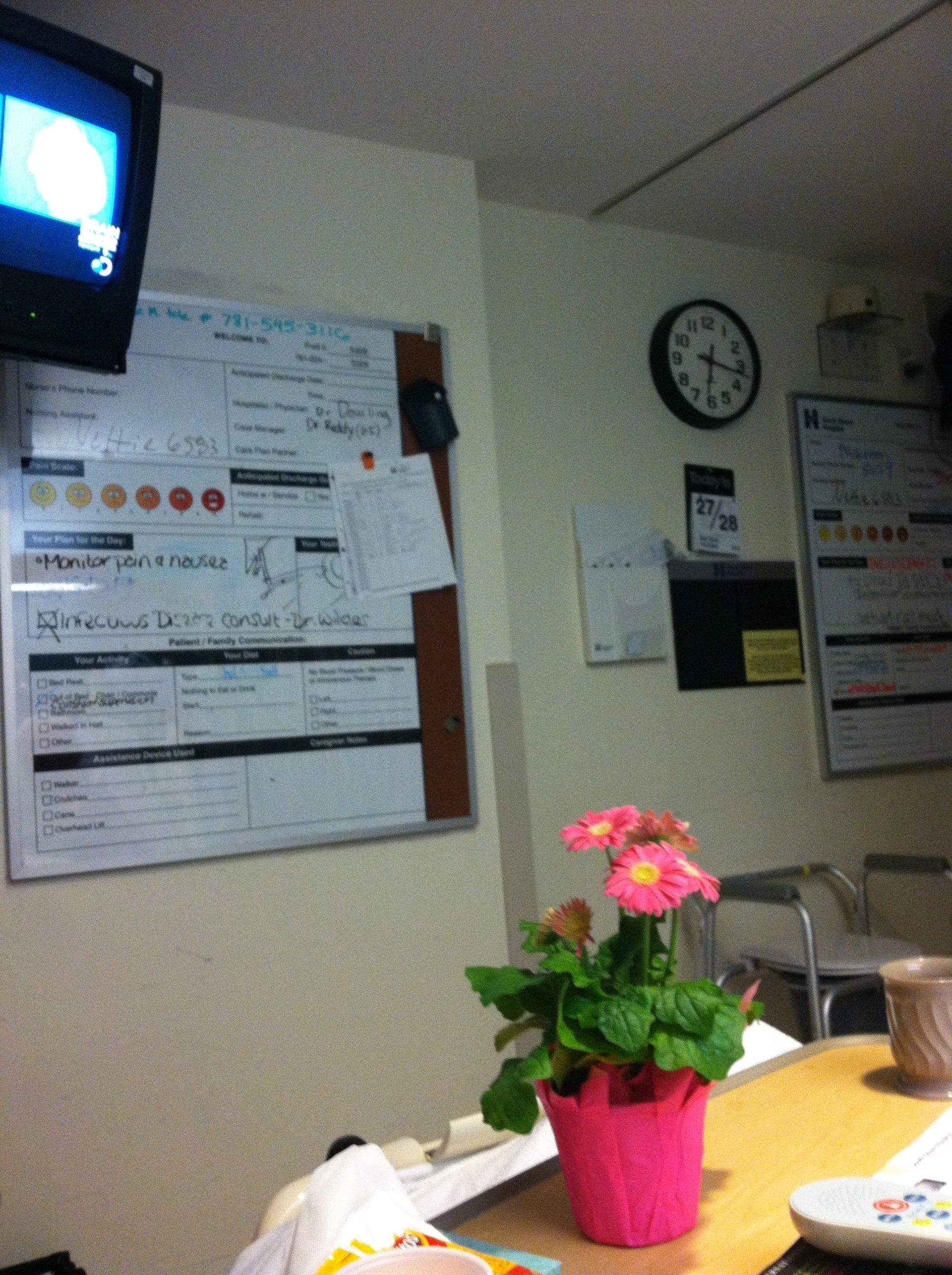
As Frankenstorm rides up the coast towards New England, I’m back in form, doing the Hospital Hang.  My life has included mostly unexpected and sometimes extended hospital stays of people I love, and I developed my skills many years ago.  They come in handy.

How to do the hospital hang?  Pack up food, reading, a computer (hospitals generally have strong and reliable wifi), work files and knitting.  You may not use all the things you bring, but it makes me feel more settled to know I have plenty to do, in case I want to do something besides just be with the person I love who’s in the hospital.

Once you arrive at the room of the person you’re hanging with, drag chairs from wherever you can find them so all the visitors can sit comfortably.  Locate the mini-kitchen and get yourself some water.  Find the closest restrooms.  Chat with all the nurses and aides and be super-friendly.  Marry a doctor and bring him along and smile while he lets the hospital staff know he’s a doctor and proceeds to ask knowledgable and important questions.

It was David’s suggestion to test for Lyme disease, and my sister’s follow-up insistence on the test, that’s resulted in a diagnosis of my mother’s confusing symptoms — acute and chronic Lyme.  Hopefully the IV antibiotics will start to turn around this multi-week roller coaster of pain and nausea, dehydration and confusion, appetite and energy loss.  I’m hoping this hospital hang resolves quickly, for everyone’s sake.  I don’t need any more practice.

Okay, the “marry a doctor” part might not be that easy, but that’s a skill I picked up for other reasons, and it comes in really handy.

Darkness and Light and Sweetness

This slideshow requires JavaScript.

Last Sunday evening Adrienne, Matt, Melia, Emilio and I went to the Rise of the Jack O’ Lanterns at Old Westbury Gardens, near where Adrienne and Matt live.  The advertised 5,000 or more hand carved Jack O’Lanterns were not disappointing.  Rather, they were a visual delight, glowing in long rows along the dark path, many with intricate paintings and carvings of flowers, trees, butterflies and celebrities.  Emilio was very excited to see Kermit and Frankenstein.  “Kermit, again?”

But the best part of the evening was when we were leaving.  As we walked to the car we passed a large pedestal with an eagle sculpture on top and pointed it out to Emilio.  Looking back at it Emilio said, “Bye-bye, Eagle.”  Then as we drove out of the Gardens, settled back in his car seat, Emilio said, “Bye-bye, Jack O’ Lanterns.  Bye-bye, Pumpkins.” No tantrum about leaving, no fussing and whining.  Just a sweet moment of Emilio letting life pass along on its swift track, ready for whatever was next.

Life’s Left Turns

Navigating the unexpected left turns in life is no easy thing.  Taking a left turn is always tricky — assessing the oncoming traffic, making sure there’s space for you to cross lanes, moving swiftly but confidently in the face of not being quite sure what might pop up in front of you.

After Eric died, I read a good bit of Pema Chodron, and was very attracted to her messages about embracing groundlessness — letting go of our expectation that life always has to be happy and perfect and planned, and realizing that life is a process unfolding in unpredictable ways that bring both joy and pain, loss and gain, grief and acceptance.  Being truly present in each moment of my life, and understanding that that’s really all there is, was a lesson I learned through my grief process, and one I have to keep relearning.  Remembering that my attachment to the idea that I know exactly where I am and where I’m going is an illusion, and that the groundlessness of life is going to catch up with me over and over again is helpful.  Get back into this moment, because really, that’s all there is.

It’s warm enough to be on the porch writing this afternoon, and I’m grateful for the soft air and the shelter that lets me be outside as intermittent showers veil the fields surrounding me.  The maples that still have leaves are yellow, and the oaks are amber behind the gray rain.  This is a moment to savor as I spin the wheel to the left.

The Gravitational Pull of Work and Haiku Habit II

This slideshow requires JavaScript.

Two months ago I recognized how much my consulting jobs have cut into my time and whatever space I was finding in my mind for writing and creative concentration.  I remembered that while I was still working at the Coalition I started the practice of writing a haiku everyday as a way to stay in touch, however briefly, with daily creativity.  Not that my work in the movement to end violence against women hasn’t always had a strong element of creativity, but it’s not the same as writing down the constant scroll of language translating experience in my mind.

Two months later I’m admitting to myself that the gravitational pull of work has landed me back in a place where much of my mental energy is expended helping organizations and projects further their work to address domestic and sexual violence.  It’s not a surprise.  No one is emailing me and calling me asking for the next poem or essay or book.  People are emailing and calling and asking me to do consulting work.  I get paid, I get praised, I get absorbed.

So back to that Haiku Habit idea from two months ago.  I’ve hardly written a haiku since, but today as I got ready to be away traveling for a job, knowing that the first real frost may finally arrive while I’m gone, I decided to let the turn of the season turn me back to at least a small space for poetry in my head every day.  I hope it lasts.

Haiku Habit II

Late garden basket
Last cascade of summer porch
Frost’s chapter opens.

Walking In the Woods

This slideshow requires JavaScript.

Walking In The Woods

We have been walking in the woods since we were children,
we never stopped, we can see the forest, now our son
tells me to slow down, there’s no hurry anymore,
you are already dead, he runs. Water drops downhill,
a stone bridge at the top of the gorge, ice and snow still,
goblets of ice hanging from branches that cross a small fall,
sharp angles of rocks, going to the river. I find dry leaves
in a sunny spot above the water, a cloud shadow and the brook
is black and white, gold glint gone, then gold again, the cloud
is in everything, at the river, a rock bench by a pool under cliffs,
snow shards, a flurry in a squall, a bank of river stones.

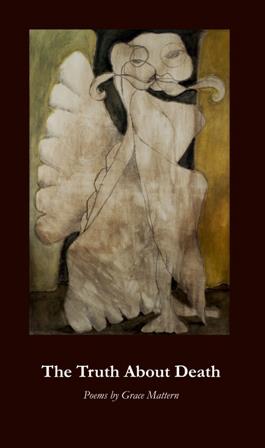
From The Truth About Death

More Truth About Death

Having The Truth About Death published was an accomplishment that meant a lot to me, not just because it felt great to have my first full length book of poetry published, but also because I believe in the story it tells, the chronicle of grief it provides, and its truth about death.  Or the truth as I experienced it.   Still, this summer I purposely let myself focus on other things — travel, family, gardening, ramping up on a couple of consulting jobs — rather than feel like I had to maintain a constant focus on promoting my book.

So I’ve been delighted twice recently when, without any prompting or focus on my part, good things have come back to me about the book.  I brought copies with me to the Vermont College of Fine Arts Writers’ Conference this summer, figuring I’d sell a few copies there, which I did.  And a week after the conference I got this wonderful email from a participant who’d bought a copy:  “I have just finished reading your book, The Truth About Death. I simply could not put it down; I read it in one day. It is so beautiful and moving and agonizing that I hardly know what to say, except that it has changed me: I feel ripped open and sewn back together. This is what I hope to find in writing, in any genre; I ask to be fundamentally altered in ways I can’t adequately describe. I am afraid to explore the topic of losing a partner. Your poems made me look at the visceral truths of such a loss, and I am grateful for that. I know this is a book I’ll read many times, finding something new in each reading. Thank you.”

“Wow!” I thought.  So it’s working.  People are experiencing the book in the way I’d hoped.  Then a couple of weeks later I got this email from a good friend:  “I thought you might like to know how your work moves around. I gave a copy of your book to my friend Jim who is now teaching for NYU in Abu Dhabi. One of his courses is called Ghastly Beauty, and deals with art as ‘a repository and record of human emotion’. He is using some of your poems in  the class. Since the students come from all over the world, they will take some of your work with them when they go.”

And tomorrow night I’ll be reading once again from The Truth About Death.  David and I are the featured readers at tomorrow night’s Portsmouth Poetry Hoot.  So, the book keeps going out into the world and coming back to me in unexpected ways.  May the magic of that continue.

Yom Kippur: Memory, Love, Stones

Last night at Kol Nidre services, the eve of Yom Kippur, I sat next to a woman who was the pianist at services for many years.  She turned to me when I sat down.  “Hello, Grace, I’m Justine.”  I told her I knew her and was glad to see her again.  At the end of the service the Rabbi asked that we leave quietly, as the Yom Kippur service doesn’t officially end, but extends for 24 hours, with breaks for sleeping and resting.  Justine turned to me and said, “I know I’m not supposed to talk, but I just wanted to tell you how much I miss Eric, what a special man he was.  I wish I’d known him better.”  This is the seventh Yom Kippur since Eric died.

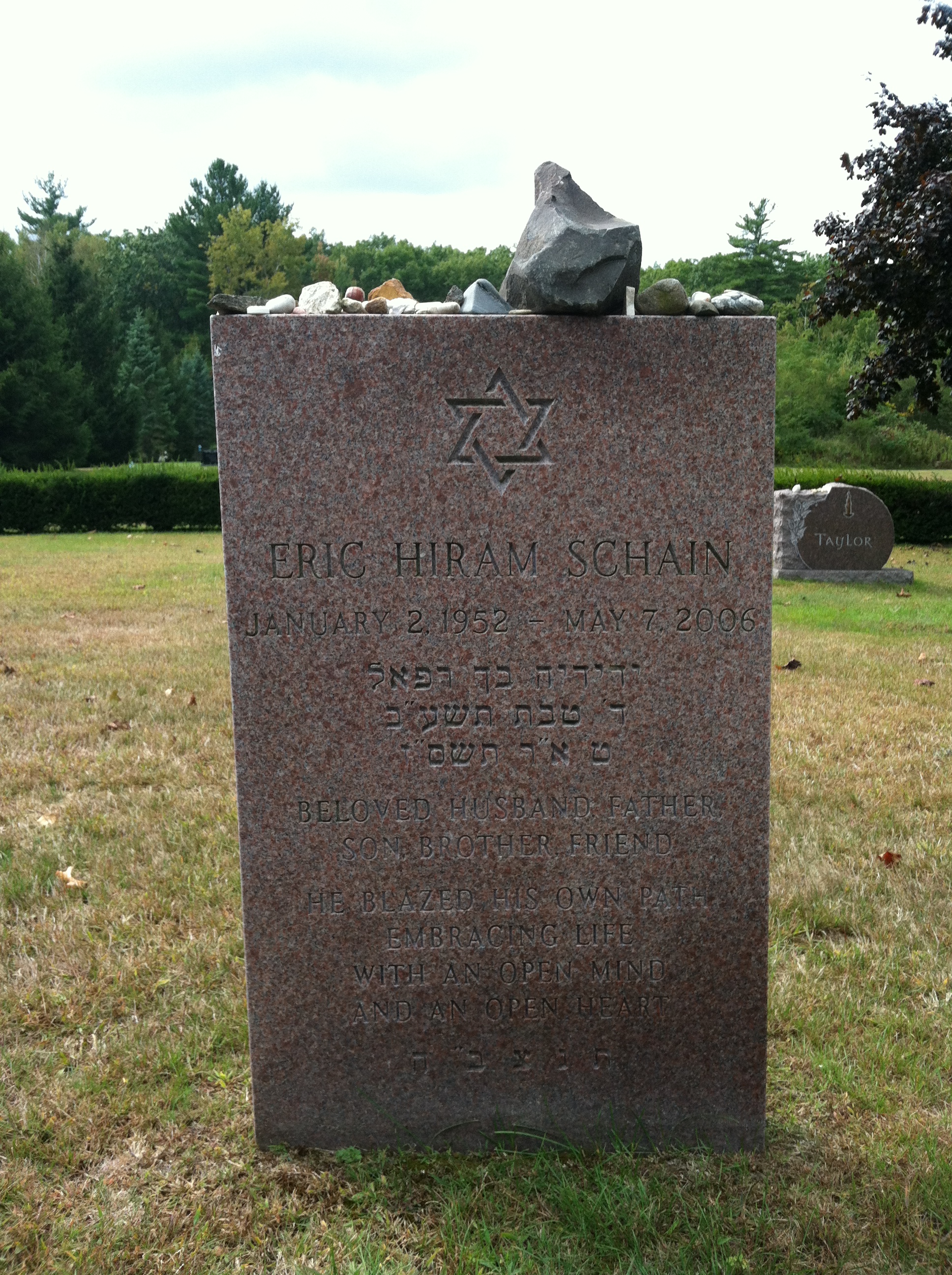
After my D’var Torah during Rosh Hashanah last week, a member of the Temple told me she’d gone to the Temple’s section of Blossom Hill Cemetery the day before.  Part of my D’var Torah talked about visiting Eric’s grave and leaving stones there.  He has a lot of rocks on his grave.  More than any other gravestone there.  “I had some young ones with me, and one boy wanted to know what the stones on the graves meant,” she told me.  “I explained that loved ones visit the graves and leave rocks as reminders of their visits.  Then he asked me how come some of the gravestones don’t have any rocks.  I explained the best I could, that maybe their family is far away, or gone.  Then the boy pointed to Eric’s grave and said, ‘Well look at all the rocks on that gravestone.  A lot of people must love him.'”

A New Year

Today is the fourth day of Rosh Hashanah, the Jewish New Year.  This year I was given the honor of delivering the D’var Torah during the second day services; it’s a tradition at Temple Beth Jacob for a member of the congregation to be the guest speaker on the second day.  A D’var Torah is a talk related to a portion of the Torah (first five books of the Jewish Bible), usually that week’s portion to be read during services, often including life lessons and commentary.  A sermon, in other words.

Eric was deeply involved with Temple Beth Jacob, and had written five different D’var Torah commentaries over the years, for different occasions.  I read them all, trying to plan what to say.  It was wonderful to reconnect with Eric in that way, to remember his commitment to Judaism and to sustaining a strong Jewish community.  I didn’t end up with a plan about how to focus my D’var Torah, but I did end up talking about the Yiddish saying, “One plans, God laughs,” and how planning can be laughable, in both a discouraging, and encouraging way.  Because our plans often get interrupted by unfortunate events, but we also often end up in fortunate places without any planning on our parts.

My talk went well, and those at services on Tuesday were uniformly positive in responding to my talk (I talked a lot, also, about Eric, and David, and the twists and turns of life and death and moving on — I’d put the talk up here, but it’s too long for a blog post).

But best of all is the herons I’ve seen every day since the beginning of the New Year.  Great Blue Herons were Eric’s favorite bird, and I see him when I see a heron.  The last two mornings, out for my morning run, a heron has lifted out of the brook I was running past and slowly flapped its long wings to cruise along the course of the water.  “Hey, Eric, Shana Tova,” I thought and heard Eric saying back to me, “Good job.”

Coincidental Conversations

This slideshow requires JavaScript.

Three times in the last week I’ve stumbled into wonderful conversations with people I didn’t know before we started talking, and found much to affirm the almost constant swirl in my own head about what I’m doing with my life right now, what I think I should be doing, what I could do better if I’m not doing things exactly right or according to some indiscernible grand plan, and how I might be doing something different if that’s what I want.  Or think?

Sound confusing?  It is, but the conversations helped.  The first was with a long ago friend of David’s, at a birthday party for another long ago friend.  A group of people who had either lived in or been connected to a large communal household in the Boston area 40 years ago had gathered for the celebration, and David and I had a long talk with Barbara, another artist, trying to understand what role art and painting plays in her life.  Right now she’s not interested in “having a show,” painting for the purpose of selling her work, or even painting for anyone else.  Instead, she’s interested in finding her voice as a painter, and trying to explore and understand the role of creating beauty as a primary purpose of art.

As she talked, I could feel her thoughts resonating with ideas of my own I hadn’t even articulated to myself.  Why do I want to write?  Why aren’t I writing more?  Who am I writing for?  Is it enough just to write when I want, however I want, for whatever reason?  Does ambition about getting published and read and recognized help in the writing process, or hinder it?  And do I even care about any of that?  Talking to Barbara helped all these questions come to the forefront, and I’m far from answering them, but I know this is a conversation I want to keep having, however I can fit that into my life.

On Tuesday, with clear days and clear calendars ahead of us, David and I went north to the White Mountains for a couple of days.  We hiked first up Mt. Madison and spent the night at the Madison Spring Hut, allowing us to stay above tree line on the grand Presidential ridge.   The Appalachian Mountain Club huts provide sleeping bunks and hearty meals to hikers at high elevation locations, making staying in the mountains a truly in-the-mountains experience.

The night at the hut gave David and me time to summit both Madison and Adams, two of the tallest mountains in New Hampshire, and the chance to share dinner and breakfast with two interesting people, extending our own dialogue, both internal and between us, about what we’re doing, what we want to do, what we should do and how do we fashion our lives in the absence of huge jobs and the presence of significant creative urges.

Francois is from outside Montreal, and was on a multi-day hike, peak-bagging, and staying in shape for his central goal, which is to climb the highest peak on each continent. He’s already done 4, including getting to the summit of Everest last May.  He’s driven by a singular goal, focused, direct and intent.  Talking to him about his adventures was wonderful, because he seems to live with very few questions about what he’s doing.  When we asked him why he’s climbing the highest mountains in the world his answer was simple.  He loves it, he loves mountains, he loves the process and opportunity for success.

We also spent a lot of time talking to Cathy, the mother of one of the hut crew members, there to visit and spend time with her daughter in the mountains. Cathy is between major projects at this point, her children grown and starting out in their own lives, her own career as a landscape architect on hold for now.  She’s interested in writing, community design, food security, urban garden planning, and her family.  Talking to her was, again, like talking to myself.  What is this later life I’m experiencing for?  What’s the best use of whatever time I have left, where should I put my focus?  What am I doing?

One thing I’m doing is finding interesting people who are happy to talk about what they’re doing, whether they have a clear answer to why they’re doing what they’re doing or what it means, or they don’t.  Because it’s really all the same, isn’t it?  We’re here and we’re doing the best we can.
Asking For Help

I’ve been traveling through cities a good bit lately, mostly because I’m working and that means travel and meetings in cities. Walking the streets of DC Friday morning I got asked for spare change by a man sitting on a stoop shaking a paper coffee cup.

I didn’t stop and give him anything, but I did remember my two trips through Boston’s South Station in the last two weeks. The first time I was sitting on a bench outside, eating lunch and enjoying the sunshine and city energy. A young woman approached me and said, “I’m not a scumbag, really. Really, I’m not.  But I’m stuck and need $7 for a ticket home to Vermont.  I never do this but if you could just help me out I’ll pay you back, I promise.” I gave her $20 and she hurried off towards the bus terminal.

Sunday night I was sitting inside the bus station waiting for the last bus to Concord when a young man came up to me. “Excuse me,” he said. “My mother would kill me if she knew I was doing this, but I lost my wallet on my last bus trip, and now I don’t have the $15 I need for a ticket back to New York City.  Could you help me out?”

“Why are you asking me?” I said.  “Because I was here a week ago and got basically the exact same story.  Why me?”  The young man shrugged and said, “You’re sitting near the ticket counter.  I just thought I’d ask you.”  I told him to ask some other people and come back to me if he didn’t have any luck.

In Manhattan two weeks ago, waiting on the sidewalk for the BoltBus, people kept coming up to me to ask, “Is this the line for the bus to Boston?”  There’s no sign, people just line up near the TicToc Diner on the corner of the block with the New Yorker hotel.  I’d asked if it was the right spot myself, and trusting the people who’d told me it was, I reassured person after person who asked that this was the place to wait (it was).  After the fourth or fifth person who came up to a long line of people and picked out me to ask, the young man standing behind me said, “People like to ask you, don’t they?”  I nodded.  “I guess so, must be something about my face.”

The young man at the South Station bus station came back about 15 minutes later.  “No luck,” he said and I gave him $20.  “Let me pay you back,” he said, taking out his phone.  “Give me your email and I swear, I’ll be in touch.  Really, I never do this.”

I just shook my head.  “No, it’s fine,” I said.  “Have a good trip home.”