New Season Budding

David and I landed back in New Hampshire yesterday afternoon, after a week away. Having been in Tennessee, we were used to fully leafed out trees and flowering azaleas and roses and peonies.  But coming home to a week’s worth of bud growth on the trees here, the growing grass, the violets popping up in my yard and garden, was a welcome scene.  Trees are like grand flowers in NH this time of year, as their buds break into catkins and furry pods of unfurling leaves, blurring the landscape with red and gold.  I wrote this poem about 15 years ago, but still remember it every year at this point in the season.


Habitat

I don’t inhabit my skin.
Here’s a story that hasn’t been told
about the trees, first budding,

branch tips tinting the horizon.
Trees don’t inhabit their bark;
all parts are one wisdom, one being

translated through one set of roots,
fibers drinking from the same soil,
then feeding that soil when dead.

Afternoons cloud over as expected,
dimming the sunlight that torches
those reds, oranges, yellows

of leaf buds splitting open to green.
Now begins gradual disappearance —
the long view constricts to the brevity

of the yard. And on this side
I disappear, my skin and stories
coming with me.

Fast Forward Season

This slideshow requires JavaScript.

I’m sitting on a patio in a backyard of a suburban neighborhood in Knoxville.  Beyond the line of trees and low bushes that block this yard from the next I can hear a basketball bouncing and occasional voices of children.  The air is cool but comfortable against my skin.  Yesterday walking along the Tennessee River the sun was summer hot.  The roses in the front of the house are dimming in the light and the white fence that encloses the patio gleams in the dusk.  It’s past 8:30 and just now getting dark.  Traveling south and west this time of year is delightful, bringing me further into the warming and day-lengthening season.  I’m relishing this fast forward season.

The Lab

This slideshow requires JavaScript.

No one is more surprised than me that my son Sam is going to be starting a Ph.D. program in organic chemistry in the fall.  “Organic chemistry?” a friend recently asked.  “Isn’t that the subject that knocks kids off their course to medical school.”  Yes, but mostly because they fail it, not because they’re so good at it their professors ask them to consider graduate work.

That’s what happened to Sam.  Three years after finishing his B.A. in English, he was still figuring out what he wants to be when he grows up.  After considering graduate work in psychology, he decided what he really wanted to do was go to medical school.  He started taking chemistry courses last summer, to get his pre-med prerequisites completed with a plan to apply to medical schools next year.  He unexpectedly found he was a natural at chemistry and loves working in a lab, that getting a graduate degree would mean free school, a decent living stipend and health insurance, and a new path opened up in front of him.

David and I are in Tennessee visiting Sam and Marianna, and we went to see the lab where Sam works today.  It looked like a real mad scientist’s lab, with a tray of dishes tilting back and forth, a beaker of a yellowish glop twirling behind a glass window, racks of small tubes with colorful tops and bottles of chemical mixtures behind glass with mysterious symbols written in black.  Sam talked about the work he’s doing and showed us his lab book, full of notes and numbers and drawings of chemical structures.  As an English major myself, I could fully appreciate the papers Sam wrote during college and the short stories and essays he produced for his honors project when he graduated from Clark University.  The research he’s part of at the University of Tennessee is all foreign to me, but fascinating, and a reminder that the best way to figure out where you’re going is often to just keep moving.

Falling In

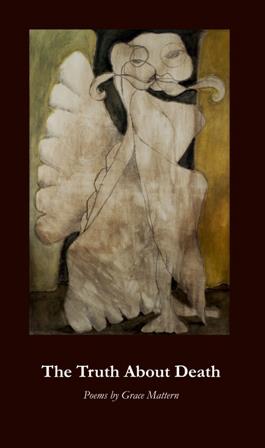
This afternoon was my first reading from The Truth About Death.  I felt anxious and churned up a good part of yesterday, and this morning, yet I wouldn’t have said I was anxious about the reading.  In fact, a friend I visited last night asked me if I was nervous about the reading and I said no.  Which was true — doing poetry readings doesn’t make me nervous.  And in my head, I was assigning the agitation I was feeling to another issue.

But driving over to the reading I could feel that I was holding myself still against some subterranean morass, a deep well that I could see I was about to fall into again.

And I did fall in.  As I read the poems from the book, the room got very still and I could feel the honesty of the wrenching grief the book chronicles holding people’s hearts, holding my heart again.  Many people talked to me after the reading and told me how moved they were by the poems, how powerful the reading was.  My friend Anne, who came with me and David told me later, “I could feel the energy you had while you were writing the book today, while you were reading.”

I came home exhausted and yet relieved, feeling like I’m doing what I set out to do with this book — make art out of sorrow, and tell the truth about death.


Almost Here

By tomorrow evening, I should be holding a copy of The Truth About Death in my hands.  Wow!  My first reading is on Sunday, at Del Rossi’s Trattoria in Dublin, NH, as part of the Writes of Spring series hosted by Rodger Martin.  Sunday night, Kevin Walzer at Turning Point Books put up a blog post about the book.  You can now order it online.  If you do order online, I encourage you to order through Gibson’s, my local independent bookstore, which will be hosting my launch party on April 26.  Wow x 2!

Passover II

Last year I wrote a post at Passover, mostly about the grief that resurfaces this time of year, because this is when Eric’s gathering pain and fatigue and confusion was finally diagnosed as metastatic cancer.  Now it’s Passover again and we had a Seder here on Friday night and it was lovely — delicious food, the usual lively reading of the haggedah, a sweet gathering of friends.  But this post isn’t really about Passover or grief.  It’s about search engines.

Because in the year since I wrote that post, the second most common search term (after my name) that’s led people to my blog is “Passover.”  And it doesn’t just happen occasionally, it happens several times a week, at least.  Really?  When I type in “Passover” in to google or yahoo, I don’t see my blog anywhere.  In what search engine is my blog post about Passover coming up as an answer to people’s search for whatever it is they want to know about Passover?

So if you’re here as a result of a Passover search, please, let me know how you got here.  I’m so curious!

The Trail to the Cairns

If you walk out Canterbury Road from my house it turns into an old woods road, eventually petering out.  It used to be the way to Canterbury, and at a party at a neighbor’s house decades ago, a man from Canterbury told me he used to ride his horse from his house to my neighbor’s house on that road.  Many many years ago.

Eric and I walked the road often.  It rises slightly from my house, passes an old cemetery bordered by dairy pastures, goes back down hill, back up through grand old maples, down and up and down again many times as it passes houses and then heads into the woods, passes a junction with two other old roads, then about two miles from the house loses its definition.  There’s a large glacial erratic that sits along the road side just about where the road becomes indistinguishable from the ramble of woods around it, and that’s where Eric and I would stop.  Sometimes we’d hang out for a while, just happy to be in the woods.  It was our turning back point.

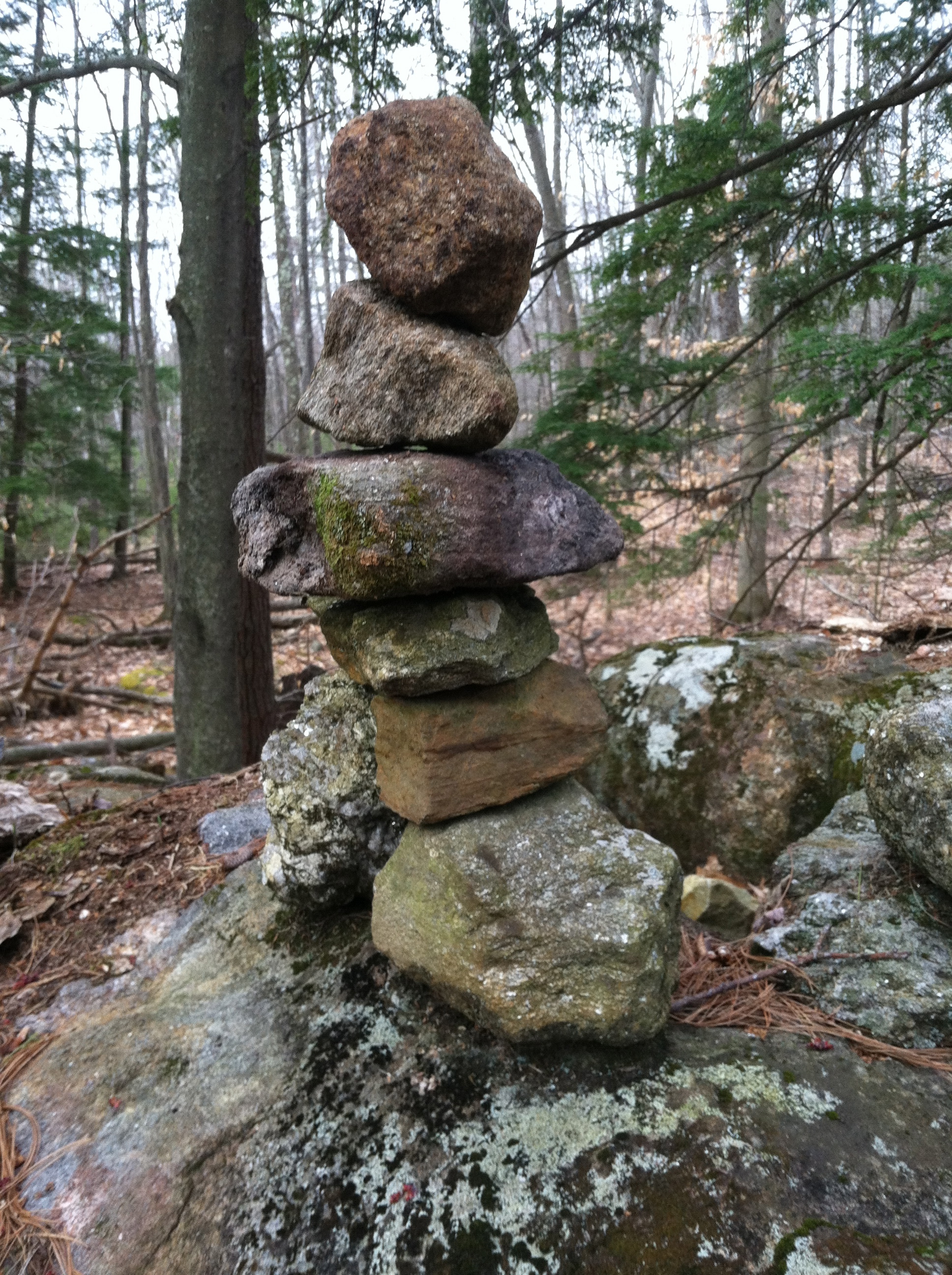
After Eric died, I started building cairns on the big rocks, a monument to Eric.  I walked out there often in the first two years after he died, adding to the cairns each time I went.  Then in July 2008 a tornado ripped through Northwood and laid a wide swath of downed trees and bramble and jumbled branches across the road, about a quarter mile short of the cairn rock.  I tried walking around it once shortly after the tornado, but the road was perpendicular to the tornado’s path, so the mess of downed trees went on for as far as I tried to walk around it.  I got lost.

After the hurricane, my neighbor who owns the land told me he planned to clear the tornado damage and open the road again.  I’ve been walking or snowshoeing or skiing out to the point of the tornado path for almost four years, hoping to find the road reopened.  When David and I walked out the road on Tuesday morning, our neighbor was working on moving and cutting the trees.  “It should be done in the next couple of days,” he said.  Today we walked out there again, and there were two young men, still clearing the last of the thick white pines that were the main trees to come down in the face of the tornado.  “We should be done by the end of today,” one of them told us.

But there was enough cleared for us to get through this morning.  I was so happy to get back to that rock, to those cairns, happy to pick up the few rocks that had fallen and put them back on top of one of the three piles.  Joy can be so simple.  A blocked path in the woods, open again.  Cairns at a turn around point, on random rock, rock I can reach.
Fagel

Fagel was one of Eric’s mother’s three sisters.  Because I know you’re probably wondering, Fagel is Yiddish for Frances, the name that was on her birth certificate.  But everyone who knew her called her Fagel.

Among the sheets of paper I found last Thursday were two pieces of small note paper, still held together tenuously at the top by a thin line of what must have been the pad’s red glue.

Eric’s notes: Fagel — Brief History

  • Always thought of others before herself
  • Always made you feel better about yourself
  • Felt loved, valued, better — now there is one less person to love me, to love each of us.  But there are many who have loved and will continue to love Fagel.
  • I have learned a lot from Fagel and later in my life my appreciation for her continued to grow.
  • Her wisdom, love, devotion to family and Judaism, all that Grace and I and our children have learned from her will endure.

Fagel died on October 7, 2004.   I spoke at the unveiling, about a year later, of her tombstone, reading the poem below.

Empty

No one lives here anymore. Her scent
has settled into the stillness, pilled sweaters
piled on boxes, floral dresses hanging
in the closet with a broken door,

metal hangers snarled in the back. In a bureau
drawer, among socks and ped stockings
I find three small, square mirrors, $20 bills
tucked beside them in protective rubber sleeves.

So many plastic rain bonnets. The books
have cracked spines; on the desk, a stack
of Rosh Hashana cards and pages from an old
address book. The improbable fitness center

tee-shirt with muscular arms flexed
on the front, I keep for myself,
the cotton worn soft and thin; it smells
of her, her empty rooms, even after washing.

Remembering A Father

I opened my copy of The Oxford Book of American Poetry on Thursday, looking for a favorite Wallace Steven’s poem to read to a group of poet friends who were coming over later that afternoon.  Tucked into the back of the book were sheets of note paper.  I pulled them out and saw they were covered with Eric’s handwriting.  Reading his writing, it was quickly apparent that the larger set of sheets were Eric’s notes for his father’s eulogy.  The smaller note paper had Eric’s thoughts for his aunt Fagel’s eulogy.

Eric’s father, Raphael Schain, or Ray, or Daddy-Ray as my children called him, was a sweet, compassionate and hard-working man, who lived most of his adult life with MS. Reading Eric’s notes, I thought of Eric himself, and how much he was guided by the example of his father’s life, in spite of his early rebellion.  When I met Eric he had little contact with his family, and in the beginning years of our relationship, all contact ended for a while, as they all healed from a period of misplaced expectations and then learned to love each other as they were.  By the time Eric’s father died in 2004, we’d had decades of close family time, and I’d come to understand how much of Eric’s character, his lived values of faith and kindness and good works in the world, came from his parents.  Eric says it the best in his words about his father.

“As a child of the depression my father was determined to find a career that would match his abilities with a profession that would enable him to be a reliable provider for his family.  As a result, he chose accounting.  He succeeded.  We never felt a hint of instability — he provided for his children’s education and the stability he provided exists to this day.  As a rebellious child of the 60’s I left my father’s house thinking I had little to learn.  What I said to my father last week is how I’ve come to realize that so much of what I’ve become that is positive is due to his influence, his value, the life he led.  Thank you, Dad, for the way you taught me to embrace our faith, Judaism, both in learning and in minyan, for the value of work, of being a good worker, colleague and leader, for your example of making our world a better place as a result of your acts, your involvement, your charity.  All the good that I may bring to my family, community and world, all that our children may bring is because of you.  Thank you and I miss you very much.”

What a blessing, that Eric and his father were completely at peace with each other when his father died.  Tomorrow, it will be Fagel’s turn.

Adrienne Rich, 1929 — 2012

When Eric and I got married, as part of our vows he read an Adrienne Rich poem to me; I read one of Shakespeare’s love sonnets to him.  I loved that Eric was reading a lesbian love poem to me at our wedding, as if by that act we were affirming love in all its expressions and rejecting society’s rejection of love between people of the same gender.  Adrienne Rich’s Diving Into the Wreck was one of my most cherished books in my early 20’s and I read it over and over, trying to master some of her poetic clarity and vision.  I got to hear her read her brilliant and brave poetry when I was at the University of Massachusetts in the 70’s and I still remember her halting walk up to the podium in a large lecture hall, already struggling with rheumatoid arthritis, but unimpeded in the power of her voice.  When I was pregnant with our first child, I asked Eric to read Rich’s Of Woman Born: Motherhood as Experience and Institution — I wanted Eric to enter into parenthood with me holding the same feminist analysis of how women are shaped by societal expectations of motherhood.  He read the book, and I think we were better parents because of it.  We named our daughter Adrienne.

Adrienne Rich died on Tuesday, and the NY Times has published a wonderful tribute to her, A Poet of Unswerving Vision at the Forefront of Feminism.  It could be the most important thing you read today.