The Shore

I grew up on the South Shore of Boston, in Scituate, a lovely town on the ocean with an excellent harbor and numerous sandy beaches.  We occasionally went to Cape Cod when I was young (I had an aunt who lived there), and we had family gatherings for several summers on Martha’s Vineyard when I was an adult, but mostly I didn’t go to “the shore” other than to Scituate.  Why go to the ocean when home was the ocean?

When I met David he talked about his family’s tradition of going to “the shore.”  The New Jersey shore?  Like in Atlantic City?  Why would anyone go to the beach in New Jersey?(Yes, I was ridiculously ignorant about where millions of people on the East Coast go to the beach.)

When I first met David’s parents, in Lancaster, Pennsylvania, they talked lovingly of their home on the shore, telling me I would have to come visit there the next summer.  Which I did and realized for the first time that the New Jersey coast is a long series of barrier islands with beautiful beaches and long bays with wide sweeps of marshland and creeks behind the islands.

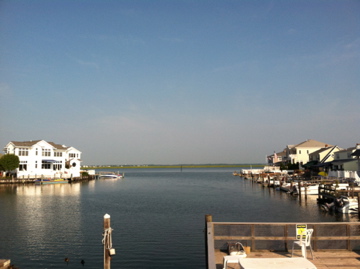
David and I are here for a week, along with our kids, in the house his parents bought in the 1960’s.  It’s not fancy, but it’s on the bay side of the island that’s divided between Avalon and Stone Harbor and sits right on the water.  From the deck you look out across “the basin,” an inlet of water from the bay, the bay itself, and then the marshes, with the mainland in the distance.

My first summer here I sat with Betty, David’s mother, one afternoon when the rest of the visiting family was out doing errands or at the beach, three blocks across the island on the ocean side.

“Oh, forget about time,” Betty said that day.  I was talking about an outing from years before, trying to remember how many years.   “Time is out there and I’m here,” Betty said.  “I’ve given up on being fact actual.”  Betty had been suffering from dementia for years when I met her, but could be amazingly lucid and insightful at times.

I was reading Jane Hirshfield’s Nine Gates, Entering the Mind of Poetry.  “Do you do any reading?” I asked Betty, knowing she didn’t.  She sat in a chair most of the time, going through magazines and catalogues and piles of paper, clipping coupons and flipping pages, over and over.

“Oh yes,” Betty said.  “But I have no book now.”

“Here’s what I’m reading,” I said, and picked up my book.  “Want to hear a poem?”  I read her Yeats’ “The Lake Isle of Innisfree.”  She laughed in delight.

“Well isn’t that the perfect poem for here,” she said, and I read the last stanza again, with its lake water lapping with low sounds by the shore. 

“The water is language,” Betty said.  “If you don’t watch the water here you miss the whole thing.”

I stopped reading and watched the water.

The Color Run

Sometimes we all need a race to be fun.  That’s exactly what The Color Run is about.  You run 5K (or walk or dawdle or do pretty much whatever you want), you get showered at each kilometer mark with powdered colors that turn you into a running rainbow, or multi-color mush, you get a packet of colored powder to throw at yourself or other runners (walkers, dawdlers) or save until the end as instructed and then throw it up in the air when everyone else does and the crowd emerges as a multi-colored mess.  The event happens in cities all over the country, there are charity partners that benefit from part of the proceeds, and the race is seriously NOT about racing.  It isn’t even timed.  Just get out there and get colored.

Adrienne and and her friend Jaime and I did The Color Run today and it was fun.  David took care of Emilio while we ran (we did run) and met us at the finish line.  We had extra packets of colored powder so we did some post-race dusting of ourselves, then went up front with the crowd to wait for the count down to throw the rest of our powder with everyone else.  Not only did Emilio love it, when the burst of rainbow powder had settled down on everyone, he said, “More,” pointing his finger into the palm of his hand (sign language for “more”) and smiled.  He looks good in pink and yellow and green and orange.

I Love Weddings!

This slideshow requires JavaScript.

Now my children are tied for having the best wedding ever.  Adrienne and Matt were married almost four years ago in a perfect NH lakeside ceremony.  Sam and Marianna were married on Sunday in a perfect, East Tennessee farm ceremony.  The last week of wedding prep was very very busy, too busy to be writing about what I was doing, just doing it.  The culmination of all the months of planning and decision-making and preparations and lists was one of the things I love best — a wedding, the grandest kind of party.

The wedding was at Evereux Farm in Bean Station, a beautiful piece of land owned and stewarded by Rob and Lisa Ray.  Being long time friends of Marianna’s family, they graciously offered to host the wedding on the farm.  The sweetness of the land, an open slope under tall trees falling away to a pond with Cherokee Lake and tree covered hills on the horizon, was the perfect setting for a country wedding.  The biggest worry was the heat, but the day cooled off just enough by the time of the ceremony, and the sun had swung west far enough so the guests were sitting in shade.  By the time everyone was dancing under the tent no one cared anymore about sweat and fallen hairdos.

The rattlesnake who’d been living in the stone wall behind the tent was caught and captured on Thursday when we were out at the farm for the tent set up.  Luckily, “Alan,” as Sammy named him when he and Rob Ray drove him to a far off hill to relocate him, came out for a nap in the sun during the afternoon.   Rob raked him into a garbage can and off he went.  And lived on in name only at the Rattlesnake Bar.

The wedding included a continuation and expansion of the dress swap tradition.  At Adrienne’s wedding, my sister Meg and her daughter Amelia and I were all admiring each other’s dresses at the beginning of the reception.  So we decided to swap dresses throughout the reception, all being about the same size, and did a three-way swap, all of us wearing one of the three dresses at some point in the evening.  We promised we’d do it again at the next wedding, and we did.  Then Pam, Marianna’s mother, wanted in on the fun, so she joined the swap, and at one point I was wearing Pam’s dress and she was wearing mine.   Was this the first wedding ever when the bride’s and groom’s mothers swapped dresses during the reception?

Every wedding has its last-minute cancellations and guests who never RSVP and then show up.  And having an old college friend call you the night before the wedding to say he’s here, he’s coming, then show up with an uninvited and unannounced guest isn’t that unusual.  But having that friend show up with a woman wearing four-inch heels that get caught in the soft grass of the farm and a poofy net-skirted dress with a tiny strapped top that shows off the spider tatoo spanning her chest, and who turns out to be a porn star at ease discussing her current work (girl on girl only these days) like others were discussing their graduate degree programs or new jobs  is pretty unique.  Porn star wedding crasher — a new one for all of us.

Emilio was the ring bearer and was almost unbearably cute.  I’ll let the photo tell that story.

On Sunday morning I drove out to the farm with Adrienne and Emilio, so I could help put Emilio down for a nap and so Adrienne could help with “day of” task management and take her turn getting her make up and hair done.  I took the opportunity to go for a long swim in the pond.  As I walked down the slope to the water, a heron lifted up and flapped its long wing beats off across the open fields.  Eric comes to me in herons, as they were a favorite bird of his.  The moment was only one of many moments of Eric’s presence, noted and silent, throughout the whole weekend.

And finally, the highlight of all highlights, my son is married to a wonderful woman.  And my daughter is married to a wonderful man.  And I’m married to a wonderful man and his wonderful daughter Melia was part of the whole family wedding weekend and now there are sisters everywhere, because Marianna has three of them and we all have Melia too.  Lots of love.  Such blessings.

Change of Status

I changed two things in my blog bio yesterday.  First, rather than saying The Truth About Death would be published in April 2012, it now says the book was published.  Hurrah!

Also, I removed “widow” as one of the many words to describe myself.  A widow is “a woman whose spouse has died and who has not remarried.”  I’m married, in fact, today is the first anniversary for David and me.  We didn’t tell anyone, other than Emilio (who so far is showing amazing skills at secret-keeping) for a long time, for a number of reasons.  We were planning to get married someday, in fact felt married, but found out last April we needed to be married by June 15 when David was also leaving his job in order for me to get on his health insurance.  The “domestic partner” provision we’d thought would cover us is only for same sex couples.  So, we got married in a hurry and decided to keep it to ourselves, mostly because we were too busy in the whirlwind of winding down our jobs and in our family lives to make a big deal out of getting married.

We started telling our children, our families, and our friends, about two months ago.  Now we’re telling everyone.  Happy Anniversary!

The Lab

This slideshow requires JavaScript.

No one is more surprised than me that my son Sam is going to be starting a Ph.D. program in organic chemistry in the fall.  “Organic chemistry?” a friend recently asked.  “Isn’t that the subject that knocks kids off their course to medical school.”  Yes, but mostly because they fail it, not because they’re so good at it their professors ask them to consider graduate work.

That’s what happened to Sam.  Three years after finishing his B.A. in English, he was still figuring out what he wants to be when he grows up.  After considering graduate work in psychology, he decided what he really wanted to do was go to medical school.  He started taking chemistry courses last summer, to get his pre-med prerequisites completed with a plan to apply to medical schools next year.  He unexpectedly found he was a natural at chemistry and loves working in a lab, that getting a graduate degree would mean free school, a decent living stipend and health insurance, and a new path opened up in front of him.

David and I are in Tennessee visiting Sam and Marianna, and we went to see the lab where Sam works today.  It looked like a real mad scientist’s lab, with a tray of dishes tilting back and forth, a beaker of a yellowish glop twirling behind a glass window, racks of small tubes with colorful tops and bottles of chemical mixtures behind glass with mysterious symbols written in black.  Sam talked about the work he’s doing and showed us his lab book, full of notes and numbers and drawings of chemical structures.  As an English major myself, I could fully appreciate the papers Sam wrote during college and the short stories and essays he produced for his honors project when he graduated from Clark University.  The research he’s part of at the University of Tennessee is all foreign to me, but fascinating, and a reminder that the best way to figure out where you’re going is often to just keep moving.

Fagel

Fagel was one of Eric’s mother’s three sisters.  Because I know you’re probably wondering, Fagel is Yiddish for Frances, the name that was on her birth certificate.  But everyone who knew her called her Fagel.

Among the sheets of paper I found last Thursday were two pieces of small note paper, still held together tenuously at the top by a thin line of what must have been the pad’s red glue.

Eric’s notes: Fagel — Brief History

  • Always thought of others before herself
  • Always made you feel better about yourself
  • Felt loved, valued, better — now there is one less person to love me, to love each of us.  But there are many who have loved and will continue to love Fagel.
  • I have learned a lot from Fagel and later in my life my appreciation for her continued to grow.
  • Her wisdom, love, devotion to family and Judaism, all that Grace and I and our children have learned from her will endure.

Fagel died on October 7, 2004.   I spoke at the unveiling, about a year later, of her tombstone, reading the poem below.

Empty

No one lives here anymore. Her scent
has settled into the stillness, pilled sweaters
piled on boxes, floral dresses hanging
in the closet with a broken door,

metal hangers snarled in the back. In a bureau
drawer, among socks and ped stockings
I find three small, square mirrors, $20 bills
tucked beside them in protective rubber sleeves.

So many plastic rain bonnets. The books
have cracked spines; on the desk, a stack
of Rosh Hashana cards and pages from an old
address book. The improbable fitness center

tee-shirt with muscular arms flexed
on the front, I keep for myself,
the cotton worn soft and thin; it smells
of her, her empty rooms, even after washing.

Remembering A Father

I opened my copy of The Oxford Book of American Poetry on Thursday, looking for a favorite Wallace Steven’s poem to read to a group of poet friends who were coming over later that afternoon.  Tucked into the back of the book were sheets of note paper.  I pulled them out and saw they were covered with Eric’s handwriting.  Reading his writing, it was quickly apparent that the larger set of sheets were Eric’s notes for his father’s eulogy.  The smaller note paper had Eric’s thoughts for his aunt Fagel’s eulogy.

Eric’s father, Raphael Schain, or Ray, or Daddy-Ray as my children called him, was a sweet, compassionate and hard-working man, who lived most of his adult life with MS. Reading Eric’s notes, I thought of Eric himself, and how much he was guided by the example of his father’s life, in spite of his early rebellion.  When I met Eric he had little contact with his family, and in the beginning years of our relationship, all contact ended for a while, as they all healed from a period of misplaced expectations and then learned to love each other as they were.  By the time Eric’s father died in 2004, we’d had decades of close family time, and I’d come to understand how much of Eric’s character, his lived values of faith and kindness and good works in the world, came from his parents.  Eric says it the best in his words about his father.

“As a child of the depression my father was determined to find a career that would match his abilities with a profession that would enable him to be a reliable provider for his family.  As a result, he chose accounting.  He succeeded.  We never felt a hint of instability — he provided for his children’s education and the stability he provided exists to this day.  As a rebellious child of the 60’s I left my father’s house thinking I had little to learn.  What I said to my father last week is how I’ve come to realize that so much of what I’ve become that is positive is due to his influence, his value, the life he led.  Thank you, Dad, for the way you taught me to embrace our faith, Judaism, both in learning and in minyan, for the value of work, of being a good worker, colleague and leader, for your example of making our world a better place as a result of your acts, your involvement, your charity.  All the good that I may bring to my family, community and world, all that our children may bring is because of you.  Thank you and I miss you very much.”

What a blessing, that Eric and his father were completely at peace with each other when his father died.  Tomorrow, it will be Fagel’s turn.

Perspectives on Walking

This slideshow requires JavaScript.

I love finding scenic places near where I live that I’ve never been before.  David and I are still walking, getting ready for that trek across England, and today we walked through Northwood State Park, crossed Old Mountain Road, and took the Parsonage Lot trail up Saddleback Mountain.   This part of the walk was familiar, but when we got to the first summit of Saddleback, we kept going, past the sign that said “To Deerfield,” a continuation of the trail I’d never walked before.

Thankfully someone has done what looks like a recent marking of the trail with orange arrows on brown boards, because this part of the trail was far less traveled and hard to see.  We pitched down a steep slope on a soft pine needle forest floor, passed through an old stone wall, and crossed granite ledge outcroppings green with moss.  Along the edges of the ledges were small hardwoods, furry with catkins.  It was lovely, and I’d never seen it before.  And maybe best of all, we didn’t get to see where the trail ends (we suspect it goes to the road on the other side of Saddleback that leads to the radio tower) because we had to turn around.  So I get to go back and see more closeby landscape I haven’t seen before.

Yesterday I went for a walk with Adrienne and Alison and Emilio, and got another new perspective on walking.  Coming back down Canterbury Road, Emilio was motoring along, his belly out, his arms pumping, his little legs lifting and cruising on the pavement.  At one point he got to the side of the road, where a solid band of sandy gravel has collected.  He slowed down, looked at his feet on the different surface, and bent his ear down to listen to the crunchy sound of his shoes on the gravel.  Then he walked purposefully back on to the pavement, watching his feet and listening.  Back to the gravel, more steps, more watching and listening.  Then back to the pavement and motoring along.  How cool, to watch that big baby brain figuring out what his feet sound like on different road surfaces.  And then go back to walking.

Next Stop Chelsea

We’re in New York City for a 5 day big city treat, with big qualifying both city and treat.  Yes, we were just in Paris.  Yes, we are very lucky to be able to have these experiences.  Yes, we are aware of our great privilege and are savoring it.  We’re renting an apartment in Chelsea through AirBnB, and we have a private terrace, we can see the sky, hear the city roar out the windows, and are about to go check out Cafe Grumpy, arguably the best coffee shop in Manhattan.


On top of all this, we spent the morning with Emilio.  Life is good.

Legacy

One of the other poets in my Yogurt Poets group brought a poem to our workshop recently, in which a woman rises from her coffin at her wake to ask for a recipe.  Jennifer said, when we talked about the poem, that she’s come to think the only real way we live on after we die is through the perennials we divide and distribute and the recipes we share.

I’ve been thinking a lot about how people live on, have actually thought a lot about it since Eric died, but it’s been closer to the front in the last six months, as I helped to dismantle David’s family’s home.  A few things from David’s parents’ house ended up here, but mostly their possessions went to auction and Goodwill and the dump.

When I first started cleaning out the house in Lancaster this summer, I noticed a small bulletin board made of wine corks in the kitchen.  “Ah,” I thought.  “Alison would like that.” She’s been collecting wine bottle corks for years, maybe even decades.  She plans to someday make a table with a top of wine corks, or some sort of cork-sided object.

This winter when David and I were doing the final clean out of the house, while the auctioneers were there carting away room after room of furniture and decorations, the cork board was still hanging in the kitchen.  I took it down, took the old papers and tacks off it, and put it at the top of a box I was filling.  When Alison came to my house a week later to help me move some rugs into our house, we opened a box looking for scissors and there was the board. “A cork board!” Alison said and I lifted it out and handed it to her.  “It’s yours.  I brought it back for you.”

When I was at Alison’s this past weekend, there was the board, hanging in her kitchen by the table.  So now there is a bit of Betty and Baird in a corner of Alison’s house, a sweet and simple legacy.