Rich Stillness

IMG_2084

Last night was the sixth night in six and a half weeks that David and I were alone in the house. We have had an amazing richness of visits, which has meant a month and a half of being in the moment for the most part, because the immediacy of having loved ones so close by has kept me securely rooted in what has been happening right here, right now.

Yes, that right here, right now has meant lots of getting beds ready and almost constant food shopping and marathon cooking of many meals for many people.  But then those beds were filled with our children and other loved ones and the table was circled by friends and family eating and talking and laughing, and none of it felt like work.  The meals ranged from 19 for Thanksgiving dinner, to 11 of us eating vegetarian chili before going to a bonfire party on a frigid night, to 14 for New Year’s Eve, to Sam and a friend eating leftover soup yesterday morning after a late night out, getting ready to head off for a skiing and snowshoeing adventure.  Thanksgiving night 15 people slept in the house, in beds, on couches and floor mats and rugs and a blow up mattress in the studio.

And now this evening it’s only David and me.  The house is quiet, and we’re not expecting any overnight guests until the middle of next month.  I’ve loved the richness and bustle and closeness of the last six weeks, but I’m feeling fine about the coming stillness.  Last night at a party I talked with a friend about her intentions for the New Year.  She wants to contain some of the pushing she usually uses to direct her life, to get her where she feels she needs to be.  “I want to let more creative unfolding happen,” she said, and I knew exactly what she meant.  Being still, listening to what is emerging, letting time unfold, can lead to unexpected places.

Just as a house full of friends and family can lead to unexpected conversations and connections and the pleasure of sharing a warm home and bountiful table, stillness can lead to a rich connection with self, and an awareness of what the next turn might mean, or be, or where it might lead.  I’m feeling full and ready.

Celebrate

20131128_182655

David and I didn’t make it above tree line in November, and rather than regret that I’m celebrating all the months this year we did manage to hike and reach a peak or a view, our time in woods and wilderness.

But mostly I’m thinking about what we did in November instead of hiking, because it’s been a month with many reasons for celebration.  We spent a lot of time with family and friends, while finishing house projects in preparation for a big holiday weekend, full of even more family and friends.  On Thanksgiving, all four of our children were together for the first time, and after the big, and very fun, groups of visiting family left on Friday, we had an evening with the six of us and Matt and Emilio.  “First time eva,” as Adrienne posted on Facebook.  “What up now?”

Equally sweet was another big event we’ve been planning in secret — a marriage celebration.  On Thanksgiving night, after lighting the Hanukkah candles, David and I surprised everyone gathered in our living room by finally having a wedding.  We were married 18 months ago and we didn’t tell anyone for almost a year (the reasons for this are too complicated for a blog post), except for Emilio.  We told him two weeks before our appointment with the Rabbi, who married us.  Emilio was four months old at the time and we were pretty sure he could keep our secret.

So we never had a wedding and some of the people closest to us (especially my sister Chris) really wanted us to and we’d always planned to have a public ceremony of commitment, even before we were sure that would be a legal marriage, so we decided, why not here and now?

After a day of feasting and celebrating Thanksgivukkah, David and I spoke our vows to each other, in front of many of those closest to us.  And then we had cake and champagne, bounty on bounty.

David began by saying, We have Chris to thank for encouraging us to create this surprise and celebrate our marriage now.  We wanted all of our family to be here, especially our children and here they are, the first time they have all been together in one place at the same time.   So, rapere ad tempus in gloria.  Seize the glorious moment.  In the best of worlds everyone would be here, all the family and friends we would want as witness.  It’s rarely the best of worlds, always the world as it is, and this is it.  

I followed.  And this is the moment we’ve chosen to declare our commitment to each other publicly.  When we first told our children we were married, almost a year afterwards, Melia told us she wouldn’t consider us really married until we stood in front of people and said vows to each other. Chris has been urging us to celebrate our marriage sooner rather than later, and when we realized today we would have our four children gathered together, and so many of the family we love, we decided to celebrate today.  It’s a day of thanks and awareness of all there is to be grateful for, and David and I are so very grateful for what we have between us every day, it’s seems perfectly fitting to declare out marriage vows to each other today, with all of you as our witnesses.  To have a wedding. 

So we did.

Sisters and Bluebirds

2013-11-16 16.12.16

More happiness?  Saturday I was walking with my sisters Meg and Chris and my brother-in-law John when we crossed a bridge over the Assabet River.  Meg stopped and pointed to a bird among the branches of a small tree on the river bank.  “I think that’s a blue bird,” she said and Chris and John and I all stopped next to Meg and leaned over the railing to look at the bird. “It looks brown,” Chris said and just as I was about to agree, I saw a glimpse of blue.  The bird opened its wings and flew to a bush a bit upriver.  Blue wings.  “It is a bluebird,” Chris said.  “Good luck,” said Meg.  John said he hadn’t seen a blue bird in years.

I saw a flock of blue birds one morning last fall, and began writing 300 to 400 words each day for the next two weeks leading up to the winter solstice.  Seeing a patch of blue birds cross my path running that morning made me decide to enact an idea I’d read about in The Sun.   A small press had invited 30 writers to write 300-400 words each day during November, 2010.  Chapbookpublisher.com then produced hand-bound books, one for each day by each author.  That’s 900 books.

The decision stuck.  I loved having a project that got me to my computer every day and that focused me beyond the light diminishing each day as we progressed to the darkest. And I was fascinated by the hand crafted books.  Almost any type of paper crafting is satisfying to me, and nothing more so than making a book.  The absorption of a creative project, whether writing or printing and folding and binding paper to make a book, is a circle of positive reinforcement.  Letting the flow of creation take over, making something appear that wasn’t there before, that only existed in my head, makes my head feel lighter.

Looking for a new way in to that creative circle earlier this fall, I decided to make books of the haikus my family all wrote as part of our annual Labor Day weekend gathering this year. Meg had emailed and asked everyone (four generations) to write at least one haiku about summer (many people wrote more, including my father who wrote 14).  As encouragement to get everyone writing, I offered to make a book for anyone who contributed a haiku, a collection of all the haikus that were shared. After the weekend was over, a number of family members still hadn’t contributed a haiku.  As a further inducement, I asked everyone to make a cover for a book, and if you contributed a cover, you would get a book, even if you didn’t write a haiku.  In the end, of course, I decided I’d make a book for every household in the family regardless of whether they wrote a haiku or made a cover.  That’s 16 books.

Making the books has been a wonderfully absorbing project; it took me weeks of fiddling with the word document to get the poems set up to print on back-to-back pages correctly. I spent a conference call I was on last week standing at the kitchen counter as I cut the 13 pages for each of 16 books, neatly slicing the paper cutter’s razor roller up and down, making printed paper into pages.

But Saturday was the most fun.  Meg and John met me at Chris’s house, and we spent part of the afternoon folding and glueing the pages of the books, then putting each set of pages into a cover.  Not everyone in the family made a cover, but we had enough.  Again, my father’s production outdid everyone.  He made seven covers.

We’d gone on our walk before we started working on the books.  The blue bird indeed seemed like a good sign, since we’d just been talking about the ever cycling reality of worry and difficulty and the utter messiness of life, and how much better we all felt being outdoors and walking.  Some of the afternoon’s sun was still settled in our shoulders when we sat down to fold and glue. We quickly figured out faster ways to do every step of the book assembling process than what we first tried.  We made mistakes and laughed, then fixed them.  We were absorbed and focused.  Meg and Chris and I have been doing this for 56 years, the first people I sat with at a table, working in the flow.  How sweet.

The Metaphor of Underpants

IMG_1933

Do you remember the first day you wore underpants?  I certainly don’t, but I spent yesterday with Emilio and it was his first day in underpants.  He was so excited.  First I helped him change into different pairs numerous times because he wanted to experience them all.  Then he showed all of us that he had underpants on by pulling down his sweat pants and displaying the colored elastic bands.  Next we looked up the Justice League, so he’d know all “the guys” pictured on that set (Superman, Batman, Green Lantern and Flash). As the morning went on there were lots more changes of underpants and pants and socks and shoes because it’s hard to remember, on your first day with underpants, that they don’t work like diapers.  After a while, Emilio was happy to get back into a diaper.  Enough change for one day.  But driving back from visiting a friend, he held a couple of clean underpants in his lap while he fell asleep in his car seat.

Be Happier

1378488_759276826206_1352928517_nThe unveiling of Natalie’s tombstone was Sunday at the Hebrew United Cemetery in Waterbury, CT. David and I met Adrienne, Matt, Emilio and Sam early for bagels (I think Waterbury has been the center of my bagel-eating life), then went to the cemetery to meet up with Eric’s brother and sister and cousin.  We’d all been to this cemetery many times, for the burials and unveilings of Eric’s parents and an aunt and uncle.  But we’d never been there in anything but inclement weather, either so frigid it was painful to stay until all the dirt had been shoveled back into the grave (a mitzvah the Rabbi had excused us from at Natalie’s funeral, saying it was dangerously cold) or so hot retreating to shade was the only sensible thing to do as soon as the service and burial were completed.

But Sunday we had over an hour in the cemetery before the unveiling, so we walked far from the corner where Eric’s parents and Aunt Belle and Uncle Babe are buried, into an expansive and attractive cemetery we hadn’t even known was there.  There were tombstones shaped like tree stumps, in a variety of thicknesses and heights, iron-fenced enclosures, and tall hard wood trees filtering sunlight through red and yellow leaves. Lovely.

When the Rabbi arrived and began the ceremony, he started by talking about Natalie’s legacy.  “What we all learned from Natalie was to try to be gentler, be kinder, be happier and be friendlier.”  Yes, I thought.  Exactly.

Because you can decide to be happier.  The field of positive psychology is burgeoning and is full of research about how to be happier, including tryng to be happy.  Concentrating on the positive aspects of life, celebrating all successes, however small, and focusing on what there is to be grateful for all contribute to a more satisfied state of mind.

When David and I saw the movie “Lincoln” last year, we looked at each other during the scene when Abe turns to Mary and says, “We must try to be happier. We must. Both of us. We’ve been so miserable for so long.”  David and I felt like Abe was talking to us.

Want to try being happier?  Read about The Habits of Supremely Happy People.  “Martin Seligman, the father of positive psychology, theorizes that while 60 percent of happiness is determined by our genetics and environment, the remaining 40 percent is up to us.” I’m working on that 40% and it’s working.

Yom Kippur

1006345_10153273800240014_1507241732_n

It’s become part of my Yom Kippur tradition to read my blog posts from past years, then add the current year’s reflections. Can this really be my fourth year of posting Yom Kippur thoughts? The eighth year of celebrating the High Holiday days without Eric?

Yes, this is year four, and yes, Eric still isn’t here.  But life is rich with family and friends. Adrienne, Matt, Emilio and Melia were all here.  Adrienne and I attended Kol Nidre and Yom Kippur services with Mark and Andi, as usual, and as usual had a lot to discuss about what we did and didn’t like in the service, the sermons, our own reflections as we thought about transgressions of the last year, forgiveness of ourselves and others, and intentions to do good and be well in the year ahead.  The afternoon of fasting at home found us gravitating towards the sun on the porch and in the yard, as it always seems to, our hungry bodies wanting at least some of the last warm sun of the season.

Our festive break fast was joined by friends last night.  We began by remembering those who aren’t still here to celebrate with us, then feasted on the garden bounty of three of us at the table and more good discussions about life and art, endurance and jelly fish and tractors, tomatoes and the after effects of fasting.

After dinner, Emilio wanted to go out outside, so he and I walked out on the porch together to watch the last of the light on the western horizon go from pale to dark.  “The sun is going down,” Emilio said.  “But it will be back.”  He nodded his head.  He’s closing in on 3 years old and is constantly putting together more and more about how the world works.

“Yes, it will come back from over there,” I said, pointing to the other side of the house.  “The sun comes up in the east, and goes down in the west, over there,” and I pointed to the horizon of trees now silhouetted against the low light.  Emilio watched me, alert and listening.  “We live in a world that’s like a big ball,” I said and made my arms into a circle.  “The sun comes up over there, and crosses the sky during the day,” now pointing, tracing the arc of the sun with my finger.  “Then it goes behind the other side of the ball where the light can’t reach us.”  And I ran my finger around the bottom edge of an imaginary circle, Emilio and I sitting on the porch in the middle.

Emilio nodded again.  “That’s why it’s dark,” he said.

On the Subject of Gratitude

IMG_1665

It started with a L’Shanah Tovah greeting from a friend.  “The Year of Gratitude” was the heading of her email.  It resonated.  One way to deal with the inevitable heartaches and troubles of any life, my life anyway, is to be grateful for what is right, what is beautiful, what is comforting and sweet.

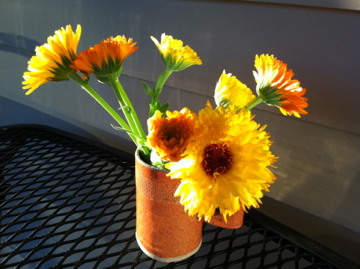
As the Jewish year of 5774 starts, I’m embracing gratitude: for the station function on Rdio which delivers an interesting mix of music familiar and new while I move around the house, processing garden bounty, cooking, kneading challah; for the flock of black birds moving through my corner of the physical landscape, flying in a twirling cloud across the yard and into a tall white pine and back into the grass of the pasture across the street, their wings beating in late afternoon sunlight like a thousand lit pages; for my health and the health of most of those I love, especially the almost miraculous continued presence, if not full health, of a beloved sister; for the reappearance of calendula in my garden, which only happened because a dear friend lost a life partner and she loved, the one who died of cancer, these flowers and we were all given packets of seeds at her memorial service in October, and now they’re blooming in my garden again, to my great delight.  I picked a bouquet today when I got home from services and put it on my new table on the porch.  Bright, hardy and simple, my kind of flower.

So gratitude will be my way of approaching another year, after a year in which all the complications of life and love and what needs to be done resulted in me to going to Rosh Hashanah services alone, for the first time, ever.  I cried through much of the service, but that’s okay.  Any truthful contemplation of forgiveness and repentance, of what has been and what might be, deserves some tears.  It’s a New Year.  5774.

Wedding in Asheville

IMG_1586

We finally fell into bed at 2:oo a.m. Saturday in Asheville, NC for a wedding later in the day.  It had been an exhausting night of travel, and at that moment, the late planes, long car ride, and late late late to bed didn’t feel like it could be worth it.  I hardly knew the parents of the bride (long-time friends of David), had never met the bride or her sister (childhood best friends of Melia) and was struggling to contain all the sad thoughts that a wedding brings up for me at this stage in my life.  How do you mix the joy of young love with the awareness of lost and about-to-be-lost loved ones who will never get to be at the weddings of their children, and a too recent reminder that what seem to be heartfelt wedding promises can be betrayed?

Then I got to the wedding.  The wedding website had said that if it was raining, we’d all just wait on the porch drinking beer until it cleared.  So we did.  This summer has been even wetter in the mountains of North Carolina than it has been in New Hampshire, and thunderstorms and heavy rain showers had been moving through all day.  At 4:00 p.m., the set wedding time, it was pouring, and 200+ guests were standing on the porch of the historic Old Sherrill’s Inn, the Blue Ridge Mountains hiding behind the sheets of rain and the low clouds.  The beer was coming out of the keg with a thick head of foam, and the young man pouring it was telling us to plunge our finger in, to “kill the foam.”  It didn’t.

The first building at Old Sherrill’s Inn went up in the late 17oos, with most of the building construction dating to the first half of the 1800s.  The house is a fascinating maze of antique-packed rooms; the study was the original log cabin, the first dwelling built on the site, and a front parlor has walls of murals painted by the grandmother of the current owner depicting the history of the Inn.  But the best history of the Inn came from talking to the husband of the woman whose family bought the Inn almost 100 years ago.

There was a long enough break in the rain that the wedding ceremony, in a tree-lined bower up through boxwood paths that had me thinking of the “walks in the shubbery” from my recent re-reading of Jane Austen, had been able to proceed and was as sweet and natural as I’d expected, given what I knew of this family.  As we listened to the music and vows and prayers, swallowtail butterflies flew in and out of the leaves far above our heads.   After a huge group photo, guests gathered under the tent and began to eat and drink in earnest as a few early dancers tested the wet dance floor, set up under strings of lights and whatever stars might come out.

I walked down to the porch to get another view of the mountains to the north, hoping to have the porch to myself to sit quietly for a few minutes.  Instead, I met a delightful couple and talked with them about life and art and creative pursuits, just the sort of unexpected conversations that make weddings, with their focus on celebrating love and connection, so remarkable.  That’s when John, one of the owners of Old Sherrill’s Inn, came out on the porch, and told us stories.  And stories and stories.

His wife’s grandparents traveled to the mountains of North Carolina on their honeymoon, having married outside of Chicago.  They arrived at the Inn in 1916, and met the current owner, an 80-year-old man, and his wife, an 18-year-old woman.  The newlyweds expressed an interest in relocating to North Carolina and buying property, and the 18-year-old started crying.  “I’m the loneliest, most miserable young woman in the county,” she said.  “Please buy this farm so I can move into town and have some friends.”

They bought the farm and their descendents live there still.  John didn’t tell us what happened to the 18 year-old wife, but I can imagine.

The clouds had lifted and the ridge of mountains to the north were settling into a deep blue haze.  Stories floated off the porch and into the evening.  The rain came and went a couple more times throughout the evening, but there was plenty of time for dancing under the strung and unstrung stars.

Being Mimi

me and emilio

Friday night I was helping Emilio take off his clothes for his bath, kneeling next to him by the tub.  “Take off your glasses,” he said to me.  “I want to look into your eyes.”  I took off my glasses and he moved his face closer to mine.  “What color do they call your eyes?” he asked and put his face up to mine, looking directly into my eyes.  “Blue,” I said, “Everyone here in the house right now has blue eyes.”  “Oh,” he said, continuing to look at me from an inch away.

This from a toddler, a few months over 2.


Generations of Jewelry

IMG_1244There was a package in the mail on Saturday, with the return address of my Aunt Muriel, and big $2 stamps plastered on the front.  Aunt Muriel is a writer, and for years we’ve exchanged news of our writing when we exchange holiday cards.  She was delighted when The Truth About Death was published, and I cheered for her when she had stories selected in local writing competitions and published in local papers.  It’s been a relationship of letters that I’ve valued, even though I haven’t seen her for 30 years or more.  I didn’t know what to expect in the package, since it’s past the usual holiday card exchange time frame.

Inside I found an ancient looking jewelry box, and a card.  The card read, “I have enjoyed keeping in touch with you and reading and empathizing with your work.  I am getting near the end of my life, and I have been going through and deciding what to do with different things and ‘treasures.’  I came across this piece that was made from Grandma McKinlay’s necklaces and I thought you might like to have it.  I hope having it will please you.”  I opened the box, which had been carefully taped shut, to find a necklace of shell beads.

Delighted with the gift, I brought the box and card to show Alison the next day, when we met to go skiing.  “Just look how old this box is.  What, maybe 50 years old?”

“Wait, I have a box just like that,” Alison said and went upstairs, coming back with a box that, though a big larger, was indeed very like the box Aunt Muriel sent me.  Alison opened the box to a pink and silver pin.

“My Aunt Jean gave me this at the end of her life,” Alison said.  “It’s a pin my mother gave her, and that she thought I’d like to have.”  Alison’s mother died when she was a child, and her Aunt Jean knew it would mean a lot to Alison to have something from her mother.  “There’s even a card,” Alison said, pulling out the small card behind the pin.  “My mother gave this to Aunt Jean for a birthday, and told her it would look good with her black and white dress.”

The fact that Alison and I will most likely never wear the jewelry our elderly aunts gave us doesn’t matter.  We both have “treasures” that we may pass along some day ourselves.