Day 7: Balance

IMG_2021

I cry during yoga.  The first time it happened was the first time I went to a yoga class in my latest attempt to bring a regular practice into my life.  When we settled in for shavasana, the lying pose at the end focused on relaxation, the teacher talked about gratitude for the chance to practice yoga, and being aware of what we could let go as we sunk our backs deeper into the floor, scanning our bodies for any places that still needed to release tension.  I felt a surge of tears rise and then quickly subside.  What was I letting go?

Then it happened again a couple of yoga classes later, and this week it’s happened every time I’ve gone.  Thankfully, that’s been a lot.  I’ve been telling myself I should start practicing yoga for almost a decade, and lately I seem to be doing just that.  I’ve been to yoga three times this week and am enjoying it and looking forward to it so much I’m hoping it’s going to flow right into being a regular part of my life.  Finally.

Today the teacher had us begin in crocodile pose, face down on our mats, our heads resting on our hands.  She wanted us to be able to feel our breath fill our bellies, pushing against the floor.  What I felt were tears rising again.  “We carry stories in our bodies,” the teacher said as we settled into an awareness of our breath.  “If we can make the stories not personal, if we can leave the drama and hurt that might go with the stories behind, we can work on accepting where our bodies are right now.”

Is it finally sitting still with mindfulness that’s letting some sadness rise to the surface for me?  Is it the practice of yoga itself, with its focus on the balance of mind, body and spirit, that’s pulling an unbalanced part of my mind and spirit back into a softer place?

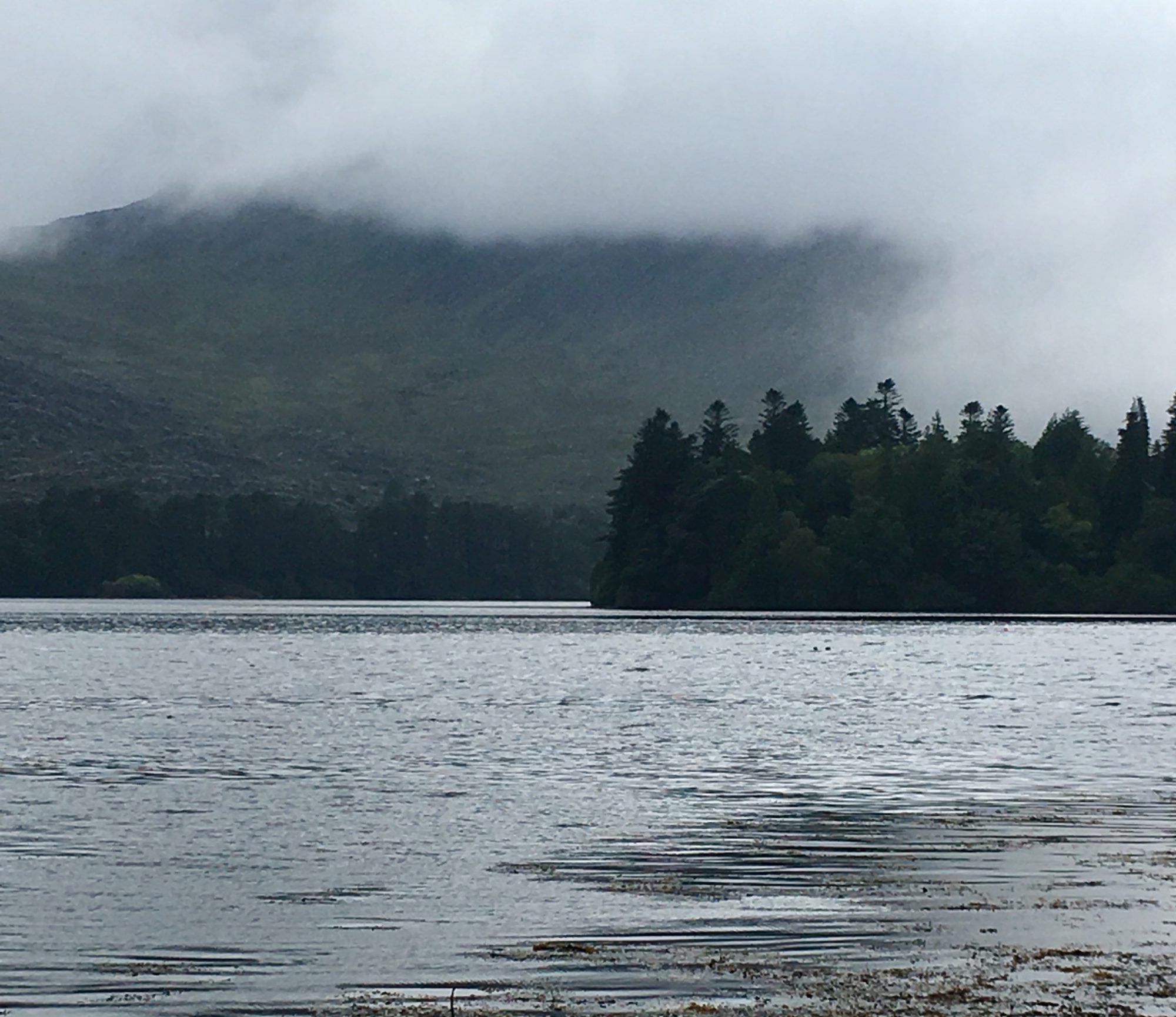
The sun has been riding through the wall of gray storm clouds to the south all morning, sinking into a hint of light then brightening again into a broad halo.  By late afternoon it should be snowing and the world will be all gray and white and black.   Something is sinker deeper in me right now, or something deeply sunk is rising.  Or maybe both, a knot of sadness that’s surfing the stillness I’m cultivating.

 

Celebrate

20131128_182655

David and I didn’t make it above tree line in November, and rather than regret that I’m celebrating all the months this year we did manage to hike and reach a peak or a view, our time in woods and wilderness.

But mostly I’m thinking about what we did in November instead of hiking, because it’s been a month with many reasons for celebration.  We spent a lot of time with family and friends, while finishing house projects in preparation for a big holiday weekend, full of even more family and friends.  On Thanksgiving, all four of our children were together for the first time, and after the big, and very fun, groups of visiting family left on Friday, we had an evening with the six of us and Matt and Emilio.  “First time eva,” as Adrienne posted on Facebook.  “What up now?”

Equally sweet was another big event we’ve been planning in secret — a marriage celebration.  On Thanksgiving night, after lighting the Hanukkah candles, David and I surprised everyone gathered in our living room by finally having a wedding.  We were married 18 months ago and we didn’t tell anyone for almost a year (the reasons for this are too complicated for a blog post), except for Emilio.  We told him two weeks before our appointment with the Rabbi, who married us.  Emilio was four months old at the time and we were pretty sure he could keep our secret.

So we never had a wedding and some of the people closest to us (especially my sister Chris) really wanted us to and we’d always planned to have a public ceremony of commitment, even before we were sure that would be a legal marriage, so we decided, why not here and now?

After a day of feasting and celebrating Thanksgivukkah, David and I spoke our vows to each other, in front of many of those closest to us.  And then we had cake and champagne, bounty on bounty.

David began by saying, We have Chris to thank for encouraging us to create this surprise and celebrate our marriage now.  We wanted all of our family to be here, especially our children and here they are, the first time they have all been together in one place at the same time.   So, rapere ad tempus in gloria.  Seize the glorious moment.  In the best of worlds everyone would be here, all the family and friends we would want as witness.  It’s rarely the best of worlds, always the world as it is, and this is it.  

I followed.  And this is the moment we’ve chosen to declare our commitment to each other publicly.  When we first told our children we were married, almost a year afterwards, Melia told us she wouldn’t consider us really married until we stood in front of people and said vows to each other. Chris has been urging us to celebrate our marriage sooner rather than later, and when we realized today we would have our four children gathered together, and so many of the family we love, we decided to celebrate today.  It’s a day of thanks and awareness of all there is to be grateful for, and David and I are so very grateful for what we have between us every day, it’s seems perfectly fitting to declare out marriage vows to each other today, with all of you as our witnesses.  To have a wedding. 

So we did.

The Metaphor of New Glasses

Photo by Grover Landscape and Design

Getting accustomed to progressive lens glasses, that correct for both up close and distant vision, isn’t easy.  If your eyes have been used to no correction, or just reading glasses, it takes a bit for the eye-brain coordination to come back into sync once you change what you’re looking through.  Which is why I’ve been putting off getting progressive lens for years, making do with reading glasses, even though my mid-distance vision has been deteriorating, and it’s meant taking my reading glasses off and on constantly.  Which has meant spending a good part of every day walking around the house, looking for my glasses.  I lost them for an entire day two weeks ago, finally finding them when they tumbled out of my pajama tee-shirt when I put it back on to go to bed that night.

I made the leap to new glasses last week, and I’m still adjusting.  The young man who helped me pick out frames at the optical shop, and who talked to me about managing the transition, told me, “You really have to look at what you want to see.”  Meaning, in order to bring something into focus through the right part of the lens, you need to point your face right at the object and look.

What a metaphor.  Looking to see.

David and I have been negotiating yet another unexpected left turn in our lives.  We’d been talking about how nice it was to go for months and months without one of those phone calls that turns everything upside down.  Then last weekend, another one of those phone calls came.  Navigating a tough week with new glasses has been both disorienting and good timing.  Disorienting because the world has literally looked different; good timing because I’ve had to pay attention to how I’m looking at things.

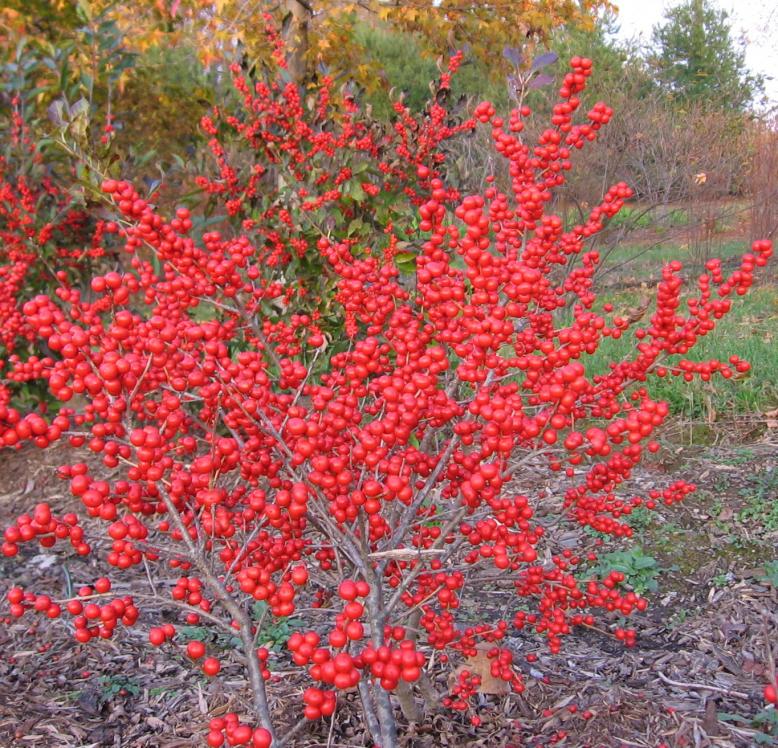
So this morning as I was running I was thinking about how I’ve been looking at things figuratively, reminding myself to remember all that is right in my life.  I was also really looking at the seasonal shifts in the landscape, particularly noticing the winterberry bushes so full of red this time of year, when most of the color in the landscape has dropped away.

I’ve been reading through essays I wrote a few years ago, looking for pieces that seem worth editing.  Paying attention to winterberries, seeing these flashes of brilliance in a dull season, is something I’ve been doing for years.  Two years ago I did a blog post about these red berries, and included a poem that features them from The Truth About Death. And here is what I had to say about noticing winterberries six years ago, again in the context of struggling to stay focused on what endures in life, what continues despite difficulty and loss.

I give up trying to keep track.  So much happens every day, and at first when Eric got sick and died so quickly I felt compelled to write down all that was happening, so he could catch up when he got back.  So I could catch up.  But it got to be much too much. There were all the details of death, the event, the paperwork, the telling people over and over, Eric is dead.  There were red berries on a bush along a river with sun on them, lit inside and out.  The unrelenting urgency of life just wouldn’t go away, all of creation and destruction churning along in its usual pattern, water moving downhill over and over.

Life is as urgent as ever, and if I remember to look directly at it, it comes into focus.

The Metaphor of Underpants

IMG_1933

Do you remember the first day you wore underpants?  I certainly don’t, but I spent yesterday with Emilio and it was his first day in underpants.  He was so excited.  First I helped him change into different pairs numerous times because he wanted to experience them all.  Then he showed all of us that he had underpants on by pulling down his sweat pants and displaying the colored elastic bands.  Next we looked up the Justice League, so he’d know all “the guys” pictured on that set (Superman, Batman, Green Lantern and Flash). As the morning went on there were lots more changes of underpants and pants and socks and shoes because it’s hard to remember, on your first day with underpants, that they don’t work like diapers.  After a while, Emilio was happy to get back into a diaper.  Enough change for one day.  But driving back from visiting a friend, he held a couple of clean underpants in his lap while he fell asleep in his car seat.

On the Subject of Gratitude

IMG_1665

It started with a L’Shanah Tovah greeting from a friend.  “The Year of Gratitude” was the heading of her email.  It resonated.  One way to deal with the inevitable heartaches and troubles of any life, my life anyway, is to be grateful for what is right, what is beautiful, what is comforting and sweet.

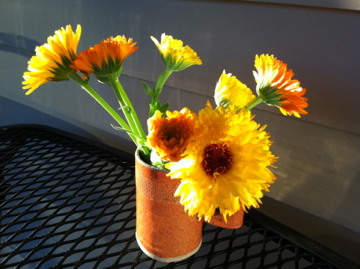
As the Jewish year of 5774 starts, I’m embracing gratitude: for the station function on Rdio which delivers an interesting mix of music familiar and new while I move around the house, processing garden bounty, cooking, kneading challah; for the flock of black birds moving through my corner of the physical landscape, flying in a twirling cloud across the yard and into a tall white pine and back into the grass of the pasture across the street, their wings beating in late afternoon sunlight like a thousand lit pages; for my health and the health of most of those I love, especially the almost miraculous continued presence, if not full health, of a beloved sister; for the reappearance of calendula in my garden, which only happened because a dear friend lost a life partner and she loved, the one who died of cancer, these flowers and we were all given packets of seeds at her memorial service in October, and now they’re blooming in my garden again, to my great delight.  I picked a bouquet today when I got home from services and put it on my new table on the porch.  Bright, hardy and simple, my kind of flower.

So gratitude will be my way of approaching another year, after a year in which all the complications of life and love and what needs to be done resulted in me to going to Rosh Hashanah services alone, for the first time, ever.  I cried through much of the service, but that’s okay.  Any truthful contemplation of forgiveness and repentance, of what has been and what might be, deserves some tears.  It’s a New Year.  5774.

What I’ve Been Up To

IMG_1637

“What have you been up to?” John, the father of the bride at the Asheville wedding asked.  We were sitting on his deck, shaded by tall trees, the wedding and morning-after brunch over, the boxes of flowers and food unloaded, a time to sit and visit for a bit before we left for the airport.

“I’ve been writing, spending time with family, doing some consulting work, training for a tri.”  I hesitated for a moment.   “And managing zucchini.”  John smiled at the zucchini comment.  I smiled because I liked my list.

It’s been a continuous struggle, since I left my job, to spend my time the way I’d imagined I would, or the way I felt I should.  But who makes up the shoulds?  I’d envisioned a life centered around my writing, with a lot of reading, and many breaks for being outdoors, gardening and kayaking and cross-country skiing, with time for traveling and unhurried visits with friends and family.  This summer, it’s finally feeling like that’s exactly what I’m doing. The activities may not be in the proportions I’d imagined, and since there’s no predicting what each day is going to bring, I’ve gotten better at not expecting a certain amount of time or attention for what I think I should be doing, and instead being grateful for the days I’m able to do largely what I want.

Maybe I’m feeling better about how this post-big-career-overwhelming-job-life is shaping up because I have been doing a lot of writing this summer.  I’m making progress on my memoir and I’ve got poems and essays out being considered for publication and at least two dozen poems in on-going revision and one poem that’s in my head as soon as I wake up, as I run or bike or swim, as I’m falling asleep, shifting a word here and there in my mind and eager to get to the page on my computer screen so I can see how it fits.

And yesterday, I cleaned the shoes out of my closet.  I had expected I would do this within a week of leaving my job over two years ago.  Seven pairs of old running shoes, three pairs of boots, black flats, slippers, walking shoes — almost twenty pairs in all, sorted and bagged and dropped off at Goodwill.  Progress.

And on the subject of gratitude, there is bounty to appreciate.  Now I’m managing cucumbers and tomatoes and green beans, as well as the zucchini.

A Tedious Habit of Introspection

IMG_1339

Albany is a city of contrasts.  Historic brick row houses line streets leading downtown, where the castle-like State Capitol building points its red-roofed turrets into the sky next to the stark, flat geometric shapes of the enormous Empire State Plaza.  “Albany is full of concrete,” Sam said to me when I told him David and I were headed there for his 40th medical school reunion.  Actually, it’s marble, not concrete, but the Empire State Plaza is a huge expanse of gray space, rimmed by tall gray buildings, and I could easily see why someone would remember Albany as a city full of concrete.  There’s even a giant gray Egg, a performing arts center that sits on the plaza like a space ship.

The highlight of the weekend was spending time with Harry, David’s good friend, and driving west out of Albany to a small town to find the farmhouse David rented for three of the years he was in medical school.  On the way there, David was talking about some recent issues that had been bothering him, and Harry said, “Your problem is your tedious habit of introspection.”

David and I laughed and nodded in agreement immediately.  Harry meant tedious to David, and in laughing and nodding in agreement, I was acknowledging how tedious my own habit of introspection is to me.  “You intellectuals think and talk too much,” another friend said to me years ago.

Yes, David and I are introspective and we talk about that introspection a lot.  In fact this blog post is going up a day later than I’d planned because we got caught in a long, tedious and deeply introspective cycle of talk yesterday.

But that’s okay.  We’re both old enough to be able to ride along with who we essentially are and make our way to the moments of appreciation and peace that the tedious process of introspection makes possible.

And how does this all relate to Albany other than Harry having made the comment there?  The contrasts in that city between ornate historic buildings and vast modern buildings remind me of what it’s like inside my brain.  Grand and multi-faceted, gray and flat, tall and wide, big in scope and rich in detail, simple and complex, all cycling in a swirl that lets me laugh at my own tedious habits and relish what they make accessible at the same time.

Generations of Jewelry

IMG_1244There was a package in the mail on Saturday, with the return address of my Aunt Muriel, and big $2 stamps plastered on the front.  Aunt Muriel is a writer, and for years we’ve exchanged news of our writing when we exchange holiday cards.  She was delighted when The Truth About Death was published, and I cheered for her when she had stories selected in local writing competitions and published in local papers.  It’s been a relationship of letters that I’ve valued, even though I haven’t seen her for 30 years or more.  I didn’t know what to expect in the package, since it’s past the usual holiday card exchange time frame.

Inside I found an ancient looking jewelry box, and a card.  The card read, “I have enjoyed keeping in touch with you and reading and empathizing with your work.  I am getting near the end of my life, and I have been going through and deciding what to do with different things and ‘treasures.’  I came across this piece that was made from Grandma McKinlay’s necklaces and I thought you might like to have it.  I hope having it will please you.”  I opened the box, which had been carefully taped shut, to find a necklace of shell beads.

Delighted with the gift, I brought the box and card to show Alison the next day, when we met to go skiing.  “Just look how old this box is.  What, maybe 50 years old?”

“Wait, I have a box just like that,” Alison said and went upstairs, coming back with a box that, though a big larger, was indeed very like the box Aunt Muriel sent me.  Alison opened the box to a pink and silver pin.

“My Aunt Jean gave me this at the end of her life,” Alison said.  “It’s a pin my mother gave her, and that she thought I’d like to have.”  Alison’s mother died when she was a child, and her Aunt Jean knew it would mean a lot to Alison to have something from her mother.  “There’s even a card,” Alison said, pulling out the small card behind the pin.  “My mother gave this to Aunt Jean for a birthday, and told her it would look good with her black and white dress.”

The fact that Alison and I will most likely never wear the jewelry our elderly aunts gave us doesn’t matter.  We both have “treasures” that we may pass along some day ourselves.

My Loss Guru

Natalie Schain

After Eric died, his mother Natalie and I grew closer than ever. Our relationship was already a happy story of transformation.  When Eric and I married in 1980, I hadn’t yet converted to Judaism — in fact, that didn’t happen for another 20 years.  Disapproving of Eric’s marriage to a non-Jewish woman, Eric’s Orthodox Jewish parents didn’t come to the wedding.  They’d been unhappy about our relationship for the five years we’d been together — I was divorced (so was Eric), I wasn’t Jewish, I was a feminist who refused to convert to a “patriarchal religion” as I told the Rabbi Eric’s parents arranged for me to meet with prior to the wedding.

For years there was controversy about our attendance at Passover Seders and other family events, and arguments among the aunts and uncles and cousins about how we should be treated.  But over time, and especially as Eric’s parents got to know me better and began experiencing the joy of their first grandchild, Adrienne, their attitude towards Eric and me warmed and softened and then grew close and supportive.  As Adrienne and Sam grew up, visits to Eric’s family were frequent and happy occasions.  When Eric died in 2006, the strong connection between Natalie and me got even stronger.

I would call her several times a week to talk about Eric.  We would relay the dreams we were both having about him, talk about how much we missed him, where we thought he was now, how we could stay connected to him.  Natalie told me stories about Eric as a baby, Eric as a boy, Eric as a teen-ager.  I told her stories about Eric’s jobs and the wonderful sympathy cards I was getting from people who’d known Eric, how much they admired him.

Natalie was devastated and overwhelmed with grief, as I was, but she kept plugging through her daily life, as she had through so much loss.  Her mother died when she was eight, her father when she was a teenager.  She lost her oldest sister in her 50’s and spent close to a decade caring for Eric’s father as he became more and more disabled from MS.  Ray died in 2004, and within 3 years Natalie lost another sister, a brother-in-law, Eric and three of her closest friends.  Then she lost her remaining sister, her sister-in-law, her brother, and many more friends.  When she talked about surviving and moving through grief, she knew what she was talking about.  I called her my Loss Guru.

Now Natalie is gone.  She died early Monday morning, after a year of failing health.  I can’t call her and talk about grief and how to manage the groundlessness of the ever shifting world that includes both joy and pain, loss and gain.  I can’t call her and cheer her up with happy news about her grandchildren and great-grandson.  I can’t call her and listen to her talk about seeing and talking to Eric, because over the past year she’s been in touch with him a lot, a trick I asked her about at one point.  “It’s really interesting that you talk to Eric so much, because he doesn’t exist in this dimension any more.”

“I know,” she said.

“Then how do you talk to him?”

“He calls on a special number,” she said.

Now she’s taken that number with her.

Hospice II and III

II

“How did you get here, Helen?” Natalie asks me.

“I’m not Helen,” I say.  “I’m Grace.  And David is here too.”

“Oh,” Natalie says, nodding, her eyes unfocused.  She’s almost completely blind from macular degeneration.  She has been for years, and now that she’s in Hospice, after a year of disorienting illness and moving around from home to hospital to rehab to home to hospital to rehab, over and over and over, when she has any idea at all who is with her it’s a victory.  “Is this real?” she asks.

“I think it is,” I answer.  “And that’s a really good question,” I say.  “You’ve had so much confusion over the past year, checking in about what’s real and what isn’t makes sense.”

“And we’re happy to help you understand what’s real,” David says, coming over to touch Natalie’s arm.  I’m holding her hand.

III

“Is this a truck visit?” Natalie asks.  We’re back after two days, having been to New York for Emilio’s birthday party.  We’re on our way back to New Hampshire.

“What’s a truck visit?” David asks.  “People who come on a truck?”

“Yes,” Natalie says.

“We didn’t come on a truck,” David says.

“We’ve been to Emilio’s birthday party,” I say and Natalie puffs out her cheeks.  “Are you making cheeks like Emilio’s?” I ask and she nods.

After I’ve helped her drink some water and eat some soup for lunch I ask, “Are you comfortable?  Do you want me to put your bed back down?”  We’ve raised the head of the bed so she can eat and drink.

“That’s two questions,” she says.

“You’re right,” I say.  “Are you comfortable?”

“You can ask me two questions,” she says.

“Okay.  Are you comfortable?  Do you want me to put your bed back down?”  Natalie nods and I press the button and the bed flattens.