
Voice

D-SunMandala-400

Voice, both literal and metaphorical, the sound produced by the vocal organs or the distinctive expression of an artist or the ability to express a choice or opinion, is critical to being heard.  If you have no voice, no one can hear what you’re trying to say, whether it’s because you’re unable to talk, or what you say is silenced and ignored, or you’re afraid to express yourself (perhaps for good reasons).

Since leaving my job at the New Hampshire Coalition Against Domestic and Sexual Violence, I’ve spent a lot of time thinking about voice — my voice in particular.  Working as a leader in the movement to end violence against women, it was a rewarding part of my job, as well as a passionate commitment, to give voice to victims who are voiceless. Whether that was speaking to reporters about the reality and tragedy of intimate partner violence after a woman was murdered by her husband or boyfriend, or testifying to legislators about the need for a statute to better protect victims, or meeting with government officials to urge changes to policies that would better support battered women and their children, I felt the force of all the victims who could not speak for themselves behind what I said.  It was an honor to provide a voice for those who were silenced by shame or poverty or fear, women who had never learned that they mattered, and so what they said mattered.  I made sure I stayed close to direct work with victims, and talked often with victims myself, so my voice could reflect theirs.

Now the voice I’m focused on is my own and what I’m working to express, distinctly, is my singular creativity.  This hasn’t been easy.  Speaking for the disempowered to promote more attention to their needs was easy because it wasn’t personal and it wasn’t for me.  I could use my verbal skills on behalf of someone else.  Transitioning to a life focused on expressing deeply personal experiences and reflections has been a more difficult journey than I expected.

After all, I’ve been writing poetry and short fiction since I was a child.  I’ve published and received fellowships, I studied creative writing in college, I’ve always been part of writing workshops where I regularly share what I’m writing.  I imagined a smooth shift.  But making my personal writing the center of my life has been hard to do in the wake of making the needs and struggles of others the central expression of my voice.  Who cares if I write another poem about the faint rose that first rises in the eastern sky at dawn and then circles around to light the horizon to the west?  What difference does it make in the world if I change a comma in a poem to a semi-colon to add weight to the following clause?

This is circular thinking for me, because it was exactly the need to have a more direct impact in the world that led to my long career at the Coalition.  I started my adult life as a writer, but couldn’t get enough traction with writing as a way to make a difference in the world.  As well as make a living.  Following my passion for social activism into social service jobs and then to the Coalition made sense.  When I left my job over two years ago, it was to give myself — my self — an opportunity to live in the middle of my own focus, to have my voice count.  So the struggle to value time spent on my own creation is nothing new, and wondering how it makes a difference to the world is a same old story for me.

But this week I’ve had an opportunity to change that story.  I’m taking an e-course, Renew Your Creative Voice, being taught by Sarah Whitten, a voice and yoga teacher and the creator of The Mindful Singer. Through breath work, meditation and journal prompts, and conversations on a Facebook page, I’ve been connecting with my creative history, obstacles, champions, goals and energy.  It’s also been a week when I’m figuring out a more natural rhythm to my day that includes intentional and focused time to write. The inner critic and the inner activist seem to be on vacation, because they haven’t been around to question what difference all those edits I’ve made to poems this week make.

The difference?  The poems are sharper.  And I can hear my voice.

Day 4: Create

IMG_1971

The morning comes up pink.  There’s going to be sun today and already the cast of the day has changed.  I anchor myself in what I see, the line of sky against the slopes of the fields to the east, the color behind the bare trees.  

David tells me I should engage my visual talents more.  My drawing has certainly improved over the last year, as I draw cows and horses and penguins for Emilio.  If I look at an object closely, I can draw a reasonable representation of it.  Collage work is completely engaging for me – someone else has already done the representational part of the work, I just need to arrange it in ways that remind me of arranging the language in a poem.  Two years ago, during one of our many visits to the Metropolitan Museum of Art, David and I walked through a small show of collage works, and there were two pieces by Anne Ryan, a writer, painter and printmaker who didn’t begin working in the medium of collage until the age of 58.  Before her death at 64, she created over 400 works.  She was inspired to take up collage work after attending an exhibition of Kurt Schwitters, a German poet and sculptor, as well as collagist.  “Since Anne Ryan was a poet, in Schwitters’s collages ‘she recognized the visual equivalent of her sonnets – discrete images packed together in an extremely compressed space.'”  

Why not me?  Why do I take out my box of cards and books with images I’ve saved for the possibility of collage, my papers and pens and colored pencils, for a day or two at a time, then pack it all up and put it back on the shelf?  I can be inspired too.

Permission to engage in visual expression is all mine.  I can create because I want to create, it doesn’t have to be useful.  My goodness, in what way is poetry useful?  In what way is any creative writing useful?  If I can tie working on something to an ambition to get it published, it might get me to the desk more often to work on it, but my focus, my stepping into the flow, is the same once I’m working on anything creative.  Without any realistic way to be ambitious about visual art, it gets pushed aside even more than writing.  So maybe I’ll start pushing my ambition aside and just create.  Drawing a cow for Emilio is enough because he wants to see the cow.  Moving a collection of images and ideas out of my head on to paper in the form of a collage or drawing, rather than a poem or essay or story, is a world I may let myself start stepping into more often.

Day 2: Two Weeks to the Turn II

IMG_1967

Dark when I wake.  Darkness wrapping the house and yard, blackness a soft touch on my shoulders.  The new clock, all white, with feathers for hands, points from its small circle base, a straight, bright line on the wall: 6:00 a.m.  No light on the horizon yet, the first light the embers in the wood stove that I pump to orange with the bellows.  The kindling pops up in flame, then a log.  I sit in front of the glow and the darkness sits around me. 

Anne P. commented on my blog last night.  The new you.  Comprised of the past, but not consumed by it. Surrounded by happiness, it shines through you.  As the darkness recedes, crests, retreats once more.  Left on the shore with a new wholeness.  Life, surfing the waves.

David and his brother and I drove to the coast on Saturday, old people going for a drive, because David’s brother’s back and hip are too sore to walk much.  That’s life surfing the waves, getting to the pulse of tide however we could.  Little Harbor was brimming, tide as high as I’ve seen it.  Driving north, after a loop around Rye Harbor, we passed a stretch of marsh, grass golden between the pools of hard blue water chopped up by a cold wind, a striking contrast.

Beauty is so often about how one visual bumps up against what is next to it.  “No one travels to see flat land,” someone once said to me and it seems true.  People travel to see mountains and cities.  Or great expanses of water, which are flat but fluid, the contrast between firm ground and a sloshing medium, all movement, wash and warble, come and go, in and out.  A shore where we find ourselves, before, after, now.

When the light comes it’s gray.


A New Look and A Return

New Photo Shot

A number of writer friends have been admonishing me for well over a year to change my photo on this blog.  Yes, it was an okay photo for my book, because after all The Truth About Death is just that and why wouldn’t I look grim on the back cover?  But this blog is about all of life, not just the sad passages, and surely I could find a better photo of who I am as a whole self.  One friend snapped some shots of me with her mini iPad the last time our writing group was gathered, figuring anything was better than what I had.

So I took that as motivation to get some real head shots done.  Which turned out to be easy when shortly after the iPad photo session I met a colleague of Adrienne’s, a talented photographer who was happy to snap a bunch of shots when I met her.  So thank you, Michelle Frantino, for the new look.

I’ve been admonishing myself about updating the overall look of the blog.  I’ve recently been redecorating my house, taking down paintings and prints and photographs I hung decades ago and putting up new pieces of art.  I’ve replaced light fixtures, rearranged furniture, and greatly reduced the cluttery stuff that accumulates on counters and sills and shelves like the dust all those tchotchkes collect.  My blog needs the same kind of attention, a bit of which I’ve started.  (Like the house redecorating, this is a process, not a once-and-done task.)

But one thing I’m repeating.  I’ve already written about my project last year of writing 300 – 400 words every day for the two weeks leading up to the winter solstice.  I’m doing it again, Two Weeks to the Turn II.  This year I’m going to put up at least some of each day’s writing on this blog, every day.  In the midst of the gathering darkness, and the frenzy of celebrating designed to push back against that very darkness, I’m going to find at least some time every day to focus on writing and try to find something worthwhile to share.  Here is a tiny bit from today, and it’s not even original.  It’s what one of my writer friends suggested was my real topic when I read a selection from last year’s Two Weeks to the Turn at our last group meeting.

The question is, how do David and I make happiness in the face of all the loss and heartache that brought us together?

I’ll be working on some answers.

What Counts

wabi_logo

Several months ago I read a column in Poets & Writers magazine about the bounds of realistic ambition for a writer, or more specifically, for a poet.  The writer of the column made a point I make a lot — how many people have ever heard of those we poets consider famous?  Almost no one.  This was made very real for me recently when Sharon Olds, a neighbor of sorts, won the Pulitzer Prize, after winning the T. S. Eliot prize a few months before, and the local daily paper made a big deal about it, as they should.  But a friend who is deeply involved in and interested in the arts had never heard of her.  Really?  Yes, really.

As a poet I’m used to a small audience, both at poetry readings, and in terms of readers. Even widely published and celebrated poets have a very small audience in our current culture.  If you touch one person with a poem, the column author I read several months ago asserted, count that as a real success.

I’ve been back out in the world with The Truth About Death, giving readings, one of which was in far northern Vermont, at the Galaxy Bookshop in Hardwick, Vermont, The Town That Food Saved.  (It’s a very groovy little town, at the epicenter of Vermont’s grow local, eat local food movement.)  The local weekly paper had requested a review copy of the book, so I sent one off.  I was delighted by the review one of the staff wrote.  “Most people would not be excited to pick up this book,” the writer begins.  “Such a depressing subject, what can she say?  But this book is so well crafted, the poems so tight and intimate, that it is exciting to read.”  Not only did the reviewer praise the book, she got it.  “Some of the poems are elegies to lost love, but many are fierce as the author courageously faces a new reality, a world without a part of her soul.”  

As happy as this review made me, I was even happier when the editor of the Hardwick Gazette came to the reading and immediately approached me.  I thanked him for printing the review.  “I read the book too,” he said.  “I lost my wife two years ago, and your book really spoke to me.  I’m buying one for a friend who lost her husband last year.”  After the reading a woman bought a copy to donate to the local hospice program.

Yesterday I did another reading and again sold a few books, one to a woman who is giving it to her friend whose son died several years ago.  Two readings in two weeks, a total of 20 people at the readings and 10 books sold.  Not very big numbers.  But in those numbers is one man who was truly touched by the book, and hopefully at least a couple others who’ll see something of their own grief journey in mine, and realize that there is a way to navigate that difficult path.  That’s what counts.

What I’ve Been Up To

IMG_1637

“What have you been up to?” John, the father of the bride at the Asheville wedding asked.  We were sitting on his deck, shaded by tall trees, the wedding and morning-after brunch over, the boxes of flowers and food unloaded, a time to sit and visit for a bit before we left for the airport.

“I’ve been writing, spending time with family, doing some consulting work, training for a tri.”  I hesitated for a moment.   “And managing zucchini.”  John smiled at the zucchini comment.  I smiled because I liked my list.

It’s been a continuous struggle, since I left my job, to spend my time the way I’d imagined I would, or the way I felt I should.  But who makes up the shoulds?  I’d envisioned a life centered around my writing, with a lot of reading, and many breaks for being outdoors, gardening and kayaking and cross-country skiing, with time for traveling and unhurried visits with friends and family.  This summer, it’s finally feeling like that’s exactly what I’m doing. The activities may not be in the proportions I’d imagined, and since there’s no predicting what each day is going to bring, I’ve gotten better at not expecting a certain amount of time or attention for what I think I should be doing, and instead being grateful for the days I’m able to do largely what I want.

Maybe I’m feeling better about how this post-big-career-overwhelming-job-life is shaping up because I have been doing a lot of writing this summer.  I’m making progress on my memoir and I’ve got poems and essays out being considered for publication and at least two dozen poems in on-going revision and one poem that’s in my head as soon as I wake up, as I run or bike or swim, as I’m falling asleep, shifting a word here and there in my mind and eager to get to the page on my computer screen so I can see how it fits.

And yesterday, I cleaned the shoes out of my closet.  I had expected I would do this within a week of leaving my job over two years ago.  Seven pairs of old running shoes, three pairs of boots, black flats, slippers, walking shoes — almost twenty pairs in all, sorted and bagged and dropped off at Goodwill.  Progress.

And on the subject of gratitude, there is bounty to appreciate.  Now I’m managing cucumbers and tomatoes and green beans, as well as the zucchini.

Monhegan Island Retreat

IMG_1545

David and I are working hard.  He’s in a week-long plein air painting class, I’m intent on completing a first draft of my island journal, a memoir I started five years ago, meant to be written only on islands.  David’s gone from 9:00 until after 5:00 every day, and comes back to the cottage we’re renting with a painting or two, depleted from a day of concentrating on capturing the clouds or the ocean or a grove of trees in paint on canvas. I’m writing and walking the many miles of trails through woods and along ocean cliffs, and reading journals from years before, sinking back into the world I was inhabiting five years ago when I wrote the first of this book I’m trying to finish.

It was a difficult time in our lives, rich with new love and terrifying with the approach of another untimely death from fast-moving cancer.  Adrienne was getting married, and our family was managing the reality that Eric wasn’t going to be at her wedding, a wedding he and I had been planning in our fantasies for her for years.  I was trying to sort out how or if to respond to the best friend I’d lost in the previous year who was reaching out and trying to reconnect, in spite of the boundary violations that had led to us breaking up (and yes, you can break up with a best friend, it doesn’t have to be a lover) never having been resolved or completely understood by either of us.

Going back to that summer, to write about it, hasn’t been easy.

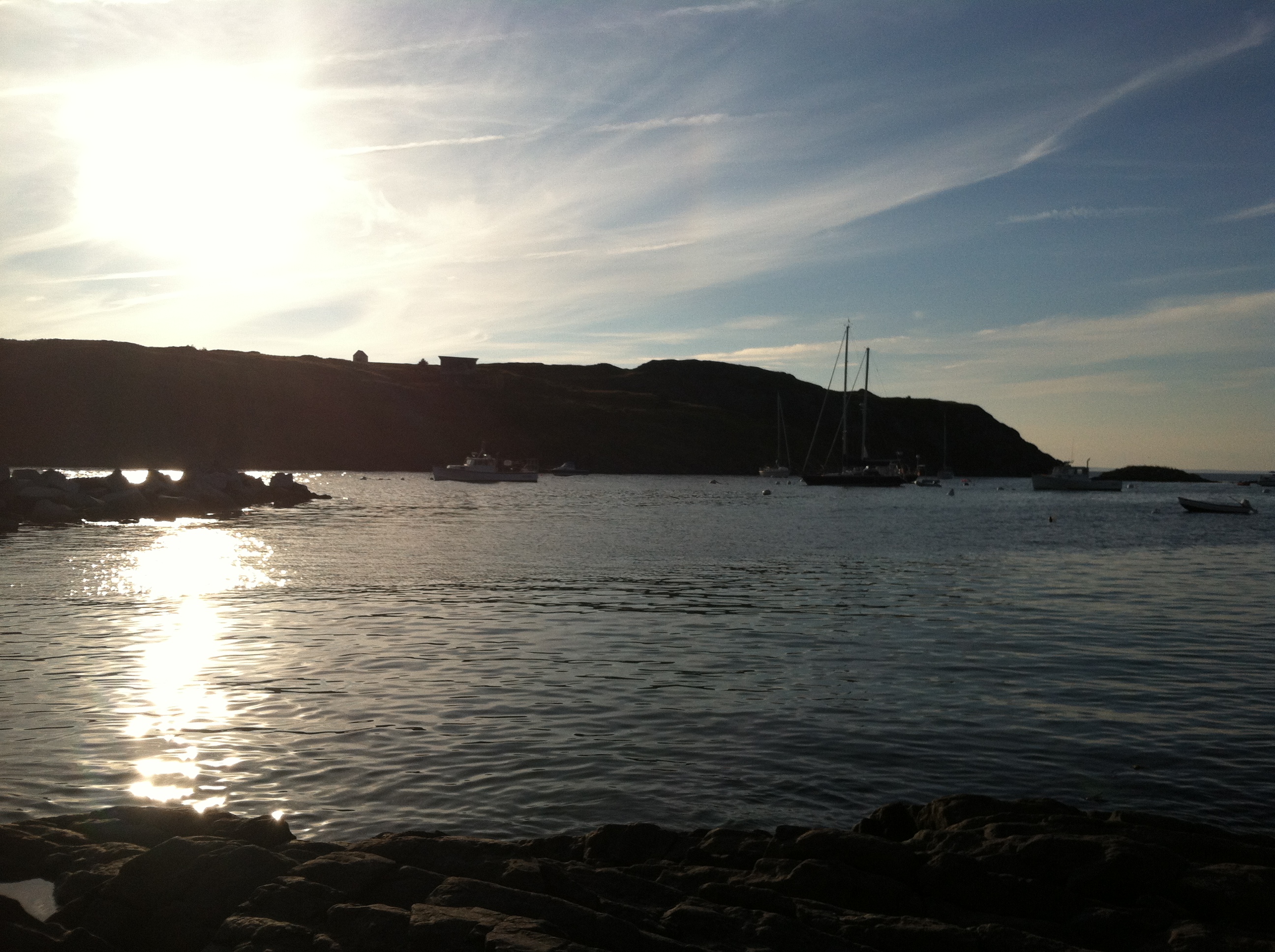
We met the painting group for a lobster dinner at the Fish House last night, a shack on Fish Beach that serves seafood across a wooden counter, with seating at sand-planted picnic tables overlooking the harbor.  Which is a pocket of water created by the rise of Manana Island, a small but tall hump of land off the western side of Monhegan.  Our first night here the harbor was full of fog.

IMG_1533

Last night it was clear.

IMG_1564

As the group talked about painting and writing and creative retreats, I was asked what my book is about.  “Love and death,” I said.  Five years ago when I was first working on the book Sam asked me what it was about.  “Death,” I said then and he said, “Well, that’s a new subject for you, Mom.”

At least now love is in the equation.

After dinner we walked back to our cottage, watching the contrails of all the jets (red-eyes to Europe we decided, coming out of New York and Boston and headed up over Greenland on their way to London or Paris or Amsterdam) bleed off into feathered lines of cloud.  The sun was reaching the water horizon, on the north side of Manana, and as we approached the Monhegan School House David mentioned that people had been talking about the good sunset views from behind it.  There was already a knot of people there watching.  One woman had binoculars, and after the sun was gone and we were all watching the after glow shift its pinks around the sky, she spotted a minke whale surfacing, out beyond a ledge of rocks.  Every few minutes we could see a bit of black break the surface of the water, then disappear again.

IMG_1568

Above Tree Line: July

IMG_1516

I’ve been a negligent blogger, for more reasons than could possibly be interesting or appropriate to describe, though one of those reasons is my near total absorption in Jane Austen’s complex prose and fascinating character development, thus the current partiality for complex prose myself, the willingness to go on and on like the ever-talkative Miss Bates, into as many subjects as can tolerably be imagined, and still hold onto the thread, as far stretched as it might get, and as many metaphors as might comfortably fit (not to mention commas), in a sentence; and for an excellent, modern example of deft and impressive sentence structure read Claire Messud‘s The Emperor’s Children.  And while you’re at it, read her new The Woman Upstairs, because it is a majorly brilliant book.

Over a week ago we fulfilled our July intention of getting above tree line.  David, Anne and I summited Mt. Eisenhower on a day of intermittent sun and clouds.  The wind was strong and cool enough to require our jackets, which was a great change and a greater relief after a too-hot week.  The Pemigewasset Wilderness ranges to our south folded away in blue layers, and we looked out over the long ridge formed by Mt. Bond and Bondcliff, imaging the 19.5 mile traverse we’re planning to do in August.  It’s not an easy hike, with over 3,700 feet of elevation besides the long mileage.  But it allows you to walk into and out of the wilderness, literally.

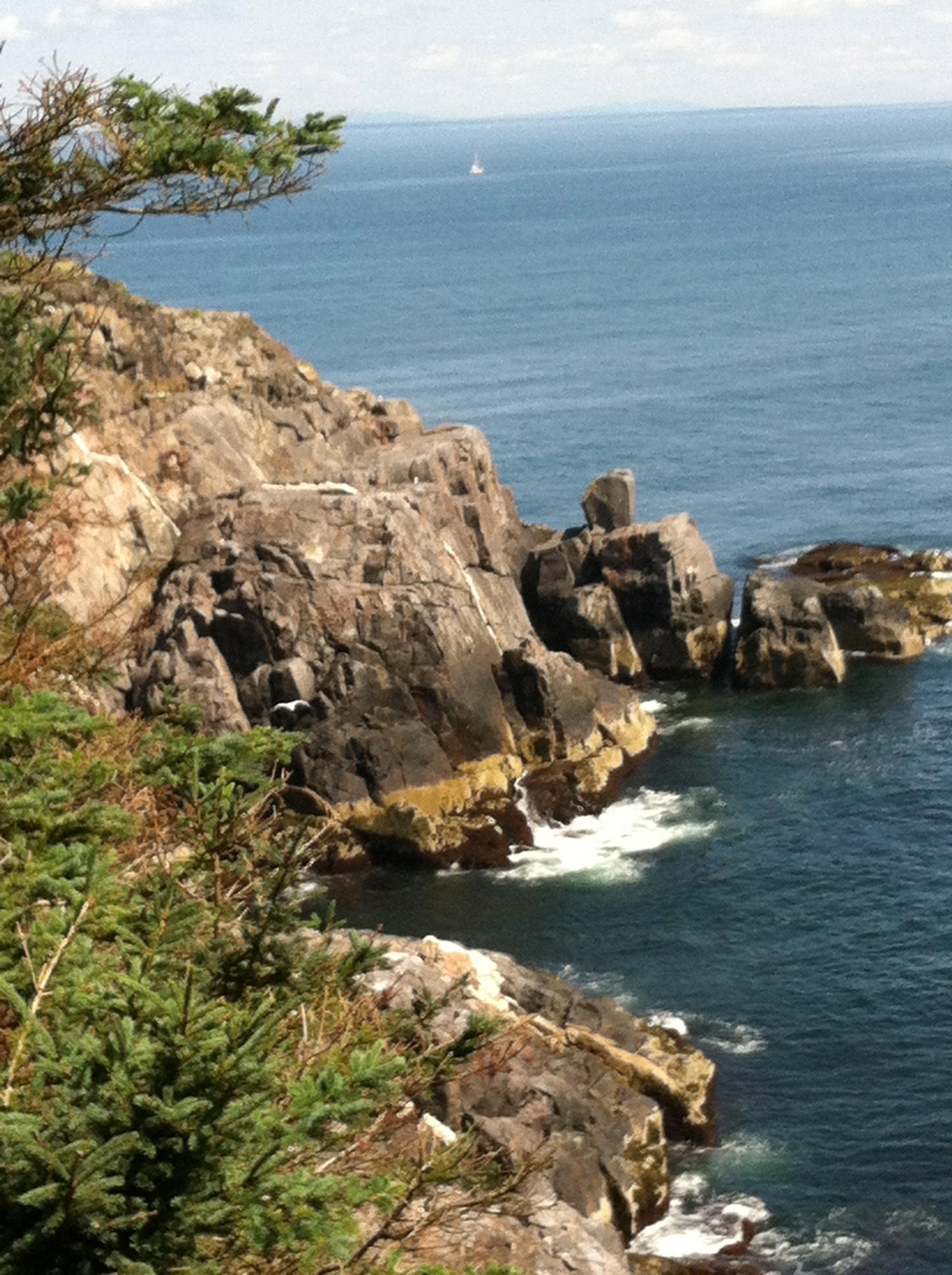
This week my training for both that long hike and an upcoming triathlon will be confined to an island, less than 2 miles long and 3/4 mile wide and 12 miles off the coast of Maine — Monhegan.  David and I walked a few of the supposed 17 (or 12, depends on which source you read) miles of trail yesterday evening, out to Burnt Head and White Head, steep cliffs overlooking the Atlantic.  He’s here to paint.  I’m writing.  Including my blog. More soon.

Retreat

IMG_1401

I’ve been on retreat, “an act of moving back or withdrawing,” or “a place of privacy or safety.” Retreating, or creating an actual retreat in the midst of every day life, is a powerful way to get creative priorities back in line. Or back to the beginning of the line.

When I left the Coalition almost two years ago, I’d imagined a life with writing as the organizing force, the central focus of what I had to do.  Everything else would fit in around it.  That has been so totally not true.  Valuing writing, valuing spending time  expressing my creative impulses whether or not that expression ever leads to publication, or praise, or whatever it is that might make it somehow count, is still unexpectedly difficult.

But at least I’m spending more time with other writers who all struggle to some extent with the difficulty of getting to the desk and getting words on paper.  I have lots of sympathy for my constant battle to push back the dailiness which can easily fill a life — grocery shopping, cooking, gardening, hanging photos and paintings up in the kitchen and hallway we had painted a year ago, visiting friends and family, training for the next tri, answering email, cleaning the old running shoes out of the bottom of my closet, a task I’d thought would be done within a week of leaving my job — and put my writing first.  “Writing is my job,” a novelist I met last summer told me.  “It comes first, every day, then I get to the other things that need attention.”  Good for her, but how do I do that?

Last week a group of my writer friends and I went on a writing retreat.  One of the women has a sister with a second home in Manchester, Vermont, who was happy to have us use it as a writing base.  After an afternoon and morning of more concentration on writing than I thought I could possibly muster, I said to one of my friends, “This is such a good reminder that going away to write, making space for that, getting to a place where all I have to do is write, really makes a difference for me.”  “It makes a difference for all of us,” she said.  “That’s why so many writers do it.”

Of course.  I keep thinking there isn’t any reason I can’t just sit down at my desk for four hours, or three hours, or five hours, or even 15 minutes, every single day.  But really, there are literally hundreds of reasons to keep me from doing that, every single day.

Sitting in a screened gazebo on a deck overlooking pastures sweeping down to the Battenkill River and up the Equinox Mt. ridge, I spent hours and hours last week, working on poetry.  I woke early the first morning we were there, after an afternoon of writing, and had to get out of bed and get to work.  I couldn’t wait to get to my poems.

Now I’ve been home a week and I’ve still been writing at least a bit every day, some days quite a lot.  Retreating at home is harder, but not impossible.  And one thing I fit in this week was making plans for the next actual retreat.

Two Weeks to the Turn

IMG_1055There are many reasons I love The Sun magazine.  One is that they published four of the poems from my then-manuscript of The Truth About Death in the December 2008 issue.  And they paid me well for those poems.  Not only do they not include any advertisements in their magazine, they actually pay writers and photographers, as in real cash, not two copies of the issue (which is what most literary journals do).  The writing is fresh, strong, real and not afraid to tackle tough subjects.  One of my poems that they published is titled, “Death.”  Every issue includes poems, fiction, creative nonfiction, and always an interview that is provocative, timely and gets me thinking in a least a few new directions.

Part of the payment for those poems in 2008 was a free subscription for a year.  I had been a regular reader of The Sun decades ago, but that free subscription got the magazine back in my mailbox, back in my house, back on my bedside table.  I haven’t let my subscription lapse since, have bought gift subscriptions for others, and make a donation to the magazine every year also.  If you haven’t checked it out, I highly recommend it.

A recent issue included “Ten Days in November” by Eric Anderson, from a project sponsored by chapbookpublisher.com, which invited 30 writers to write 300-400 words each day for the 30 days of November, 2010, and then produced hand-bound books, one for each day by each author.  That’s 900 books.

I don’t do well with diminishing light, and I do well with assignments.  Looking for a catchy way to get myself to write every day, and any way to distract myself from the encroaching darkness of these December days, last weekend I decided to write 300-400 words each day until the winter solstice.  When I looked at my calendar I realized that the solstice was exactly two weeks away.

So far I’ve kept at it, and even named it:  “Two Weeks to the Turn.”  Without a predetermined focus for this chunk of prose I’m creating, I’m not reviewing the previous day’s writing when I sit down each day.  Whatever has bubbled up enough to get me to the desk is what I write.  I don’t know what will turn up, but I’m willing to find out.  Maybe some of it will turn up here.