Another Story

IMG_3537

A flock of robins has been flapping around my yard this week, lifting off from the maple outside my study window to fly to the garden and pick at shriveled globs that used to be apples, still hanging from bare branches.  They’re also eating the berries on the barberry bushes, leaving bright red splotches of bird droppings in the snow under the maple tree. Puffed up against the frigid temperatures and wild wind, as if making their feathers into bulky coats, their orange breasts are a welcome touch of color in the monochrome landscape of bare trees, white pines harboring darkness under their boughs and snow.

Anyone who lives in the southeastern part of New Hampshire knows that snow and snow and then more snow has been our story for the last couple of weeks.  I went to a Martin Luther King Day Commerative at the University of New Hampshire last week, to hear Natasha Trethewey deliver the Commerative Presentation, which turned out to be her talking about how she came to write her poems, a selection of which she then read. Stunning.  And encouraging to realize a woman of color could be so highly celebrated, even appointed U.S. Poet Laureate, for writing direct and accessible poems about our country’s history of racism and power imbalances.

So what does that have to do with robins and snow?  One of the speakers before Trethewey said that courage has been called the willingness to tell your story wholeheartedly.  That got me thinking about stories, in particular my story, or stories, as I think about the next steps in my writing projects — getting back to my novel to get it in shape for readers, and then reengaging with my memoir.  I was at a meeting a couple of weeks ago and we were discussing someone who had mentioned she was writing a memoir.

“She’s writing a memoir?” a woman at the meeting said.  “As if her life is that interesting.”

“I’m writing a memor,” I said and the woman replied with something about my life being interesting enough to write about.  She was covering herself, because she hardly knows me and has no idea what my story is, or what part of my story I’m putting in the memoir.

And it also made me think about this blog and the blogs I follow.  They tell stories, some large, some tiny, the most successful translating some part of a life into a narrative interesting enough that others want to read it.

So what is today’s story, or the story of the last couple of weeks when I haven’t managed to post anything on my blog?  I’ve been busy being Mimi to another new baby.


IMG_3522

I’ve been working on both volunteer and consulting projects that always seem to chew up more time than they should.  I’ve not been writing much (as evidenced by the lack of blog posts) but I did go to a party with bigger-than-life-size super hero balloons and spent time batting Spider Man up in to the air to float above me.  That was a first.


IMG_3488

I’ve been skiing every day I can and shoveling snow every day I have to, which has been most days.

IMG_3532

I’ve been watching the robins try to make it through this very wintry weather and anthropromorphisizing their regret at not having migrated this year.  Does this make a story?  It’s made for a very full couple of weeks anyway.


Questions


IMG_2820

WOM-PO, a women’s poetry list serve, has had a round of posts in the past week lauding a poem by Alicia Ostriker recently published in Plumean online poetry journal.  “Q&A,” the poem, has touched many women on the list serve, setting off numerous exclamations of “Brava!” and appreciation for the poem’s content, format and effect.

Why are we drawn to questions?  What is the role of literature, of poetry specifically, in asking questions and answering questions we don’t even know we have?  As William Carlos Williams wrote, “It is difficult/to get the news from poems/yet men die miserably every day/for lack/of what is found there.”

The truth telling of poetry is the truth telling of breath, how language and thought move through us to create meaning and carry it into the rhythm of our bodies.  Poetry is a distillation of experience into a music that hums under the surface of conscious awareness. A well written poem reaches past what we know about the words collected on the page and tugs at a deeper understanding than what our logical mind constructs from those words, until we understand that we feel something deeper, even if we can’t exactly name what it is.

All of which reminds me of a poem I wrote years ago about exactly this, after asking myself a simple question.

Hope

What would be enough? Sometimes
it’s simply getting through
this hour and the next. Sometimes
it’s the hours dropping away, the day
a river of light, the passage
of sun moving shadows across snow.
More rare, the swelling of enough,
like a pool filling at the unreachable
core I can feel but not locate,
that comes sudden and sweet – the thin
chip of a cardinal on a winter
morning, the sun rising north
of the white pine, again, the last
clothespin clipped to the sheet’s corner
as the hemmed end charges a clear sky.

Cooked

Gratuitous Mimi Love Photo of Ava Having Little To Do With the Blog Post

“You need to find a sucker who’ll cook for you,” Isabella said.  There was the usual assortment of painters and sculptors and mixed media artists and writers sitting around a long wooden table in the dining hall of Vermont Studio Center, and we were all wondering how we were going to manage returning to our every day lives after almost four weeks of a residency, and specifically, how were we going to manage making meals again?  All we had to do to get fed at VSC was show up at meal time, fill our plates, and bus them when we were done.  We were all doing a residency in order to focus on our creative expressions without the distractions and chores of every day life.  That’s what residencies are for.

“I’m the sucker in my house,” I said.  “I do the cooking.”

Isabella didn’t really mean that someone who cooks is a sucker, what she meant is how much time attending to the daily tasks of life can suck out of a creative focus. How could we recreate the freedom from every day tasks once we got home and continue to concentrate on our creative goals for what felt like almost unlimited hours every day?

We couldn’t, and in powerful ways, that’s okay.  In the spirit of the Zen saying, “Chop the wood, carry the water,” there’s a balance that attention and absorption in every day tasks brings to life.  If I had unlimited time for creative expression every day I’d undoubtedly freak out, as I did for close to the first week at Vermont Studio Center last March.  Not that the residency wasn’t fantastic and that I didn’t get a lot done, because it was and I did.  But that kind of unlimited time for creation, ungrounded in the details of life, wouldn’t work for me forever.  My creativity needs to sit in the center of a life attentive to dailiness if it’s going to be connected to life in a grander sense.  Yes, there’s an ongoing need to value my writing and make space and time for it, to believe it matters, but there’s also a need to take care of daily chores and believe that matters too.

Which is exactly what Michael Pollan talks about in his book Cooked.  Cooking matters. Preparing our own food, from real ingredients we’ve grown or chosen ourselves, connects us to our bodies and our place in the world.  We nourish ourselves and those we feed in ways that go beyond the nutritional elements of the food we prepare.  If we can chop an onion with presence and attention and allow ourselves to value and be patient with the entire process of creating a meal, we can then bring that nourishment, attention and patience to the task of writing a novel (though right now it’s editing a novel I’m trying to get a handle on) or painting a picture or playing the guitar or spinning clay into a bowl.

David read Cooked also and is now joining me in the kitchen more, chopping onions and frying eggs and stirring the pot of chili.  Are we both suckers?  No, we’re feeding ourselves.

Winter?

IMG_3464

The birches and hardwood saplings are bowed again, weighted by another load of ice that slim trees can’t hold up.  Along Canterbury Road, the route we walk most and often our way into the woods, there were trees still hanging over the gravel a week after the heavy wet storm in November and many of them finally broke, young trunks snapped to expose white wood. There is debris all over the old roads we walk in the woods and we’re using the broken branches of maple and lilac we picked up in the yard as kindling. The world falling apart in sticks.

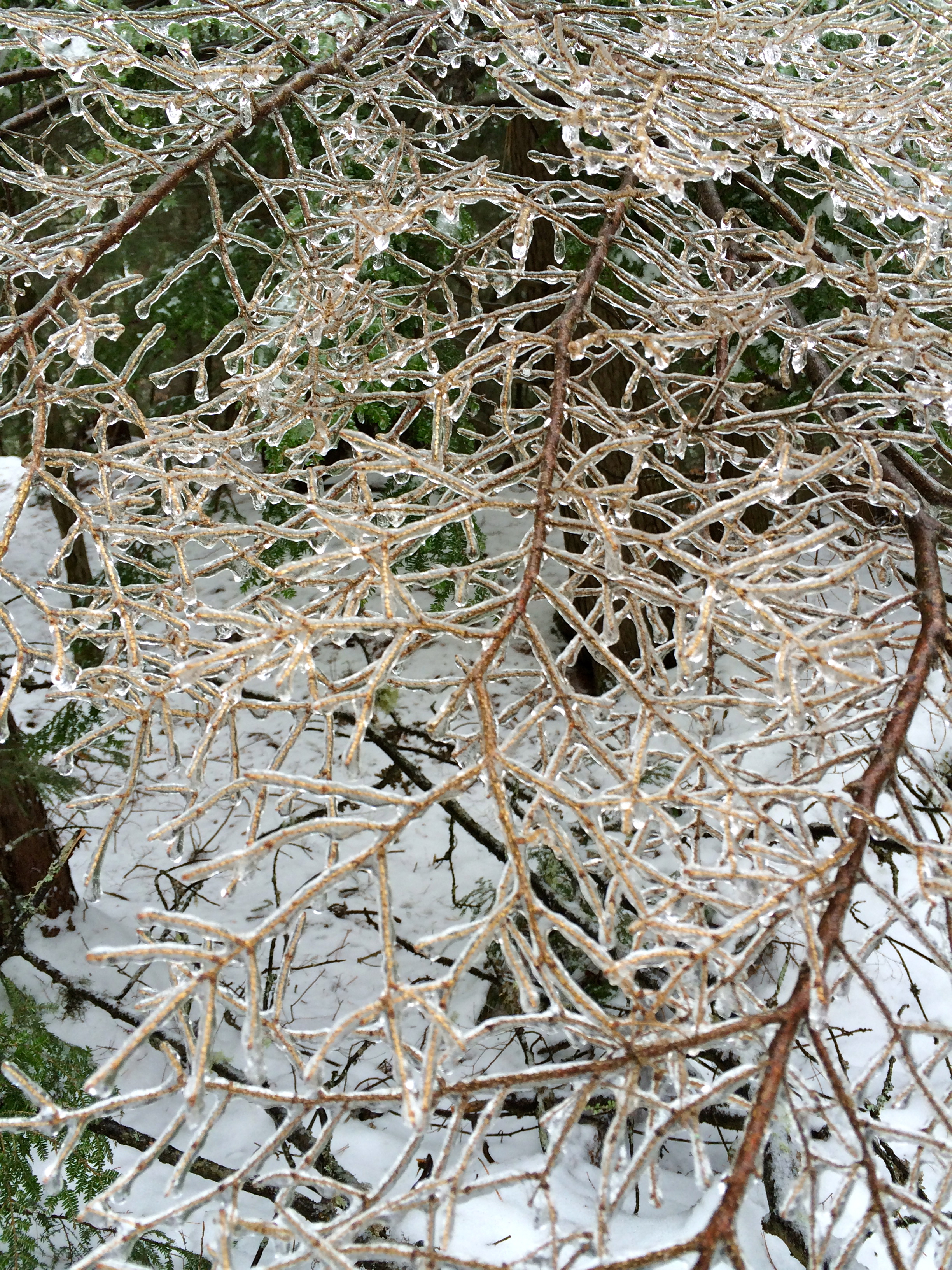
IMG_3447Today it’s ice-bowing time even more so.  The snow last night, overlaid with sleet then freezing rain then rain coated the world with up to a quarter inch of ice and now the birches aren’t just bowed over the road, they’re blocking it.  Our neighbors that live further down Canterbury Road have created a woven path to drive around the ice-laden crowns of the trees now bent all the way to the road.

I’ve just finished reading Flight Behavior by Barbara Kingsolver, a book I wouldn’t have read except it’s for my book club, and isn’t that what book clubs are for, to cause you to read books you otherwise might not?  Aside from The Poisonwood Bible, a novel I remember as exceptionally good, I’ve never cared for Kingsolver’s heavy messaging in her novels, how her stories and characters serve a larger statement about some sorry state of the world rather than trusting that describing the trajectory of one life will resonant for others who’ve been on wholly different paths.

IMG_3457And Flight Behavior is no different.  The story of Dellarobia, accidentally named after a cheesy crafting product when the name could have come from an Italian sculptor or scripture, which says plenty about the hardscrabble circumstances of Dellarobia’s life that land her dissatisfied to the point of desperation until she finds a mountainside of monarch butterflies displaced from their usual Mexico winter habitat due to weather shifts caused by global warming.  As heavy as the story could have come off, it works as a novel.  Yes, the warnings about climate change are a bit much, and Kingsolver lays on the symbolism pretty heavily, but I recognized Dellarobia as an interesting person I wouldn’t otherwise know, so I stayed with her story and was not dissatisfied with how it was handled.

IMG_3462On this miserable day of icy snow, which ruined the ponds and lakes for skating (my skating friends and I have been on a pond, the lakes would have been perfect in another day) and doesn’t leave nearly enough snow for skiing, it’s easy to feel the hard reality of climate change.  There seem to be fewer and fewer good years for skating and skiing. Didn’t we used to reliably skate by Thanksgiving, the lakes freezing before the heavy mid-winter snows came?  Snow that when it came always seemed ripe for skiing?

I don’t think I have it wrong.  Something definitely has changed.  That doesn’t keep the ice-encased world from being beautiful, and so today it was a walk, weaving under small trees bent over every road we walked, looking at buds encased in ice, inching our eyes up trunks to  where a tree had broken, immersed in the new world, which is the world every day.

IMG_3460

Happy Birthday, Jesus!

photo (3)

Was I supposed to get Jesus a gift for Christmas?  Because it’s his birthday?

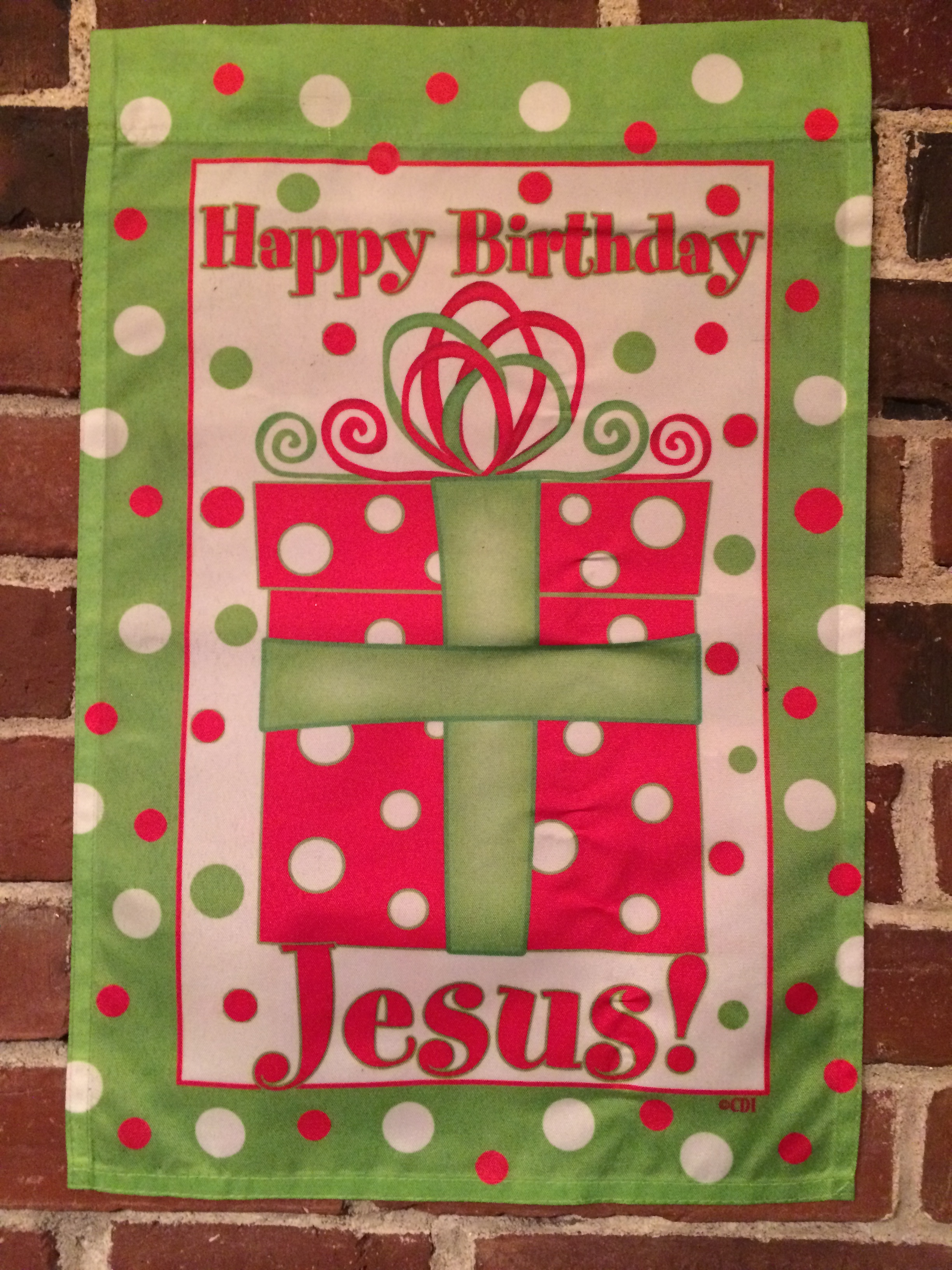
As I pulled up to our mail box last night, returning home from family holiday celebrations in Massachusetts, the headlights caught something with the ubiquitous late December red and green wrapped around the base of the pole.  Positioning the car so I could snag whatever was coloring the ground underneath the mailbox, I pulled up a bright piece of cloth, printed with a birthday salutation to Jesus and a fancy gift box.  

Where did this small flag come from?  My house is in a very windy place, sitting on the eastern edge of acres of open pasture and hay fields, so it’s not unusual to find something in my yard that started out west of here.  But this was a find of a whole different kind.

Looks like Jesus had a good year this holiday season based on the gift depicted on the flag, though I have no idea what’s in the box.  But it’s nicely wrapped and ribboned and could pass for either a holiday or birthday gift.  It guess it needs to be both.

I don’t think it’s just that I’m Jewish that made me miss getting Jesus a gift.  Did you get him one?

Money

photo (2)

In this season of advertised merriment with its vision of happy times supported by a hefty bout of shopping, posting the last of the four poems in my list of universal experiences that hold too much silence — sex, death, drugs, money — seems very appropriate.

Here I’m recounting the responses to what counts as wealth in the larger world and my own reckoning of true wealth, having experienced a deep and encompassing love.

On this gray morning polished by slow snow, as we travel towards the turn of the sun, the winter solstice only hours away, may you find your own sources of wealth to celebrate.

Money

I sit on the window ledge of the restaurant
and talk to the woman beside me, her head
wrapped in a bandana, she lives on the streets,
she had a brain aneurysm, her family is lost
along the west coast, no chemicals,
it keeps her safe, she didn’t repeat herself
for a long time. Two men in a row tell me
it’s not my luck but my heart that makes me
put large bills in their cups, the blessing
I carry with me. You ate pears whole,
ignoring the core, to you all fruit.

Drugs


Image by David Coursin

I take drugs. The fact that I have an anxiety disorder that is greatly helped by the right doses of medication is a cause for celebration for me, not shame.  Celebration that there are drugs that help, not that I have an anxiety disorder.  That’s been a hard thing to live with, going back to when I was a very young child.

The first episode of intense anxiety that I remember happened when I was five and a kindergarten classmate died of a heart condition.  His obvious frailty and my robust health meant nothing to my five year old brain that was busy imagining all the ways I might die, especially while I was asleep, making sleep terrifying rather than a refuge.  In third grade a class mate died of leukemia.  In high school a student in the next town died of spinal meningitis.  Life was dangerous — it ended in death.

But I didn’t need a death close by to feed by anxiety. I made up many of my fears by myself.  When I was a pre-teen it was brain tumor that was going to kill me.  One day an aunt asked me why I was always feeling my scalp and I told her I was checking to see if the lumps on my head were getting any bigger because I was afraid they were tumors.  She laughed, kindly, and told me I wouldn’t be able to feel tumors from the outside and I just had a lumpy head.  For some reason, that didn’t translate into a fear that tumors I couldn’t feel were growing in my brain, probably because that particular bout of anxiety was waning.

My acute phases of anxiety weren’t constant and usually lasted several months and then got better.  When I went through a particularly bad bout at 30, I thought back to other bad patches and realized the anxiety had peaked in six to seven year cycles since that first episode at five.  It was also when I was 30 that a doctor finally named for me what was going on and suggested medication.  I tried medication eagerly and have never regretted it.

I know there is still stigma about taking medication for mental health problems and I’m a bit of a zealot about trying to convince people to get over it.  In my professional life I watched many colleagues suffer through depressions and anxiety issues, refusing to try medication because they thought they should be able to take care of their moods and distress themselves.  Yes, I would tell them, you can take care of it, by seeing if you might be helped by medication.

It’s not always easy to find the right medication, and you have to find the right medical practitioner to work with you until you find the one or the combinations that work for you.  I feel lucky that my route to effective medication has been fairly straightforward.  I used to only need the medications periodically, when a flare up of anxiety would manifest.  But since Eric’s death I’ve only been off my anti-depressant for less than a year and needed to get back on it, and I’ve never even tried to stop taking my anti-anxiety medication.  I live with such a weight of knowledge of the pain in the world, I need the floor that the medications provide.  It gives me something to rest that weight on.

When Eric died, I admit (which is clear from reading The Truth About Death) that I turned at times to pretty hearty self-medication on top of prescribed ones.  And thus the third of the four truth-telling poems — death, drugs, sex, money.   I talk.

Drugs

I wake up drunk, I wake up hung over
on klonopin, I go for a run and hear
and then see a cardinal at the top of a spruce,
down by the lake still frozen but softening.
By now you were walking more than running
and I walked with you. I explode
inside my own brain, I want other brains
to explode, fragments hit me, I cherish
the bits, the glint of metallic memory,
the shine of light off your glasses.

Birth and Death

It’s been over a week since I posted “Sex,” a poem from The Truth About Death which was one of the four that addressed “the more universal, the more silence.”  I said I’d post the other three by the end of the week, but instead I was awakened early Thursday morning by a call from Adrienne, letting me know her labor had started.

At 9:30 that night, Ava was born, a pink package of baby life finally slipping free of the birth canal (lots of heroic pushing on Adrienne’s part) and seeming to fly up to Adrienne’s chest. I know it was the midwife who caught Ava and guided her up to Adrienne, but from my vantage, looking over Adrienne’s shoulder as I helped her hold up her head and shoulders to curl around her womb and push, it looked like a magic dance, a bright red face then chest then wormy body suddenly in the world and then snuggled against Adrienne as the cord pulsed between them.

So what does a birth and a new baby mean in the context of a poem about death, a poem written when I was entirely absorbed in the exit from life rather than the entrance?  It means it takes me over a week to write a new post, because my days have been full with being an extra set of hands for Adrienne and Matt and Emilio — shopping, cooking, cleaning up, washing and folding laundry, holding Ava, walking and rocking Ava, driving Adrienne and Ava to appointments, sleeping with Ava sleeping on my chest.  Right now she’s cuddled up against me in a fabric sling, squeaking and squealing, those tiny baby noises that come back in a flood of memory once I hear them again.  Her breath is so quick and shallow it feels like there’s a bird at my breast.

But it’s a person.  A birth.  So far from what was happening in my life when I wrote the poem “Death.”

Death

You took the crash course, and me along with you
because where else would I be except beside
you? Now I study death with the deliberate
focus you loved. People are afraid of me,
especially couples. I smoke on the porch
in your jacket, making the brown moleskin smell,
watching planes cross the dark sky as they fly
in and out of the airport to the south. I think
about quitting. What do we each know now
that the other doesn’t? And our children,
think of all they know that we didn’t.

Sex

IMG_3192

No, this isn’t a post about sex, or not exactly.  “Sex” is the title of a poem in The Truth About Death, which I thought about today because I walked out to the rock featured in the poem, the rock where I’ve built cairns since Eric died, and it was another icy day, like the day almost eight years ago when I first wrote it.

There’s a poem called “Talk” in the book with the lines:
The more universal, the more silence –
death, drugs, sex, money.  I talk.

So there is a poem for each of those topics — Death, Drugs, Sex, Money. I don’t know that anyone has ever noticed that, but it was very intentional on my part. Truth telling was my mission in writing the book and if a topic was difficult for people to talk about, I wanted to open a door to the possibility of talk that could lead to truth.

The truth about today is that the poem came to mind not because of sex, or how Eric’s absence continues to inhabit the world, especially on a day when the fog coming across the pastures like an enormous animal grazing on sleet is so thick it makes the nightlight in the hallway outside my study flicker on and off, as if it can’t decide whether it’s night time after all, but because of the ice lace on everything as I walked to the rock. Every twig, bud, bush, branch, berry, weed stalk and blade of glass sticking through the crusty snow like the white whiskers on an old man.

So, the poem. Probably the other three by the end of the week.

Sex

I walk to the rock we used in the years the house
had packs of children coming and going
in unpredictable waves and the two mile walk
across the open meadows of the ridge
and into the woods along an old road overhung
by hemlocks, rising into oaks and maples,
was just far enough, to the rock with a ledge
just the right height, a condom and tissue
in your back pocket. Today I start a second cairn,
an ice storm makes lace of the blueberry stems.

Practice

Screenshot 2014-11-20 08.57.11

I’ve recently been corresponding via email with a friend who is fairly new to personal writing.  He’s sent me a couple drafts of a memoir essay he’s working on, asking for feedback and general thoughts about what is and isn’t working in the piece.  Reading his essay and framing my thoughts has been helpful to my own writing because it’s another way of looking at a collection of words and thinking about what arrangement would best work to pull in a reader and create associations that will resonate.  It’s doing what I’ve told him is the most important thing he can do to improve his writing.  Keep writing and read, read, read.  In other words, practice.

When we think about a musician getting better as an artist, we expect that he or she would practice, whether it’s hours spent at the piano or the guitar or the flute.  We wouldn’t expect a painter to be a good painter the first time oil met canvas.  The same with a dancer or singer of photographer.  But I think writing is often seem more as a talent — you’re either good or you’re not.  That may be true to some extent, but even if you’re naturally good, you’re not going to get better without practice.

Perhaps it’s that writing practice is often all the drafts of a story or novel or poem that no one but the writer ever sees.  Will the 36,347 words I’ve logged so far in this year’s NaNoWriMo amount to anything, or the more than 72,000 total words of the novel so far? Does the instant publication gratification of writing a blog post deem the words written any more worthy than words that fill my journals no one will ever read?  What about the boxes of old poems and stories and manuscripts stored in the barn, or the full file drawer in my study.

In a way, none of that matters.  It’s all practice.  Besides NaNoWriMo, I’m also doing The Grind this month, a practice-based endeavor that the writer Ross White organizes.  Ross sorts Grinders in to groups by genre (poetry or prose, new or revised, or manic mix, which is the group I keep choosing and I don’t want to think too deeply about what that says about me) 10 or 12 per group, then sends everyone each other’s email and you’re responsible to send a new piece of writing every day to each other via email.  You don’t comment on each other’s work or even acknowledge it.  This isn’t about feedback or workshopping, it’s about being accountable to other people, strangers in fact, to practice each day by writing.

Pairing NaNoWriMo and The Grind has worked out well, because I’m working on the novel almost every day.  On days when I don’t get to the novel, I write a poem to send my sister and fellow grinders, or send the revision of a poem I’ve just edited, or a fragment of essay, anything that makes me practice my writing.  I’m getting a lot of practice this month, and I have faith that it’s all going to make me a better writer if nothing else.

Writing this blog has been good practice, practice about practice.  How meta.