Telling Our Own Stories

cropped-img_24601

Regular readers of this blog know that I’m quite open about the struggles I face that arise from my own direct experiences.  If anxiety or grief or sadness comes from something that’s happened to me I’ll reveal what that something is.  It’s my story.  But sometimes I reference having a hard time without being specific about what exactly is going on, because what’s going on isn’t my story to tell —  I’m reacting to something that’s happening to someone I care about.  If it’s not my story, I don’t feel entitled to tell it.

One thing that’s been hard for me (and many others) for the past several years, and even more so the last 18 months, has been my sister Chris’ journey through a recurrence of breast cancer, and a spread of the metastatic disease.  Now it feels exactly right to write about it so I can direct you to Chris’ own story.  Over the past 10 months Chris has been writing a remarkable collection of essays about what it’s like to live with metastatic cancer and she’s eager to get these essays out into the world for others to read.  Today she launched a blog as way to share her story and her essays with as many readers as possible, so head to A Cancer Journey With Chris.  She has the first of the essays up and background of her cancer journey.  There’s more to come from her, so bookmark her blog, pass on the link, and stay tuned.
Views Far and Near

IMG_2296

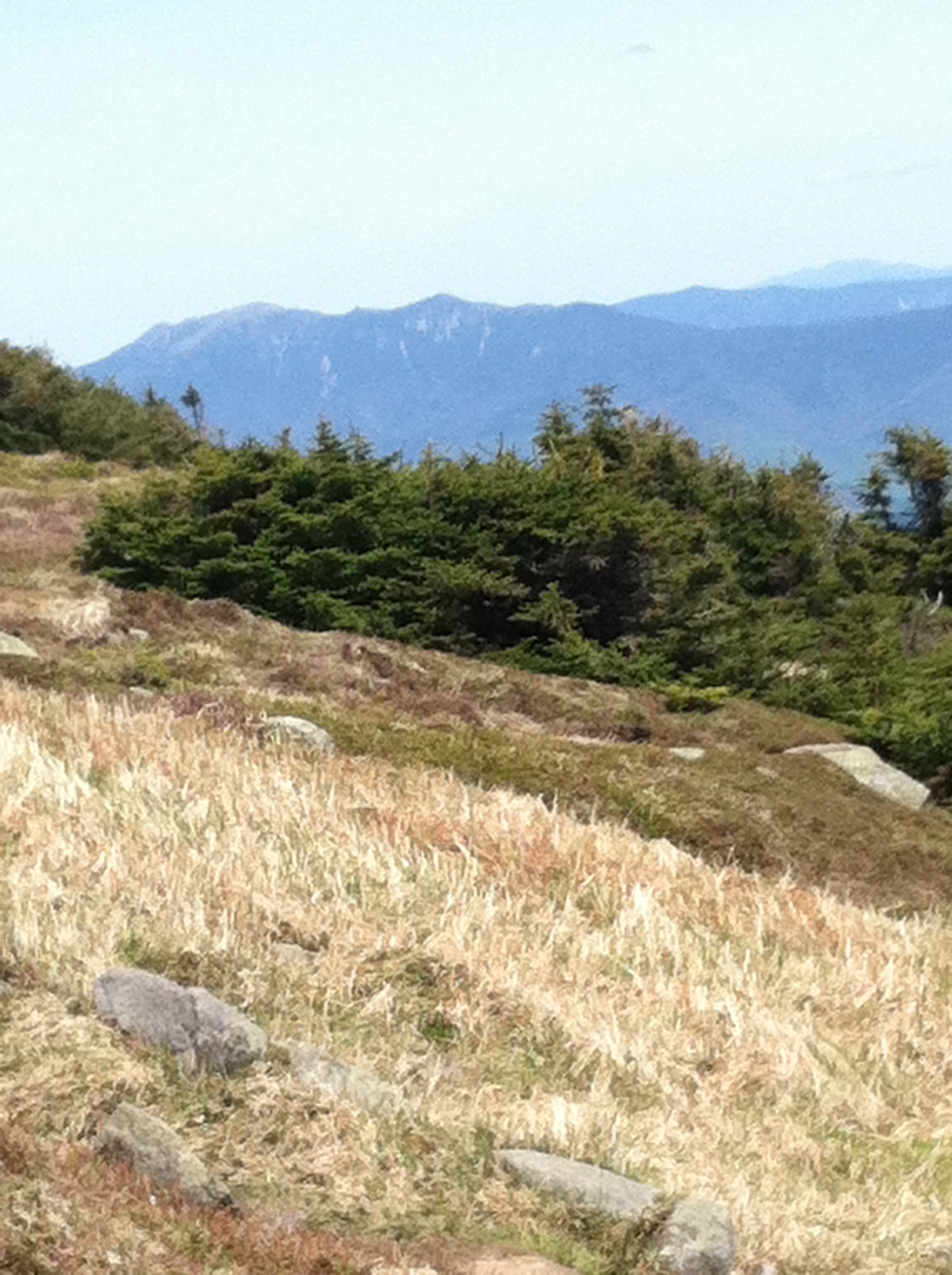
Yesterday was finally the day I got to linger and enjoy looking far into the distance from the top of Mt. Moosilauke.  The summit is broad and open, and sitting to the west of most of the White Mountains, has spectacular views of the Franconia Ridge and all the mountains beyond.  Every other time I’ve hiked to the top of Mt. Moosilauke there has been some sort of unfavorable weather to deal with — mist or scattered rain or snow, and most often hard wind that makes it too cold to stay at the top for long.

Yesterday was warm, sunny and bright, with little wind and no bugs.  This was the Moosilauke hike I’ve been waiting for.  I hiked with a group of friends and we spent a long time at the summit, enjoying the view, the fair weather and the satisfying stretch of our muscles after our first serious hike of the season.

But even when the views were near rather than far yesterday it was beautiful.  The rivers and brooks we crossed and hiked along were running clear over speckled rocks, glinting in the sun, and there were beautiful flowers along the trail — trout lily, tiny white violets and trillium. There was also a broad bush with lacy white blossoms we couldn’t identify.  When I look at the ridges of the White Mountains from any summit I can name the peaks.  When I look at flowers in the woods I want to be able to name them too, so I looked up the flowering bush — hobblebush viburnum.

IMG_2298

I’ve been thinking about view and perspective a good bit the last week, because I’m taking a break from working on the memoir.  Having spent three months working through several drafts, I can’t see it as a whole piece right now.  I can edit individual sections and see where a word or phrase or sentence needs to change.  But I’ve gotten too close to be able to see how the pieces work together and whether those pieces make sense as a book.  Time to step away for a bit and see if I can come back to it with a wider view.

Getting to the top of Mt. Moosilauke on a sunny day, enjoying the trailside flowers and tumbling water along the way, was a good lesson in perspective.


Journal Journey

IMG_2294

The journal is beautiful.  Covered with textured paper and bound with string, its large pages are thick and creamy, flecked with fibers.  When I couldn’t sleep one night almost six years ago, staying with David at a friend’s camp on Bear Island in Lake Winnipesaukee, I got up to write.  As I sat down and opened this journal, which David had recently given me, I thought to myself, “I’m going to write a book, in this journal, and only write it on islands.”  I filled that journal over the next eight months, always writing on islands, and have since filled many more pages on many other islands in other journals and on my computer.

When I started writing that night, I had no idea where my intention would lead and certainly never thought I would soon be recording another difficult life passage, as untimely cancer death bumped up close again within weeks of our time on Bear Island.  Turning that original island journal into a full story, into the book I’d imagined, has also meant going back to my life with Eric and how losing him reverberated in so many unexpected and disorienting ways.

That’s the memoir I’ve been working on over the last several months, starting with my time at Vermont Studio Center.  Several blog posts lately have talked about the difficulty of revisiting such turbulent times in my life, but there’s more to it than how hard it sometimes is.  It’s also necessary.

As one writer friend said to me, when I told her there are days I start to hate this book, “You have a story to tell and this is your story.”  She shrugged.  Another writer friend asked, “Why are you writing this book,” not to challenge me, but to understand why I’m engaging with a subject that’s clearly hard for me.  “It’s a story that resonates with people, that I want more people to hear,” I said.  “It’s about recovering and getting past something you feel you can’t get past and learning how to go on.”  She nodded.  She understood.

I understand too.  I need to do this, which is why I’m sticking with this book, even when it makes me uncomfortable.  How could I have known opening this lovely journal on a summer night six years ago it would lead me here?

Bluets


IMG_2293

Bluets are blooming, salting the grass with clusters of their pale blue blossoms, another reminder of how this season conflates renewal and loss for me.   “I know you haven’t been able to get outside much for the last few weeks, so I brought some outdoors to you,” a friend said to me the day of Eric’s funeral.

My friend is a clay artist, and had made a tiny pot, dug up a clump of bluets and packed them into the bowl to bring to me.  He was right.  Eric’s illness and death had been so fast, and taking care of him so all consuming, the opening of spring happened without me having time to notice.

I kept the small patch flowers on my windowsill for a few days, and when the flowers faded, I kept the pot.  The small empty well of brown clay was sad and sweet and comforted me, thinking of my friend’s thoughtfulness, and how right he was to know I’d missed the outdoors.

When the pot got knocked off its shelf a few years later and broke, I was sorry but not upset.  I had the memory and the association of the bluets, that still comes back to me every year.  The Truth About Death holds the bluets too, as one of the final images from that year of grief, that season that comes and goes.

Anniversary II

Someone is being buried, cars clustered on the road
by the cemetery, brilliant like the day your coffin rocked
in the haul, the cemetery men jiggling a stuck strap, rocked
as if in your boat, we’d dressed you for kayaking, swinging
paddles in the pivot of your hands. I’ve stayed organized, ready
for blackness, speed the answer, no question. The grass is longer,
dandelions will be next. I found stones in a box on your bureau.

I was dazed, I was sitting in the funeral car, the scary center,
a friend ran to get me water when I asked, the clearness
of water, the green gleam of lake water over white sand,
the coves we found and rocked over, passing fruit and Scotch
across our boats, parallel, holding each others paddles,
face to face. I move too fast, bruise my hips, keep
moving. You told me never to leave you alone again.

I bring the stones to your grave, one white, one a perfect black
circle, I slept with them in the pocket of your father’s shorts,
found them on the sheet this morning. Birdsong from a maple
budded red like at home, bluets in the grass. I’m living
on ink, fire on the paper for the millisecond before it dries,
sunlight on water, the constant flow and flash, the center,
going through the door and never coming back.

Disappearance

IMG_0651

So much appears in spring, it seems counter intuitive to think of it as a season of disappearance.  Trees are full of blossoms, from the silky petals of magnolias to the rows of white cherries that line roadways and sidewalks.  The buds of the maple in my yard are like small flowers, red bleeding in the veins of tiny green leaves.  The crowns of hardwoods on the hills to the south soften as rose buds break open to the chartreuse of new growth.

David and I went for a hike yesterday and the branches of bushes and trees were covered with specks of leaves, a slight fuzzing of the views we could still catch as we climbed.  By the time we walk that trail again, the views will be gone.  A riot of leaves will have filled in all the spaces that let in some distance, and there will be walls of green wherever we look.

Sitting on the back deck in morning sun, we can still see the neighbors’ yards and the road on the other side of the brook. Soon the apple trees beyond the garden beds will fill in and the trees along the brook will make a privacy fence for our back yard.  The road and neighbors’ yards will disappear, and so will we.

Like everything, spring is a paradox.  The green world expands, and our views constrict. As I say in one of my poems, that’s “the nature of nature.”

Eight Years


Eric Schain1

What does eight years feel like? The grain of memory runs against the rushing train of time, and too many mornings of sun through the windows as I first walk into the kitchen get crushed into today. For the first two years after Eric died the early sun made me cry.  “Why do you do that to yourself?” my therapist asked me and all I could think of was the river I was swimming across and how some days the river seemed to widen into infinite water. The sun was in my eyes.

“You won’t always wake up to the slap of it,” a friend told me in the months afterwards.  She knew, because it had happened to her, that every morning when I woke the first thing I felt was the truth of Eric’s absence in my gut, as if I was being hit with a 2×4.  Hard.  My friend was right.  One day I woke up to sadness, but it had softened.

“It will change between the second and third year,” another friend who lost her partner told me and again, she was right.  There was no day or week or hour or moment I could point to and say, “there, that’s when it changed.”  But at the third year “deathaversary” the grief had spread out into a quieter pool.  I could touch the shore on the other side of the river.

I still tell time by before and after Eric, but now that it’s been eight years it’s more events than emotions I can track.  One morning last week he visited me in a dream, walking into the house with a brown paper bag under his arm.  What was in the bag?  Peanut M&Ms and Twizzlers, his favorites?  A bottle of single malt scotch?  Milk for coffee in the morning?  His appearance was so ordinary and extraordinary.  I was glad to see him.

It’s been eight years.


The Refusal of Time

images

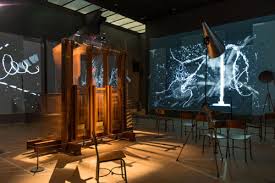
The Refusal of Time is a brilliant exhibit by South African artist William Kentridge.   Currently showing at the Institute of Contemporary Art in Boston (but only through Sunday so get there soon if you want to see it), the work uses drawings, collages, dance and theater moving across five-channels of video projected on large wall panels, music and spoken text, and a central “breathing machine” sculpture to explore time’s mysterious elements — how time shifts and moves, how we try to regulate time, how time is perceived, how the measurement of time has changed over human history, how we “refuse” time.

“Everybody knows that we are going to die,” writes Kentridge, “but the resistance to that pressure coming towards us is at the heart of the project. At the individual level, it was about resisting; not resisting mortality in the hope of trying to escape it, but trying to escape the pressure that it puts on us.”  And politically, “the refusal was a refusal of the European sense of order imposed by time zones; not only literally, but this refusal also referred metaphorically to other forms of control as well.”

Sound deep and interesting?  It is.  The 30 minute video and sound loop is mesmerizing and complex enough that I sat through much of it for a second time.  I wrote down words that were projected or announced that spoke to my own musings about time, which find their way into my writing over and over.

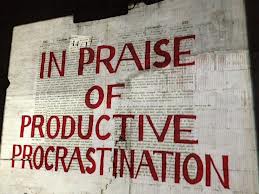
Some samples:  “In praise of bad clocks.”  “Full stop swallows the sentence.”  “Here I am, here I am, here I am.”   “The universal archive of images.”  “Poems I used to know.”  “Performances of transformation.”  “A suitcase of teeth and glass.”  The poetry of this astounding work is profound.

images (1)

Tending the Cairns


IMG_2273

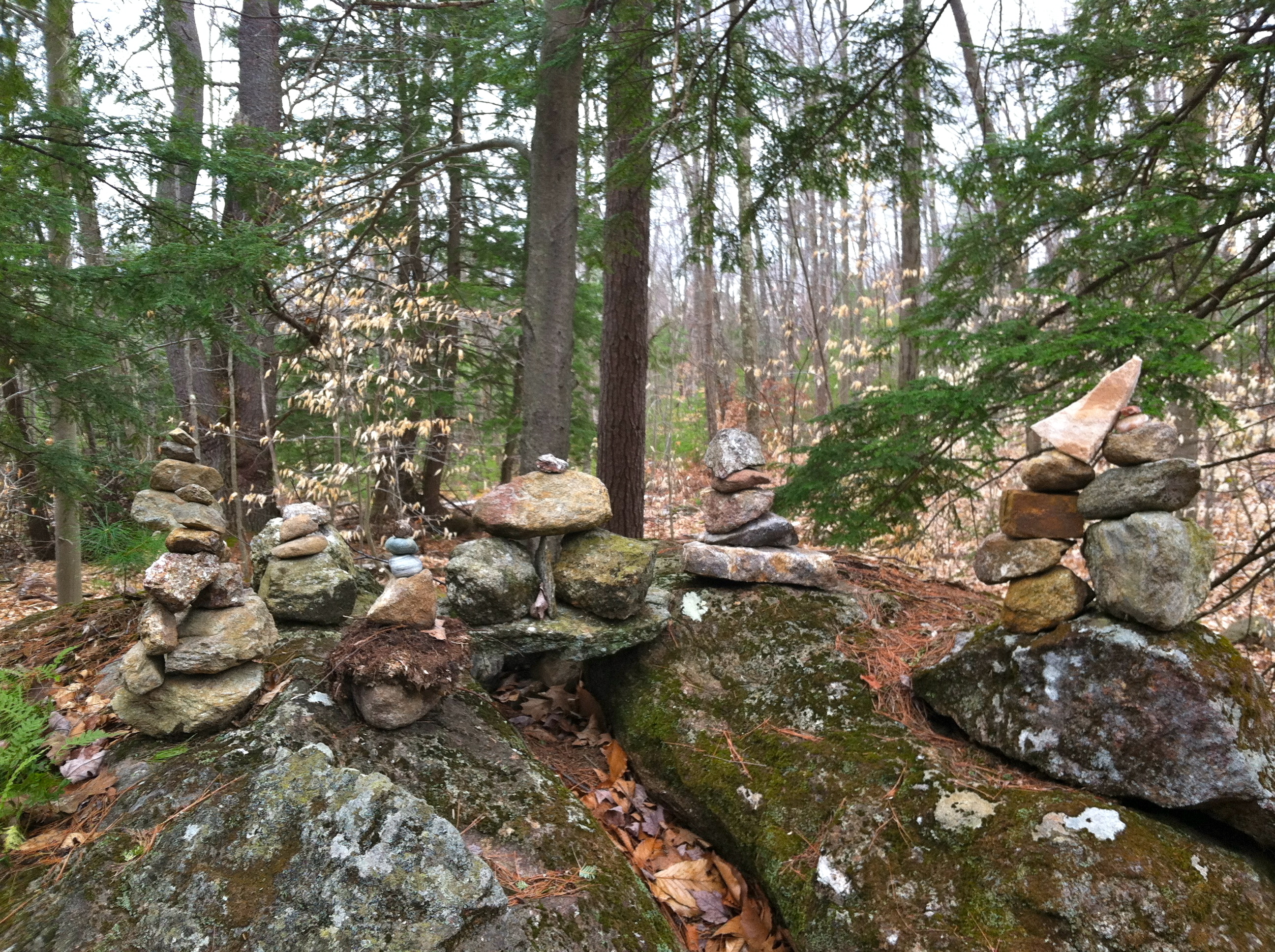
Tending the Cairns

Rain begins as I do but I keep walking, only
showers, sure I have time to get to the rock

two miles out the road into the woods,
climbing slowly to a ridge it never reaches.

Here is where my husband walked with me
his last time, in this season when we recount

liberation in order to count, the Passover meal
served after we eat bitterness and tears,

after we remember how we arrived
at this table. Winter walks hid what fell,

pillars of freeze and melt, how weather
broke the cairns I’ve built for him for years.

Now I reach the rock, my shoes muddy,
my hair a moist frazzle but no rain yet,

time to gather fallen stones and rebuild
balance, adding one stone I chose today, one

each visit. I bow, I tell him stories we told
last night then turn for home, running in rain.

The Train of Memory

IMG_2271

Passover is over, the train of memory that carried me into this year’s observance has moved on.  Working on the memoir I’m writing has meant living in the present moment (or as close to being present to the present as I can get) while on some level reliving the turbulent years that are at the center of the book.  Part of the book’s story is Eric’s illness and death.  Eric’s metastatic disease was first diagnosed just before Passover in 2006, and Passover this year was almost exactly the same time as that year.  It makes sense that the overlay of date and season, along with significant immersion in my experience of that period of my life, would make this Passover carry an extra weight of memory and grief.

One thing I’ve discovered in working on the memoir is how much of the story of Eric’s illness I was telling David two years later, shortly after we met.  Many days in April of 2008 I was writing emails and letters to David, telling him what had been happening on that day two years before — this is the weekend Eric first slept all weekend and hardly ate, this is the day he went back to the doctor and ended up at the hospital, and on and on.  I couldn’t help reliving everything and writing it down helped make it easier to carry. Having David to write it to made it easier still.

I’m having another one of those years.  Because I’m writing about and reading about remembering each day as if overlaid with that day in 2006, I found myself back on the train of memory.  Here is a letter I wrote to David on April 13, 2008:
Eric’s diagnosis came just before Passover, the Jewish calendar is lunar so the dates float across the Roman calendar. Two years ago tonight was the night we were going to host a Seder here with our NH Jewish friends, a Seder tradition dating back to when we first moved to NH.  I was so delusional in the face of Eric’s mounting illness I’d shopped for the big Seder the weekend before even while knowing on some level it would never happen.  So two years ago Eric was just home from the hospital and we did a little Seder with just the family. Eric told the Passover story, gave a short history on the tradition of the Seder, and Matt told Adrienne later that it had been great to listen to Eric, he’d learned so much, he wished he’d have more Passovers with Eric. Adrienne told Eric Matt had said that, then Eric said to me (so much circular conversation!) “Well, that’s a reason to stay alive for another year. To teach Matt more.” And Eric was dead in three weeks. Yikes. I’ve been crying a lot tonight.

But time is on its constant track, so even as I remember sad times from eight years ago, or remember remembering six years ago, today is today and we had a wonderful Seder last week with some of those same friends.


Bearers of Distance

bod_front_cover


A year ago, the day after the Boston Marathon bombing, Massachusetts Governor Deval Patrick and Boston Mayor Thomas M. Menino created The One Fund with the purpose of helping those most affected by the bombings.  The Fund collected and distributed nearly $61 million  to over 230 individuals in just the first few months.

Shortly after the bombing, two poets, runners and editors decided they wanted to contribute also, and conceived the idea of an anthology of poems by runners, with half the profits from sale of the anthology going to The One Fund.  Martin Elwell and Jenn Monroe put out a call for poems, and a few months later published Bearers of Distance. The book includes nearly 50 poems written by runners and poets of all ages, backgrounds, and abilities, poems that aren’t necessarily about running but inspired by running.  Besides the usual poetry bio for each contributor, there is also a running bio. 

I was honored to have the poem below selected for inclusion in the anthology, and especially today, as we all think back to that grim afternoon a year ago, I’m happy to have been a tiny part of one effort to bring healing to those affected.  

Naming

Don’t name the color. Let the dawn
on snow be the last finch flapping
out of my sleep and drawing me

into the morning ice air sharp
against my cheeks. Yesterday’s
footsteps lead into the street,

the robin that haunts the buried garden
waits at the end of the road. Desire
twitches its tail, lungs feed my heart,

my blood carrying memory, a lover’s
arm that wrapped my waist as I slept,
the sun gold, snow on fire.