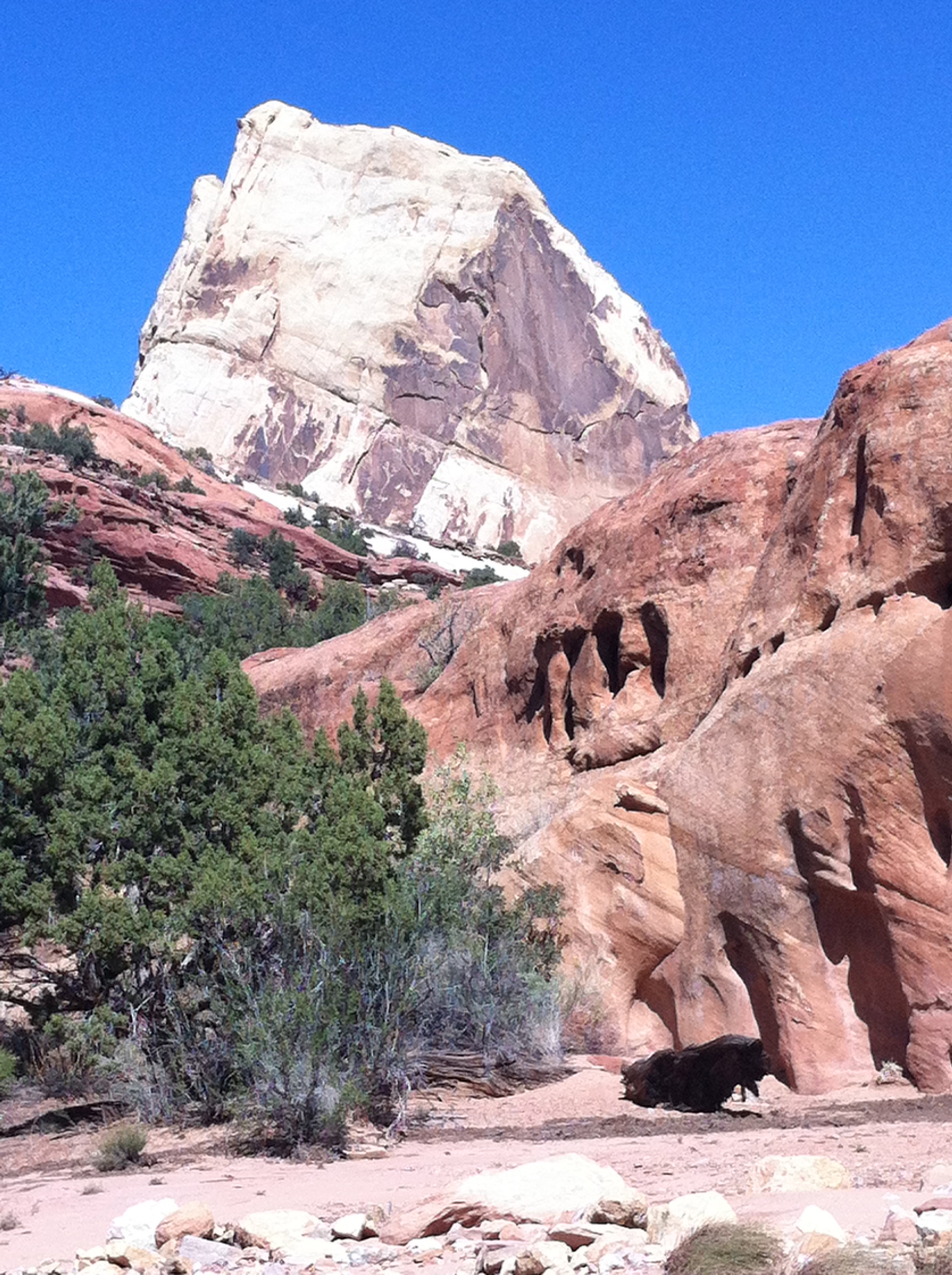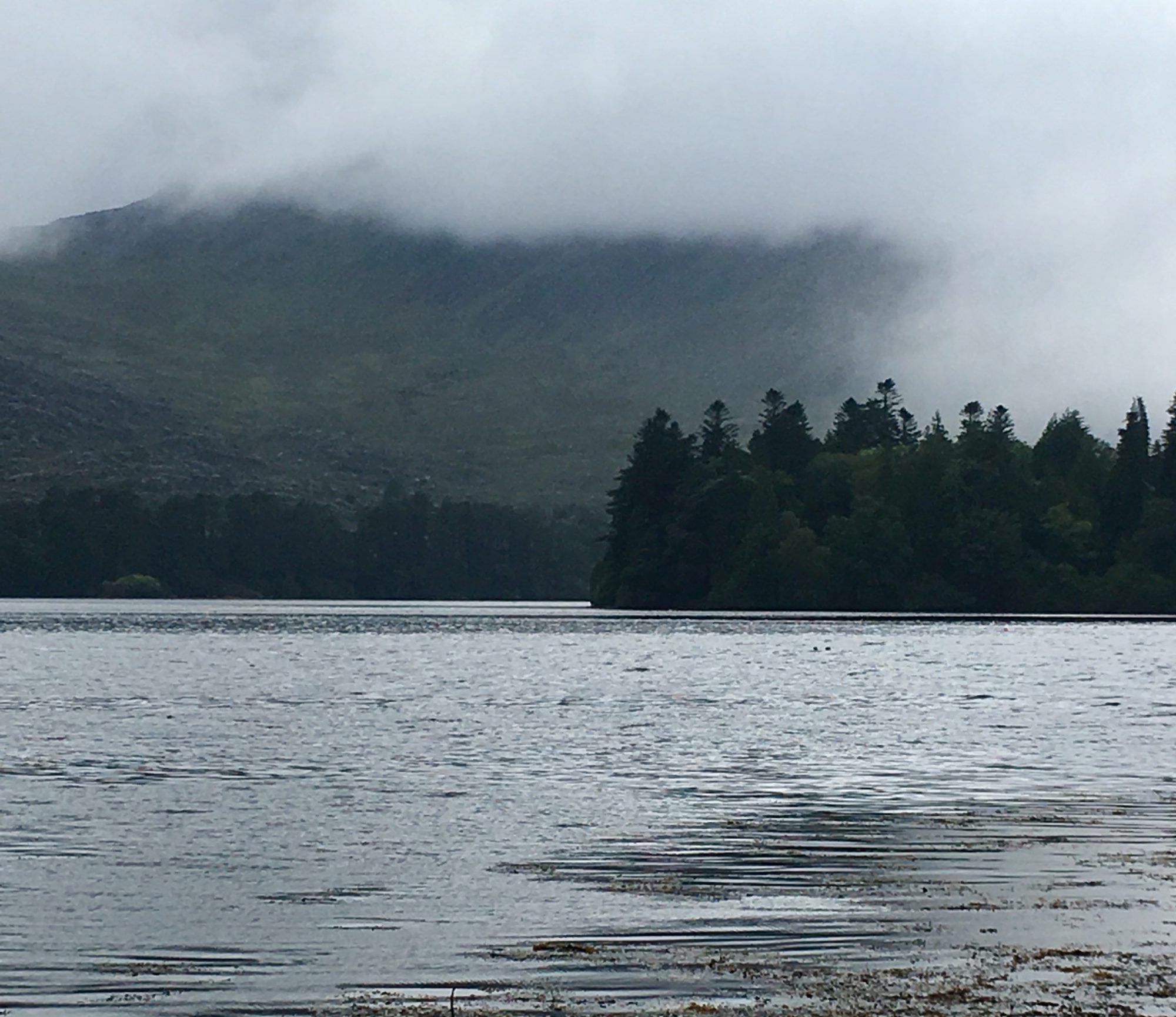

Celebrate

20131128_182655

David and I didn’t make it above tree line in November, and rather than regret that I’m celebrating all the months this year we did manage to hike and reach a peak or a view, our time in woods and wilderness.

But mostly I’m thinking about what we did in November instead of hiking, because it’s been a month with many reasons for celebration.  We spent a lot of time with family and friends, while finishing house projects in preparation for a big holiday weekend, full of even more family and friends.  On Thanksgiving, all four of our children were together for the first time, and after the big, and very fun, groups of visiting family left on Friday, we had an evening with the six of us and Matt and Emilio.  “First time eva,” as Adrienne posted on Facebook.  “What up now?”

Equally sweet was another big event we’ve been planning in secret — a marriage celebration.  On Thanksgiving night, after lighting the Hanukkah candles, David and I surprised everyone gathered in our living room by finally having a wedding.  We were married 18 months ago and we didn’t tell anyone for almost a year (the reasons for this are too complicated for a blog post), except for Emilio.  We told him two weeks before our appointment with the Rabbi, who married us.  Emilio was four months old at the time and we were pretty sure he could keep our secret.

So we never had a wedding and some of the people closest to us (especially my sister Chris) really wanted us to and we’d always planned to have a public ceremony of commitment, even before we were sure that would be a legal marriage, so we decided, why not here and now?

After a day of feasting and celebrating Thanksgivukkah, David and I spoke our vows to each other, in front of many of those closest to us.  And then we had cake and champagne, bounty on bounty.

David began by saying, We have Chris to thank for encouraging us to create this surprise and celebrate our marriage now.  We wanted all of our family to be here, especially our children and here they are, the first time they have all been together in one place at the same time.   So, rapere ad tempus in gloria.  Seize the glorious moment.  In the best of worlds everyone would be here, all the family and friends we would want as witness.  It’s rarely the best of worlds, always the world as it is, and this is it.  

I followed.  And this is the moment we’ve chosen to declare our commitment to each other publicly.  When we first told our children we were married, almost a year afterwards, Melia told us she wouldn’t consider us really married until we stood in front of people and said vows to each other. Chris has been urging us to celebrate our marriage sooner rather than later, and when we realized today we would have our four children gathered together, and so many of the family we love, we decided to celebrate today.  It’s a day of thanks and awareness of all there is to be grateful for, and David and I are so very grateful for what we have between us every day, it’s seems perfectly fitting to declare out marriage vows to each other today, with all of you as our witnesses.  To have a wedding. 

So we did.

A Seat In the Woods

IMG_1950

Yesterday’s bright sun and hard wind (though not as hard as today) called for a walk in the woods.  Which made me think of the Great Brook Trail in Deerfield, a three-mile walk through a variety of woodlands and wetlands, past beaver ponds and along the Great Brook, and up and down hummocks of granite ledges.  There are bridges to cross, delightful hand-lettered signs pointing out side trails to vernal pools and overlooks, and best of all, a bench set on a rock outcropping halfway along the trail, positioned to look up Great Brook as it runs through a small gorge.

A seat in the woods is an invitation to be present.  Present to what?  To whatever has brought me outside, or even better, to what is in front of me now that I’m out.  Often it’s simply the need to have more space around me, to let some of the energy radiating from my body be absorbed by the wind and rocks and trees.  In my last blog post, I described my project last year at this time to write 300 — 400 words each day of the two weeks leading to the winter solstice.  On the second day I wrote,  I need to be outside moving around.  There has been too much moving inside me the last several months, and expanding this churn of energy into a greater sphere has come to feel essential.

Whenever I pass this bench along the Great Brook I imagine coming here some day with a book and a journal and just sitting.  Observing, reading, writing.  I think the same on many of the hikes I do, imagining an afternoon on a favorite ledge with no ambition beyond being in that spot for as long as I can manage to stay still.

I never do it, always moving on, with some place to get to or some place to be.  But yesterday I did stop long enough to sit on the bench and watch the water coming down through the rocks, noticing how light was falling into the woods through the bare trees.  I walked and sat and looked.  Present.

IMG_1951

Sisters and Bluebirds

2013-11-16 16.12.16

More happiness?  Saturday I was walking with my sisters Meg and Chris and my brother-in-law John when we crossed a bridge over the Assabet River.  Meg stopped and pointed to a bird among the branches of a small tree on the river bank.  “I think that’s a blue bird,” she said and Chris and John and I all stopped next to Meg and leaned over the railing to look at the bird. “It looks brown,” Chris said and just as I was about to agree, I saw a glimpse of blue.  The bird opened its wings and flew to a bush a bit upriver.  Blue wings.  “It is a bluebird,” Chris said.  “Good luck,” said Meg.  John said he hadn’t seen a blue bird in years.

I saw a flock of blue birds one morning last fall, and began writing 300 to 400 words each day for the next two weeks leading up to the winter solstice.  Seeing a patch of blue birds cross my path running that morning made me decide to enact an idea I’d read about in The Sun.   A small press had invited 30 writers to write 300-400 words each day during November, 2010.  Chapbookpublisher.com then produced hand-bound books, one for each day by each author.  That’s 900 books.

The decision stuck.  I loved having a project that got me to my computer every day and that focused me beyond the light diminishing each day as we progressed to the darkest. And I was fascinated by the hand crafted books.  Almost any type of paper crafting is satisfying to me, and nothing more so than making a book.  The absorption of a creative project, whether writing or printing and folding and binding paper to make a book, is a circle of positive reinforcement.  Letting the flow of creation take over, making something appear that wasn’t there before, that only existed in my head, makes my head feel lighter.

Looking for a new way in to that creative circle earlier this fall, I decided to make books of the haikus my family all wrote as part of our annual Labor Day weekend gathering this year. Meg had emailed and asked everyone (four generations) to write at least one haiku about summer (many people wrote more, including my father who wrote 14).  As encouragement to get everyone writing, I offered to make a book for anyone who contributed a haiku, a collection of all the haikus that were shared. After the weekend was over, a number of family members still hadn’t contributed a haiku.  As a further inducement, I asked everyone to make a cover for a book, and if you contributed a cover, you would get a book, even if you didn’t write a haiku.  In the end, of course, I decided I’d make a book for every household in the family regardless of whether they wrote a haiku or made a cover.  That’s 16 books.

Making the books has been a wonderfully absorbing project; it took me weeks of fiddling with the word document to get the poems set up to print on back-to-back pages correctly. I spent a conference call I was on last week standing at the kitchen counter as I cut the 13 pages for each of 16 books, neatly slicing the paper cutter’s razor roller up and down, making printed paper into pages.

But Saturday was the most fun.  Meg and John met me at Chris’s house, and we spent part of the afternoon folding and glueing the pages of the books, then putting each set of pages into a cover.  Not everyone in the family made a cover, but we had enough.  Again, my father’s production outdid everyone.  He made seven covers.

We’d gone on our walk before we started working on the books.  The blue bird indeed seemed like a good sign, since we’d just been talking about the ever cycling reality of worry and difficulty and the utter messiness of life, and how much better we all felt being outdoors and walking.  Some of the afternoon’s sun was still settled in our shoulders when we sat down to fold and glue. We quickly figured out faster ways to do every step of the book assembling process than what we first tried.  We made mistakes and laughed, then fixed them.  We were absorbed and focused.  Meg and Chris and I have been doing this for 56 years, the first people I sat with at a table, working in the flow.  How sweet.

The Metaphor of New Glasses

Photo by Grover Landscape and Design

Getting accustomed to progressive lens glasses, that correct for both up close and distant vision, isn’t easy.  If your eyes have been used to no correction, or just reading glasses, it takes a bit for the eye-brain coordination to come back into sync once you change what you’re looking through.  Which is why I’ve been putting off getting progressive lens for years, making do with reading glasses, even though my mid-distance vision has been deteriorating, and it’s meant taking my reading glasses off and on constantly.  Which has meant spending a good part of every day walking around the house, looking for my glasses.  I lost them for an entire day two weeks ago, finally finding them when they tumbled out of my pajama tee-shirt when I put it back on to go to bed that night.

I made the leap to new glasses last week, and I’m still adjusting.  The young man who helped me pick out frames at the optical shop, and who talked to me about managing the transition, told me, “You really have to look at what you want to see.”  Meaning, in order to bring something into focus through the right part of the lens, you need to point your face right at the object and look.

What a metaphor.  Looking to see.

David and I have been negotiating yet another unexpected left turn in our lives.  We’d been talking about how nice it was to go for months and months without one of those phone calls that turns everything upside down.  Then last weekend, another one of those phone calls came.  Navigating a tough week with new glasses has been both disorienting and good timing.  Disorienting because the world has literally looked different; good timing because I’ve had to pay attention to how I’m looking at things.

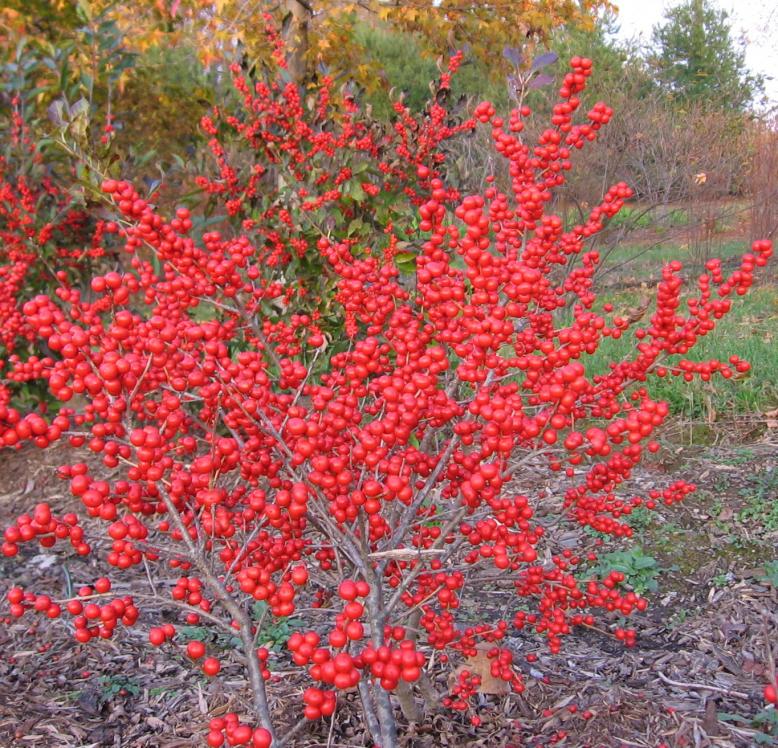
So this morning as I was running I was thinking about how I’ve been looking at things figuratively, reminding myself to remember all that is right in my life.  I was also really looking at the seasonal shifts in the landscape, particularly noticing the winterberry bushes so full of red this time of year, when most of the color in the landscape has dropped away.

I’ve been reading through essays I wrote a few years ago, looking for pieces that seem worth editing.  Paying attention to winterberries, seeing these flashes of brilliance in a dull season, is something I’ve been doing for years.  Two years ago I did a blog post about these red berries, and included a poem that features them from The Truth About Death. And here is what I had to say about noticing winterberries six years ago, again in the context of struggling to stay focused on what endures in life, what continues despite difficulty and loss.

I give up trying to keep track.  So much happens every day, and at first when Eric got sick and died so quickly I felt compelled to write down all that was happening, so he could catch up when he got back.  So I could catch up.  But it got to be much too much. There were all the details of death, the event, the paperwork, the telling people over and over, Eric is dead.  There were red berries on a bush along a river with sun on them, lit inside and out.  The unrelenting urgency of life just wouldn’t go away, all of creation and destruction churning along in its usual pattern, water moving downhill over and over.

Life is as urgent as ever, and if I remember to look directly at it, it comes into focus.

The Metaphor of Underpants

IMG_1933

Do you remember the first day you wore underpants?  I certainly don’t, but I spent yesterday with Emilio and it was his first day in underpants.  He was so excited.  First I helped him change into different pairs numerous times because he wanted to experience them all.  Then he showed all of us that he had underpants on by pulling down his sweat pants and displaying the colored elastic bands.  Next we looked up the Justice League, so he’d know all “the guys” pictured on that set (Superman, Batman, Green Lantern and Flash). As the morning went on there were lots more changes of underpants and pants and socks and shoes because it’s hard to remember, on your first day with underpants, that they don’t work like diapers.  After a while, Emilio was happy to get back into a diaper.  Enough change for one day.  But driving back from visiting a friend, he held a couple of clean underpants in his lap while he fell asleep in his car seat.

Above Tree Line: September and October

IMG_1785

Intentions are a means of getting ourselves where we want to be, rather than letting life’s currents spin us along.  Not that letting currents take you into unknown and unexpected territory is a bad thing.  After all, my tag line for this blog is “Life is more about floating down river than it is marching across a field.”

Balance is the key, between letting events and experiences unfold, and making sure you have enough of what sustains you in your life.  The intention David and I committed to for this year — to get above tree line at least once a month — was meant to make sure we have enough hiking in our lives, because hiking to a view is nourishing for both of us.  The effort, the exercise, often the friends with us on the hikes, the reliable renewal of being outdoors, and the visual expanse all contribute to the pleasure we get from being above tree line.

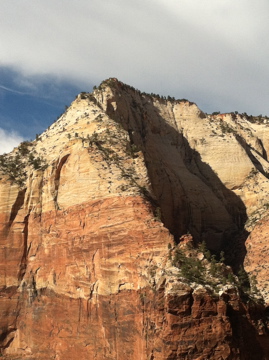
So does the hiking we did in Arizona and Utah count towards that intention?  Yes. Even though we weren’t technically getting above tree line, we were hiking.  A lot.  In fact, in the Grand Canyon we hiked down to an elevation that would be far above tree line in New Hampshire, and for the entire time we were out west we were at elevations that would be above tree line here.  We had expansive views on every hike, mostly because we were below tree line, we were outside for most of every day, and there was plenty of effort and exercise, often to get to a mesa top where there were trees again, after walking through rock-walled canyons.

We had the intention of going out west to center our days around being outdoors, walking in new territory, and seeing vastly different landscapes.  And that’s what happened.  It was grand.

Be Happier

1378488_759276826206_1352928517_nThe unveiling of Natalie’s tombstone was Sunday at the Hebrew United Cemetery in Waterbury, CT. David and I met Adrienne, Matt, Emilio and Sam early for bagels (I think Waterbury has been the center of my bagel-eating life), then went to the cemetery to meet up with Eric’s brother and sister and cousin.  We’d all been to this cemetery many times, for the burials and unveilings of Eric’s parents and an aunt and uncle.  But we’d never been there in anything but inclement weather, either so frigid it was painful to stay until all the dirt had been shoveled back into the grave (a mitzvah the Rabbi had excused us from at Natalie’s funeral, saying it was dangerously cold) or so hot retreating to shade was the only sensible thing to do as soon as the service and burial were completed.

But Sunday we had over an hour in the cemetery before the unveiling, so we walked far from the corner where Eric’s parents and Aunt Belle and Uncle Babe are buried, into an expansive and attractive cemetery we hadn’t even known was there.  There were tombstones shaped like tree stumps, in a variety of thicknesses and heights, iron-fenced enclosures, and tall hard wood trees filtering sunlight through red and yellow leaves. Lovely.

When the Rabbi arrived and began the ceremony, he started by talking about Natalie’s legacy.  “What we all learned from Natalie was to try to be gentler, be kinder, be happier and be friendlier.”  Yes, I thought.  Exactly.

Because you can decide to be happier.  The field of positive psychology is burgeoning and is full of research about how to be happier, including tryng to be happy.  Concentrating on the positive aspects of life, celebrating all successes, however small, and focusing on what there is to be grateful for all contribute to a more satisfied state of mind.

When David and I saw the movie “Lincoln” last year, we looked at each other during the scene when Abe turns to Mary and says, “We must try to be happier. We must. Both of us. We’ve been so miserable for so long.”  David and I felt like Abe was talking to us.

Want to try being happier?  Read about The Habits of Supremely Happy People.  “Martin Seligman, the father of positive psychology, theorizes that while 60 percent of happiness is determined by our genetics and environment, the remaining 40 percent is up to us.” I’m working on that 40% and it’s working.

Civil Obedience Santa Fe Style

IMG_1895

David and I arrived in Santa Fe on Saturday night, after a drive through Southern Colorado that we both found stunning and comforting at the same time.  Land more like home, hillsides colored with vegetation rather than layers of rock, open valleys with horses and cows, and the southern end of the Rockies making a jagged ridge of the far horizon.  We came here with the intention of spending time with Marsie, experiencing the delights of this city, and being civil and obedient.  In other words, relaxing.  We’ve achieved all those goals.

After four days in Santa Fe I now understand why people are smitten with this city.  The russet and cashew-colored adobe buildings, with their low profiles, soft rounded edges and decorative wooden doors are soothing to walk among.  The coyote fences made from rows of standing sticks are unlike anything at home, able to last in the dry air under perpetually sunny skies.  The people are friendly and talkative and everyone has a story of how they came to be in Santa Fe.  There is art on every corner, in a gallery or a courtyard or the central plaza.  Mountains define the horizons, whether up close or distant, and there is a network of trails throughout the city, including the 5 mile trail we hiked yesterday that took us to the top of Atalaya Mountain, a 1,500 foot climb to look over Santa Fe below.  And the food is simply fabulous.  We’ve had a couple of meals here that compare to anything we’ve had anywhere.

IMG_1899

But it’s more than all these things by themselves. There’s a slower vibe here, an appreciation for beauty and the sensual delights of a hospitable climate and stunning natural world.  The colors are vibrant and striking and subtle at the same time, with sage brush spreading across red earth, interspersed with the deep green of pinyon pine and juniper.  In the mountains ponderosa pine hold their broad needle fans up into the sky to contrast their sun-sheened green with the deep blue.  It makes me feel relaxed, and that’s no small thing for me.

We fly back to New Hampshire today.   It’s been a grand trip and we’re already planning the next western adventure.  In the meantime, David is busy organizing a NationalParksProtest movement, so check out his blog Old Man Bad Back.  Want to take back our national parks and make a statement about the government shutdown?   This is your chance.

Civil Disobedience, Rangers and Cowboy Poets

IMG_1878

Just as we were rounding the first mound of rock to disappear on the Chimney Rock Trail in Capital Reef National Park yesterday, we heard a siren whirl from the road and saw a National Park truck pulling up to the trailhead.  We’d parked in a pull-out up the road and walked down to the trail.  The word in town (because we’d talked to people as we bought groceries and coffee) was that all the trail entrances along Route 24 were blocked, people were parking elsewhere and walking to the trails, and if they got caught, were being given $150 tickets.  David and I stopped and looked and a woman got out of the truck and yelled at us.  “You need to come back and get off this trail.”

We walked back.  The ranger began the conversation by being firm and telling us we had to leave, that it didn’t matter to her if we felt we weren’t doing anything wrong by walking on our public land, and that we’d get ticketed (yes, $150) and even arrested if we didn’t get off the trail.

“But we were in the park yesterday,” I said.  We’d gone to the southern end of Capital Reef the day before, because we’d heard (everyone out here is talking about the national park closures) at dinner that the eastern and southern ends of the park were open.  “They only have 5 rangers for the whole park,” one person told us.  “They can’t patrol it all.”

IMG_1869 IMG_1853

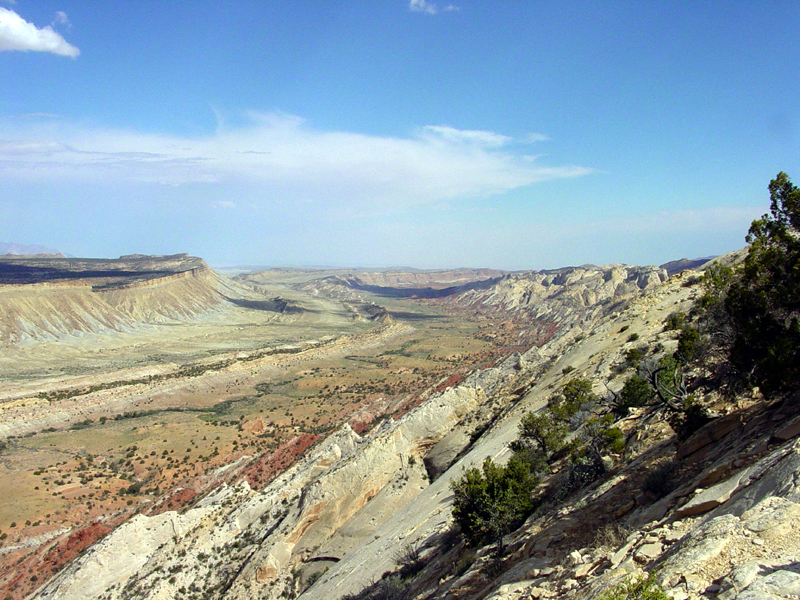
We’d driven the long, gravel Notom Road down the eastern side of the park, then turned on the Burr Trail, a 35 mile road that climbs through the Waterpocket Fold of Capital Reef on steep and narrow switchbacks.  The fold is an upheaval of layers of the earth along a fault that’s almost 100 miles long and that reaches over 2500 feet (it used to reach over 7,000 feet).  David and I had hiked the Upper Muley Twist Canyon the day before, which follows the wash of a river through the spine of the fold after climbing to the top, providing incredible views of the jumbled rocks stretching north and south.

Photo from Wikipedia

“We were on the Upper Muley Twist trail yesterday,” I told the ranger.  “Well you were hiking illegally,” she said.  We hadn’t really engaged in civil disobedience, I thought but didn’t say, because there were no signs saying the trail was closed.  Instead, I told the ranger I felt a moral obligation to continue to hike as planned, in spite of the national park closures, because I truly believe the parks are public land and that the public can’t be denied access.  David talked to her about his vision of national park protests and sit-ins by older Americans, the people taking back the parks.  “You’d need to pick a more well-known park than this one,” she said.  She argued with us for a few more minutes, but then started suggesting other hikes that wouldn’t be illegal and asked us not to continue with our protest right then and there by continuing to hike, “because then I’ll have to arrest you and take you to jail all the way in St. George, and that’s not going to be fun for anyone.” 

IMG_1861

The ranger was reasonable, she was only doing her job (without pay), she was listening to us and she was nice.  We didn’t want to ruin her day, and we didn’t want to spend the weekend in jail (which the ranger had told us would likely happen if she did arrest us) so we left, after thanking her for working without pay.  We drove back down the Notom Road to Cottonwood Wash, another river bed that runs west into the Waterpocket Fold, and walked up through a series of unimaginably varied, colorful and angled rocks.

We’d shifted our plans and decided to do half of the long drive back to Santa Fe yesterday, rather than a 10 hour drive today, so we came to Durango, Colorado last night.  We’d heard it’s a wonderful town (it is) and the drive was spectacular, with the widely varying landscapes we’ve come to expect on this trip, including a long descent through a red canyon, 1,000 foot walls of Navajo sandstone rising on either side of us, and dropping us at a northern edge of Lake Powell where the Dirty Devil and Colorado Rivers flow in.  Towards the end of the drive we got into more familiar looking mountains, forested with spruce and colored russet and golden with the changing foliage of oaks.

IMG_1891

We expected an interesting and charming town, steeped in cowboy culture, which we found.  What we didn’t expect is that this weekend is the 25th anniversary Durango Cowboy Poetry Gathering.  Last night after dinner we walked into the Strater Hotel and listened to cowboy poets reading and singing and telling stories.  All the men were wearing cowboy hats and all the poems rhymed.

The next four days in Santa Fe don’t include plans to visit national parks, so our days of civil disobedience might be over.  Or maybe we’ll get back to New Hampshire and start organizing in a park people have heard of.  A sit-in at Acadia next weekend?

National Park Civil Disobedience Day 2

IMG_1831

“I’m not talking to you anymore,” the man ranger said to David, holding his hands up as if to push David away. We’d stopped to get out and talk to the rangers when we saw two of them standing in front of orange cones and making cars turn around on the road into Bryce Canyon National Park.  I was having better luck talking to the woman ranger.

“Would I be breaking a federal law or a regulation if I drive down the road and park?” I asked her and she said she wasn’t sure, but then decided it was a federal law.  “You’ll be arrested,” she said.  “We have national park law enforcement and they’ll arrest you and take you to jail.”  By then David had joined the conversation, since the man ranger wouldn’t talk to him any more.

“I’m in a place in my life where that might be okay,” David said.  “What jail would they take us to?”  David and I told the ranger about our idea of organizing thousands of vacationing grandparents and getting them to stage a sit-in at a national park lodge and refuse to move.  I told her about my history of civil disobedience, having been arrested at the Seabrook nuclear power plant and at a Wall Street protest in the 70’s.  She told us she was working without pay, “because I love this park.”  We told her we’d created a Twitter hashtag #nationalparksprotest but since I only have about 80 Twitter followers and David just set up a Twitter account last night to tweet under that hashtag it probably wasn’t going to get a lot of traction.  She laughed.

David and I thanked both rangers for working without pay, then got in the car and drove down a dirt road we found out of the parking area across the street.  We found crowds of people on the rim of the canyon, most of them having taken a back road behind the Bryce Canyon Best Western, some in tour buses.  We crossed the fence into the park and started walking, following foot paths along the edge of the canyon.  The further we walked the more spectacular the hoodoos (the spires of rock that make Bryce so remarkable) became.  The rocks got redder and the canyon glowed with color.

IMG_1840 IMG_1834

At a mile and a half we reached the first parking area of the park and picked up the official park trails.  We kept going until we reached Sunrise Point, an elevated platform which looks out over the Bryce Amphitheater.  We were the only ones there.  The only people we met actually in the park (most people who’d come in the back road to the rim weren’t going more than a few hundred yards) were Europeans.  I welcomed them to our national park and they smiled and thanked me.

Tomorrow, Capital Reef National Park, which is vast and criss-crossed with back roads.  We’ll find a place to park and take another hike on our public land.

IMG_1850