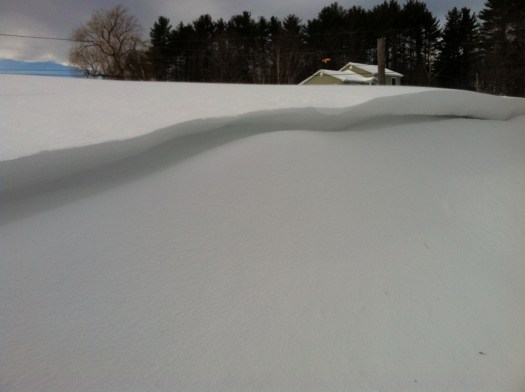
A drift lip of field blown powder
banks over the dip of the road,
sculpted line of swept snow
beauty’s winter thin edge.
Words & Images
A drift lip of field blown powder
banks over the dip of the road,
sculpted line of swept snow
beauty’s winter thin edge.
As soon as we walked into the Chanukah party a family friend was having at Sammy’s Roumanian we knew we were in for a good time, and not only because it was our first chance this holiday season to all be together — Adrienne, Sam, Matt, Emilio, David and I. Told to expect something along the lines of the cheesiest Bar Mitzvah we could imagine, we weren’t disappointed.
We’d walked through the sketchy neighborhood on the Lower East Side of Manhattan and down the steps to the crowded basement dining room, graffiti scrawled across the sign above the door. The walls were plastered with photos and business cards, old news clippings and posters. The ceiling was low, and in one corner, practically on top of the tables, a man at a keyboard was enticing everyone to get up in between the tightly packed tables and dance the Horah, circling the room.
“Who’s a Jew?” he shouted and everyone cheered. “Who’s happy?” he shouted again and again everyone cheered. “You’re a bunch of liars. There aren’t any happy Jews! Okay, okay, should we sign a Christmas song for the goys?” More cheers. He started playing the keyboard and singing, “Jingle bells, jingle bells, Jesus was a Jew.” Everyone laughed. He looked at a couple sitting at the table right in front of him and nodded at the man. “I recognize you from last year. You’ve gained weight.” More laughter.
The 750 ml bottles of Ketel One vodka came to the table frozen into blocks of ice. Following large bowls of chicken liver chopped with onions and strips of turnip, the platters of food kept coming out of the kitchen piled high with meat, meat and more meat, then a few potatoes. The two long tables of our party talked and laughed and ate and shouted over the music and the talk and laughter of all the tables squeezed around us. The man at the keyboard took a break, then came back and shouted and swore and made fun of more people, and played more music.
The friend who hosted the party said he first found Sammy’s decades ago when he was in graduate school in New York City. Nothing has changed. As the night wore on, tables were taken down in the middle of the crowded room and the man at the keyboard started playing dance songs. More bottles of vodka frozen into blocks of ice came to the tables. Strangers and friends and family got up and danced. Then sang and danced some more. Emilio got passed from Adrienne to Sam to me to Matt, bobbing his head and dancing along with everyone else, long past his bedtime, his eyes frozen into wide circles of fatigue and excitement. Chanukah had already been over for more than a week, but nobody cared.
The next morning I asked Emilio if he’d enjoyed the party the night before. He nodded his head. “Yes,” he said. “Music!”
 Two women came out of the room closest to where I was sitting in the hallway with Natalie, Eric’s mother. Natalie has been through another round of hospitalization, and this time the doctor suggested she be discharged to hospice. The Connecticut Hospice is in a beautiful location, on the water at the entrance to Branford Harbor. Sunday was a gray and windy day and the wall of windows in the lobby opened to waves sloshing against the rocks along the shore.
The older of the two women put her hand on my shoulder and stood next to me. Natalie was dozing, I was sitting quietly, content just to be there with her through her cycles of waking and napping. “I know what it’s like,” the woman said. “It’s good of you to be here.”
I looked up at her. “I know what it’s like too,” I said. “I’ve been through this before.” I nodded towards Natalie. “I was married to her son who died.”
“My son, 46-years old.” The woman gestured towards the room she’d come out of.
“I’m so sorry,” I said. “Her son, Eric, was only 54. Ocular melanoma.”
“Brain tumor,” the woman said, and again I said, “I’m so sorry.” The other woman with her just stood there nodding. We all looked at each other, quiet, letting our shared language of ages and diseases settle between us.
The women were gone by the time Natalie opened her eyes again. The sound of a trio, violin, piano and guitar, playing holiday music came down the hall from a common room. “Let’s get moving,” Natalie said, not for the first time during the visit. “Okay, let’s move.”
“Why don’t we stay here,” I said. “We can listen to the music.”
 There are many reasons I love The Sun magazine. One is that they published four of the poems from my then-manuscript of The Truth About Death in the December 2008 issue. And they paid me well for those poems. Not only do they not include any advertisements in their magazine, they actually pay writers and photographers, as in real cash, not two copies of the issue (which is what most literary journals do). The writing is fresh, strong, real and not afraid to tackle tough subjects. One of my poems that they published is titled, “Death.” Every issue includes poems, fiction, creative nonfiction, and always an interview that is provocative, timely and gets me thinking in a least a few new directions.
Part of the payment for those poems in 2008 was a free subscription for a year. I had been a regular reader of The Sun decades ago, but that free subscription got the magazine back in my mailbox, back in my house, back on my bedside table. I haven’t let my subscription lapse since, have bought gift subscriptions for others, and make a donation to the magazine every year also. If you haven’t checked it out, I highly recommend it.
A recent issue included “Ten Days in November” by Eric Anderson, from a project sponsored by chapbookpublisher.com, which invited 30 writers to write 300-400 words each day for the 30 days of November, 2010, and then produced hand-bound books, one for each day by each author. That’s 900 books.
I don’t do well with diminishing light, and I do well with assignments. Looking for a catchy way to get myself to write every day, and any way to distract myself from the encroaching darkness of these December days, last weekend I decided to write 300-400 words each day until the winter solstice. When I looked at my calendar I realized that the solstice was exactly two weeks away.
So far I’ve kept at it, and even named it: “Two Weeks to the Turn.” Without a predetermined focus for this chunk of prose I’m creating, I’m not reviewing the previous day’s writing when I sit down each day. Whatever has bubbled up enough to get me to the desk is what I write. I don’t know what will turn up, but I’m willing to find out. Maybe some of it will turn up here.

“Do you have Chanukah candles?” I asked the young woman at the customer service desk at Hannaford’s grocery store yesterday. I’d forgotten to check and make sure I had candles to light last night, the first night of Chanukah, and figured I’d pick some up just to be sure.
“Yes, in front of checkout 5,” she said, and I could see a tall cardboard display, remembering the display from two years before, Chanukah in a box in the card aisle. At least now Chanukah has moved to the front of the store, I thought.
Then I got to the display. No candles, but a “My First Chanukah” bib, a hostess set of tea towels, oven mitt and pot holder, a latke spatula, ornaments and gift tags and wrapping paper and blue bows. Oy! This is a festival of light!
I was happy to find I had two boxes of candles when I got home.
I ran into a friend last night while out with David. “How are you two?” she asked. “I hope things are settling down. When I saw your last blog post I thought ‘No, not more tough stuff.'”
She’s right. Enough tough stuff. One afternoon shortly after Eric was first diagnosed with metastatic ocular melanoma, and we realized how very sick he was and how little time he had left, we were lying on the bed together talking. “We’re the luckiest unlucky people in the world,” Eric said, and I agreed. The cancer was enormous bad luck, but we were so lucky in so many ways — our love and marriage, our children, our family and friends, our comfortable and privileged life.
After Eric’s original diagnosis, three years before, I’d thought a lot about the concept of luck, and how often we only perceive our good fortune in contrast to what could have been worse. Here’s the poem I wrote then. I’m still as lucky as ever.
LUCKY
to be alive after an accident,
after a grave illness, to be able
to recover and comprehend
all that could have gone wrong
the wrongness that happened
the reference for all that’s left intact.
Why do we need misfortune
to remind us how full the bucket
of luck is, each moment unfolding, one
glow after another, out in the silver
dawn, out in the indigo dusk, hauling
our luck around with us, holding on.
“Our family’s fan is positioned too close to the source of shit,” Sam said to me Sunday evening, as we were leaving the hospital. We’d been visiting a dear friend, hospitalized because of troubling symptoms, yet to be clearly diagnosed. We had a Thanksgiving weekend rich in family and friends, all gathered essentially to love each other. “Your family has a remarkable capacity for being together without any conflicts,” David said to me at one point over the weekend.
True, but in the midst of the weekend gathering we’d gotten a phone call about our friend that let us know, once again, the fan was in the direct path of the shit. But our Thanksgiving weekend was also full of fun with epic eating, hours of sitting in the warm sunshine on the south side of the porch, and a walk everyone was able to take on Friday morning, including my mother who was in the hospital herself, barely able to get out of bed, just a few weeks ago.
The domed pile of brush I’d been adding to all summer and fall got torched on Friday night, burning quickly in a hot whoosh of flame, then settling down into a warm, firewood-fed campfire. A gang of Sam’s friends had come for the weekend, and along with family, and more friends, a ring of us sat around the fire talking and laughing and telling stories. Feeding the fire, we were feeding our selves, soaking up the fundamentally satisfying act of watching wood burn while sitting with people we love.
So I’m repositioning the fan, or at least putting it on oscillating mode, so it can swing between all this weekend’s memories — the food, the fire, the family and friends laughing and walking and sitting in the warmth of the sun and the burning wood, and yes, the suckiness of more illness in our lives. Back and forth. Here we go.
Saturday we climbed Mt. Liberty. It was a cold day, even with the bright sun, and stopping along the trail as I hiked to the top of the Franconia Ridge, I chilled easily and had to start moving again. But at the summit there was full sun and no wind, the least wind I’ve ever experienced on that ridge. While we ate lunch I savored the view, and let the sun heat the black jacket across my back.
Yesterday morning we pulled up the shades in the bedroom and the cows in the pasture across the street were staring right into windows. Could they see us? Frisky all day, they kept sniffing and jumping on each other’s rear ends, watching me as I did a final mow of the yard, then trotting again in a circle around the close corner of the field, as close to me as they could get.
Top to bottom, field to forest, long sloping ridge lines to cow eyes tracking my day. I keep moving through whatever is next.
My days have felt focused and scattered, frenetic and flattened, too short and too long. Trying to hang on to my balance in the swirl of events I’ve been living through lately, I’ve found walking the evening into dusk and then darkness has helped a lot. I grind through the day getting what must be done done, or whacking away at some item on the long list of things I thought would have been done long ago, but aren’t. Suddenly the day is almost over and a walk lit by the last of the light has been seeming just right.
A favorite track crosses the hay field at the top of Harmony Hill, then follows a trail into Northwood Meadows State Park, making a loop around the pond. Yesterday the evening light turned rose as the clouds picked up color from the setting sun and the pine needles along the trail fired into a deep orange. The pond reflected the changing light, from pink to gray to the last of the day’s blue. Walking back to the car the trees were black and the path was white, drawing my attention to exactly where it should be, right there, right then, right now.
I’ve been quiet on this blog lately for too many reasons to get into here. This poem from The Truth About Death speaks to the silence.
Silence
I am squatting in the fireplace, hands out
to catch the heat off the first flame, the only
heat in the house, the furnace fan out,
the belt and pulleys jiggled off their mounts.
Last night a friend and I were comparing pathetic
and now I win. I am trying silence today,
lie on the floor, again, in the sun on the carpet
in the room where you died, heavy wind,
the shadow of plants below the great windows,
warm, how grateful you were for this room, open
and high. I don’t want to make sense, I am fed up
with misfortune. I walked the frozen brook
into the wind of the marsh, following the tracks
of a dog. I sat in the sun but it was too cold.
 Grace Mattern